
New paper out in PNAS (led by Julia Heinen). Here, we reported a clear loss of coevolutionary history and functional potential on seed dispersal after vertebrate extinctions and introductions in islands.
doi.org/10.1073/pnas...
@ipna.csic.es
Photo: B Rodríguez (Gallotia galloti-Plocama pendula)
13.10.2025 12:25
👍 4
🔁 4
💬 0
📌 0

Abierta la convocatoria para 4️⃣ contratos predoctorales en el #IPNA-CSIC en el marco de las ayudas del Gobierno de Canarias destinadas a promover la #investigación en el archipiélago
📅Hasta el 9/10/2025
ℹ️https://sitios.csic.es/web/sede/convocatorias/-/convocatoria/38139
#doctorado #becas
30.09.2025 15:47
👍 1
🔁 2
💬 0
📌 0
A 1-min video on outdoor cats and extinctions
(sound on)
@ebdonana.bsky.social
15.09.2025 13:17
👍 38
🔁 19
💬 3
📌 5

Phenology changes for the Japanese cherry tree (Prunus jamasakura) in Kyoto. Left: Day of the year of the flowering peak for the period between 812 and 2024. Right: Relation between March mean air temperature (°C) in Kyoto and the day of the year of the Japanese cherry tree peak flowering for the period between 1890 and 2024.
https://jgpausas.blogs.uv.es/2025/06/11/134-years-of-climate-warming-effects/
Climate warming is not a recent phenomenon; it has had detectable impacts on plants for at least 134 years!
The onset of phenological plant response to climate warming @newphyt.bsky.social
nph.onlinelibrary.wiley.com/doi/10.1111/...
🧪🌎🌿🌐🌳 🍁 #PlantBiology @cideinvestiga.bsky.social @csic.es
11.06.2025 12:21
👍 151
🔁 69
💬 3
📌 9

Pasquali et al. (2025) demonstrated wild bee abundance declined around 80% over 4 years after the introduction of beehives in Giannutri, a small island in the Mediterranean.
Pascualli et al. (2025) CURRENT BIOLOGY
doi.org/10.1016/j.cu...
24.03.2025 14:39
👍 7
🔁 2
💬 0
📌 0
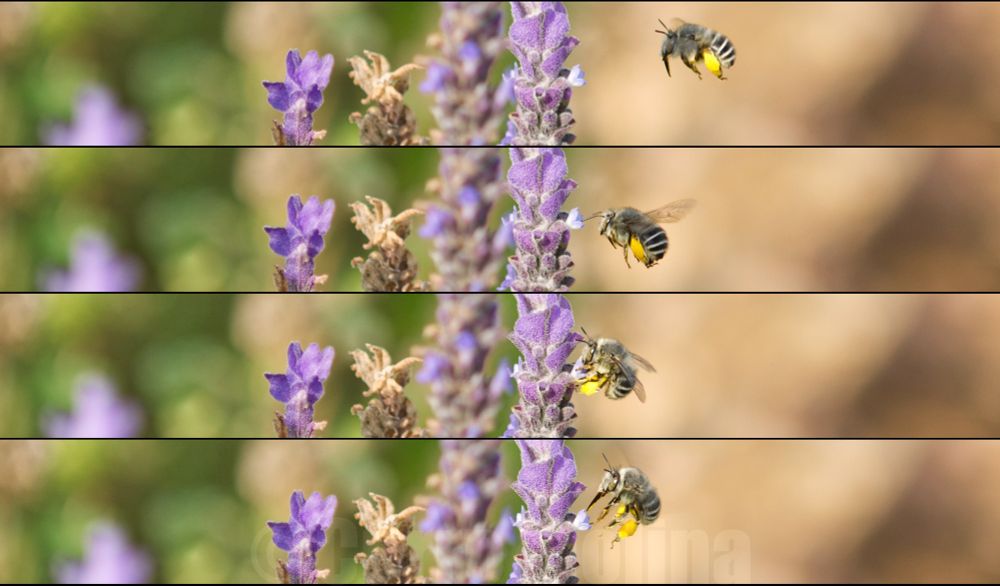
This Amegilla fasciata (Apidae) is looking for pollen and nectar in Lavandula multifida (Lamiaceae), but in the flowers, not always all resources are good, she uses her antennas to check the quality and decides if she stops to feed.
P.Natural Cabo de Gata (Almería)
24/04/2017
09.03.2025 17:20
👍 24
🔁 4
💬 0
📌 0

Nice collaborative research just published in @globalchangebio.bsky.social. In this study, led by Raúl Orihuela, we analyzed key drivers behind Anthropogenic Plant Extinctions in the Macaronesian islands
Orihuela-Rivero et al 2025 doi.org/10.1111/gcb....
@jairopatinolab.bsky.social
@ipna.csic.es
25.02.2025 14:10
👍 4
🔁 0
💬 0
📌 0

In this study authors concluded that beekeeping compromises wild bee conservation in nature reserves. Both taxonomic (TD) and phylogenetic (PD) diversity of wild bees was reduced near to beehives. Keep away beehives from protected areas
Tourbez et al. (2025) APIDOLOGIE
doi.org/10.1007/s135...
24.01.2025 12:17
👍 63
🔁 32
💬 1
📌 3


