Paper out!🌳🐾Vital role of human footprint in altering forest resilience after disturbances.
Forest resilience anomalies after extreme droughts relate to species richness positively or negatively, but when human pressure is included, its interaction with species richness diminishes forest resilience.
05.03.2026 10:33
👍 10
🔁 5
💬 0
📌 0

Summer School - Forests for the Future
Summer School "Forests for the Future: Strategies for Carbon Sequestration"
16–21 August 2026; Congressi Stefano Franscini at Monte Verità, Ascona, Switzerland
Deadline: 30 April 2026
Applications can be submitted to: swissforestlab_summerschool@wsl.ch
swissforestlab.wsl.ch/en/veranstal...
05.03.2026 17:11
👍 12
🔁 6
💬 0
📌 0
This makes science not really credible. I see nevertheless that approaches such as the ones of Zhu et al are important - as micro- and nanoplastics are likely a global threat. But we - the scientists- need to put our results into a realistic context - this is our core responsibility.
10.10.2025 18:15
👍 4
🔁 1
💬 0
📌 0
This paper is a perfect example how trying to get newspapers-citable into the focus of a paper invalidates the really important findings (microplastics can reduce photosynthesis but we do not know how this might scale to our ecosystems - just because we have no data at all.
10.10.2025 18:09
👍 5
🔁 1
💬 1
📌 0
Just imagine you go with machine learning from scarce lab data with almost no information on plastic pollution under real world conditions to crop and fishery yield losses as a result of that given pollution. I acknowledge that this is a first step - but you need to name the shortcomings.
10.10.2025 18:05
👍 3
🔁 1
💬 1
📌 0
They (1) extrapolate plastic impact measurements on photosynthesis under controlled and highly artificial conditions to the real world (2) without valid data on global plastic pollution and (3) without any baseline for their model.
10.10.2025 18:00
👍 3
🔁 1
💬 1
📌 0
We still feel that this later statement in their response letter is not congruent with the alarming statements in the original text: „These findings underscore the urgency of integrating plastic mitigation into global hunger and sustainability initiatives“ which seem to be targeted to press coverage
10.10.2025 17:55
👍 3
🔁 1
💬 1
📌 0
PNAS
Proceedings of the National Academy of Sciences (PNAS), a peer reviewed journal of the National Academy of Sciences (NAS) - an authoritative source of high-impact, original research that broadly spans...
In their response (www.pnas.org/doi/10.1073/...) some authors of the original paper state that „[they] believe it is scientifically sound and responsible to use currently available—albeit limited evidence—for preliminary assessments and to stimulate broader scientific and policy dialog“
10.10.2025 17:49
👍 2
🔁 1
💬 1
📌 0

A global estimate of multiecosystem photosynthesis losses under microplastic pollution | PNAS
Understanding how ecosystems respond to ubiquitous microplastic (MP) pollution is
crucial for ensuring global food security. Here, we conduct a mul...
This is our critical assessment of www.pnas.org/doi/10.1073/... These authors claimed that they can calculate quite exact MP-induced real world global photosynthesis losses translating in a reduction of 22.15 to 115.73 MT·y−1 in main crop production and 0.32 to 7.39 MT·y−1 in seafood production.
10.10.2025 17:44
👍 2
🔁 1
💬 1
📌 0
Integrate Workshop - Increasing biodiversity to promote adaptation and resilience of European forests by using close-to-nature forestry
📅 June 02-04, 2025
📍 ETH Hönggerberg, Zurich
💰 CHF 200
Register here: https://lnkd.in/eBV4997C
More info: https://lnkd.in/e7nQZgm8
30.04.2025 14:39
👍 8
🔁 4
💬 0
📌 0
@wslresearch.bsky.social , @ethzurich.bsky.social, @inrae-france.bsky.social , @www.helmholtz.de, @dfg.de , @snsf-ch.bsky.social, @maxplanck.de and others - let's organize a science-directed #diamondopenaccess system instead of funding the obscene profits of commercial publishers! Go Diamond!
02.04.2025 15:32
👍 6
🔁 2
💬 0
📌 0
No-deal with #Wiley. The publisher has blocked access to 2025 journal issues to #SwissUniversities, and researchers in Switzerland can no longer publish Open Access within the read & publish agreement. Hey, #Wiley, researchers provide the content, and we review and edit for free.
02.04.2025 15:27
👍 6
🔁 2
💬 1
📌 0
Climate change will increase the risk of such double-stress situations with late frost events followed by drought.
31.03.2025 07:56
👍 1
🔁 0
💬 0
📌 0

Eine Gruppe Personen sitzt an zwei Holztischen im Wald. Mehrere Personen stehen. Sie alle hören WSL-Direktor Rolf Holderegger zu, der eine Rede hält.
WSL-Direktor Rolf Holderegger bei der Präsentation des #Waldbericht2025 vor Medienschaffenden im Galmwald, Kanton Freiburg. Mehr zu den Inhalten in Kürze! Rolf Holderegger, directeur du WSL, présente le #Rapportforestier2025 aux médias dans la forêt domaniale du Galm, canton de Fribourg. À suivre !
18.03.2025 10:43
👍 8
🔁 3
💬 0
📌 0
Forest Report 2025
Development, Condition and Use of Swiss Forests. 2025
Swiss Forest Report 2025 by @wslresearch.bsky.social and #BAFU provides an overview of the condition and development of Swiss forests over the past ten years. It assesses the outlook for all relevant areas against the backdrop of advancing climate change. www.bafu.admin.ch/bafu/en/home...
18.03.2025 10:35
👍 26
🔁 9
💬 0
📌 0
Waldbericht 2025
Entwicklung, Zustand und Nutzung des Schweizer Waldes. 2025
Der Schweizer Waldbericht 2025 von @wslresearch.bsky.social und #BAFU zeigt den Zustand und die Entwicklungen des Schweizer Waldes in den letzten zehn Jahren. Er gibt einen Ausblick für alle Themenbereiche im Hinblick auf den fortschreitenden Klimawandel: www.bafu.admin.ch/bafu/de/home...
18.03.2025 11:11
👍 7
🔁 1
💬 0
📌 0
Archiv
30 Jahre Langfristige Waldökosystemforschung #LWF an der @wslresearch.bsky.social: Zusammenfassung der wichtigsten Ergebnisse zum Zustand des Schweizer Waldes in der #SZF: www.szf-jfs.ch/de/archiv/02...
28.02.2025 13:12
👍 7
🔁 3
💬 1
📌 0
Towards a global understanding of tree mortality - @newphyt.bsky.social ; @treemortality.bsky.social : https://nph.onlinelibrary.wiley.com/doi/10.1111/nph.20407
01.02.2025 20:00
👍 9
🔁 2
💬 0
📌 0

Summary of the spatial and temporal coverage of forest plots according to our survey of global mortality monitoring plots: (a) percent of the total forest area surveyed per country, (b) plot area surveyed over time for different continents and globally (black line), and (c) the distribution of size and number of plots. For countries coloured dark grey in (a), we did not receive any responses in our survey. Countries coloured light grey are countries with < 10% of their terrestrial land area covered by forests.
Integrating forest inventories with remote sensing and modelling is needed to better understand tree mortality. A global effort should promote equitable collaborations, empowering scientists from less wealthy regions. @treemortality.bsky.social nph.onlinelibrary.wiley.com/doi/10.1111/...
31.01.2025 13:56
👍 14
🔁 5
💬 0
📌 0
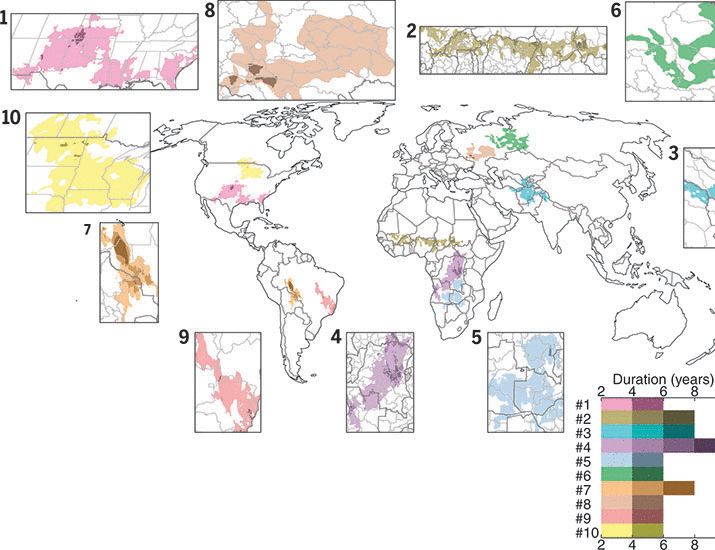
There are so many signs that #climate change is severely affecting #ecosystems and consequently human societies - @liangzhi-chen.bsky.social et al. showed a global increase in the occurrence and impact of multiyear #droughts. We need to act now!
https://www.science.org/doi/10.1126/science.ado4245
19.01.2025 19:31
👍 5
🔁 2
💬 0
📌 0