
Again, Kyle and Judith provide a great summary of the science around this earthquake
09.12.2025 03:54
👍 44
🔁 15
💬 0
📌 0
Again, Kyle and Judith provide a great summary of the science around this earthquake

Sometimes, music is the only tool I have for coping with the world. youtu.be/2Xj0KSgD24k?...
Only the Rialto events are aftershocks to the July 31 M4.3. The Lytle Creek events are near the San Andreas but not necessarily on it. We often see small events around the San Andreas but some analyses suggest they are on small faults not the main surface that will move in the big quakes.

In the last 24 hours, we have seen several M3s in 3 locations. The events near Ontario are at the western end of the Fontana trend. The Lytle Creek events are near the San Andreas & the Rialto events are where the Fontana trend intersects the San Andreas. Last week's M4.3 was at the Rialto location
The New York - Philadelphia - Wilmington urban corridor has felt small earthquakes roughly every 2-3 years. Moderately damaging earthquakes strike somewhere in the urban corridor roughly twice a century. So infrequent but not weird
On the M4.3 on the Fontana trend
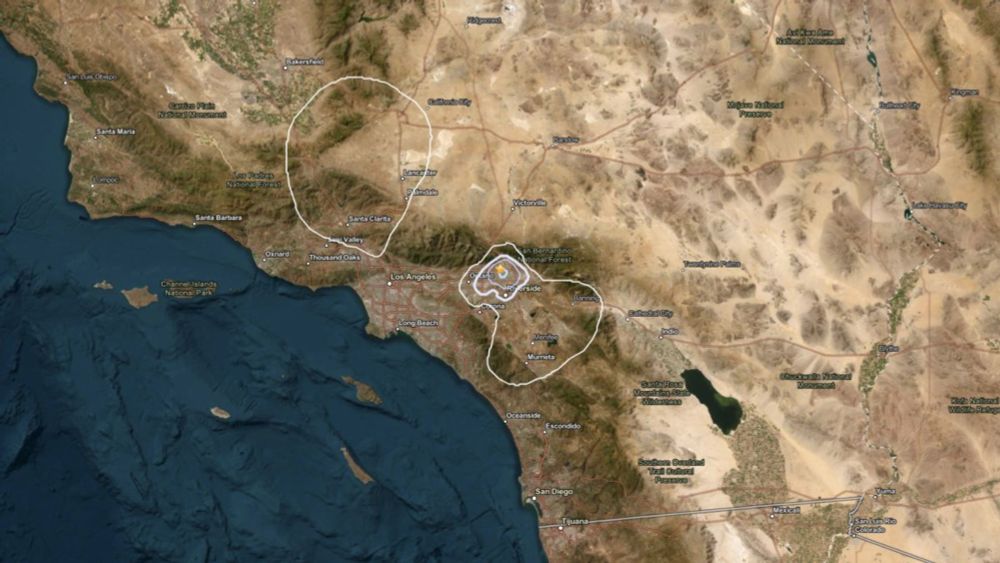
A series of earthquakes, including a preliminary M4.3, shook the San Bernardino area Thursday morning, with shaking felt across SoCal. @drlucyjones.bsky.social explains what it means—watch the full discussion on NBC LA: www.nbclosangeles.com/news/earthqu...
Looks like a small swarm in the Fontana trend. This M4.2 had a few foreshcoks including a M3.0. The Fontana trend is a NE-striking lineation of earthquakes under the sediments of the San Bernardino Vslley. We believe it is one of the left-lateral striking faults that are south of the San Gabriels.
I’m seeing lots of questions about whether the rate of great earthquakes is changing or whether climate change affects earthquakes. The answer is no. The long term rate of these big events is about 1/decade. But the distribution is random. The last one was 2011 in Japan
The 7/29/2025 M8.8 looks like a repeat of an earthquake in 1952

An 8.7M earthquake in Russia has prompted a tsunami watch along the entire #California coast. @drlucyjones.bsky.social takes a closer look at the initial temblor and what the watch means in this NBC LA interview: www.youtube.com/watch?v=Uw2E...

@drlucyjones.bsky.social joins KTLA5 to discuss the California coast #tsunami watch following the 8.7M quake in Russia. Watch the full interview: www.youtube.com/watch?v=NuKG...
In addition to many M7+ earthquakes, this boundary has also hosted half a dozen M8+ earthquakes. Red circles mark the epicenter above the site where fault rupture began, and yellow shows the area on the megathrust fault that ruptured.
Even very small quakes can be felt if you are nearby (and a shallow quake is closer to people on the surface). But there is not much to be said about an M2.7 except that it happened
earthquake.usgs.gov/earthquakes/...
I once had a M2.7 directly under my house that felt so strong I went to work without waiting for a page (in pre-Internet days). It's a good reminder that how strong the shaking feels has much more to do with how close you are to the event. Duration of shaking is better for guessing magnitude.
This study uses "overdue" to mean that time time since the last quake is longer than the average time between earthquakes. But that doesn't mean the next quake is more likely in the near future. The length of intervals between events is very variable even at one location.
This does not mean the big earthquake is more likely. Whatever is making for long intervals is happening now.

A new study outlines the flooding risk from a magnitude 9 quake along the 700-mile Cascadia fault line.@drlucyjones.bsky.social explains that while we could still see damage for coastal areas, the fault line is offshore, so the heaviest shaking would be underwater. Watch her full interview on ABC7:

Last week, @drlucyjones.bsky.social gave a lecture at the Newport Beach Public Library, providing insights on earthquake prediction, the importance of resilient structures, and why knowing your neighbors may matter most. Read more on the @latimes.com: www.latimes.com/socal/daily-...

I've partnered with OcTech, Caltech's choral octet, to create Courage To Care: a concert & discussion to process climate angst in a time of historic fires. If you're in SoCal, come build community with us!
Sunday, April 27th, 7:30 PM
Dabney Lounge on the Caltech campus
Tickets: No tickets - free!

@drlucyjones.bsky.social joined KCAL News today to discuss the recent 5.2-magnitude earthquake in #SanDiego County, noting a relatively large aftershock sequence. In the same interview, she also addressed the overall earthquake activity in #SoCal ▶️: www.youtube.com/watch?v=rFJ1...

Interesting to look at the detailed relocations of the aftershocks to the M5.2. It looks like they are not on the main strand of the Elsinore fault.
Earthquake Early Warning requires estimating the magnitude from the first few seconds on just a few stations. It is always very rough but lets us get out something quickly. There is a lot of variation between locations. The final magnitude averages 100+ stations and is always more accurate

The USGS produces a nice quantification of the risk of aftershocks. 7% chance of another M5 and less than 1% chance of being followed by a M6.

Today's M5.2 is the largest quake near the Elsinore fault since I came to California in 1983. But there were quite a few M4s along the way. A junior sibling to the San Andreas, the Elsinore is long enough to have given us some bigger events

A 7.7 quake struck Myanmar on Friday, killing over 2,000 people and shaking buildings as far as Bangkok. What caused this quake, and could it happen in the US? @drlucyjones.bsky.social joined ForbesWomen’s Maggie McGrath to answer these questions and more ▶️ www.youtube.com/watch?v=sc-v...

I was proud to be a federal scientist at the USGS for 33 years. "Earth science in the public service" meant I could focus on creating and explaining science for public officials and providing public education, not just educating students at one university. theconversation.com/us-earthquak...

#AirTalk with Larry Mantle celebrates 40 years on air, with leading voices joining to help listeners better understand the many facets of L.A.—from science to politics to history. Hear from guests, including seismologist @drlucyjones.bsky.social in this special episode: laist.com/shows/airtal...

After the fires, the only person I wanted to talk to was @drlucyjones.bsky.social. I was so thrilled to be able to sit down with her for this interview for Dwell. Our conversation about LA's future was, at times, painfully honest — but ultimately very hopeful
The high rise that collapses in Bangkok would have lower design standards than a building in LA. But notice the very long period (slow) motions in Bangkok. The long period waves travel farther and affect taller buildings, so collapsing a high rise while smaller buildings are ok is to be expected.

