
3️⃣ As a result of this enrollment re-sorting, representation of URM students at highly selective colleges declined in fall 2024 by 4-5 percentage points (relative to public colleges in states with pre-existing bans on race-conscious admissions)
Much more in the paper!
23.02.2026 15:39
👍 0
🔁 0
💬 0
📌 0

2️⃣ First-time URM students in 2024 enrolled in colleges with worse student outcomes (e.g., median earnings) than they did in 2023, especially for students with high SAT scores
23.02.2026 15:39
👍 0
🔁 0
💬 1
📌 0

A few highlights:
1️⃣ We find that high-achieving underrepresented minority (URM) students were up to 10 percentage points (14 percent) less likely to enroll in highly selective colleges in fall 2024 than in fall 2023
➡️ Instead, these URM students "cascaded" into less selective colleges
23.02.2026 15:39
👍 0
🔁 0
💬 1
📌 0
Happy to share this new paper co-authored with many of my colleagues
We study how college enrollment changed in 2024 after SCOTUS's ruling in SFFA v. Harvard using data on millions of SAT/PSAT/AP exam takers linked to college enrollment records
👇 Check it out! edworkingpapers.com/ai26-1392
23.02.2026 15:39
👍 2
🔁 1
💬 1
📌 0
Happy to have this descriptive piece with @camilantmorales.bsky.social, Kalena Cortes, @julia-turner.bsky.social, & @loismiller.bsky.social out!
Look for more causal work on this topic from our team in the near future 👀
19.01.2026 12:40
👍 24
🔁 8
💬 0
📌 0
Anyone wishing to pontificate about changes in the demand for a college education should be forced to stare at this graph for a bit first
01.12.2025 14:08
👍 66
🔁 14
💬 3
📌 0

Meet the 2025–2026 job market candidates from GSU Economics! 🎉
@gsueconomics.bsky.social #econsky
👇 Here’s a quick introduction to each candidate.
22.09.2025 12:38
👍 9
🔁 5
💬 1
📌 1

Political Views and College Choices in a Polarized America
Riley Acton
Miami University & IZA
Emily Cook
Texas A&M University & CESifo
Paola Ugalde A.
Louisiana State University
We examine the role of students’ political views in shaping college enrollment decisions in the United States. We hypothesize that students derive utility from attending institutions aligned with their political identities, which
could reinforce demographic and regional disparities in educational attainment and reduce ideological diversity on campuses. Using four decades of survey data on college freshmen, we document increasing political
polarization in colleges' student bodies, which is not fully explained by sorting along demographic, socioeconomic, or academic lines. To further explore these patterns, we conduct a series of survey-based choice experiments that quantify the value students place on political alignment relative to factors such as cost and proximity. We find that both liberal and conservative students prefer institutions with more like-minded peers and, especially, with fewer students from the opposite side of the political spectrum. The median student is willing to pay up to $2,617 (12.5%) more to attend a college where the share of students with opposing political views is 10 percentage points lower, suggesting that political identity plays a meaningful role in the college choice process.
🚨 New working paper alert! 🚨 #econsky
Emily Cook, Paola Ugalde, and I are thrilled to share "Political Views and College Choices in a Polarized America" — now out with both @iza.org and @annenberginstitute.bsky.social EdWorkingPapers
www.iza.org/publications...
edworkingpapers.com/ai25-1280
08.09.2025 20:24
👍 54
🔁 18
💬 1
📌 8
HBCU Enrollment and Longer-Term Outcomes
(August 2025) - Using data from nearly 1.2 million Black SAT takers, we find that students initially enrolling in a historically Black college and university (HBCU) are 14.6 percentage points more lik...
"[Black] students initially enrolling in a HBCU are 14.6 percentage pts more likely to earn a bachelor's degree and, ... have higher household income and more student loan balances... driven by relatively broad-access HBCUs in lieu of a two-year college or no college." www.aeaweb.org/articles?id=...
30.07.2025 14:50
👍 13
🔁 9
💬 0
📌 2

Scatter plot comparing median program debt (x-axis, $50k-$300k) vs 10-year cumulative earnings (y-axis, $0.5M-$2M) for professional programs. Medicine MD programs (pink squares) cluster in upper right with high debt ($150k-$250k) and high earnings ($1.4M-$1.8M). Law programs (blue circles) cluster in the bottom left corner with lower debt and lower earnings, though some elite programs show medicine-level earnings and somewhat higher debt than other law schools. Veterinary Medicine (green diamonds), Dentistry (plus signs) and Pharmacy (X marks) are distributed across middle ranges of earnings, but across wide ranges of the distribution of debt, with almost all pharmacy programs having lower debt than almost all dentistry programs. Physical therapy and veterinary programs have law-like earnings (between half a million and a million over 10 years), and while PT has law-like debt as well, veterinary debt is generally much higher and closer to medical school.
New at @pseocoalition.bsky.social, @julia-turner.bsky.social & I have a new report on grad school debt & earnings over the medium term. For some key professional fields (🩺⚖️🦷💊🐾), we show the varied patterns both within & across areas of study, looking at the first decade of earnings after graduation
30.06.2025 17:31
👍 23
🔁 12
💬 3
📌 2


Siblings catch each other’s bugs—and propensity to vote
New research by Bloem et al finds an elder voting sibling doubles a younger sibling’s likelihood of voting, with 1/3 of the effect causally attributable:
buff.ly/euLbMxL
Via coauthor @johnholbein1.bsky.social
18.06.2025 15:09
👍 4
🔁 4
💬 0
📌 0
Check out our new working paper where we quantify how siblings influence each other to vote!
"Voting Among Siblings"
www.dropbox.com/scl/fi/xa7od...
13.06.2025 13:47
👍 3
🔁 1
💬 0
📌 0
👀
12.06.2025 21:25
👍 2
🔁 0
💬 0
📌 0
Very cool to see this paper (my former JMP!) forthcoming at one of my favorite journals!
22.04.2025 15:24
👍 6
🔁 4
💬 1
📌 0
Thrilled to see this paper out!
This is part of a larger research agenda documenting that:
1) A variety of (often understudied) factors affect the quality of colleges students choose, and
2) College choice and quality matter for longer-run outcomes like graduation and earnings.
10.03.2025 16:32
👍 38
🔁 18
💬 2
📌 2
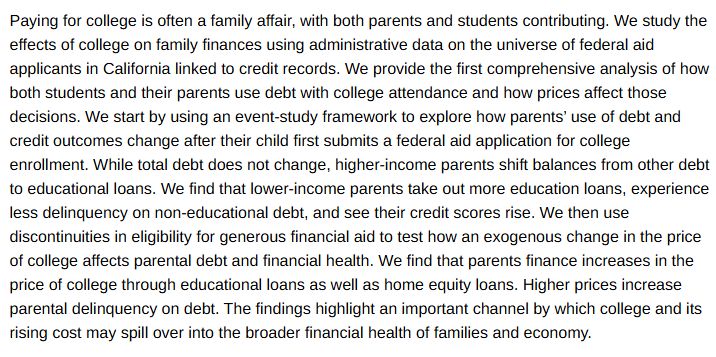
How are parents affected by their kid going to college? How are they affected when their kid gets a scholarship or grant?
New working paper with @palaashbhargava.bsky.social @econsandy.bsky.social @odedgurantz.bsky.social and Rob Fairlie
www.nber.org/papers/w33497
24.02.2025 13:31
👍 23
🔁 14
💬 1
📌 0
In an ideal world we would have a government statistical agency doing this work of counting college students
However Congress has banned the existence of a federal “unit record” data system bc higher ed lobbyists pressed them to
Wouldn’t want transparency and accountability after all
14.01.2025 12:17
👍 113
🔁 36
💬 6
📌 7
Happy to have this paper (coauthored with an amazing team: Kalena Cortes, @loismiller.bsky.social, & @camilantmorales.bsky.social!) out on NBER this morning! Take a look 👇
06.01.2025 13:59
👍 18
🔁 7
💬 0
📌 0
Research Data Gov
Research Data Gov
🚨🚨Exciting News for All Education Researchers🚨🚨
The PSEO data are now available for request in the Federal Statistical Research Data Centers!!!!
www.researchdatagov.org/search?q=PSEO
12.12.2024 17:13
👍 24
🔁 5
💬 2
📌 1


