Title: Taking Back Technopower: STS and strategic interventions for the fight against technofascism
with authors and research areas

The current moment is characterized by resurgent struggles against technofascism. These struggles include community resistance against data centers, strategic actions against tech companies complicit in genocidal violence, and organizing efforts across many sectors against the proliferation of AI in the workplace. This open panel gathers people engaged in these sites of struggle to collectively consider the following question: how can STS approaches advance these struggles against fascist technopower, and work towards constructing more liberatory futures?
In addressing this question, we seek to surface the incipient militant potential of STS, often submerged under scholarship that muddies strategic analysis and disarms political action through the register of subversive critique. Through close attention to relationality and sociality, STS may help build solidarities while unsettling the sedimented categories that impede movement building (Breymen et al, 2017). By incorporating materialist, political economic accounts of technology, STS may help push beyond the boundaries of "ethical tech” by revealing the imbrications of economic and financial processes with technoscience (Birch, 2013). And as a roving, interdisciplinary field attuned to embodied and situated practices (Haraway, 1988), an STS lens may help ensure that analyses are constantly attentive to the lively contingencies of on-the-ground struggles.

We seek to explore theories born through political struggle, and examples of how STS theory informs praxis. Submissions may include, but are not limited to: strategic reflections from organizers and activists; historical accounts that can inform future organizing and activism; or the analysis of organizing artefacts (e.g., propaganda, slogans, campaigns) and their role in advancing political struggle. We will facilitate this panel as an open discussion among folks situated across different sites of struggle, aiming to provide a space for advancing the struggle against technofascism through the development of relationships, theories, and strategic insights.
hi STS people! are you engaged in political struggle against fascism? do you have things to share: strategic reflections, organizing artefacts, etc.? do you have thoughts about how we will win? if so, you should submit something to our open panel at 4S this year! www.4sonline.org/accepted_ope...
05.03.2026 00:41
👍 16
🔁 12
💬 1
📌 0

On the left 'recomputing e-waste' with 'recycling, repairing, reusing, reducing' below it. On the right, a large lifecycle graph with mining, manufacturing, using, recycling, and discarding labeled. Green arrows coming out of and going back into the using node labeled repairing and reusing, with four images of projects alongside. An arrow for reducing from using to landfills with a project image. And finally, a label of full stack recycling with several arrows coming out and returning.
✨I'm on the faculty job market! ✨
I’m a University of Chicago Computer Science PhD Candidate building more sustainable computing ecosystems 💻🌱
I develop computational approaches for reducing, reusing, and recycling e-waste (I like to call it recomputing e-waste)
read more: jasminelu.site
🧵 (1/7)
23.09.2025 16:45
👍 7
🔁 2
💬 1
📌 0
Cella M. Sum –
✨I’m on the academic job market ✨
I’m a PhD candidate at @hcii.cmu.edu studying tech, labor, and resistance 👩🏻💻💪🏽💥
I research how workers and communities contest harmful sociotechnical systems and shape alternative futures through everyday resistance and collective action
More info: cella.io
09.10.2025 14:39
👍 72
🔁 36
💬 3
📌 4
a bit tangential but I've been pretty interested in "misuse" as a category as well, especially given how LLMs have been marketed as "relevant in any context"/"general use"
08.09.2025 15:11
👍 2
🔁 0
💬 0
📌 0

Screenshot of the CSCW 2025 paper "The Future of Tech Labor: How Workers are Organizing and Transforming the Computing Industry"
CELLA M. SUM, Carnegie Mellon University, USA
ANNA KONVICKA, Princeton University, USA
MONA WANG, Princeton University, USA
SARAH E. FOX, Carnegie Mellon University, USA
Abstract: The tech industry’s shifting landscape and the growing precarity of its labor force have spurred unionization efforts among tech workers. These workers turn to collective action to improve their working conditions and to protest unethical practices within their workplaces. To better understand this movement, we interviewed 44 U.S.-based tech worker-organizers to examine their motivations, strategies, challenges, and future visions for labor organizing. These workers included engineers, product managers, customer support specialists, QA analysts, logistics workers, gig workers, and union staff organizers. Our findings reveal that, contrary to popular narratives of prestige and privilege within the tech industry, tech workers face fragmented and unstable work environments which contribute to their disempowerment and hinder their organizing efforts. Despite these difficulties, organizers are laying the groundwork for a more resilient tech worker movement through community building and expanding political consciousness. By situating these dynamics within broader structural and ideological forces, we identify ways for the CSCW community to build solidarity with
tech workers who are materially transforming our field through their organizing efforts.
What can #CSCW learn from tech workers who have been involved in collective action and unionization about how to make transformative change within our field?
My new #CSCW2025 paper with Mona Wang, Anna Konvicka, and Sarah Fox seeks to answer this question.
Pre-print: arxiv.org/pdf/2508.12579
28.08.2025 14:14
👍 43
🔁 17
💬 3
📌 4
Hybrid workshop where you can hear from Lucy Suchman, HCI legend and organizer with Computer Professionals for Social Responsibility, the amazing Joan Greenbaum with Computer People for Peace, and other awesome organizers from #notechforapartheid and other tech-ademia organizing efforts
25.07.2025 01:42
👍 31
🔁 14
💬 0
📌 0
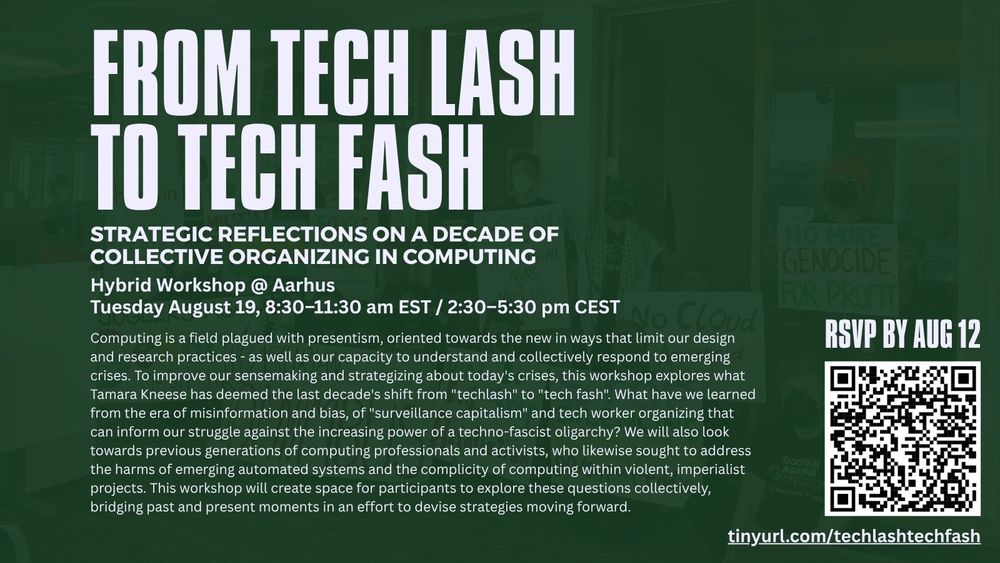
a simple, dark green flier with a bold, white text header:
From Tech Lash To Tech Fash: Strategic reflections on a decade of collective organizing in computing
The flier includes the following text and details:
Hybrid Workshop @ Aarhus - Tuesday August 19, 8:30–11:30 am EST / 2:30–5:30 pm CEST
Computing is a field plagued with presentism, oriented towards the new in ways that limit our design and research practices - as well as our capacity to understand and collectively respond to emerging crises. To improve our sensemaking and strategizing about today's crises, this workshop explores what Tamara Kneese has deemed the last decade's shift from "techlash" to "tech fash". What have we learned from the era of misinformation and bias, of "surveillance capitalism" and tech worker organizing that can inform our struggle against the increasing power of a techno-fascist oligarchy? We will also look towards previous generations of computing professionals and activists, who likewise sought to address the harms of emerging automated systems and the complicity of computing within violent, imperialist projects. This workshop will create space for participants to explore these questions collectively, bridging past and present moments in an effort to devise strategies moving forward.
RSVP by Aug 12 https://tech-organizing-reflections.github.io/
Very excited to share this workshop I'm helping to host on August 19: "From Tech Lash To Tech Fash: Strategic reflections on a decade of collective organizing in computing"
tech-organizing-reflections.github.io
23.07.2025 15:21
👍 43
🔁 16
💬 1
📌 2

Academic paper titled un-straightening generative ai: how queer artists surface and challenge the normativity of generative ai models
The piece is written by Jordan Taylor, Joel Mire, Franchesca Spektor, Alicia DeVrio, Maarten Sap, Haiyi Zhu, and Sarah Fox.
As an image titled 24 attempts at intimacy showing 24 ai generated images with the word intimacy, none of which seems to include same gender couples
🏳️🌈🎨💻📢 Happy to share our workshop study on queer artists’ experiences critically engaging with GenAI
Looking forward to presenting this work at #FAccT2025 and you can read a pre-print here:
arxiv.org/abs/2503.09805
14.05.2025 18:38
👍 27
🔁 4
💬 2
📌 0
+ some related work from the team at #ICLR2025 !!
27.04.2025 22:55
👍 0
🔁 0
💬 0
📌 0

New ICLR blogpost! 🎉 We argue that understanding the impact of anthropomorphic AI is critical to understanding the impact of AI.
27.04.2025 21:54
👍 15
🔁 4
💬 1
📌 1
Presenting this at #CHI2025 tomorrow, Monday, April 28 in the "Expressive Machines" (lol 🤷♀️) session at 4:44 p.m. in Annex Hall F206
27.04.2025 13:03
👍 24
🔁 1
💬 1
📌 0
Yes, I’ll be there — would love to chat and hear more about your work!!
09.03.2025 15:02
👍 1
🔁 0
💬 0
📌 0
& Check out more of our related work from this summer in this great bsky thread: n/n
06.03.2025 04:00
👍 1
🔁 0
💬 0
📌 0
Especially important are challenges around the nature of language & tensions involved in shifting conceptions of human-likeness of technology. Check out Section 5.2 of the paper for more on this related to standard language ideology & risks of dehumanizing humans. arxiv.org/abs/2502.09870 3/n
06.03.2025 03:44
👍 0
🔁 0
💬 1
📌 0
Recent discussions have considered when anthropomorphism might be inappropriate. We encourage use of our taxonomy for more targeted identification and mitigation of harmful impacts stemming from anthropomorphism of language technologies. arxiv.org/abs/2502.09870 2/n
06.03.2025 03:44
👍 0
🔁 0
💬 1
📌 0
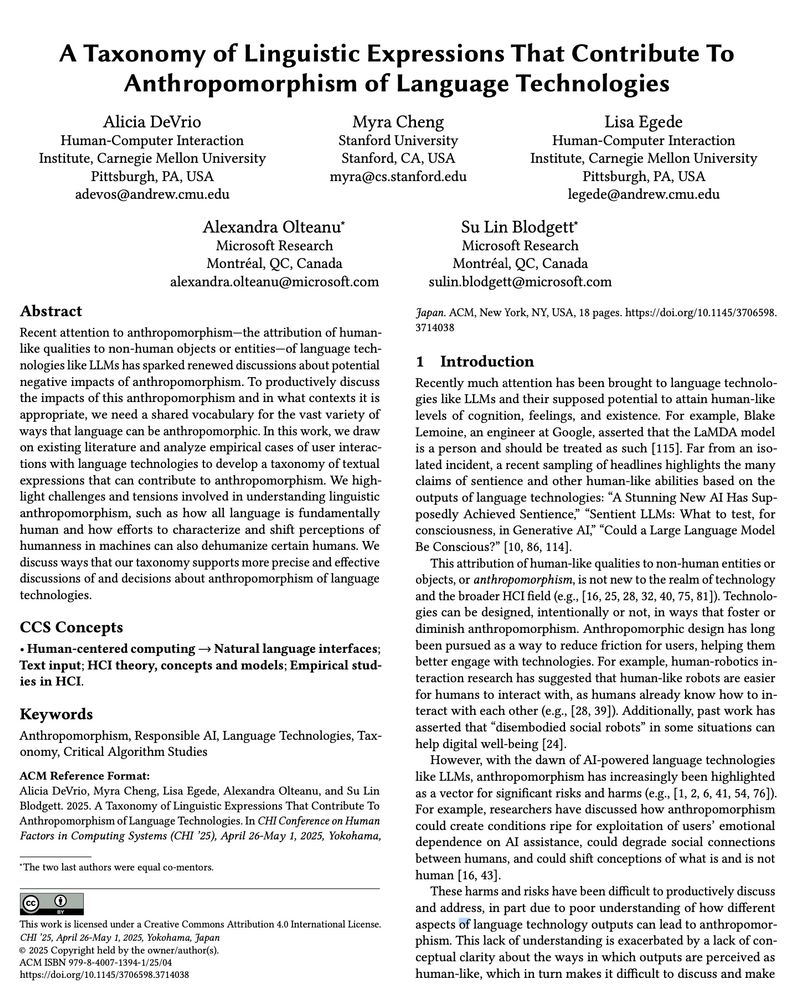
Image of the first page of the CHI 2025 paper titled "A Taxonomy of Linguistic Expressions That Contribute To Anthropomorphism of Language Technologies" by authors Alicia DeVrio, Myra Cheng, Lisa Egede, Alexandra Olteanu, & Su Lin Blodgett
How can we better think and talk about human-like qualities attributed to language technologies like LLMs? In our #CHI2025 paper, we taxonomize how text outputs from cases of user interactions with language technologies can contribute to anthropomorphism. arxiv.org/abs/2502.09870 1/n
06.03.2025 03:43
👍 43
🔁 11
💬 2
📌 3

A Fork in the Road
AI is an excuse that allows those with power to operate at a distance from those whom their power touches.
Thoughts on what’s happening now, as technopolitics becomes politics and AI — as a technical and ideological system — is poised to become the government. mail.cyberneticforests.com/a-fork-in-th...
02.02.2025 12:41
👍 91
🔁 31
💬 6
📌 11
Ali Alkhatib: Defining AI
hi, i wrote a post - "Defining AI".
ali-alkhatib.com/blog/definin...
06.12.2024 18:56
👍 431
🔁 102
💬 52
📌 70
(in other news pls add me to starter packs 🥺👉👈 I do HCI research on harmful algorithmic systems & the ways that everyday people act to resist them)
20.11.2024 15:25
👍 8
🔁 2
💬 0
📌 0
Bluesky-specific feeling: starter pack fomo???
20.11.2024 15:23
👍 8
🔁 0
💬 2
📌 0
Using Bluesky sort of makes me feel like I'm using an InVision mockup of Twitter where they couldn't quite match the assets
13.09.2023 21:59
👍 10
🔁 0
💬 1
📌 0