New paper alert from the group!! 🚨: DNA flexibility tips the balance between stability and plasticity in nucleosomes
One of the works from my PhD, co-led alongside @nachper.bsky.social, is finally out! Work from @rcollepardo.bsky.social & @janhuemar.bsky.social
⬇️
www.biorxiv.org/content/10.6...
⬆️
18.02.2026 19:04
👍 11
🔁 6
💬 1
📌 2
How do DNA sequence and histone chemistry tune nucleosome stability and plasticity?
Check out our latest work to find out. Now available on bioRxiv!
www.biorxiv.org/content/10.6...
@juliamaristany.bsky.social
@janhuemar.bsky.social
@rcollepardo.bsky.social
Share with your colleagues!!
⬇️⬇️⬇️
18.02.2026 19:52
👍 8
🔁 4
💬 0
📌 0
A Goldilocks zone of DNA flexibility defines stable yet plastic nucleosomes, tuned by histone chemistry https://www.biorxiv.org/content/10.64898/2026.02.16.706184v1
18.02.2026 15:48
👍 6
🔁 4
💬 0
📌 0
New preprint alert! Very proud of this work, lots of hard work that turned into a really cool story!
This was my first chance to step into a senior role, but most importantly, it means far more to me than just the science.
You should always say yes to new projects.
www.biorxiv.org/content/10.6...
18.02.2026 19:34
👍 2
🔁 1
💬 0
📌 0
Congratulations Alberto!
Looking forward to read it!
04.12.2025 22:16
👍 0
🔁 0
💬 1
📌 0
Super excited to share that our paper is now out in @science.org. Lots of work, but also lots of fun getting this out.
Be sure to check it out!
www.science.org/doi/10.1126/...
Also, follow:
@huabin-zhou.bsky.social @juliamaristany.bsky.social @kieran-russell.bsky.social @rcollepardo.bsky.social
04.12.2025 22:15
👍 46
🔁 11
💬 0
📌 2
Very excited to present OpenCGChromatin🔥🔥🔥
A new coarse-grained model that probes full chromatin condensates at near-atomistic resolution to reveal the molecular regulation of chromatin structure and phase separation
Brilliantly led by @kieran-russell.bsky.social, with the Rosen and Orozco groups
18.11.2025 15:07
👍 48
🔁 15
💬 2
📌 1
So exciting to see this amazing paper out! Many thanks to @jojdavies.bsky.social for inviting us to contribute with our models to this fascinating story!
@rcollepardo.bsky.social @juliamaristany.bsky.social
06.11.2025 10:25
👍 3
🔁 0
💬 0
📌 0

A mechanism for Oct4 binding to closed chromatin. We hypothesize that the sampling of inaccessible regions of the genome might be aided by the formation of clusters that grow bigger in the presence of chromatin, facilitating the finding of specific target genes in cellular reprogramming.
We propose that the reshaping of chromatin and the binding in a cluster-like manner can be one of the solutions to the so-called search problem. We hypothesize that this binding in high concentrations of Oct4 might be key to explaining how silenced genes are activated in cellular reprogramming.
21.10.2025 09:58
👍 3
🔁 1
💬 1
📌 0

The size of the Oct4 clusters is significantly bigger in the presence of chromatin
The formation of these clusters is agnostic to the presence of nucleosomes. But they grow significantly larger when they are bound to chromatin! Chromatin acts as a flexible scaffold that concentrates Oct4 molecules and promotes their coalescence into larger clusters.
21.10.2025 09:58
👍 1
🔁 0
💬 1
📌 0

Oct4 prefers to bind Linker DNA, even if binding to nucleosomal DNA is still significant. The NRL has a non-trivial effect in the modes of binding
The binding to chromatin is happening preferentially to the free DNA regions, almost exclusively via the DNA-binding domains. This leaves the long, disordered activation domains free to interact with each other and promote the formation of Oct4 clusters...
21.10.2025 09:58
👍 1
🔁 0
💬 1
📌 0

Binding of Oct4 to different Nucleosomal Repeat Lengths (167, 172, 177, 182)
Using our near-atomistic coarse grained model, we have simulated the effect of having varying Oct4 concentrations in a 12-nucleosome chromatin fibre. We show that the binding of Oct4 rearranges chromatin, making it more irregular, in a way that depends on the chromatin linker length.
21.10.2025 09:58
👍 1
🔁 0
💬 1
📌 0

A rendering of multiple Oct4 molecules bound to a chromatin fibre
🚨 🚨 🚨 New preprint alert!!! 🚨 🚨 🚨
In the past, we have learnt that Oct4 can induce nucleosome breathing on the mono-nucleosome level.
But what happens when you have a fibre of multiple nucleosomes?
www.biorxiv.org/content/10.1...
@rcollepardo.bsky.social @juliamaristany.bsky.social
21.10.2025 09:58
👍 25
🔁 9
💬 1
📌 2

An electrostatic repulsion model of centromere organisation
During cell division, chromosomes reorganise into compact bodies in which centromeres localise precisely at the chromatin surface to enable kinetochore-microtubule interactions essential for genome se...
1/ New preprint alert!
In collaboration between the Rosen, Redding, Collepardo-Guevara & Gerlich labs, we uncover a surprising principle of chromosome organisation: electrostatic repulsion positions centromeres at the chromosome surface during mitosis.
🔗 doi.org/10.1101/2025...
03.09.2025 08:11
👍 67
🔁 27
💬 2
📌 2
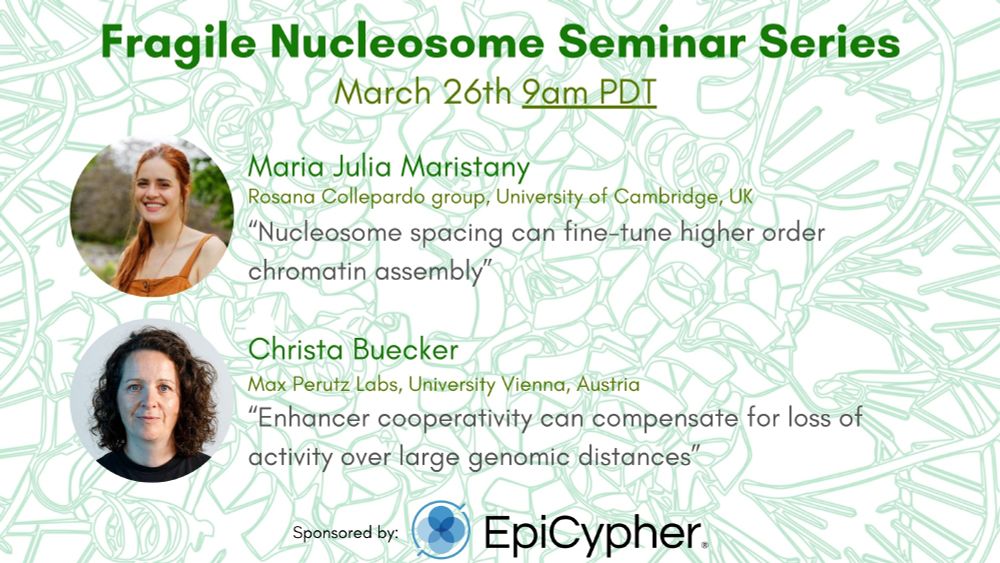
🌱Join us for the first #FragileNucleosome seminar of this spring! We are excited to host @juliamaristany.bsky.social & @chribue.bsky.social this week!
If you have registered before you can join from the same link, if not, don't forget to register!
us06web.zoom.us/webinar/regi...
23.03.2025 14:02
👍 18
🔁 11
💬 1
📌 3
Excited to share our newest collaboration with @kazu-maeshima.bsky.social and @masaashimazoe.bsky.social, where we show that H1 acts as a liquid-like glue in chromatin.
Go check the paper on the biorXiv!
07.03.2025 11:52
👍 9
🔁 1
💬 0
📌 0

Disrupting droplets
Mutations in certain protein regions have predictable effects on the stability of cellular droplets and the risk of harmful protein clumps forming inside them.
Proud to have the final version of our paper on mutations + condensates + scaling laws published in @elife.bsky.social! Work led by @juliamaristany.bsky.social w/ @rcollepardo.bsky.social ! Read the digest here: elifesciences.org/digests/9906...
15.02.2025 02:00
👍 15
🔁 6
💬 2
📌 0
Are you in #BPS2025?
Come to join us at the MGO Symposium this afternoon!
15.02.2025 15:14
👍 2
🔁 1
💬 0
📌 0

Who's going to #BPS2025?
Please join us at the MGO Symposium @mgo-bps.bsky.social on Saturday 1:30 pm Room 511ABC
Featuring experiments, simulations, and all the scales by
@serenasanulli.bsky.social @melikel.bsky.social
@maristizabal.bsky.social @janhuemar.bsky.social and more
Please repost! 🚀✨
07.02.2025 10:33
👍 18
🔁 8
💬 0
📌 2
Thanks a lot Srinjan!
23.01.2025 09:49
👍 1
🔁 0
💬 0
📌 0
[6/6] Our work bridges molecular structure, mesoscale organization, and phase separation in chromatin condensates. I only highlighted the simulations results, but there is a lot more! Go read the preprint for the full story: www.biorxiv.org/content/10.1...
22.01.2025 17:31
👍 3
🔁 0
💬 0
📌 0

[5/6] Here we saw that 25 bp chromatin builds inter-fiber networks with abundant, strong intermolecular interactions leading to stable condensates, whereas in the 30bp, the tails are mainly forming intra-fiber contacts, making intermolecular contacts weaker.
22.01.2025 17:31
👍 2
🔁 0
💬 1
📌 0

[4/6] Moreover, using a combination of the experimental data and our minimal model, we were able to get a high resolution reconstruction of an interaction cluster with all the nucleosome tails!
22.01.2025 17:31
👍 2
🔁 0
💬 1
📌 0

[3/6] Our simulations allowed us to explore the different chromatin structures:
The 25 bp chromatin forms flexible, heterogeneous structures with diverse tail interactions, whereas the 30 bp chromatin favors compact, rigid (and very ordered) stacking with lots of inter-nucleosome contacts
22.01.2025 17:31
👍 2
🔁 0
💬 1
📌 0

[2/6] How’d we do it? High-resolution cryo-ET captured chromatin condensates at nanometer detail, while simulations brought the histone tails and nucleosome dynamics to life. Together, these tools showed how molecular interactions drive mesoscale chromatin behavior.
22.01.2025 17:31
👍 3
🔁 0
💬 1
📌 1