#Datenqualität #Sozialforschung #LGBTIQData
🚨 Methodische Brüche im #Mikrozensus
Seit 2020 ist die Zahl gleichgeschlechtlicher Partnerschaften in den Daten stark gestiegen – allerdings nicht durch gesellschaftliche Veränderungen, sondern durch veränderte Erhebungsverfahren.
11.06.2025 08:00
👍 10
🔁 3
💬 3
📌 1
Verantwoord AI-gebruik bij overheidsinstanties - Vrije Universiteit Amsterdam
Verantwoord AI-gebruik bij overheidsinstanties
The first research project where I am PI, “Responsible use of Artificial Intelligence in government agencies”, was selected by the Vrije Universiteit Amsterdam to seek sponsorship!
Everything is in Dutch, but it can be translated with the Google translate plugin.
22.05.2025 12:14
👍 16
🔁 5
💬 1
📌 2

Today, the ERC formally adopted a decision to increase its support for researchers moving to Europe.
On top of its normal grants, the ERC offers 'start-up' funding to help PIs establish laboratories / research teams in Europe.
This extra funding is now x2 (up to €2 million!)
europa.eu/!6Vdgmp
16.05.2025 10:58
👍 789
🔁 273
💬 21
📌 30

Fast jede zweite Person sieht Rassismus als ein Phänomen,
das den Alltag und die gesell-schaftlichen Institutionen prägt.
Mehr als 80 % der Befragten
sagen, dass es in zentralen Lebensbereichen wie Schule,
Arbeit und Wohnen Rassismus gibt.

Ein Fünftel der Gesamtbevölkerung (22 %) gibt an, selbst schon einmal Rassismus erfahren zu haben.
Direkt betroffen sind rassistisch markierte Personen wie Schwarze Menschen, Jüdinnen und Juden, Muslim*innen, Sinti*zze und Rom*nja.
📊 Wie verbreitet ist #Rassismus in Deutschland? NaDiRa-Studie „Rassistische Realitäten“ zeigt: 90 % der Befragten erkennen Rassismus in Deutschland als Realität an #aktionswochegegenrassismus
Zu den Ergebnissen: www.rassismusmonitor.de/publikatione...
19.03.2025 15:30
👍 3
🔁 1
💬 0
📌 0

The new version of PreReg is now available via: https://prereg-psych.org
🌟 We have launched our preregistration platform PreReg! 🌟
PreReg guides researchers through all the steps of pre-registration and now offers an even clearer structure.
#Preregistration #OpenScience #Psychology
leibniz-psychology.org/en/news/deta...
12.02.2025 12:44
👍 34
🔁 25
💬 0
📌 0
The use of error frameworks for identifying and dealing with potential sources of error in the social and behavioral sciences
Presentation held at the 7th Perspectives on Scientific Error Workshop at Bern, Switzerland, February 5-7, 2025
Since a couple of people were interested in my presentation on "The use of error frameworks for identifying and dealing with potential sources of error in the social and behavioral sciences" at the 7th Perspectives on Scientific Error Workshop, I have made the slides available here: rrr.is/error
10.02.2025 16:18
👍 12
🔁 5
💬 1
📌 0

In case you are unable to join the online tribute honoring the life and contributions to sociology of Michael Burawoy today, Feb. 8, at noon (12 pm Eastern), you can watch the recording on the ISA YouTube channel afterward https://bit.ly/414VbLC
08.02.2025 15:50
👍 57
🔁 26
💬 2
📌 0
RIP 😢
06.02.2025 16:34
👍 4
🔁 0
💬 0
📌 0
📢Calling all aspiring demographers! Apply for next year’s EDSD here: eaps.nl/edsd/how-to-... and join us in Paris at INED! Deadline March 25 at noon
04.02.2025 14:35
👍 24
🔁 16
💬 0
📌 0
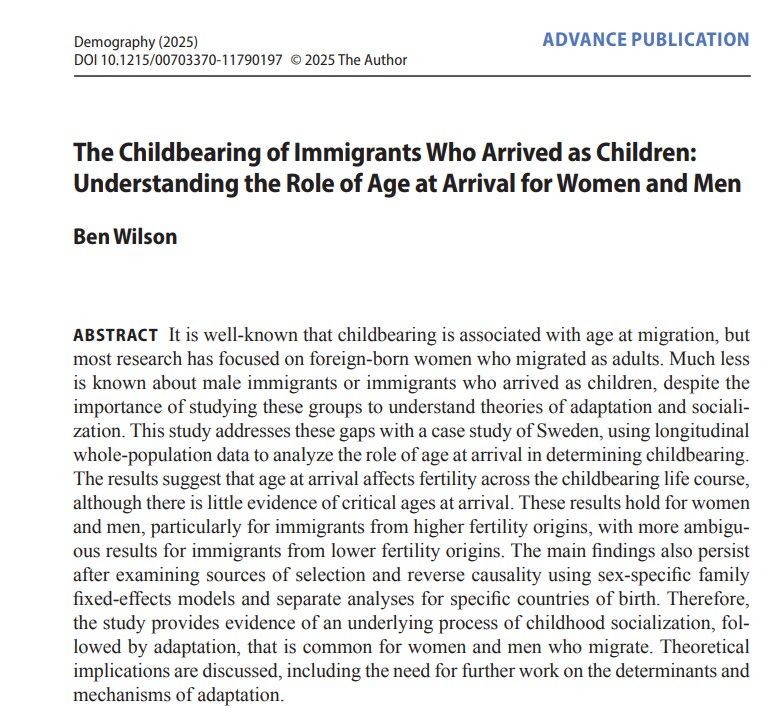
“Childbearing of Immigrants Who Arrived as Children”: Ben Wilson conducts “dynamic analyses of adaptation over the childbearing life course w/ tests of childhood socialization” & finds that age at arrival is important, esp. for inds. from higher fertility origins. read.dukeupress.edu/demography/a...
31.01.2025 17:47
👍 11
🔁 2
💬 0
📌 1

Wirtschaft, Migration, Vertrauen in die Politik, Klimawandel & Rechtsextremismus. DeZIM-Studie zeigt: Das sind die drängendsten politischen Probleme von Menschen mit und ohne Migrationshintergrund.
📣 Welche politischen Probleme beschäftigen Menschen mit und ohne Migrationshintergrund in Deutschland? Neue DeZIM-Studie zeigt: Wirtschaft, Migration und Vertrauen in die Politik belasten beide Gruppen.
Alle Ergebnisse auf einen Blick ➡️ www.dezim-institut.de/aktuelles/wi...
30.01.2025 08:26
👍 4
🔁 2
💬 0
📌 0
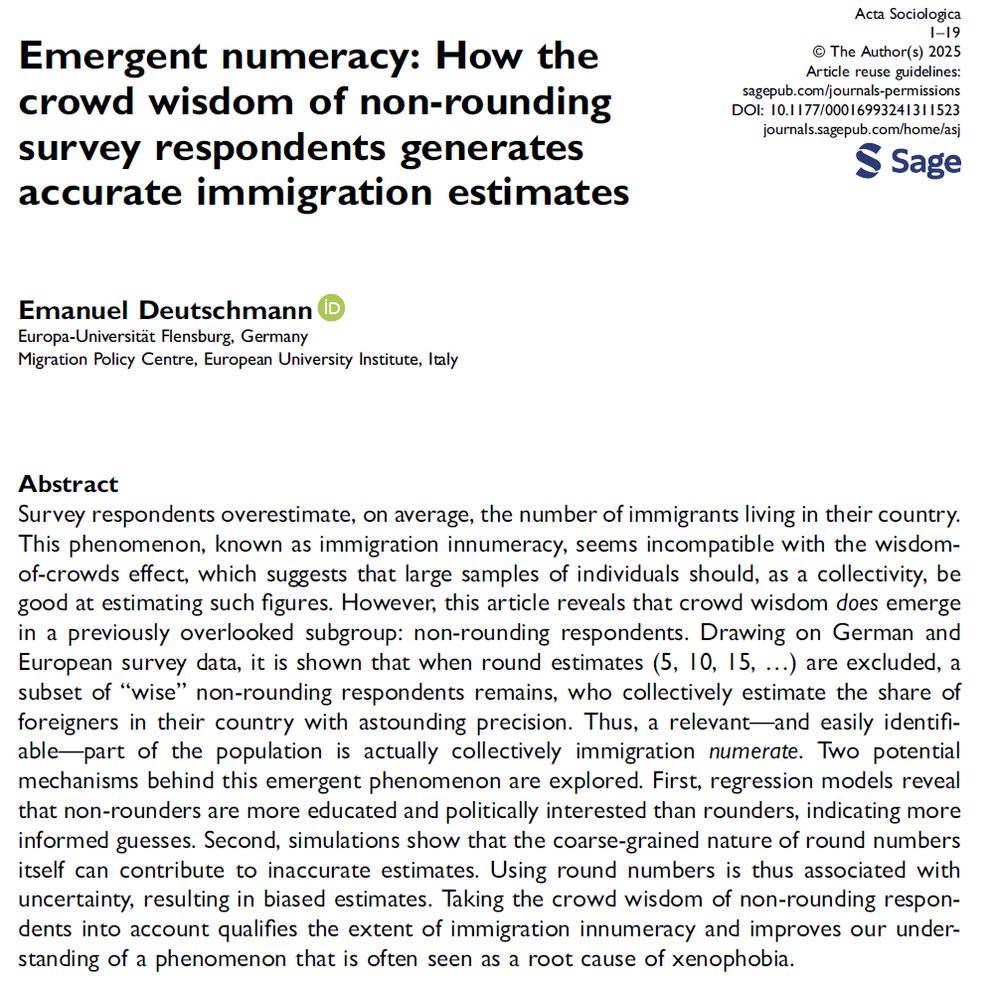
Abstract of the paper "Emergent Numeracy: How the Crowd Wisdom of Non-Rounding Survey Respondents Generates Accurate Immigration Estimates": Survey respondents overestimate, on average, the number of immigrants living in their country.
This phenomenon, known as immigration innumeracy, seems incompatible with the wisdomof-
crowds effect, which suggests that large samples of individuals should, as a collectivity, be
good at estimating such figures. However, this article reveals that crowd wisdom does emerge
in a previously overlooked subgroup: non-rounding respondents. Drawing on German and
European survey data, it is shown that when round estimates (5, 10, 15, …) are excluded, a
subset of “wise” non-rounding respondents remains, who collectively estimate the share of
foreigners in their country with astounding precision. Thus, a relevant—and easily identifiable—
part of the population is actually collectively immigration numerate. Two potential
mechanisms behind this emergent phenomenon are explored. First, regression models reveal
that non-rounders are more educated and politically interested than rounders, indicating more
informed guesses. Second, simulations show that the coarse-grained nature of round numbers
itself can contribute to inaccurate estimates. Using round numbers is thus associated with
uncertainty, resulting in biased estimates. Taking the crowd wisdom of non-rounding respondents
into account qualifies the extent of immigration innumeracy and improves our understanding
of a phenomenon that is often seen as a root cause of xenophobia.
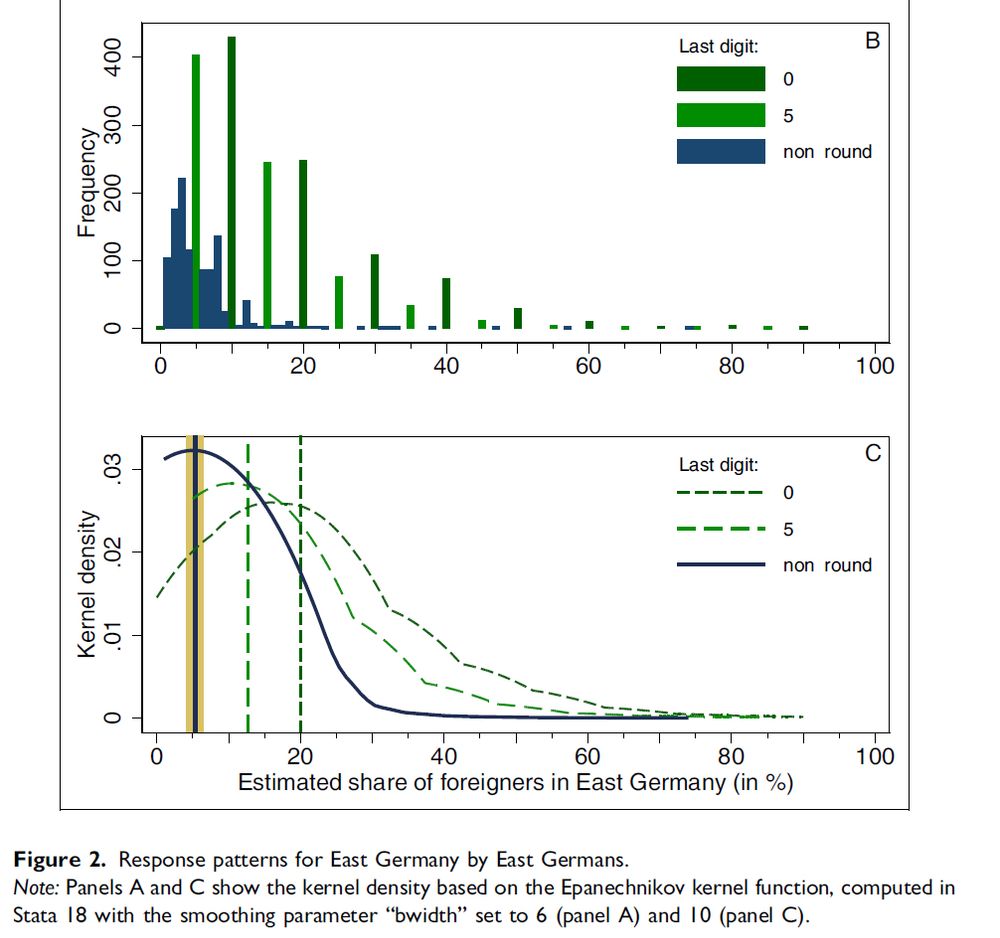
Graph that shows that rounding survey responents on average over-estimate the share of foreigners living in Eastern Germany, whereas non-rounding survey respondents are collectively very close to the official value.
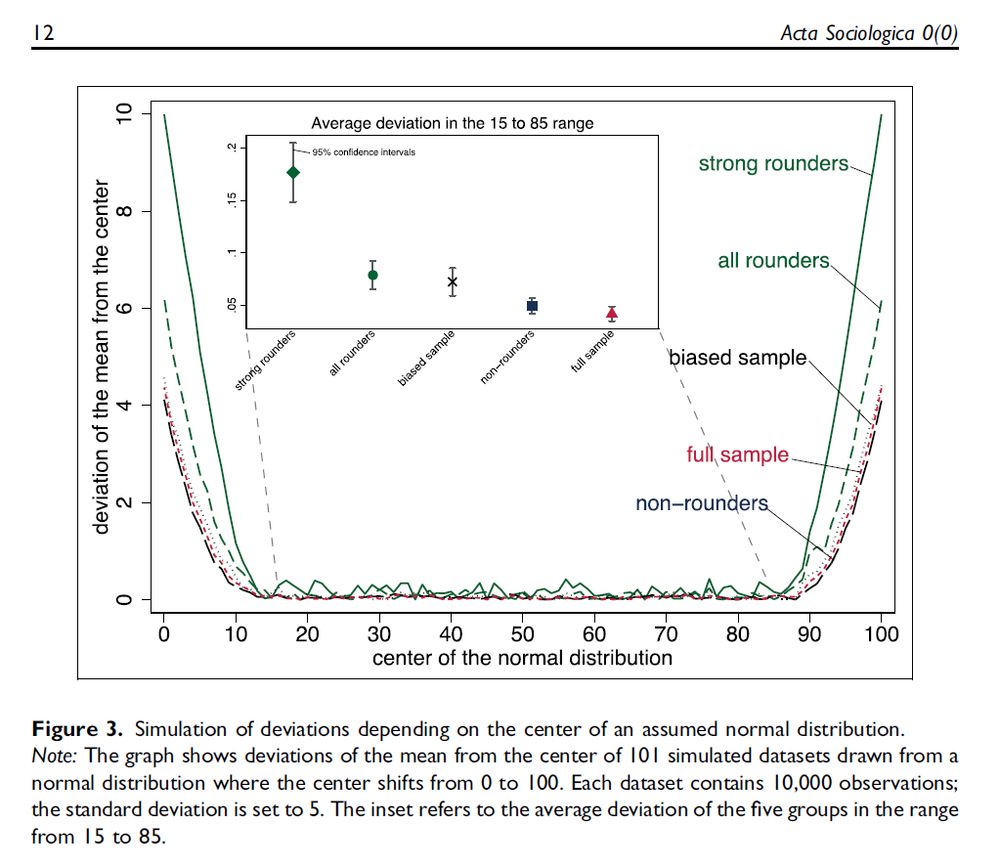
Graph that reveals based on simulated data that the coarse-grained nature of round values contributes to the imprecision of round estimates.
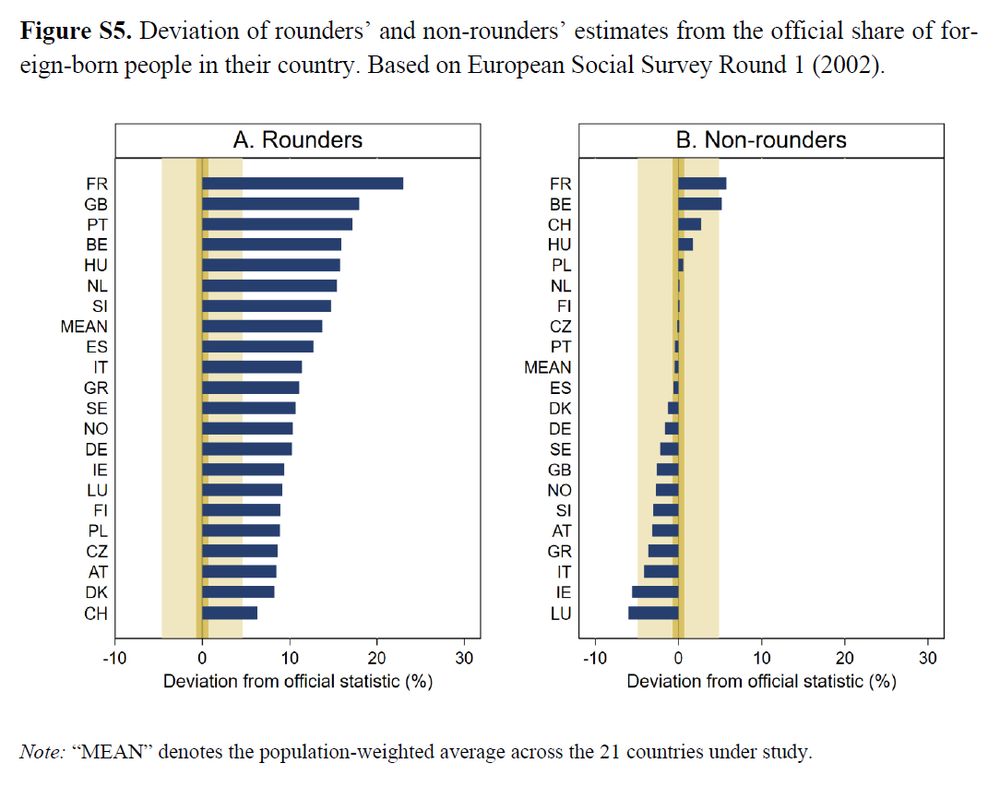
Graph from the supplementary material that shows based on international ESS data that across countries in Europe the same pattern holds: rounders overestimate the share of migrants, non-rounders are close to the offical value on average.
People usually overestimate the share of immigrants in their country.
However, in this new #openaccess paper, I show that survey respondents who do not use round numbers like 10% or 20% in their guesses collectively estimate the share with astounding precision. #crowdwisdom
doi.org/10.1177/0001...
24.01.2025 16:02
👍 67
🔁 20
💬 4
📌 7
🚨Job Offer🚨PhD Studentship in Social Statistics with focus on Digital & Computational Demography: 3.5-year @official-uom.bsky.social doctoral studentship in Social Statistics. The studentship is jointly funded by the University of Manchester and @mpidr.bsky.social.
www.demogr.mpg.de/en/career_61...
14.01.2025 08:51
👍 21
🔁 20
💬 1
📌 1

#bundestagswahl #federalelection
The GLES Tracking is the fourth in our series of GLES surveys for #BTW2025📣
Online cross-sectional surveys of around 1,500 respondents with questions on voting intentions, political attitudes, and political issues 🎊
More information: www.gesis.org/en/gle...
21.01.2025 10:30
👍 3
🔁 2
💬 0
📌 0
Sciences Po is hiring an Assistant Professor on Digital Inequalities. Candidates should have strong theoretical/methodological skills, and an ambitious research agenda on social stratification and inequality. www.sciencespo.fr/osc/sites/sc...
19.01.2025 15:10
👍 34
🔁 34
💬 1
📌 0
View of Just Another Day on Twitter: A Complete 24 Hours of Twitter Data
If you are interested in studying good old human activity on pre-Musk Twitter, we are now sharing the complete 375M dataset of our 24h Twitter data collection with researchers. Get in touch!
ojs.aaai.org/index.php/IC...
Please forward to interested scholars.
18.01.2025 05:28
👍 87
🔁 41
💬 0
📌 2