Thank you!
28.11.2025 15:05
👍 2
🔁 0
💬 0
📌 0

REAL HOPE. REAL CHANGE.
CONGRATULATIONS
ZOHRAN
FOR NEW YORK CITY
Green Party
Promoted by Chris Williams on behalf of The Green Party, both at PO Box 78066, London SE16 9GQ
Huge congratulations to Zohran Mamdani on his election as Mayor of New York City from all of us at the Green Party! 🎉💚
05.11.2025 07:00
👍 964
🔁 207
💬 11
📌 16
Obviously I don't mean that human behaviour caused by disability should be presented as scary. Just that the cruel ways people treat each other is much scarier than someone who looks different. This piece was primarily about physical disability – clearly there's a lot more that could be written
03.11.2025 13:47
👍 1
🔁 0
💬 1
📌 0

In her excellent International Booker-longlisted novel Hunchback, Saou Ichikawa references The History of the Body, edited by Corbin, Courtine and Vigarello: “The ‘criminalisation of the gaze’ that took hold around the dawn of the 20th century had led to the decline of the freak show, which was subsequently replaced in popularity by the Monsters of Hollywood. Now, with costumes serving as an ethical cushion, people can enjoy ogling deformity without guilt or reserve.”
What is perhaps more painful, and insidious, is the portrayal of disability in films not specifically in the horror genre but which trade in a sense of discomfort: arthouse films by respected auteurs, with less emphasis on gore or jump scares than on an undercurrent of psychological unease. In these films, a disabled actor (or an actor in prosthetics) will often appear at a crucial moment as a visual signifier heightening the level of eeriness in a scene. This has happened in some of the best films ever made: the mute, paraplegic girl in Andrei Tarkovsky’s Stalker (referred to as a “mutant”), the “dwarf serial killer” in Nicolas Roeg’s Don’t Look Now, “the disabled one” in Aster’s Midsommar, the gratuitous five-second shot of a facially scarred amputee gleefully clapping along at a Nazi event in Jonathan Glazer’s The Zone of Interest (a modern masterpiece, and one of the most important films of this century). In Yorgos Lanthimos’s remarkable Poor Things, Willem Dafoe’s prosthetics-assisted “deformed … scary face” (as it is described in the screenplay) and Emma Stone’s character’s intellectual disability are not a sign of moral depravity but are nevertheless presented as “creepy and uncanny”. The saddest thing is that these are some of my favourite films. I have no wish to publicly criticise them, but feeling excluded from them is particularly hurtful.
I love most of the films I mentioned in the piece. This isn’t an attack on these directors, and I’m not telling anyone they can’t enjoy these films. I would just like this kind of thing to stop, so that people with disabilities can enjoy films along with the rest of you without feeling excluded
31.10.2025 14:34
👍 4
🔁 2
💬 1
📌 0

There is something sadomasochistic about being a horror fan with a disability. For as long as I can remember, I have been drawn to the intoxicating cycle of dread-terror-release that a genuinely frightening horror film can bring – the simultaneous feeling of “I hate this and want it to end” and “This adrenaline rush is making me feel fully alive.” But I have also come to expect certain tropes that I know will make me feel a different kind of dread, which other people in the cinema may not necessarily be attuned to.
Guillermo del Toro’s handsome adaptation of Frankenstein, which received a 15-minute standing ovation in Venice this August, powerfully makes the case that we ought not to be afraid of difference. However, given that the story is widely regarded as an allegory for disability, it is disappointing that the film stars only able-bodied performers and that a creature repeatedly referred to as “deformed” is portrayed by Jacob Elordi. While the creature is shown to be gentle despite his “obscene” appearance, the audience is heavy-handedly invited to conclude that “the real monster” is his creator, Victor Frankenstein (in case you hadn’t understood the book). Unfortunately the film then drives home the point about Victor’s moral degradation by making him increasingly disabled – in a departure from the original novel, he is given a prosthetic leg, facial scarring and amputated fingers. Del Toro may have adapted the book with a great deal of panache and visual flair, but he has not understood its most basic message.
(Re Frankenstein: visually stunning, great performances, hated the saccharine ending, but why tf, in an allegory about the dangers of ableism and fear of the Other, would you make the villain disabled – when he isn’t in the book – to make the point he is “the real monster”...?)
31.10.2025 14:32
👍 4
🔁 3
💬 1
📌 0

Screenshot of Guardian comment piece: Horror movies have an ableism problem. Isn’t it time we found new ‘monsters’? by Kathryn Bromwich.
Films such as Frankenstein still use disability as shorthand for moral depravity. But human behaviour is far scarier than human appearance
This was a painful piece to write. I love horror, but it doesn’t always love me back. I wish I didn’t have to write this, but it keeps happening, often from people who should know better
Tl;dr: we need more disabled writers/directors so we can tell our own stories 🙏 Please share
31.10.2025 14:31
👍 25
🔁 10
💬 3
📌 5
Kathryn Bromwich
Freelance writer and editor, London
This is the rest of my portfolio: kathrynbromwich.com
And here is my email address if you would like to get in touch: kathrynbromwich@gmail.com
31.07.2025 12:45
👍 1
🔁 0
💬 0
📌 0
Love that book
31.07.2025 12:34
👍 1
🔁 0
💬 1
📌 0
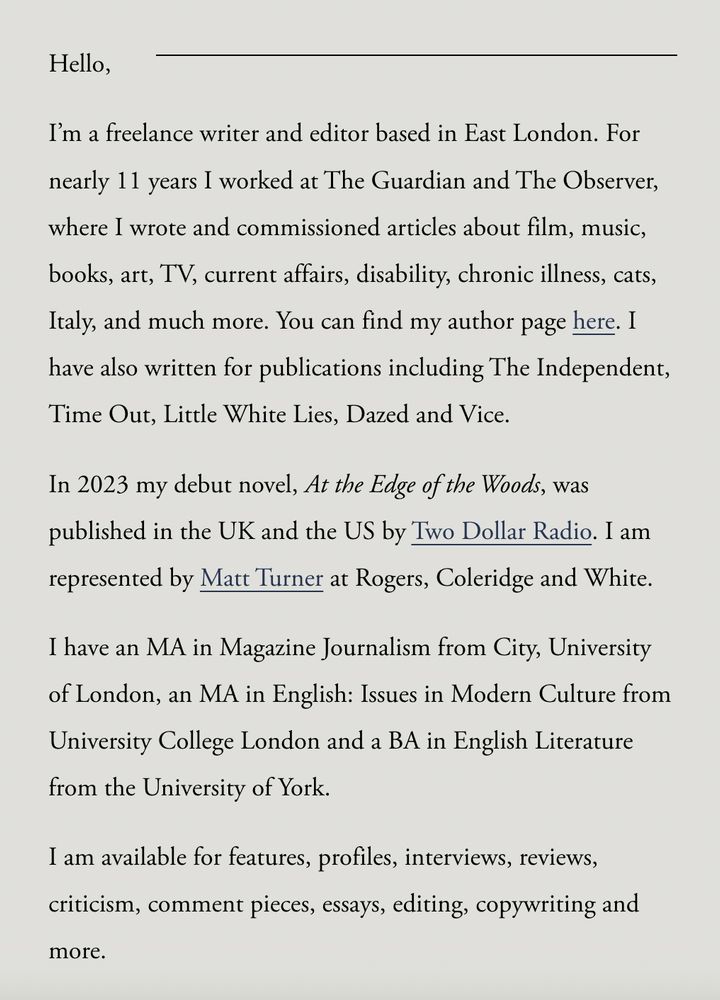
Hello. After 11 years @theguardian.com & @theobserveruk.bsky.social I am now freelance and available for commissions. I do features, profiles, interviews, reviews, comment pieces, editing and more
Here are 10 pieces I'm proud of:
31.07.2025 11:35
👍 40
🔁 23
💬 1
📌 0

The high and dry home on its own Cornish island
The house, known as The Island, is a familiar landmark on the Cornwall coast
I interviewed the owner and the architect behind the renovation of this mad, beautiful house on a rock overlooking the Atlantic ocean
observer.co.uk/style/interi...
17.06.2025 08:36
👍 1
🔁 0
💬 1
📌 0
Kate Nash - GERM (Official Lyric Video)
YouTube video by Kate Nash
And also for the shoutout in the actual song
youtu.be/q2MoQJP-PhA?...
04.06.2025 15:58
👍 2
🔁 0
💬 0
📌 0
Kathryn Bromwich
Freelance writer and editor, London
I'm going to take it easy for a couple of months before starting freelancing in earnest... in the meantime, here's my portfolio / contact details if you want to get in touch
kathrynbromwich.com
28.04.2025 12:42
👍 4
🔁 0
💬 0
📌 0

Help us challenge the Supreme Court’s judgment on trans rights | Good Law Project
Labour's new policy - of humiliating trans people by requiring them constantly to self-identify - we believe puts the UK (again) in breach of its obligations under the European Convention on Human Rights and will seek a declaration of incompatability. goodlaw.social/0r6l
25.04.2025 07:55
👍 1601
🔁 595
💬 26
📌 43
Thank you!
22.04.2025 18:11
👍 1
🔁 0
💬 1
📌 0