
Congratulations!
08.12.2025 10:57
👍 1
🔁 0
💬 0
📌 0
Congratulations!
Excited to share my new publication @poppublicsphere.bsky.social! We often think that women’s formal political participation began in the 1900s. Using archival records from over 150 assembly meetings between 1493-1789 in France, I show that, in fact, some women had political rights much earlier!

Analysis of German elections shows female candidates underperform mainly because parties nominate them in less favorable districts, not due to voter bias or candidate traits, from Thomas Fujiwara, Hanno Hilbig, and Pia Raffler www.nber.org/papers/w34396


#POLITKOLUMNE: The ageing of the electorate is accelerating, and so is the growing divide between the youngest & the oldest voters in Swiss direct democracy, espec. on social policy issues. On av., the generational gap now amounts to 13%pts, as large as the Röstigraben www.derbund.ch/stimmrechtsa...

The expansion of voting rights beyond territory and citizenship marks a major democratic development of the last fifty years. Migrant suffrage has been mostly studied from a state-centric perspective. But the rights that migrants hold emerge from specific combinations of the country of residence and the country of citizenship. From this migrant-centric perspective, what is the diagnosis of the spread and status of global migrant suffrage? We present franchise constellations as a migrant-centric framework for studying voting rights. Drawing on the most comprehensive dataset on migrant electoral rights, combined with novel data on nationality-specific restrictions, we compute almost 1.3 million dyad-year observations based on 172 countries between 1960 and 2020. Using migrant stock data, we find that at least 74 million migrants remained completely disenfranchised in 2020. Bilateral and multilateral efforts emerge as a fruitful path for addressing global migrant disenfranchisement.
➡️📍📑 New Working Paper
with @sumpierrez.bsky.social and Rainer Bauböck
Work on migrant voting rights often has a state-centric perspective. We propose *migrant franchise constellations* as a migrant-centric approach.
A 🧵 with our argument and new data! 🗳️
preprints.apsanet.org/engage/apsa/...
Thrilled that the first paper in my PhD thesis “State Action and Moral Attitudes toward Sexual Consent”, co-authored with Francesca R. Jensenius and @oskorge.bsky.social , has been accepted for publication in the @thejop.bsky.social! 1/
The dataset created with Patrick Emmenegger, @lucasleemann.bsky.social and @megapeng.bsky.social provides 1.3 million observations from over 600 national votes spanning more than 150 years.

Excited to share our new article published in @spsr.bsky.social! We compiled Swiss municipality-level direct-democratic vote results from 1866 to 1944 through extensive archival work and filled some gaps in existing datasets up to 2023.
onlinelibrary.wiley.com/doi/abs/10.1...
Our article on Swiss municipality-level vote results has just been published in the @spsr.bsky.social!
We compiled results from 1866 to 1944 by visiting numerous archives and filled some gaps of the dataset for the period 1944-2025 from the Swiss Federal Statistical Office.
Looks like almost everyone studying gender has their NSF funding revoked today.

I am incredibly honored that my paper "Shaping institutional change in skill formation", which is my first-ever PhD project, has received the @ces-europe.bsky.social Political Economy& Welfare Best Paper Prize and has been published in @jeppjournal.bsky.social 🎉
www.tandfonline.com/doi/full/10....

BJPolS abstract discussing regional biases in electoral systems due to population distribution and its impact on democracy, presented in a green bordered box with a white background.
NEW -
Who Counts? Non-Citizen Residents, Spatial Sorting, and Malapportionment - cup.org/42vfiTR
- @megapeng.bsky.social & Patrick Emmenegger
"we argue that regions with high shares of non-citizen residents benefit from population-based apportionment"
#OpenAccess
This is:
1. an absolutely nonsensical way to think about trade
2. nothing to do with tariff barriers, it’s just…relative trade. It’s just something else entirely
3. a CRAZILY back-of-the-envelope way to set global trade policy
It is mad that this is real.

Thrilled to have started my postdoc at the University of Luxembourg! I'm excited to research the effects of gender quotas for candidate lists for the Luxembourgish parliament.
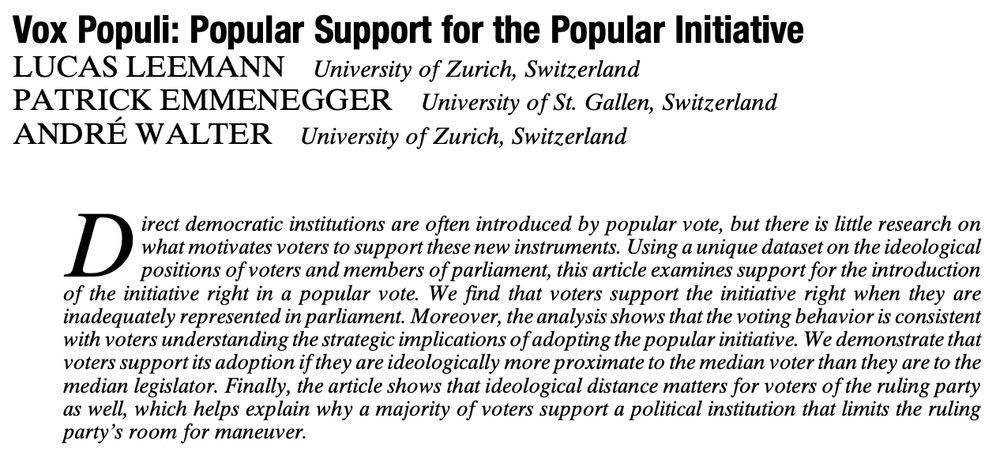
Just published on APSR First View: "Vox Populi: Popular Support for the Popular Initiative" by Lucas Leemann (@LucasLeemann), Patrick Emmenegger, and André Walter. www.cambridge.org/core/journal...