Diese Woche hatte ich das große Vergnügen, den AbiturientInnen des www.rama-mainz.de im Rahmen des Kleinen Studium Generale etwas über kognitive Humandifferenzierung zu erzählen. Tolles Publikum, spannende Rückfragen. @sortingpeople.bsky.social
07.02.2026 11:26
👍 7
🔁 1
💬 0
📌 0

American Gothic ist ein Gemälde (Öl auf Spanplatte, 76 cm × 63,3 cm), das 1930 von Grant Wood (1891–1942) gemalt wurde. Das realistisch gemalte Bild zeigt einen Mann, der eine Heugabel hält, und – je nach Interpretation – seine Ehefrau oder seine unverheiratete Tochter, vor einem neugotischen Holzhaus. Der Mann schaut mit strenger Miene den Betrachter direkt an, die ebenfalls ernste Frau blickt an Betrachter und Mann vorbei. Das Bild hängt heute im Art Institute of Chicago.

Meloni neben Merz beim Treffen in Rom
Mein #ikonographischesGedächtnis hat wieder einen seltsamen Bezug hergestellt:
24.01.2026 15:40
👍 282
🔁 59
💬 8
📌 2
OSF
Pre-Print
When are citizens able to discern plausible from implausible conspiracy theories?
We @rolandimhoff.bsky.social @lpummerer.bsky.social @stephanwinter.bsky.social address this question in two large scale studies (in Germany and the UK).
Blinded by the Lies or Lifting the Blinds osf.io/daz2q
15.01.2026 15:02
👍 3
🔁 3
💬 5
📌 0

11.01.2026 18:17
👍 4314
🔁 913
💬 16
📌 45

Der Spotify Wrapped für Sone & Solche 2025 zeigt: die Wiedergabezeit ist um 356% gestiegen, Top-Land ist Deutschland, es gibt 14 Top Fans und wir haben 71% an Follower:innen hinzugewonnen
Unser Spotify wrapped ist da!
Hier könnt ihr sehen, wie unser Podcast #SoneUndSolche sich im letzten Jahr entwickelt hat 🤩
10.12.2025 10:19
👍 3
🔁 1
💬 1
📌 0
Top-Folge des Sone/Solche Podcasts des @sortingpeople.bsky.social !! Yay!
10.12.2025 11:08
👍 5
🔁 1
💬 0
📌 0

3rd Goldegg Meeting on Social Psychology & History, lunch break #historicaldistortion #historicalrepresentation
04.12.2025 13:52
👍 5
🔁 0
💬 0
📌 0
OSF
Kazarovytska, F., Árnadóttir, K., D’Ottone, S. A., Halabi, S., Clarke, E. J. R., Sharma, S., Heidrich, V., & Imhoff, R. (in press). Do people across the world want to remember positive ingroup histories? Journal of Personality and Social Psychology. Preprint doi: doi.org/10.31234/osf...
26.11.2025 20:36
👍 4
🔁 0
💬 0
📌 0
OSF
Across seven countries, we find striking cross-national differences in what people want to preserve in collective memory. In some countries, primarily want to remember events in which the ingroup behaved morally. In other countries, there is a weaker preference for these ingroup-favoring histories.
26.11.2025 20:36
👍 4
🔁 1
💬 1
📌 0
OSF
🚨New Preprint (in press @ JPSP)🚨
Publishing my research on Germans' desire for a “Schlussstrich” (to achieve closure on the Nazi past) was hard, as it seemed too specific for one context to many. Our new paper led by @zakfio.bsky.social provides global perspectives on the desire to remember/ forget.
26.11.2025 20:36
👍 11
🔁 2
💬 1
📌 0
21.11.2025 14:41
👍 3
🔁 0
💬 0
📌 0

a man in a white shirt is walking towards a train at a train station .
ALT: a man in a white shirt is walking towards a train at a train station .
DB-Durchsage zum wohlverdienten Ruhestand von Lokführer Harald nach 47 Jahren im ICE 557: "Harald Du bist mehr Kilometer im Zug gefahren als die meisten Menschen gelaufen sind!" Potzblitz!
20.11.2025 13:21
👍 1
🔁 0
💬 0
📌 0

Die Geisteswissenschaften und die Öffentlichkeit –
Szenen einer Legitimationskrise
Johannes Franzen
1 Katastrophenmeldungen
Die populistischen Angriffe auf die Wissenschaft in der Gegenwart haben die
Überzeugungskraft wissenschaftlicher Erkenntnisse nicht nur geschwächt,
sondern auch zu einem Legitimationsschub beigetragen. Im April 2017 etwa
demonstrierten zehntausende Menschen weltweit in einem ‚March for Science‘
gegen die Aushöhlung wissenschaftlicher Autorität, die vor allem mit
Donald Trump, dem seit 2016 amtierenden Präsidenten der USA, assoziiert
wurde. Trump gehörte nicht nur zu den prominentesten Leugnern des Klimawandels,
sondern stand auch stellvertretend für eine Politik, die im Sinne
‚alternativer Fakten‘ oder eines ‚postfaktischen Zeitalters‘ eine rationale,
Die Geisteswissenschaften und die Öffentlichkeit – Szenen einer Legitimationskrise
Mein Aufsatz über die Forderung, Geisteswissenschaften sollten öffentlicher sein oder sich verweigern, und über die Angst, Richard David Precht zu werden, ist erschienen (open access).
brill.com/edcollchap-o...
28.10.2025 11:00
👍 296
🔁 84
💬 16
📌 14
CALL FOR SUBMISSIONS – EASP 2026 PRECONFERENCES
Social Psychology News Articles
Join us for the EASP 2026 Preconference:
"Social Psychological Processes of Collective Memory"
@easp2026.bsky.social ✨
With @olivierklein.bsky.social @jrvollhardt.bsky.social @michelletwali.bsky.social @elifsandal.bsky.social @laurentlicata.bsky.social
Submit here: www.easp.eu/news/itm/cal...
20.11.2025 08:31
👍 13
🔁 9
💬 0
📌 2

Neues #openaccess Kapitel: Für den von Mathis Lesau und Hans-Christian Riechers herausgegebenen Sammelband "Überzeugungskräfte: Über das Vertrauen in Wissenschaft (und Pseudowissenschaft)" durfte ich einen Beitrag zu Verschwörungstheorien als heterodoxes Wissen beisteuern. doi.org/10.30965/978...
19.11.2025 22:07
👍 8
🔁 2
💬 1
📌 0

Screenshot of the landing page of the paper "The Psychology of Conspiracy Mentality"
On January 6, 2021, the US Capitol was attacked by a mob of Trump supporters. Exactly 5 years later, the free access to my new overview paper "The Psychology of Conspiracy Mentality" will expire. Coincidence, Elsevier? 🤐
Download now before it's too late:
authors.elsevier.com/a/1m7EoErgEa...
17.11.2025 15:44
👍 9
🔁 3
💬 1
📌 0
Ich freue mich sehr auf das @leizarchaeology.bsky.social Streitgespräch am 10.12. - 19 Uhr. "Wollen wir belogen werden?"
14.11.2025 07:12
👍 4
🔁 0
💬 1
📌 0

All roads lead to Rome... Surely hope all train tracks as well. Starting my ~20h journey to attend the #EASP EC meeting...
05.11.2025 22:32
👍 1
🔁 0
💬 0
📌 0
So, the visually accessible MC ratio on gender cues is typically enhanced. For categories like race, an implication would be that an increased frequency of people visually read as "biracial", the salience of the category dimension might attenuate...
05.11.2025 09:41
👍 1
🔁 0
💬 0
📌 0
Yes! It may also be part of the puzzle why age is less reliably used. In the information ecology, it has no clear category boundaries and a flat meta contrast ratio -- unless it is institutionally created (e.g., in schools). On the contrary, gender is actively done and emphasized: costumes, make-up
05.11.2025 09:39
👍 1
🔁 0
💬 1
📌 0
Forgot to tag @chrispetsko.bsky.social - apologies!
05.11.2025 09:25
👍 1
🔁 0
💬 0
📌 0
OSF
Heidrich, V., Flade, F., & Imhoff, R. (in press). Face the difference: Meta-contrast as an affordance to spontaneous social categorization. Journal of Personality and Social Psychology.
osf.io/preprints/ps...
05.11.2025 07:00
👍 2
🔁 0
💬 0
📌 0

This idea started in my 2019 ESCON keynote (with Felicitas Flade) and came to life thanks to the incredible talent of Verena Heidrich who turned this vague idea into a paper I am really proud of.
05.11.2025 07:00
👍 1
🔁 0
💬 1
📌 0

Across 5 pre-registered experiments, we found:
People don’t just categorize more when meta-contrast is high —
They prefer to use the dimension with the stronger relative meta-contrast when several are available.
05.11.2025 07:00
👍 1
🔁 0
💬 1
📌 0
We call the clarity of those clusters the meta-contrast ratio (kind of like an ANOVA F value or Cohen's d).
It’s like how the same mean difference feels “bigger” when the groups themselves are less variable.
Low within-group variance = stronger affordance to categorize along that line.
05.11.2025 07:00
👍 1
🔁 0
💬 1
📌 0

Imagine the features that define a category (like skin color for race or skin texture for age). If these cues fall into two tight, non-overlapping clusters, categorizing is easy.
If they’re messy and (almost) overlapping, not so much.
05.11.2025 07:00
👍 1
🔁 0
💬 1
📌 0

a close up of a person 's face wearing glasses with a large lens
ALT: a close up of a person 's face wearing glasses with a large lens
Borrowing from Christopher Petsko’s idea: What lens do people put on to make sense of their social world?
We suggest it depends on the information ecology — the distribution of cues we use to infer who belongs where.
05.11.2025 07:00
👍 2
🔁 0
💬 2
📌 0

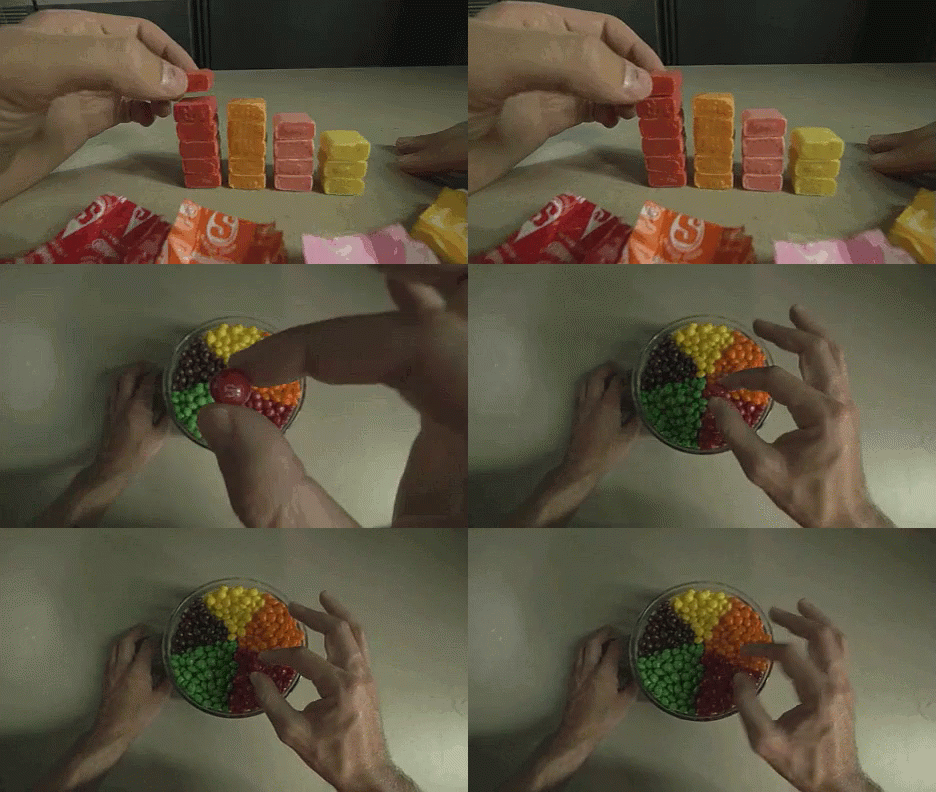
a person is stacking blocks of gum on top of each other .
ALT: a person is stacking blocks of gum on top of each other .
Humans spontaneously sort others into categories — “women,” “BIPOC,” “elderly,” etc.
That’s well known.
But what’s less clear: why one category dimension dominates in a given situation. Why gender here but race there?
05.11.2025 07:00
👍 2
🔁 0
💬 1
📌 0
OSF
🎉 New paper accepted at JPSP: ASC!
Verena Heidrich, Felicitas Flade & I ask:
When people meet others, which social lens do they use — age, gender, race?
Our paper: “Face the Difference: Meta-contrast as an Affordance to Spontaneous Social Categorization.”
osf.io/preprints/ps...
05.11.2025 07:00
👍 24
🔁 8
💬 3
📌 0