
An empirical approach to evaluating the prevalence of long-lived balancing selection in humans--and important limitations. Work by @hannahmm.bsky.social
11.11.2025 19:14
👍 62
🔁 35
💬 0
📌 0
An empirical approach to evaluating the prevalence of long-lived balancing selection in humans--and important limitations. Work by @hannahmm.bsky.social

How does life evolve to adapt to modern cities?
Out now in Science, my PhD work with @lindymcbr.bsky.social uncovers the ancient origin of the “London Underground mosquito” – one of the most iconic examples of urban adaptation.
🧵(1/n)
@science.org
www.science.org/doi/10.1126/science.ady4515

Our new paper from #EntoPOC led by Dr. Evangelista! Evaluating perceptions of STEM majors to explain diversity gaps in entomology and other sciences url: academic.oup.com/aesa/article...

a group of Drosophila erecta fruit flies on a small food patch. flies on white background
Excited to share our new #biorxivpreprint
We discovered that the fruit fly #drosophila erecta requires food odor to mate and arousal is further enhanced by social group motion.
Cross-species analysis of brain activity reveals a novel gate evolved from within a conserved circuit
shorturl.at/gGYm7
i'm at the Yes Kings rally and it's really rough. most of it is me pouring mead for this guy while he entertains lords from far away lands

A macro photo of a strikingly-patterned cockroach on a lined, pale green leaf. The insect is brown and orange, with white spots against black on the upper thorax, and angled chevron-like lines on the wings. Its head is orange and the large compound eyes are beautifully shiny.
A pretty little cockroach (iNat suggests Euphyllodromia sp.) in Costa Rica. Only around 30 of the 4,600 or so species of cockroaches enter homes. Most are detritivores, important members of nature's cleanup crew. This one had cool chevron patterns and compound eyes like polished glass. 🐙🌿 #insects

The creative process in science has a set of thinking tools that we could do a better job teaching. Here are the 12 articles that Martin and I wrote about them, including "It takes two to think", "A hypothesis is a liability" and "The two languages of science". night-science.org/home/learn/r...
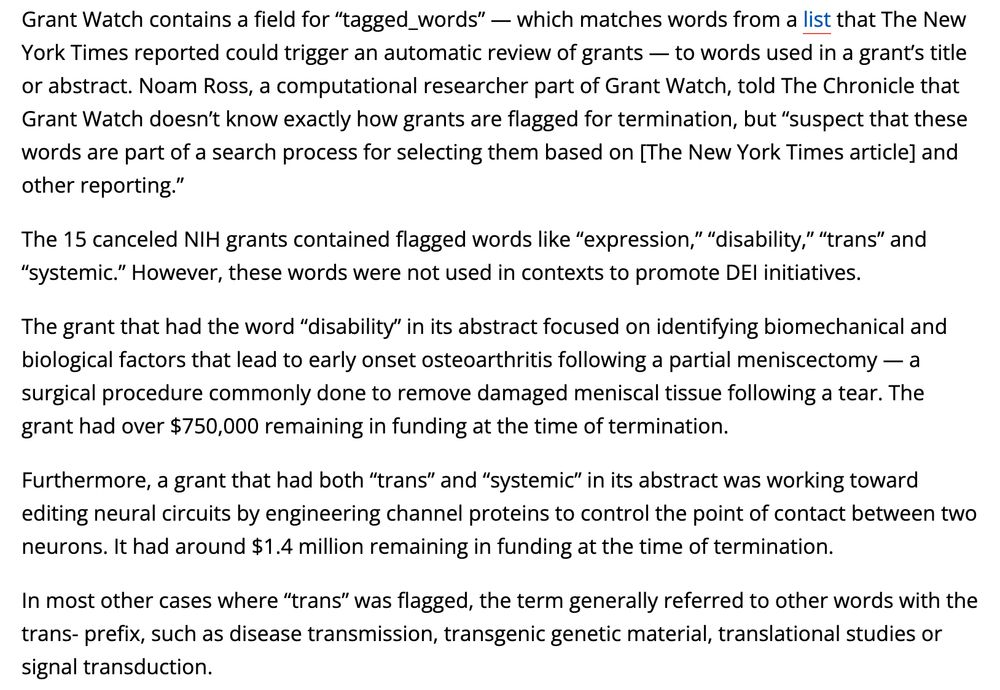
Duke appears to have lost NIH grants because they used the prefix "trans" in reference to disease transmission, transgenic genetic material, translational studies, or signal transduction www.dukechronicle.com/article/2025...

Kip Lacy (@mendelslols.bsky.social) of @danielkronauer.bsky.social's lab has won the W. D. Hamilton Award for Outstanding Graduate Student Presentation from @sse-evolution.bsky.social for his talk "Unselfish meiotic drive maintains heterozygosity in the clonal raider ant." Congrats!

"It’s hard to understand why the administration is pausing funding for medical research and clinical trials if its goal is to counter antisemitism." @megtirrell.bsky.social looks at how Northwestern's trials for heart disease and other diseases are collapsing. www.cnn.com/2025/06/23/h...
Thanks, Philipp!
Thanks!
Thanks, Hugo!
Thanks, Brendan!
Thanks Andrés!
I am humbled and honored to have received this year’s Hamilton Award! Thanks to the @sse-evolution.bsky.social , to my advisor @danielkronauer.bsky.social and the @rockefelleruniv.bsky.social graduate program, and to everyone else who helped me along the way and made this possible.
My ongoing request:
If your NSF or NIH grant was terminated--whether at Harvard or elsewhere--please report it here.
NSF: grant-watch.us/submit-nsf.h...
NIH: grant-watch.us/submit-nih.h...
Our trackers are actively used in lawsuits and are often the only record that terminations ever occurred.
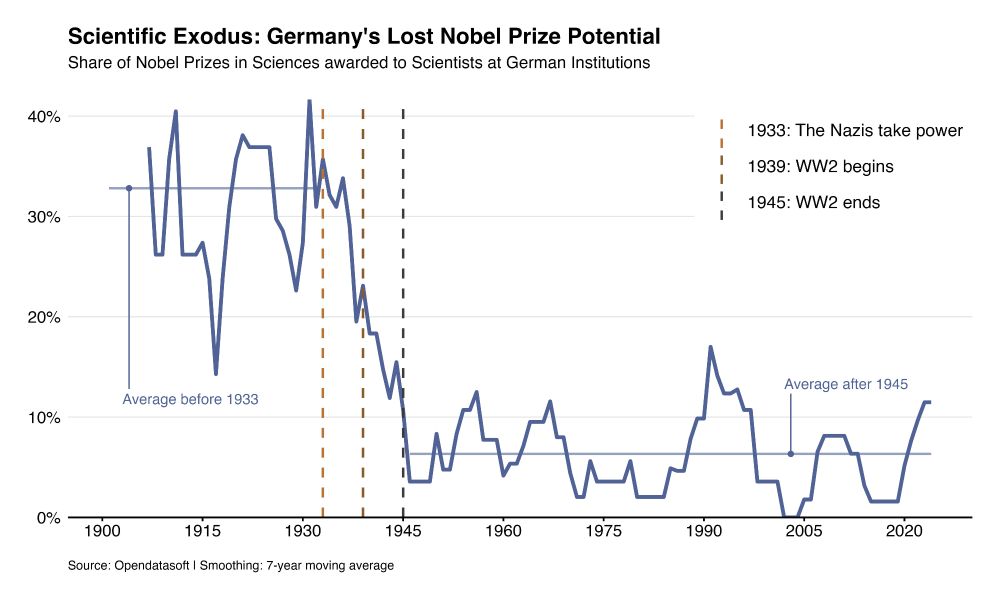
What happens to science under autocracy? The rise of the National Socialist Party in 1930s Germany provides an (admittedly extreme) example. Prior to the early 1930s, scientists at German institutions won a third of Nobels. 10 years later, that number was 5%, and has never recovered.
A Path Forward to Save American Bio-Medical Research
r.mail.talkingpointsmemo.com/mk/cl/f/sh/1...

a square filled with the color #fc7a17.
#fc7a17

Whip spider (Paraphrynus laevifrons) covered with chloropid fly puparia. The parasitoid fly attacks the eggs carried by the female. When done, the maggots climb on the "childless" mom's back and pupate. She protects them during this period thanks to her motherly instincts.

A macro photo from the side of a male velvet ant (actually a type of solitary wasp). You can tell it's a male because females are wingless. It is covered in fine, fuzzy hairs, in black and orange patches, with black wings. It is perched atop lime-green leaves.
A male velvet ant, which is not an ant but a species of solitary wasp. Females are wingless. Males are stingless. (Montana)
🐙🌿
Doing science is mostly just realizing that what you initially lack in expertise, you more than make up for with excitement
Thank you so much, Brendan!

Also, the first paper from my Ph.D. demonstrated that clonal raider ants go to great lengths to avoid losses of heterozygosity (doi.org/10.1038/s415...). Heterozygosity-dependent due to complementary sex determination might help explain why.
More work will need to be done to figure out the mechanisms involved, but with these new studies, we are beginning to learn more about the evolutionary patterns of CSD in ants. For example, the tra-homolog containing locus that was mapped in Vollenhovia was not found in either other ant species. 👀

This peak negligibly affects protein coding sequence, but is closely linked to a lncRNA putatively homologous to ANTSR, which work in Linepithema implicated in having a role in sex determination.

This selection against homozygosity leads to "balancing selection" at CSD loci, which can support many different alleles at intermediate frequency. We explored this by looking at genome-wide "nucleotide diversity" in clonal raider ants, and found a peak within the mapped candidate CSD locus.
This CSD system is also interesting because diploid males produce diploid sperm and are, therefore, functionally sterile. Thus, in species with CSD, there should be natural selection for homozygosity avoidance. Intriguingly, many wasps, ants, and bees obligatorily outbreed.

This suggests that the role of this locus in complementary sex determination evolved over 110 million years ago at the base of the formicoid clade of ants!