
Join the development of the mouse forelimb prosthesis as a post-doc, apply!
05.01.2026 13:00
👍 1
🔁 3
💬 0
📌 0
Join the development of the mouse forelimb prosthesis as a post-doc, apply!
🦾 🧠 Are you interested in building and experimenting with the second version of our mouse forelimb prosthesis? Apply to our Post-Doc position at Université paris-Saclay.
Neuroscientists with interest for engineering, and engineers with interest for neurosciences all welcome! Apply now 🔽🔽🔽
We have a Post-Doc position in the team. Learn more and apply 🔽🔽🔽

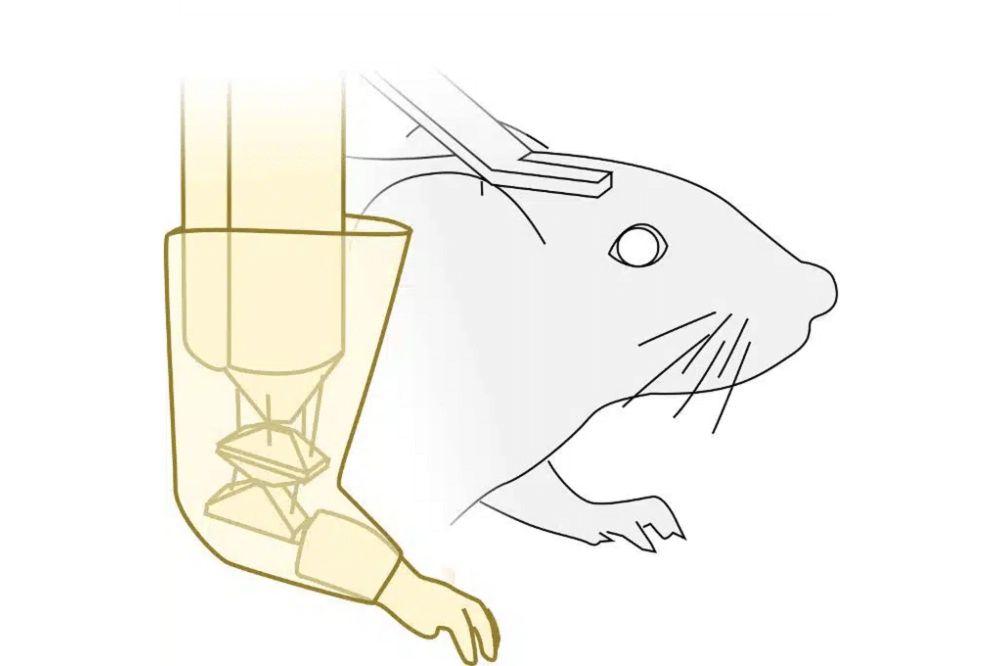
Left: the upper-limb prosthesis can collect water from a tank, and bring it close to the mouth. Right: skeleton of the prosthesis with 4 DOF. THis prosthesis relies on Bowden cables.
1/4 Today we introduce the first upper limb prosthesis for the mouse model, controlled by a brain-machine interface! We show that mice can control this prosthesis via a brain-machine interface to solve a rewarded task.
Our team has a new BioRxiv out, on the operant conditioning of cortical waves, led by Anton Dogadov @dogadov.bsky.social !
We looks at cortical wave conditioning, and at the interactions between peripheral inputs and cortical dynamics which shape waves that match an arbitrary conditioning rule.
🎉 L'interdisciplinarité est à l'oeuvre dans notre institut.
🤝 Nos liens forts avec la communauté des ingénieurs du L2S @centralesupelec.bsky.social nous valent le label PRIME de @cnrs.fr !
Two postdoc positions in the lab within the ERC Synergy project "Chronology" in collaboration with S. Ostojic, M. Jazayeri and V. van Wassenhove @virginievanw.bsky.social . Two focuses: sound sequences representations across the brain & novel all-optical technology. Contact: brice.bathellier@cnrs.fr
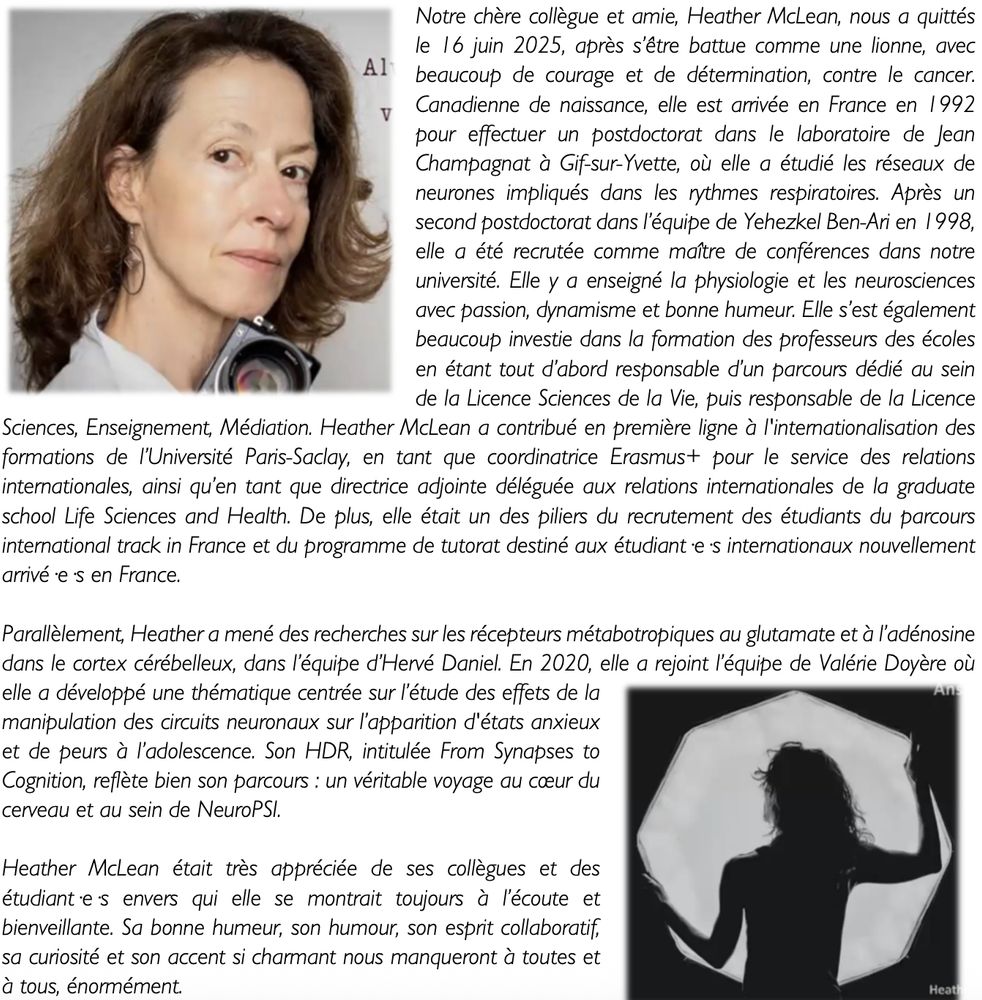
Notre chère collègue et amie, Heather McLean, nous a quittés le 16 juin 2025, après s’être battue comme une lionne, avec beaucoup de courage et de détermination, contre le cancer. Canadienne de naissance, elle est arrivée en France en 1992 pour effectuer un postdoctorat dans le laboratoire de Jean Champagnat à Gif-sur-Yvette, où elle a étudié les réseaux de neurones impliqués dans les rythmes respiratoires. Après un second postdoctorat dans l’équipe de Yehezkel Ben-Ari en 1998, elle a été recrutée comme maître de conférences dans notre université. Elle y a enseigné la physiologie et les neurosciences avec passion, dynamisme et bonne humeur. Elle s’est également beaucoup investie dans la formation des professeurs des écoles en étant tout d’abord responsable d’un parcours dédié au sein de la Licence Sciences de la Vie, puis responsable de la Licence Sciences, Enseignement, Médiation. Heather McLean a contribué en première ligne à l'internationalisation des formations de l’Université Paris-Saclay, en tant que coordinatrice Erasmus+ pour le service des relations internationales, ainsi qu’en tant que directrice adjointe déléguée aux relations internationales de la graduate school Life Sciences and Health. Parallèlement, Heather a mené des recherches sur les récepteurs métabotropiques au glutamate et à l’adénosine dans le cortex cérébelleux, dans l’équipe d’Hervé Daniel. En 2020, elle a rejoint l’équipe de Valérie Doyère où elle a développé une thématique centrée sur l’étude des effets de la manipulation des circuits neuronaux sur l’apparition d'états anxieux et de peurs à l’adolescence. Son HDR, intitulée From Synapses to Cognition, reflète bien son parcours : un véritable voyage au cœur du cerveau et au sein de NeuroPSI. Heather McLean était très appréciée de ses collègues et des étudiant·e·s envers qui elle se montrait toujours à l’écoute et bienveillante. Sa bonne humeur, son esprit collaboratif et sa curiosité nous manqueront à toutes et à tous, énormément.
C'est notre grande tristesse d'annoncer le décès de Heather McLean, Maitresse de Conférence en neuroscience à @univparissaclay.bsky.social, chercheuse à @neuropsi.bsky.social.
🧵New preprint from @tom-quetu.bsky.social and me, done in Dan Shulz’s lab @touchmovelab.bsky.social at @neuropsi.bsky.social :
We uncover how a tactile code emerges in cortical layer 5a from temporal integration of thalamic input.
www.biorxiv.org/content/10.1...
Let’s break it down 👇

🐀💪More coverage of our latest mouse limb embodiment work @plosbiology.org in @newsweek.com !

The rubber-hand illusion was translated to the mouse model. Just like in humans, embodiment in mice can be achieved by brushing the real forelimb of the mouse and the artificial limb (yellow) in synchrony to generate matching visual and touch percepts. This study suggests that as the mouse looks at the artificial limb, it perceives it as its own limb, and feels threatened if the artificial limb is threatened. Image credit: Luc Estebanez.
The "rubber hand illusion" in mice... @lucestebanez.bsky.social &co use automated videography to show that mice display quantifiable behavioral markers of the embodiment of an #ArtificialLimb, opening the door to future research into human #BodyOwnership disorders @plosbiology.org 🧪 plos.io/4jHsESn

About our latest study, with comments by @plasticity-lab.bsky.social Tamar Makin inside!
🔽🔽🔽🔽
www.livescience.com/health/neuro...
We are pleased to have this publication out in @plosbiology.org!

Our work on rubber hand embodiment in mice is out @plosbiology.org! We show that just like in humans, visuo-tactile pairing can lead mice to an embodiment-like behavior with respect to an artificial limb.
A very clear, detailed, and fair account on the (obscure?) French way to distribute positions in academia, and then manage to actually do some research! Thanks Olivier
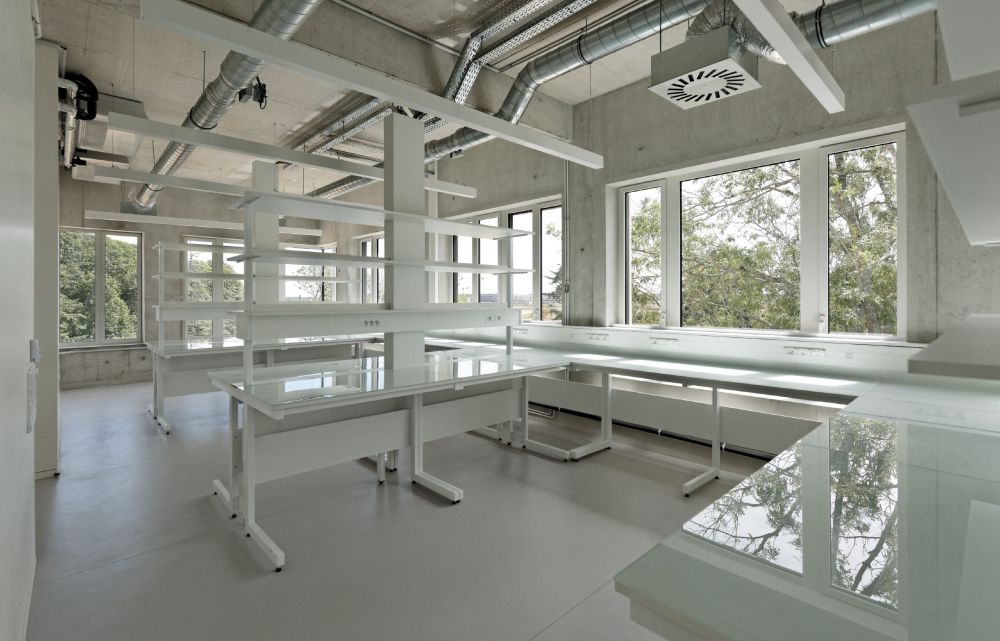
A tenure track "AI and pathological behavioral trajectories" Professor position is open at NeuroPSI.
Learn more and apply
🔽🔽🔽🔽🔽🔽
emploi.cnrs.fr/Offres/CPJ/C...

Just arrived in Montpellier for #Neurofrance2025! Thanks to Ahmed for the invitation to the Somatosensation Symposium, tomorrow morning 😀

During symposium S05 (Wednesday morning), Valérie Ego-Stengel will discuss the integration of artificial cortical stimulations, covering a lot of the new data from our team! #NeuroFrance2025

📰 In poster PS1.093, Edouard Ferrand develops a mouse upper-limb prosthesis and shows that mice can learn to use it to solve a motor task. #NeuroFrance2025

We will be at #NeuroFrance2025 !
📰 In poster PS3.092, Alexandre Tolboom will present work demonstrating an optimal latency on closed-loop Brain-Machine Interfaces.

Heureux d'avoir pu brièvement présenter dans "Avec Sciences" de alexandremorales.bsky.social sur @franceculture.fr , les publications dans @nature.com du consortium MICrON concernant la reconstitution anatomo-fonctionnelle d'un mm² de cortex visuel !
⚠️ Un poste de MCU en Maths-Info-Stats s'ouvre bientôt à Sorbonne Université pour rejoindre mon équipe (background computationnel et experience en analyse de données de neurosciences experimentales souhaités + qualification requise). Contactez-moi pour plus d'infos!
Please RP!

We are pleased to announce a Youtube channel for our institute: www.youtube.com/@NeuroPSI-sa...
You will find here a selection of our conferences, and more!

📢 📢 📢 The deadlines for both registration and abstract submission have been extended for 1 week!
Do not miss this opportunity to participate in the Braincoder conference and shape the future of brain-machine interfacing!
Check out our new work on mouse forelimb embodiment, led by @lucestebanez.bsky.social

Congratulations to our team head Daniel Shulz, who was awarded the Nature Award for Mentoring in Science!
This recognizes a life of dedication to the success of junior scientists and to the development of the neuroscience community in France and beyond.
Congratulations and thank you Dan!

