Waddington's Land Escape: Escaping lands of attraction
06.03.2026 08:25
👍 1
🔁 0
💬 1
📌 0
Waddington's Land Escape: Escaping lands of attraction

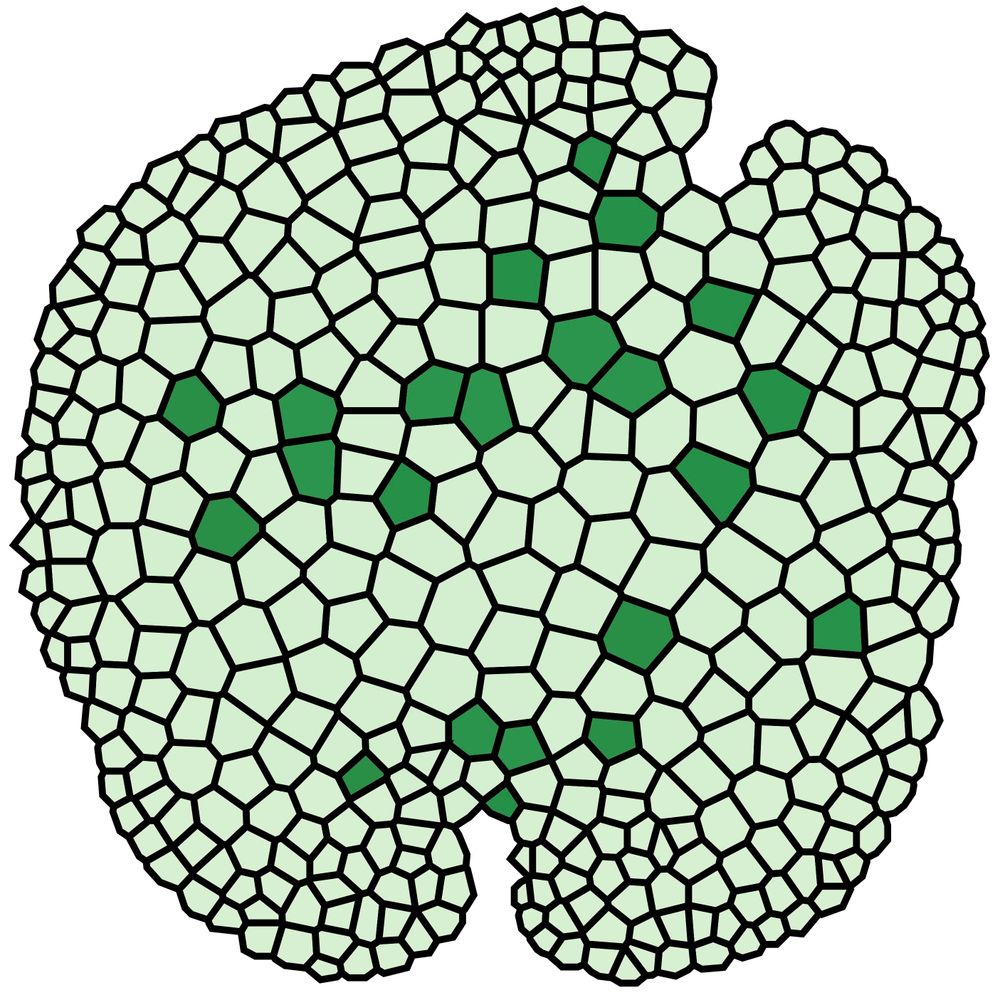
Pictures of M. sharonae, the oldest fossil liverwort, displaying very well-preserved dark cells forming salt-and-pepper patterns, a hallmark of lateral inhibition.
Enter the oldest known fossil liverwort, Metzgeriothallus sharonae (ca. 388 Ma). These exceptionally well-preserved fossils allow us to distinguish different cell types. Dark cells (homologs of oil body cells of modern liverworts) form salt-and-pepper patterns, a hallmark of lateral inhibition.
Interested in fossils, evo-devo, and how mathematical modeling can help us understand the evolution of developmental processes? In our latest preprint, we uncover an ancestral lateral inhibition mechanism underlying epidermal patterning in liverworts.
“They want violence” no they very explicitly want compliance and acquiescence and if you don’t give it to them they will fucking murder you

You know me I don't share fundraisers unless I can tell you I trust them with my whole heart and my own wallet. This one gets protective gear to legal observers in Minneapolis / Saint Paul
www.gofundme.com/f/help-equip...
ICE just shot another one of my neighbors. They had the person on the ground, being beaten by several agents, and then fired multiple shots. In front of the donut shop where we like to get donuts for our kids.
Another friend put it to me like this: "ICE has made the classic Nazi mistake. They've invaded a winter people in the winter."

Our paper on the mysterious Devonian organism Prototaxites has now finally been published! See the paper here (www.science.org/doi/10.1126/...) and our explainer thread below!
Prototaxites reconstruction by Matt Humpage
Wonderful Life by Stephen J. Gould. From 1989, but still timeless.

What in the Gestapo is going on in Grand Rapids?
Watch this activist get arrested *mid-interview* for speaking out against U.S. action in Venezuela.
2026 starts with a big adventure: I travel by train to Paris, my Swiss mountain retreat, and then Barcelona, and back to Vienna on Feb 9.
No flights needed. Even for big trips in Europe these days.
Only: this costs SO MUCH MORE than a bunch of cheap flier tickets would've set me back.
#EU and […]

graphic with logos for openai's chatgpt, github's copilot, meta's llama, anthropic's claude, alibaba's qwen and google's gemini
¡Que se vayan todos!
Check out the preprint for further details! This was a fun and unexpected collaboration with Susan Tremblay, Leonie Kraska (@leoniekraska.bsky.social), Martin Hutten, and Pau Formosa (@pauformosa.bsky.social).

Liverwort phylogeny, showcasing the types of oil body cells. Also, a stability diagram of the model showing the patterning regions, and how evolutionary transitions can be interpreted within this framework.
Our framework provides an explanation for lineage-specific phenotypic transitions—such as the complete loss of oil bodies or the shift from ubiquitous to patterned oil body cells—as outcomes of a conserved patterning module that has been repurposed over evolutionary time.

Oil body cell patterns in fossils and extant taxa, compared to simulations with the mathematical model.
But not only that: we found that the same mechanism could explain oil body cell patterns in extant taxa, suggesting that the patterning mechanism has been conserved during liverwort evolution!

Sketch of a mechanism involving local activation and lateral inhibition, a paradigm of patterning. Also showing the equations of the model and a stability diagram displaying the patterning regimes.
Using quantitative spatial statistics and mathematical modeling, we were able to show that these patterns are consistent with a mechanism of cell patterning involving local activation and lateral inhibition (for the mathematically-inclined, this included cool results using bifurcation theory).
Pictures of M. sharonae, the oldest fossil liverwort, displaying very well-preserved dark cells forming salt-and-pepper patterns, a hallmark of lateral inhibition.
Enter the oldest known fossil liverwort, Metzgeriothallus sharonae (ca. 388 Ma). These exceptionally well-preserved fossils allow us to distinguish different cell types. Dark cells (homologs of oil body cells of modern liverworts) form salt-and-pepper patterns, a hallmark of lateral inhibition.
Interested in fossils, evo-devo, and how mathematical modeling can help us understand the evolution of developmental processes? In our latest preprint, we uncover an ancestral lateral inhibition mechanism underlying epidermal patterning in liverworts.
Lateral inhibition governs ancestral cellular patterning in fossil and extant liverworts https://www.biorxiv.org/content/10.64898/2025.12.27.696693v1
Homology of the dark cells of Paleozoic liverworts with the specialized oil body cells of modern liverworts (Marchantiophyta) https://www.biorxiv.org/content/10.64898/2025.12.24.696392v1
Homology of the dark cells of Paleozoic liverworts with the specialized oil body cells of modern liverworts (Marchantiophyta) https://www.biorxiv.org/content/10.64898/2025.12.24.696392v1

Happy to see this out! We describe a patterning mechanism underlying rhizoid specification in Marchantia. Contrary to classic patterning mechanisms (e.g., Turing), rhizoid specification depends on both randomness and lateral inhibition, involves subcritical bifurcations, and occurs at criticality!
Check it out to learn more!
Happy to see this out! We describe a patterning mechanism underlying rhizoid specification in Marchantia. Contrary to classic patterning mechanisms (e.g., Turing), rhizoid specification depends on both randomness and lateral inhibition, involves subcritical bifurcations, and occurs at criticality!
Richard Lewontin is turning in his grave.
Is this a joke?
It looks very much like Posidonia oceanica, a very common seagrass in the Mediterranean. The brown balls are fibers from the dead leaves, which are carried to the shoreline by the waves!
Really happy to see my PhD work out. Big thanks to @tonnigrubeandersen.bsky.social and everyone involved. I hope you enjoy reading it :)

Time for another paper from our lab!
This time it’s about passage cells. This work originated from a collaboration with @lauraragni.bsky.social and was spearheaded by the super-talented @leoniekraska.bsky.social Below you will find a thread that explains our findings.
www.cell.com/cell-reports...
