Title page of a Psychological Bulletin article titled “Positive and Negative Parenting Practices and Offspring Disruptive Behavior: A Meta-Analytic Review of Quasi-Experimental Evidence,” listing authors Lucy Karwatowska, Francesca Solmi, Jessie R. Baldwin, Sara R. Jaffee, Essi Viding, Jean-Baptiste Pingault, and Bianca Lucia De Stavola, with institutional affiliations and abstract text below.
🚨 Our new meta-analysis on the causal influence of parenting on disruptive behaviour (DBDs) is now published in Psychological Bulletin. Across 45 quasi-experimental (QE) studies (N ≈ 38,600), we find a small but causal effect of negative parenting on DBDs.
08.01.2026 16:02
👍 4
🔁 3
💬 1
📌 1
Evaluating open science practices with AI, with Dr Daryl Lee
Join Dr. Yu Heng Daryl Lee to learn about the efficacy of AI in evaluating open science practices.
Can AI be used to evaluate open science practices? 🤖🔎
Join us to find out from Dr Daryl Lee at the next ReproducibiliTea! 🫖
📅 Jan 13th, 3pm GMT
www.eventbrite.co.uk/e/evaluating...
@tabeasch.bsky.social @uclopenscience.bsky.social @uclpals.bsky.social @reproducibilitea.org @ukrepro.bsky.social
07.01.2026 11:22
👍 6
🔁 5
💬 0
📌 1

Are Preregistered Studies Publicly Shared? With Eline Ensinck
Eline Ensinck will present research on the number of preregistered studies which are never published and the reasons behind this
How many preregistered studies end up in the file drawer? 🗂️
Join us to find out from Eline Ensinck at the next ReproducibiliTea!
📅Nov 25, 3pm GMT
www.eventbrite.co.uk/e/are-prereg...
@tabeasch.bsky.social @reproducibilitea.org @uclopenscience.bsky.social @ukrepro.bsky.social @lakens.bsky.social
11.11.2025 13:02
👍 16
🔁 10
💬 0
📌 0

Hi #ASHG2025, the Lausanne team made it to Boston ! Excited to present our latest discoveries — come say hi and learn more about our research! @samuelmoix.bsky.social @rjhfmstr.bsky.social
14.10.2025 11:18
👍 7
🔁 4
💬 1
📌 0

Research Fellow in Mental Health at UCL
Apply for the Research Fellow in Mental Health role on jobs.ac.uk, the top job board for academic positions in higher education. View details and apply now.
I'm hiring! ✨ Looking for a Research Fellow to study environmental factors that mitigate intergenerational transmission of mental health.
3-year post at UCL @uclbrainscience.bsky.social with great opportunities for training, collaboration & exciting science!
🔗 Apply: www.jobs.ac.uk/job/DOZ633/r...
10.10.2025 09:41
👍 17
🔁 15
💬 1
📌 3

When and How to Deviate From a Preregistration, with Prof Daniël Lakens
Prof Daniël Lakens will share guidance on appropriate circumstances and methods for deviating from a pre-registration
When is it appropriate to deviate from a pre-registration, and how should this be done? 🧐
Join us to find out from Daniël Lakens @lakens.bsky.social at the next ReproducibiliTea!
October 28, 1pm GMT.
Sign up: www.eventbrite.co.uk/e/when-and-h...
@tabeasch.bsky.social @reproducibilitea.org
13.10.2025 10:41
👍 23
🔁 16
💬 2
📌 1

🚨 New preprint out!
We reconstructed parental haplotypes in >440k individuals (UK & Estonian biobanks) to estimate assortative mating directly in the parental generation.
This reveals intensified assortment in recent generations.
www.biorxiv.org/content/10.1...
26.09.2025 17:10
👍 30
🔁 18
💬 1
📌 0
Amazing work from my colleague and postdoc Dr. Isabelle Foote on the genetic architecture of frailty. Encourage you to check it out!!!!
06.08.2025 16:16
👍 15
🔁 3
💬 0
📌 0

🚨 Our parent-of-origin study is out in Nature! 🧬
Maternal and paternal alleles can have distinct — even opposite — effects on human traits, revealing a hidden layer of genetic architecture that standard GWAS miss.
🔗 www.nature.com/articles/s41...
Highlights below!
06.08.2025 18:27
👍 117
🔁 55
💬 2
📌 5
Happy to receive any feedback you may have! Very grateful to everyone involved in this work, huge thanks to Simon Wiegrebe, Thomas Winkler (@winkusch.bsky.social) & Zoltán Kutalik (@zkutalik.bsky.social ) 👏
08.07.2025 12:46
👍 0
🔁 0
💬 0
📌 0
9/ Finally, we examined the role of non-linear age-varying genetic effects. While such effects could contribute to discrepancies between the two designs, given the differing age ranges in cross-sectional and longitudinal samples, they explained little of the observed differences.
08.07.2025 12:46
👍 0
🔁 0
💬 1
📌 0
8/ Focusing on other factors, we found that selective participation also contributed to differences between the two designs. This may reflect distinct participation mechanisms, such as selective enrolment in cross-sectional samples versus survival/dropout in longitudinal samples.
08.07.2025 12:46
👍 0
🔁 1
💬 1
📌 0

7/ However, effect size estimates showed less agreement between the two designs (r = 0.74). Similar to the phenotypic findings, differences were primarily due to gene-by-cohort effects, where genetic associations vary across birth years, introducing bias into cross-sectional estimates.
08.07.2025 12:46
👍 0
🔁 1
💬 1
📌 0

6/ Among the identified SNPs, 86% showed consistent interpretation across designs regarding the direction of age-varying genetic effects. These included both attenuation with age (e.g., for obesogenic traits) and intensification over time (e.g., for disease burden and medication use).
08.07.2025 12:46
👍 0
🔁 1
💬 1
📌 0

5/ At the genetic level, we identified 57 SNPs with significant age-varying effects. Most were detected in the cross-sectional design, likely reflecting greater statistical power due to larger sample sizes and broader age ranges.
08.07.2025 12:46
👍 0
🔁 0
💬 1
📌 0

4/ We observed that this likely reflects confounding by year-of-birth effects (e.g., younger cohorts tend to smoke less), which can bias age estimates in cross-sectional analyses.
08.07.2025 12:46
👍 0
🔁 1
💬 1
📌 0

3/ RESULTS:
At the phenotypic level, cross-sectional and longitudinal age effects showed only moderate agreement. For several traits, especially lifestyle behaviours, effects differed in their direction: e.g., smoking appeared to increase with age cross-sectionally but declined longitudinally.
08.07.2025 12:46
👍 0
🔁 1
💬 1
📌 0

2/ Using data on 31 health-related traits from the UK Biobank, we focused on two questions:
🔹 Do the two designs lead to the same conclusions?
🔹 If not, what are the sources of bias that account for the observed discrepancies?
08.07.2025 12:46
👍 0
🔁 1
💬 1
📌 0
1/ We compare two common approaches to modeling age-varying genetic effects:
🔹 Cross-sectional: Comparing genetic associations across individuals of different ages.
🔹 Longitudinal: Estimating genetic effects on change over time within the same individuals.
08.07.2025 12:46
👍 0
🔁 0
💬 1
📌 0
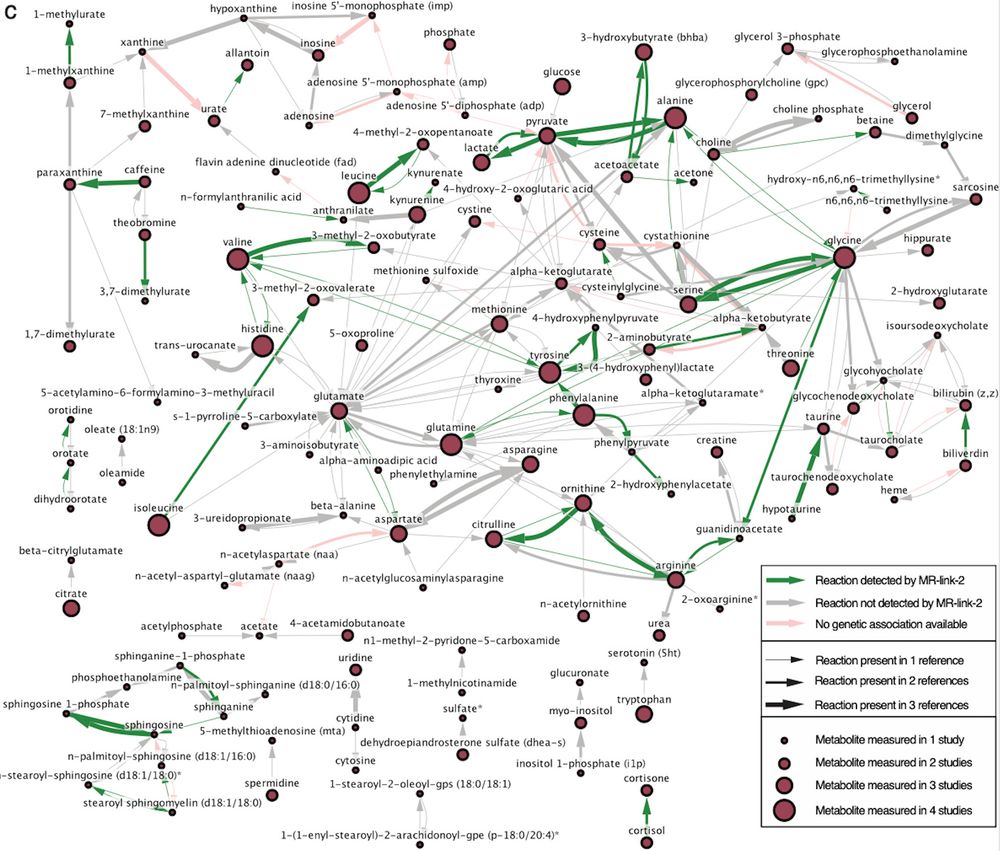
A network of metabolites and their potential causal relationships. Green edges are Detected by the statistical causal inference method MR-link-2
Our paper, MR-link-2 has just been published! Offering pleiotropy robust Mendelian randomization from a single region! www.nature.com/articles/s41...
04.07.2025 08:52
👍 33
🔁 15
💬 2
📌 1
OSF
🧵 THREAD: Preprint from @chrisrayner.bsky.social reveals how to fix selection bias in the Norwegian #MoBa study using population-wide registry data! For the first time, we can quantify and adjust for selection bias in this major epidemiological resource.
Spread the good news!
osf.io/preprints/os...
13.06.2025 17:51
👍 23
🔁 10
💬 2
📌 1

🧠🧬🧑🤝🧑 New CoDE Lab study: Disorder-specific genetic effects drive the associations between psychopathology and cognitive functioning. Link to preprint: www.medrxiv.org/content/10.1... Led by the brilliant Wangjingyi Liao 🌟
A short thread summarising the study👇
10.06.2025 09:51
👍 6
🔁 5
💬 1
📌 0
PGI Repository v2.0 preprint out! A 🧵 on the main results and updates @robel-alemu.bsky.social @paturley.bsky.social @alextisyoung.bsky.social
20.05.2025 10:18
👍 35
🔁 13
💬 1
📌 1
All GWA summary statistics will be soon available @gwascatalog.bsky.social (accession codes GCST90565836-GCST90565865)! As always, wonderful teamwork with @zkutalik.bsky.social and Jean-Baptiste Pingault @atcmap.bsky.social 🙂
19.05.2025 12:28
👍 2
🔁 1
💬 1
📌 0

Further, we found little evidence of common risks shared by (cross-sectional) level of functioning and (longitudinal) decline in cognitive and physical outcomes (11/11)
19.05.2025 12:28
👍 0
🔁 0
💬 1
📌 0
Using Mendelian Randomization to identify risk factors involved in age-related decline, we found that most risks were specific to either cognitive decline (e.g., Alzheimer’s disease liability) or physical decline (e.g., shorter telomere length, higher bone mineral density) (10/)
19.05.2025 12:28
👍 0
🔁 0
💬 1
📌 0