Super happy to receive an M-2 weave grant from the NWO (Dutch Research Council). Together with Sayed Abd El-Whab we will study the molecular features of H5Nx HA and NA proteins. #glycotime www.nwo.nl/en/news/gran...
24.11.2025 09:42
👍 2
🔁 1
💬 0
📌 0
Big shout out to @LiangRuonan and many thanks to @TheBoonsGroup , @UnioneLuca @UU_Glycoscience @uuuips.bsky.social
18.07.2025 08:04
👍 0
🔁 1
💬 0
📌 0
The latter is vital, as many H3N2 viruses bind solely to these complex structures, and many zoonotic avian HAs, engineered to bind human-type receptors, do so as well.
18.07.2025 08:04
👍 0
🔁 1
💬 1
📌 0
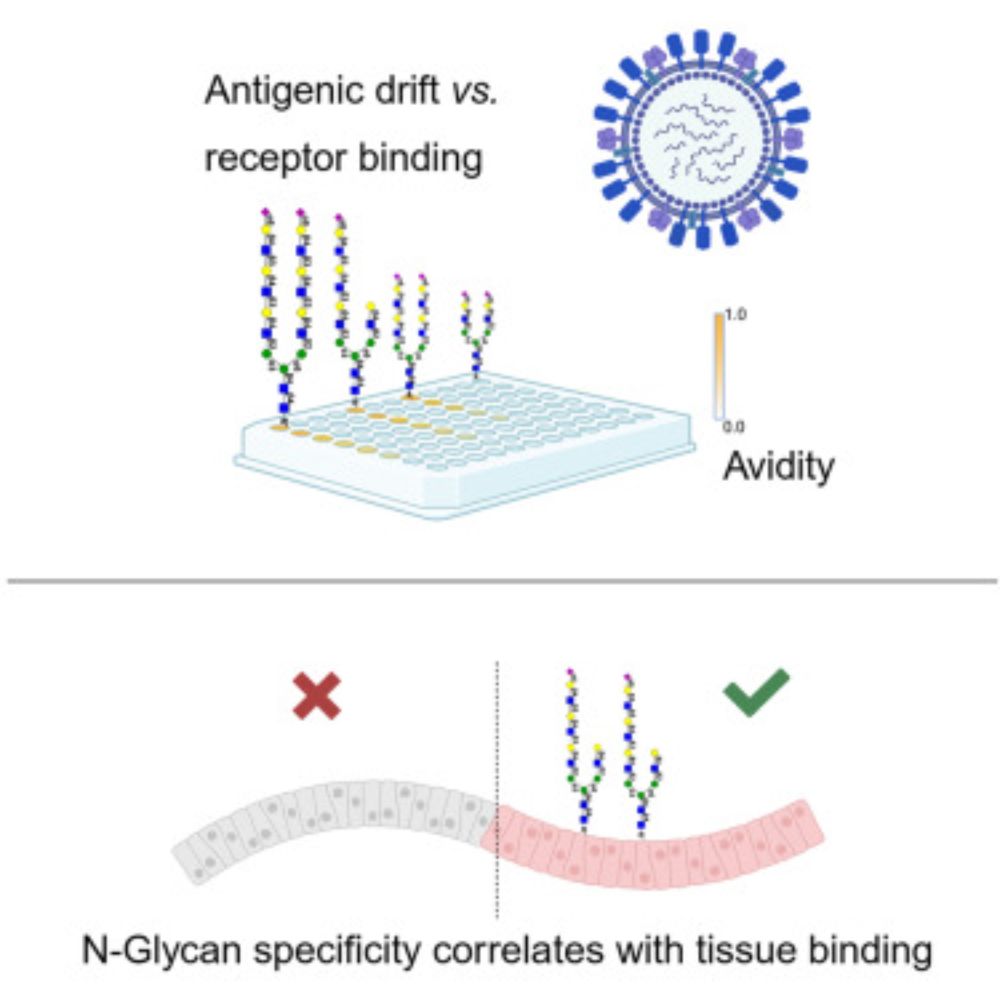
Significant observations indicate that the conserved 195Y, which changes to F, rescues binding properties in specific backgrounds. And symmetric N-glycans with tri-LacNAc arms are not displayed on human tracheal epithelial cells.
18.07.2025 08:04
👍 0
🔁 0
💬 1
📌 0
She followed those results up with, amongst others, a tissue binding experiment on human tracheal tissues. As glycan binding is one thing, but binding tissues is another.
18.07.2025 08:04
👍 0
🔁 0
💬 1
📌 0
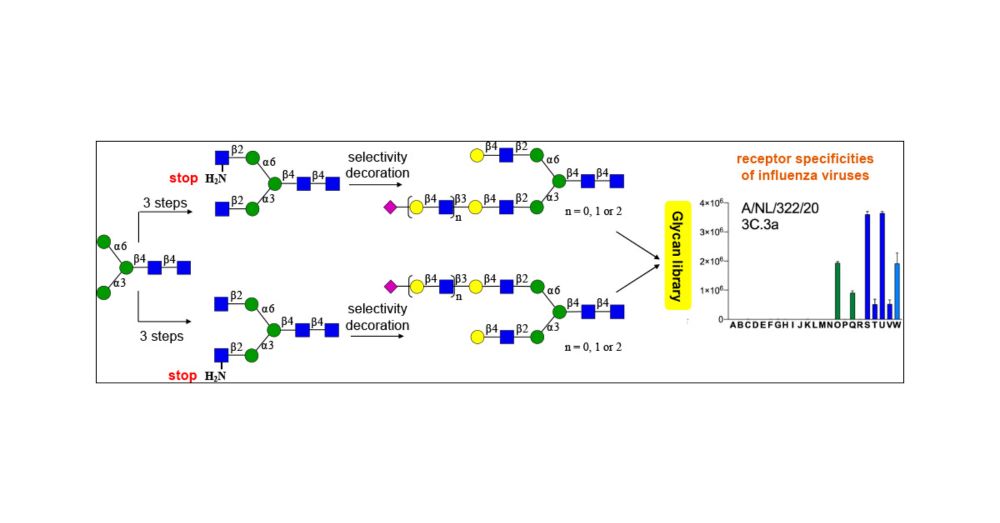
Here, we aimed to identify the molecular determinant of tri- vs. di-LacNAc binding in strains that have circulated over the last 10 years. Ruonan created a mutant library and utilized complex N-glycans in an ELISA assay to assess specificity and avidity.
18.07.2025 08:04
👍 0
🔁 0
💬 1
📌 0
And now published! #glycotime "Sialic Acid-Containing Glycolipids Extend the Receptor Repertoire of Enterovirus-D68" fantastic collaboration with @lisabauervirus.bsky.social @debbyvanriel.bsky.social @TheBoonsGroup enjoy 👍https://pubs.acs.org/doi/10.1021/acsinfecdis.5c00063
10.07.2025 07:50
👍 5
🔁 2
💬 0
📌 0

Sialic Acid-Containing Glycolipids Extend the Receptor Repertoire of Enterovirus-D68
Enterovirus D68 (EV-D68) emerged as a pathogen of increasing health concern globally, particularly due to its association with outbreaks of severe respiratory diseases and acute flaccid myelitis (AFM) in children. Knowledge regarding the tissue tropism and pathogenesis of EV-D68 within the respiratory tract and central nervous system remains limited, primarily due to an incomplete understanding of the host factors that facilitate the entry of EV-D68 into host cells. Several cellular receptors involved in EV-D68 infections have been identified, including ICAM-5, sialylated glycoproteins, and heparan sulfate (HS). Here, we investigate the receptor requirement of a panel of EV-D68 strains covering all clades, focusing on HS and sialosides utilizing glycan arrays. We found that all EV-D68 strains binding to HS harbor a cell culture adaptive substitution in the structural protein VP1 at position 271, which changes the amino acid into a positively charged one. Glycan array analyses revealed that EV-D68 strains prefer α2,6-linked sialic acids presented on N-glycans, α2,8-linked sialic acids on gangliosides, or both. Inhibition of glycolipid biosynthesis or multivalent glycolipid mimics confirmed that ganglioside structures serve as entry receptors for certain EV-D68 strains. Lastly, we examined whether EV-D68 strains that bind to HS or glycolipids require different uncoating mechanisms. Bafilomycin A1 minimally affected the cell entry of HS-binding EV-D68 strains B2/039 and B2/947, and the ganglioside preferring B1/2013 and other viruses were strongly inhibited. Together, we identified that EV-D68 strains can use disialoglycolipids as novel receptors and that different EV-D68 strains show a promiscuous sialic acid binding repertoire.
We are happy to share the first publication of our consortium:
pubs.acs.org/doi/10.1021/...
10.07.2025 06:42
👍 16
🔁 7
💬 1
📌 0
What a great thread and very interesting preprint 👍
27.05.2025 16:58
👍 2
🔁 0
💬 0
📌 0

Happy Eurovision! Basel is awesome, getting ready for the final!🏳️🌈🇫🇮
17.05.2025 17:11
👍 3
🔁 0
💬 1
📌 0
Bijvoet symposia 👍 #glycotime @uu-cbdd.bsky.social
12.05.2025 10:05
👍 0
🔁 0
💬 0
📌 0
Many thanks to @uu-cbdd.bsky.social @uuuips.bsky.social
25.04.2025 06:37
👍 0
🔁 0
💬 0
📌 0
Of course, we don't know if precisely these O-glycans enable these viruses' unique zoonotic capabilities, as many other virological and ecological factors are likely involved. However, we do like to hypothesize that these binding properties contribute to these capabilities.
25.04.2025 06:37
👍 1
🔁 0
💬 1
📌 0
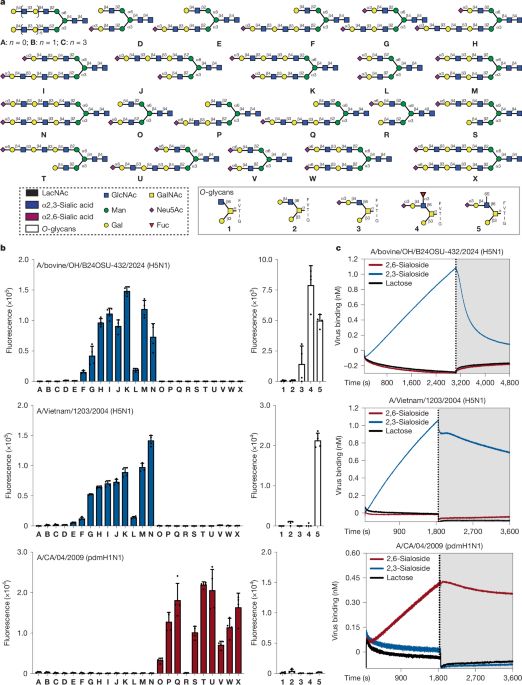
Another observation we made is that the cattle-derived recombinant virus had nearly identical receptor binding properties compared to one of the first 2.3.4.4 viruses isolated over 10 years ago. Receptor specificity is relatively conserved for 2.3.4.4 viruses.
25.04.2025 06:37
👍 1
🔁 0
💬 1
📌 0
Our colleagues at @scripps.edu determined the structural features of these specificities. And i hope you can appreciate how the fucose lies in the receptor binding site. Fun observation is that we saw the peptide interacting with a very well-known epitope in the HA stalk
25.04.2025 06:37
👍 1
🔁 0
💬 1
📌 0
Using these mucin-like O-glycans as a glycan array screen, we observed that these 2.3.4.4b were unique in their promiscuous receptor binding properties. These properties resulted in binding to human respiratory tract tissue while not binding human-type receptors.
25.04.2025 06:37
👍 0
🔁 0
💬 1
📌 0
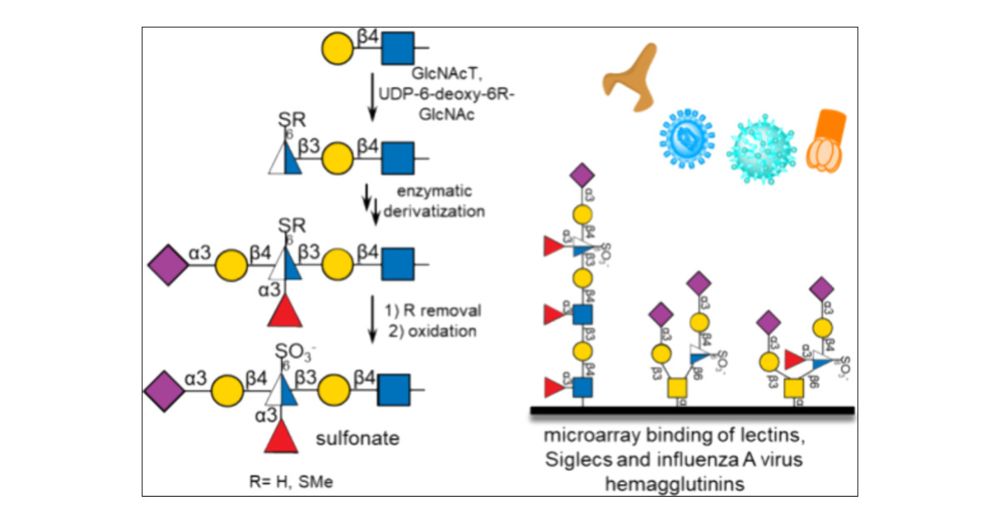
Many years ago, a carbohydrate chemist, Julia, started to synthesize mucin-like O-glycans, as they were greatly understudied. This was also when 2.3.4.4b H5Nx viruses were taking the stage.
25.04.2025 06:37
👍 1
🔁 0
💬 1
📌 0
Maria and our colleagues at @scrippsresearch have done fantastic work on this. A 2.3.4.4e H5 only needed a single Q226L mutant to bind canonical human-type receptors! A representative H5 from the current cow outbreak did not shift receptor binding with the Q226L only.
16.04.2025 07:57
👍 3
🔁 0
💬 1
📌 0
#Viruseslikeitsweet is online! We are a consortium of the department of Viroscience @erasmusmc.bsky.social and the department of Chemical Biology & Drug discovery @utrechtuniversity.bsky.social
Follow our progress here or via our Linked-In account: NWO-XL Consortium Viruses like it Sweet
09.04.2025 06:48
👍 7
🔁 4
💬 1
📌 0