
R-Ladies branded graphic with purple-to-indigo gradient background. The classic R-Ladies logo (purple R in a gray oval) is centered at the top. Large white text reads "We Are R-Ladies." Below, three statistics are displayed: 200+ chapters, 60+ countries, 100k+ members. A tagline reads "Promoting gender diversity in the R community worldwide." The bottom bar shows rladies.org, #RLadiesIWD2026, and #IWD2026.
We Are R-Ladies
200+ chapters. 60+ countries. 100,000+ members.
Since 2012, we've been promoting gender diversity in the R community — building a global network of R leaders, mentors, learners, and developers.
This is who we are.
rladies.org
#RLadiesIWD2026 #IWD2026
08.03.2026 00:00
👍 33
🔁 13
💬 0
📌 1
Job Opening
Annonce d'ouverture de poste
We are looking for a new colleague!🧠🇨🇭🦩
A new post doc position is available in our lab - check the link for more details!
www.unige.ch/fapse/womcog...
02.03.2026 11:21
👍 9
🔁 9
💬 0
📌 2
APA PsycNet
Can We Process Information Without Encoding It into Working Memory?
Our findings with @gidon-frischkorn.bsky.social and @koberauer.bsky.social suggest that processing entails encoding. Task-irrelevant information enters working memory during processing, impairing memory for relevant information.
19.02.2026 16:26
👍 20
🔁 9
💬 1
📌 1
We are: @isabelcourage.bsky.social, @hannahdames.bsky.social, David Dignath, Christina U. Pfeuffer, Moritz Schiltenwolf, Andrea Kiesel, and @koberauer.bsky.social
12.02.2026 19:47
👍 1
🔁 0
💬 0
📌 0

Bindings for Action: Bridging the Gap Between Theories of Procedural Working Memory and Action Control Research | Journal of Cognition
In a new review paper in @jcgntn.bsky.social , we compare the #BRAC framework with procedural #WM theories.
We clarify where they agree & diverge, and demonstrate with simulations that procedural WM can capture hallmark BRAC effects.
journalofcognition.org/articles/10....
12.02.2026 19:47
👍 9
🔁 4
💬 1
📌 1
"Repetitions lead to better memory." Sure - but how? Our new paper led by former lab member @philippmusfeld.bsky.social shines new light on this question, and challenges some longstanding assumptions. Now published in Perspectives on Psychological Science.
journals.sagepub.com/doi/10.1177/...
03.02.2026 16:00
👍 11
🔁 7
💬 1
📌 0
If you @solomonkurz.bsky.social are interested in the details of the translation we implement you can extract either the brmsformula and family from a fit object or also extract the stancode from any model you specify.
30.01.2026 18:49
👍 2
🔁 0
💬 0
📌 0
The Multinomial / Memory Measurement Model (M3)
I also thought about „refcat = NA“! Nice to see that this provides tha proper solution.
This is also what we implement when translating multinomial measurement models into brms in the bmm R package: venpopov.github.io/bmm/articles...
30.01.2026 18:49
👍 3
🔁 0
💬 1
📌 0

Process-oriented intelligence research: A review from the cognitive perspective
Despite over a century of research on intelligence, the cognitive processes underlying intelligent behavior are still unclear. In this review, we summ…
With a more conceptual approach to this in cognitive individual differences research I try to advocate for a similar approach bridging formalized modeling with traditional psychometric work: www.sciencedirect.com/science/arti...
Looking forward to where the field is heading in the next few years 🤓
29.12.2025 18:35
👍 2
🔁 0
💬 0
📌 0
Again more interesting work on bridging #psychometrics with #experimentalpsychology! Looking forward to reading this preprint and it is awesome to see that more and more people are working at the intersection of psychometrics and experimental psychology!
29.12.2025 18:35
👍 3
🔁 0
💬 2
📌 0


Big news from the lab today: @joschadutli.bsky.social has officially defended his PhD! 🎉
We’re grateful to @aidanhorner.bsky.social for serving as external examiner and as Joscha’s supervisors we @leabartsch.bsky.social and @koberauer.bsky.social are incredibly proud—congrats, Joscha!
10.12.2025 12:23
👍 21
🔁 6
💬 0
📌 1
Andy Conway and I are honored to serve as inaugural co-Editors of this new Psychonomics journal, focused on the rigorous study of individual differences in cognition. Please spread the word to potentially interested colleagues; we hope that you will send us your best relevant work!
24.11.2025 14:54
👍 33
🔁 13
💬 2
📌 0
Good news for all those of us who plan to grow old: Some forms of learning do not decline in old age. Our new paper in Psychology and Aging shows equivalent learning rates in older and younger adults in chunk learning, tested through the Hebb repetition effect.
21.11.2025 13:50
👍 8
🔁 2
💬 0
📌 0
APA PsycNet
Memory researchers have known this: If we leave more free time between one study item and the next, memory is better. This is true for WM and LTM - but is it so for the same reason? Probably not. If you want to know more, have a look at our new paper in JEP:General: psycnet.apa.org/record/2026-...
26.11.2025 12:53
👍 7
🔁 2
💬 0
📌 1
The Cognition Lab @ University of Zurich is on Bluesky! Follow us for updates on new papers & preprints, conferences that lab members attend & other news around research on #workingmemory, #attention, and #longtermmemory.
05.11.2025 16:54
👍 20
🔁 11
💬 1
📌 0
Simonsohn has now posted a blog response to our recent paper about the poor statistical properties of the P curve. @clintin.bsky.social and I are finishing up a less-technical paper that will serve as a response. But I wanted to address a meta-issue *around* this that may clarify some things. 1/x
25.09.2025 10:07
👍 77
🔁 31
💬 2
📌 8


3/3 My personal highlight of #ESCOP2025 was becoming this year‘s #WomWom research fairy! 🧚♂️ Thanks again to all my fellow #WomeninWorkingMemory. It means a lot ❤️
15.09.2025 04:09
👍 18
🔁 2
💬 0
📌 1
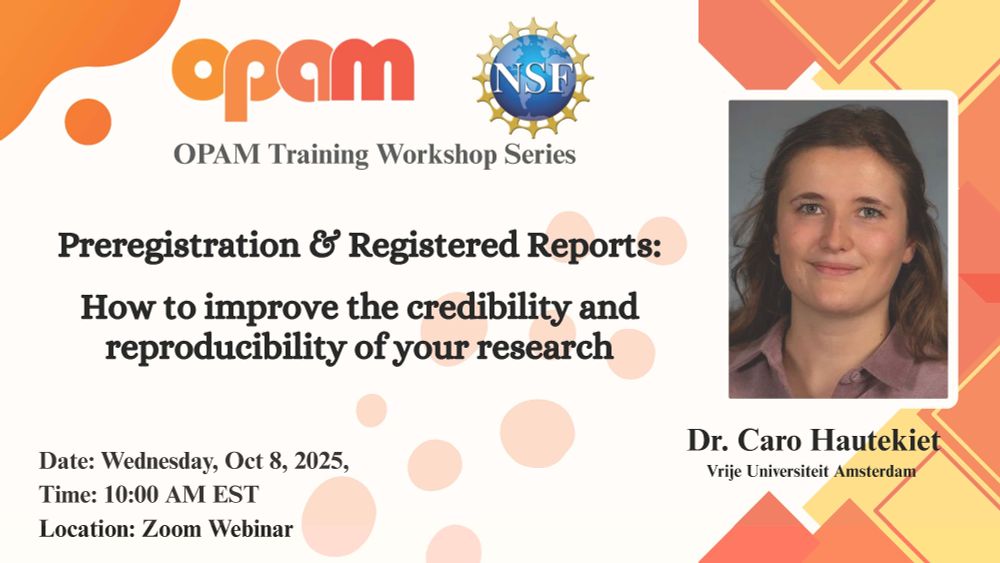
The next installment (October 8th) of our OPAM Training Workshop series will feature Dr Caro Hautekiet (of Vrije Universiteit), who will be discussing pre-registration and registered reports. Visit this page for info on all our (free!) workshops: www.opamconference.com/workshops-su...
11.09.2025 19:46
👍 13
🔁 5
💬 1
📌 1
It was an absolute pleasure and so much fun to teach this course at #ESCoP25! Huge thanks to my co-organizers, all the participants, and the ESCoP team for making it such a fantastic experience!
12.09.2025 10:08
👍 12
🔁 2
💬 0
📌 0
Yes, this was a really great experience! Thanks for @cvonbastian.bsky.social and @vmloaiza1.bsky.social for asking us to do this as part of #ESCOP2025! And if you are interested in having a similar workshop for your PhD Programm or similar, feel free to reach out!
12.09.2025 10:00
👍 15
🔁 5
💬 0
📌 0
With less than week until #ESCOP2025, we're super excited to kick-off our conference with something truly special - an Algorave! 🤩 (1/12 👀)
28.08.2025 13:44
👍 13
🔁 5
💬 2
📌 0
Hey #memory folks, check out this new preprint by @joschadutli.bsky.social , @koberauer.bsky.social, and @leabartsch.bsky.social showing that elaboration benefits are likely driven by aiding in establishing efficient retrieval cues.
28.08.2025 14:57
👍 11
🔁 8
💬 0
📌 0

Expression of Interest in Serving as a PsyArXiv Moderator
As you might have heard, PsyArXiv is having some issues with an increase in low-quality submissions, ranging from AI generated manuscripts to inflate citation metrics, incoherent or nonsensical docume...
PsyArXiv is seeking new moderators to help combat an increase in AI submissions! If you've ever posted a preprint to PsyArXiv, please consider joining. Minimum commitment 1h/month, there's a training session this Monday @ 1pm ET. More info here: forms.gle/9LB1rEtxHAeZ... #PsychSciSky
15.08.2025 17:31
👍 74
🔁 91
💬 0
📌 14

The Flexibility of Working Memory in Drawing on Episodic Long-Term Memory Representations in Serial Recall | Journal of Cognition
New content: Rodriguez, A., Musfeld, P., & Bartsch, L. M. (2025). The Flexibility of Working Memory in Drawing on Episodic Long-Term Memory Representations in Serial Recall. Journal of Cognition, 8(1): 40, pp. 1–26. DOI: doi.org/10.5334/joc.... #psychscisky
08.08.2025 09:47
👍 14
🔁 7
💬 0
📌 1

Applications are invited for a
Postdoctoral Position (80%)
at the Cognitive Psychology Unit, Department of Psychology, University of Zurich. The ideal
start date would be January 1st, 2026 but could be somewhat earlier or later. The position is for
initially 3 years, with possible renewal for another 1.5 years.
The successful applicant will work with the head of the Cognitive Psychology Unit, Prof. Dr. Klaus
Oberauer, and the Cognitive Psychology team. The post involves research and teaching (one course
per semester).
Research at the Zurich Cognitive Psychology Unit focuses on capacity limits of cognition, in particular
working memory, long-term memory, and attention, which we investigate with experimental,
individual-differences and aging studies and computational modeling. For further information see:
https://www.psychology.uzh.ch/en/areas/nec/allgpsy.html
We offer:
- An attractive research environment with close collaboration within the team
- Excellent lab infrastructure
- Salary according to Cantonal regulations
We expect:
- a PhD in psychology or a related discipline
- experience with experimental research
- excellent method knowledge and skills
- very good command of English
- interest in pursuing an academic career in cognitive psychology
In addition, it would be desirable if you had:
- experience with publishing in international journals
- programming skills
- experience with mathematical / computational modeling
Please send applications including your CV and motivation letter
no later than September 10, 2025
electronically as a single PDF to: Michaela Oestmann, michaela.oestmann@psychologie.uzh.ch
For questions about the position please contact Klaus Oberauer, k.oberauer@psychologie.uzh.ch
🚨 PostDoc Opening 🚨 The lab of Klaus Oberauer is looking for a new postdoc, starting end of this/beginning next year. Research focus is #cognition, #workingmemory, #methods and #computationalmodeling or anything in that direction. I cannot highlight ENOUGH how great it is to work in this lab 🥰🤓
06.08.2025 12:05
👍 53
🔁 44
💬 3
📌 2
Thanks for creating this! Would be great if you would add me 😇
29.07.2025 18:14
👍 0
🔁 0
💬 1
📌 0
We had some weird effects where the evidence for an interaction was ambiguous with dummy coded factors, but with the same data and sum-to-zero coded factors there was strong evidence for an interaction based on Bayes Factors.
26.07.2025 17:27
👍 3
🔁 0
💬 1
📌 0
Yes, the priors are typically set in the effect coefficients. Thus, dummy coding changes the prior predictive for different group means. As the reference group would only get the intercept prior, whereas an effect group would get intercept prior + effect prior.
26.07.2025 17:27
👍 1
🔁 0
💬 1
📌 0
For frequentist analysis the coding might be more of a convenience choice, depending on which coefficients are easier to interpret for you. But in Bayesian analyses the coding can make a big difference for the inference you draw. At least when using Bayesian Factors & prior predictive comparisons.
26.07.2025 14:56
👍 1
🔁 0
💬 1
📌 0
The Multinomial / Memory Measurement Model (M3)
For details on the Memory Meausurement Model (M3) see this article: venpopov.github.io/bmm/articles...
And for all #decisionmaking researchers, you can easily use the model for any multinomial data assuming continuous activation strengths underlying the competitive selection among candidates
24.07.2025 18:03
👍 1
🔁 0
💬 0
📌 0
