
Size matters. Among the great apes, human penises are unusually large. Why? Check out our new open access paper in @plosbiology.org led by @upama.bsky.social. Link here: journals.plos.org/plosbiology/...
And read the lay article in @theconversation.com here: journals.plos.org/plosbiology/...
22.01.2026 23:10
👍 13
🔁 8
💬 0
📌 1

Just published: a global synthesis of the ecological, economic, and socio-cultural impacts of #BiologicalInvasions, led by P. Haubrock. A timely framework for science, management, and policy in the Anthropocene.
👉 doi.org/10.1002/brv....
🧪🌐🌍 #bioinvasions #InvasiveSpecies
30.12.2025 17:01
👍 32
🔁 9
💬 0
📌 1
Our new article in Life (MDPI) explored the vulnerability of caves inhabited by bats to anthropogenic disturbances. We found most caves in Mount Elgon (areas of Uganda) are utilized by human communities for a wide range of purposes. #bats #OneHealth. @MDPIOpenaccess
doi.org/10.3390/life...
19.12.2025 14:10
👍 0
🔁 0
💬 0
📌 0

Picture of baobab trees.
Baobab trees provide fruit, fibre, medicine and shelter for people & wildlife. Their survival depends on pollination by bats & moths. While these trees can cope with a wide range of environmental & climatic conditions, bats and moths may be more susceptible.
📰 https://ow.ly/1J6250XponU
10.12.2025 10:00
👍 18
🔁 10
💬 0
📌 0

HEY! YOU! ggdibbler 0.6.1 is finally up on CRAN!
harriet-mason.github.io/ggdibbler/in...
You can now pass random variables to any aesthetic in any ggplot geom/stat. If you can express it as a distribution, ggdibbler can plot it. It also works with ggplot extensions, like gganimate. #rstats
06.12.2025 15:16
👍 115
🔁 37
💬 2
📌 1
[📢 #Recrutement #Postdoc]
Looking for a post doc (29 month) to work on Protected Areas with us #ProtectedAreas. @celinebellard.bsky.social
@oaggimenez.bsky.social @cnrsecologie.bsky.social
more information here :
👉 bit.ly/43uRz6Z
24.11.2025 14:02
👍 7
🔁 10
💬 0
📌 0

Saving a species but at the expense of others?
The way to hell is paved with good intentions. In the hope of saving certain endangered species and ecosystems, some conservation projects propose the introduction of large plant-feeding mammals int...
A study of introductions of large herbivorous mammals outside their native range suggests they do more harm than good to local biodiversity. Only 1 in 5 impacts is positive. Positive effects on certain native species often come at a cost to other natives. #bioinvasions www.unifr.ch/news/en/3344...
30.11.2025 02:05
👍 20
🔁 13
💬 2
📌 1

🌳 "Protected areas shape human-nature connections in diverse ways. Our study identifies five key narratives—learning, care, regional heritage, multifunctional production & collaborations—offering insights to strengthen conservation strategies"
📖 Read the full paper here ➡️ buff.ly/HntSxCk
27.11.2025 11:00
👍 16
🔁 7
💬 0
📌 0

Seven key principles for the regenerative governance of social-ecological systems. The seven principles depicted here draw on the seven central insights of resilience and regenerative systems literature as summarized in Fig. 1 for resilience (i, iii, iv) and Fig. 2 for regeneration (ii, v, vi, vii). While each item is derived from either body of literature on resilience or regeneration, the list of items offered here is fully complementary. See main text for details and references and Table 1 for some of the most pertinent similarities and differences between the two bodies of literature
Resilience and regeneration for a world in crisis
Fischer+
doi.org/10.1007/s132...
building on resilience thinking
"regeneration can help through its explicit focus on human agency and mutualistic social-ecological relationships...
‘Poly-opportunities’ thus become a conceptual possibility"
28.11.2025 15:33
👍 2
🔁 2
💬 0
📌 0

Comparison of land system among four future scenarios: national level (NAT), provincial level (PRO), local level (LOC), and multi-scale (sustainable development). (a) Areal fractions of different land types. In wind-rose plots, each sector represents an areal fraction of the corresponding land types. A larger surface area indicates a larger areal fraction. Land types with an area fraction of less than 10 are additionally marked. (b) Land system changes along two pathways: 2020–2050 and 2050–2100.
Integrating Multi-Level Sustainability and Ecosystem Integrity for Adaptive Scenario Planning in China
Wang+
doi.org/10.1029/2025...
using an adaptive approach can produce better policies
that reconcile conflicting policy goals of different levels of government
04.11.2025 01:40
👍 3
🔁 2
💬 1
📌 0
📖Published📖
Sanczuk et al. present a novel means of performing a quasi-continuous quantification of microclimatic temperatures in space and over time using fibre-optic distributed temperature sensing 🌡️ Read more here 👇
buff.ly/G4iMg5m
🌍 🧪
03.10.2025 11:02
👍 1
🔁 1
💬 0
📌 0
Nice photos! What camera do you use? I want to get one
28.08.2025 18:27
👍 0
🔁 0
💬 0
📌 0

Researchers from #Eawag have conducted an extensive meta-analysis of field studies worldwide to better understand how land-cover changes in the watershed influence freshwater food webs.
👉 onlinelibrary.wiley.com/doi/10.1111/...
@florianaltermatt.bsky.social #foodwebs #landuse
04.08.2025 11:18
👍 20
🔁 11
💬 0
📌 0


Chapter 15: Ecological Modeling & Geocomputation 🌱🗺️
Modeling the floristic gradient to reveal distinctive vegetation belts! 📌 Learn spatial modeling techniques with random forests & hyperparameter tuning to analyze ecological data in R.
🔗 r.geocompx.org/eco
#rstats #rspatial #geocompx
03.08.2025 17:30
👍 11
🔁 1
💬 0
📌 0

Coming soon!
#bioinvasions #invasivespecies
21.07.2025 20:31
👍 20
🔁 3
💬 1
📌 1

FIGURE 1 Conceptualizing the relationship between biodiversity credits and offsets. Circles at the top in the supply side are projects (marketable or non-marketable biodiversity gains). The fungible effect at the bottom refers to the possibility of selling biodiversity credits as offset, but not vice versa. In practice today, nearly all of the world's biodiversity offsets are delivered through regional mandatory offset markets (Bull and Strange 2018), and the total value of credits traded as offsets equates to approximately $11.7 billion/year (UNEP 2023), whereas to date very few non-compensatory biodiversity credits have been purchased.
Biodiversity Credits: An Overview of the Current State, Future Opportunities, and Potential Pitfalls
Wunder+
doi.org/10.1002/bse....
"the core challenge with many environmental markets to date has been that they are overly focused on tradability, and insufficiently on the environment itself"
11.07.2025 11:32
👍 6
🔁 5
💬 0
📌 0

Australia gives up on eradicating devastating wood-boring beetle - Australian Geographic
Authorities have ceased trying to eradicate the invasive pest that has destroyed 4500 trees in the one city where it has been detected.
The most concerning part of a 'transition to management' for PSHB is that the full extent of national impacts are not clear for stakeholders, nor is what happens when the transition finishes in 18 months. Eradication is challenging but not impossible.
www.australiangeographic.com.au/science-envi...
12.07.2025 01:26
👍 2
🔁 3
💬 0
📌 0

Thrilled to announce the publication of the trophiCH database: a multi-trophic, species-level #metaweb for #Switzerland🇨🇭
Out now in #ScientificData 📃 www.nature.com/articles/s41...
Want to explore the dataset? 🔍 webapps.wsl.ch/trophiCH/
#OpenData #Ecology #FoodWebs 🌐
1/6
09.07.2025 14:03
👍 55
🔁 15
💬 1
📌 2

Extreme heat is disrupting athletic events worldwide. Is sports ready?
Extreme heat is disrupting athletic events worldwide. Is sports ready for the future?
www.nytimes.com/athletic/647...
08.07.2025 12:32
👍 2
🔁 1
💬 0
📌 0
I'm sure I'm not the first one to put this together
03.07.2025 08:29
👍 69
🔁 4
💬 6
📌 0

STAGGERING: This new study of 133 countries is the first to estimate the impact of all USAID’s work. In 2 decades, it has saved *92M* lives. Current cuts, if not reversed, are forecast to cost up to *14M* lives thru 2030. www.thelancet.com/journals/lan...
01.07.2025 14:23
👍 3754
🔁 2378
💬 95
📌 811
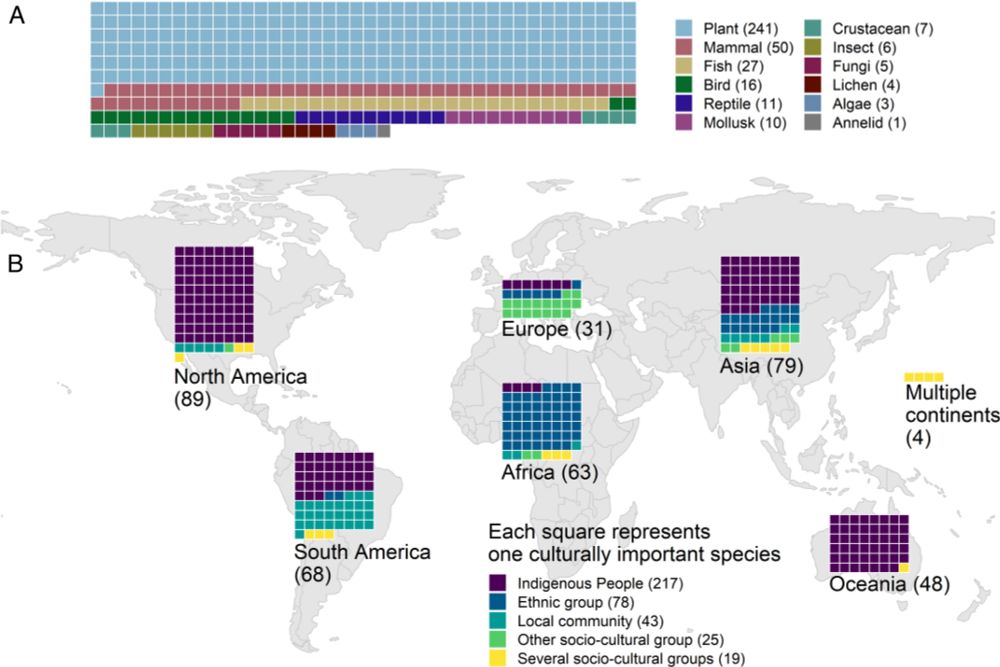
Biocultural vulnerability exposes threats of culturally important species | PNAS
There are growing calls for conservation frameworks that, rather than breaking the
relations between people and other parts of nature, capture plac...
Biocultural vulnerability exposes threats of culturally important species
Reyes-García+
doi.org/10.1073/pnas...
"propose a framework to globally assess the biocultural status of specific components of nature that matter to people and apply it to culturally important species (CIS)."
03.07.2025 10:03
👍 5
🔁 3
💬 0
📌 0


