Nine UvA researchers receive ERC Consolidator Grants
The European Research Council (ERC) has awarded Consolidator Grants to nine UvA researchers. The laureates are: Thijs Bol, Jaron Harambam, Eirini Karyotaki, Patty Leijten, Dora Matzke, Matthijs Roodui...
Extremely happy that my project got funded with a Consolidator Grant from @erc.europa.eu. The project is called FIRMS, and with a team, I'll study how the workplace/firm affects inequality in careers. We'll use register data to trace the careers of millions of workers. 1/3
www.uva.nl/en/content/n...
09.12.2025 11:41
👍 95
🔁 7
💬 11
📌 1
The genetic lottery goes to school: Better schools compensate for the effects of students’ genetic differences
Interdisciplinary paper with @paulhufe.net Astrid Sandsør and Nicolai Borgen now out in PNAS!
www.pnas.org/doi/epdf/10....
Causal evidence of gene-environment interaction for reading test scores based on:
🧬 Exogenous within-family genetic differences
🏫 Exogenous variation in school value added
28.10.2025 11:25
👍 46
🔁 20
💬 2
📌 5

Blending in or moving on? Immigrant coworkers, assimilation, and employee turnover
Abstract. How does the presence of immigrant coworkers shape the likelihood that minority employees stay or leave their jobs? This study uses linked employ
👥 More immigrant coworkers and diversity improve minority retention — but may reinforce workplace segregation
🌐 Assimilation: coworker effects weaker in the second generation
💼 Policy implication: turnover shapes workplace composition — it’s not just about who is hired
Link: doi.org/10.1093/sf/s...
08.10.2025 15:10
👍 1
🔁 0
💬 0
📌 0

Figure 2. Estimated effects of proportion of immigrant-background coworkers on the probability of workplace exit by immigrant background. Note: Average marginal effects from Ordinary Least Squares (OLS) regressions where the proportion of immigrant coworkers is measured continuously with a quadratic term (a) and in 5-percentage-point intervals using dummy variables (b). The shaded areas around the point estimates represent 95% confidence intervals. OLS regressions (linear probability models) predicting the likelihood of workplace exit in the next year. Control for workplace covariates, employee covariates, workplace fixed effects, individual fixed effects, and year fixed effects. Workplace covariates include the proportion of university-educated coworkers, proportion of male coworkers, workplace job destruction, workplace age, workplace mean wage, mean age of employees, and the proportion of immigrantbackground workers in the municipality and industry of employment. Employee covariates include age and age squared, gender, education, occupation, part-time position, log monthly salary, and workplace seniority. Huber–White standard errors within parentheses are robust to within-workplace and within-individual clustering and heteroscedasticity.
📌 Key finding: More immigrant coworkers → lower exit rates among immigrant workers, small increase in exits among majority workers
🔑 Why? Effects are strongest when coworkers are coethnics, when they have the same skills, and when immigrant coworkers are represented among top earners
08.10.2025 15:10
👍 2
🔁 0
💬 1
📌 0

🚨 New paper in @sfjournal.bsky.social: Blending In or Moving On? @enlar.bsky.social @aleksandermadsen.bsky.social, and I study how the share of immigrant coworkers affects whether immigrants stay or leave their job. Here’s what we find 👇
Link to paper: doi.org/10.1093/sf/s...
08.10.2025 15:10
👍 14
🔁 3
💬 1
📌 2

Inequalities also vary by field.
⚖️ Law and 🩺 medicine stand out as the most selective by family background, with about 70% of faculty having university-educated parents.
These fields show especially limited representation from low-SES families.
02.10.2025 19:58
👍 13
🔁 3
💬 0
📌 2

Nearly 40% of professors come from families without university-educated parents.
But across cohorts, professors from low-SES families have become less common in more recent generations.
02.10.2025 19:58
👍 19
🔁 7
💬 1
📌 0

But these gaps are explained by who completes a PhD — not by barriers after the PhD.
Once individuals hold a doctorate, parental background — whether measured by education, earnings, or professor titles — no longer predicts who becomes a professor.
02.10.2025 19:58
👍 17
🔁 3
💬 1
📌 2

The likelihood of becoming a professor rises sharply when considering both parental education and parental earnings together. Children from high-education, high-income families are vastly overrepresented in the professoriate.
02.10.2025 19:58
👍 15
🔁 3
💬 1
📌 0

• Children of PhD-educated parents are 28 times more likely to become professors than those whose parents only completed compulsory school.
• Children of professors are 11 times more likely to join the faculty than everyone else.
02.10.2025 19:58
👍 47
🔁 11
💬 3
📌 9

🚨 New paper: Who climbs the Ivory Tower? 🏛️ Together with Nicolai Borgen and Astrid Sandsør (@astridsandsor.bsky.social), we find that the chances of becoming a professor differ enormously by family background. Here’s what we find 👇
journals.sagepub.com/doi/full/10....
02.10.2025 19:58
👍 83
🔁 36
💬 3
📌 3

The next ECSR conference is brought to you by @tcdsociology.bsky.social and @esri.ie!
Trinity College Dublin, 15-16 June 2026
www.ecsr2026.net
#ECSR2026
Abstract submission deadline: 11 January 2026
18.09.2025 14:06
👍 24
🔁 14
💬 0
📌 3
Two awards in one week to our "Great Separation" article in AJS, brilliantly led by Olivier Godechot!
13.08.2025 19:54
👍 5
🔁 0
💬 0
📌 0
a classic!
08.08.2025 17:44
👍 1
🔁 0
💬 0
📌 0
It was such an honor to receive this award from @isa-rc28.bsky.social
on behalf of @oliviergodechot.bsky.social and other coauthors.
07.08.2025 05:21
👍 10
🔁 2
💬 1
📌 0

The winner of this year’s significant contribution award goes to
The great separation: Top earner segregation at work in advanced capitalist economies
O Godechot, et al
American Journal of Sociology 130 (2), 439-495, 2024
www.journals.uchicago.edu/doi/abs/10.1...
07.08.2025 02:22
👍 24
🔁 5
💬 0
📌 1
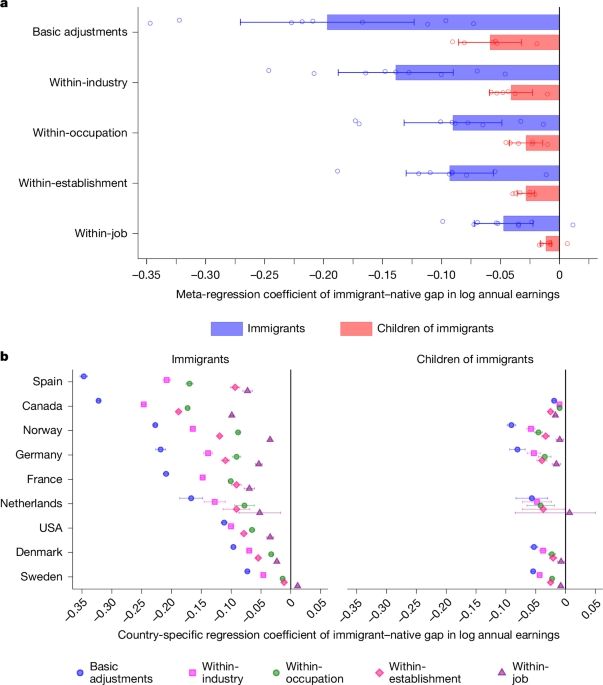
📍 Immigrants to Europe and North America earn, on average, 17.9% less than natives, as they struggle to gain access to jobs in higher-paying industries, occupations and companies. Three-quarters of the pay gap between the two correspond to a lack of access to high-paying jobs for immigrants. (1/4)
17.07.2025 07:37
👍 1
🔁 1
💬 1
📌 0
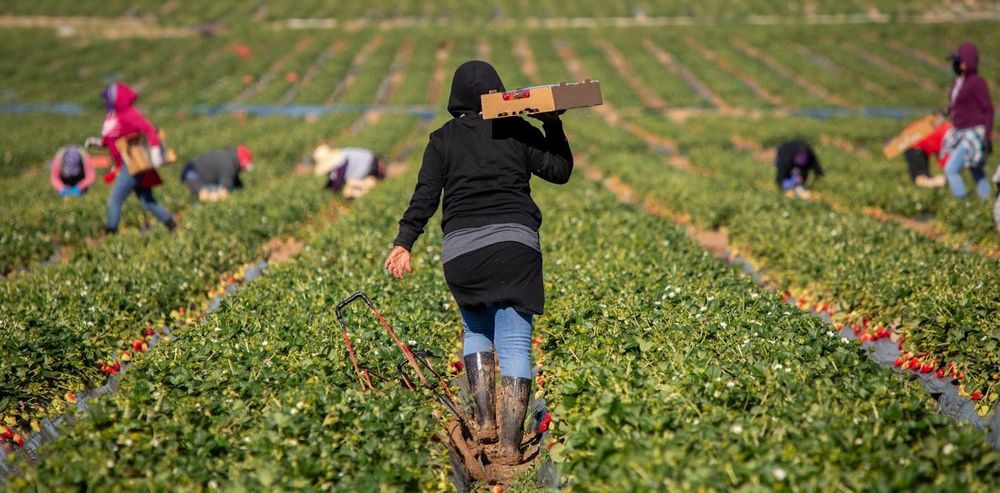
Immigrants in Europe and North America earn 18% less than natives – here’s why
Immigrants struggle to access higher-paying jobs, meaning their skills often go to waste.
Short piece about our @nature.com paper on the immigrant-native pay gap in The Conversation! Also broad coverage in (so far) German, Dutch, and Spanish central news outlets today!
17.07.2025 09:14
👍 16
🔁 7
💬 1
📌 1
does *not* change pattern that much
17.07.2025 08:15
👍 3
🔁 0
💬 0
📌 0
...but interestingly Canada behaves as one would expect if positive selection on education (i.e., gaps decrease slightly in model without adj for education). Also, between-country variation in hourly wages is relatively similar to annual earnings pattern.
17.07.2025 08:14
👍 2
🔁 0
💬 0
📌 0
Yes, I agree--we've been digging into it as best we can. Models without adjustment for education (+/- geographic region of employment) is found in Ext Data Fig 8 (plus SI tables 33-35). Does change main pattern that much...
17.07.2025 08:13
👍 2
🔁 0
💬 2
📌 0
@oliviergodechot.bsky.social
@msafi.bsky.social
@dont-d.bsky.social
@andrewpenner.bsky.social
@martinhallsten.bsky.social
@lippenyi.bsky.social
...and István Boza, Marta Elvira, Halil Sabanci, Malte Reichelt, Lasse Folke Henriksen, Feng Hou, Erik Vickstrom, and Trond Petersen.
16.07.2025 15:16
👍 2
🔁 1
💬 0
📌 0

In countries where we can track workers as they change jobs over time, panel data analyses (AKM models) show that immigrants’ lack of access to high-paying jobs is attributable to segregation both in the job-level earnings premiums that employers pay and segregation based on worker skill. 8/9
16.07.2025 15:16
👍 1
🔁 0
💬 1
📌 0