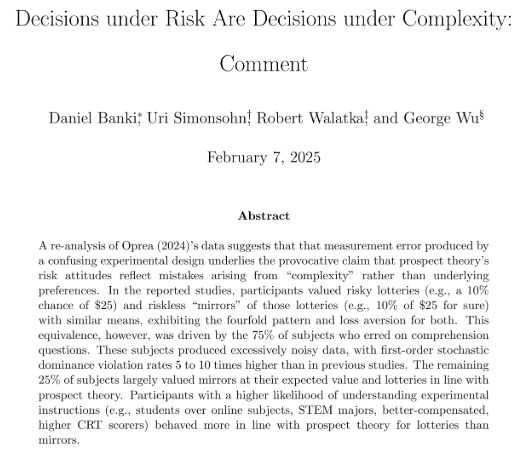
Title Authors Abstract (Decision under Risk are Decisions Under Complexity: Comment)
A new working paper with Daniel Banki, @urisohn.bsky.social and Robert Walatka, just submitted to SSRN.
The paper is comment on Ryan Oprea's recent AER paper.
The paper is processing, but you, my friends, get early entry.
papers.ssrn.com/sol3/papers....
07.02.2025 01:08
👍 106
🔁 32
💬 2
📌 11
03.02.2025 23:57
👍 2
🔁 0
💬 0
📌 0
Just speculating:
Could the source of denialism be that more supply makes the area more interesting/liveable, hence increasing the price of land (houses, not housing)?
03.02.2025 23:44
👍 0
🔁 0
💬 2
📌 0
Ungated here: arielrubinstein.org/articles/Per...
24.12.2024 20:23
👍 46
🔁 15
💬 1
📌 7

new double loaded corridor apartment in seattle with a tiny courtyard

social housing in vienna made or connected point access blocks. single stair allows for thinner building and a massive courtyard.
left: new housing in seattle (double loaded corridor)
v.
right: >85 year old social housing in vienna (connected point access blocks)
19.12.2024 04:19
👍 33
🔁 3
💬 1
📌 0
HERE IT IS! My 1st Urbanism & City-Building Starter Pack. I’ll keep adding to it as more city champions arrive here on Bluesky & I discover more of you. Please share this far & wide to support and grow our urbanism community here. Our cities need all the help they can get! go.bsky.app/G7isZfk
11.11.2024 03:16
👍 1073
🔁 386
💬 137
📌 70
You discuss monitoring costs, but I am not sure you acknowledge “hidden costs of control” arguments that arise in other (non-gig economy) settings where monitoring feels intrusive.
12.12.2024 01:24
👍 1
🔁 0
💬 1
📌 0
Btw why don’t you have an hourly wage control group? I mean, apart from the fact that it would cost more money to run the experiment...
12.12.2024 01:24
👍 1
🔁 0
💬 2
📌 0
For example, would you get similar estimates if the task was different (e.g., more/less responsive to effort or requiring more creativity)? Or uncertainty was not on the wage but on task characteristics (e.g., difficulty).
12.12.2024 01:24
👍 1
🔁 0
💬 2
📌 0
It's interesting and rather unusual to see quantitative estimates based on an online experiment. To be convinced of these estimates, one might expect to see robustness across some dimensions.
12.12.2024 01:24
👍 1
🔁 0
💬 1
📌 0
Great paper!
A few comments after a quick read:
12.12.2024 01:24
👍 1
🔁 0
💬 2
📌 0
For my inaugural BlueSky post, I'm dropping a new working paper! djh1202.github.io/website/gig....
Read on to see how wage contracts are shaped by moral hazard and adverse selection. #EconSky
1/n
11.12.2024 15:36
👍 24
🔁 6
💬 3
📌 2
What about professor supply, is it responding?
11.12.2024 23:27
👍 0
🔁 0
💬 1
📌 0
I think talent complementarities are generally undervalued (e.g. defensive midfielders in football teams). Do you find this?
10.12.2024 07:59
👍 0
🔁 0
💬 0
📌 0
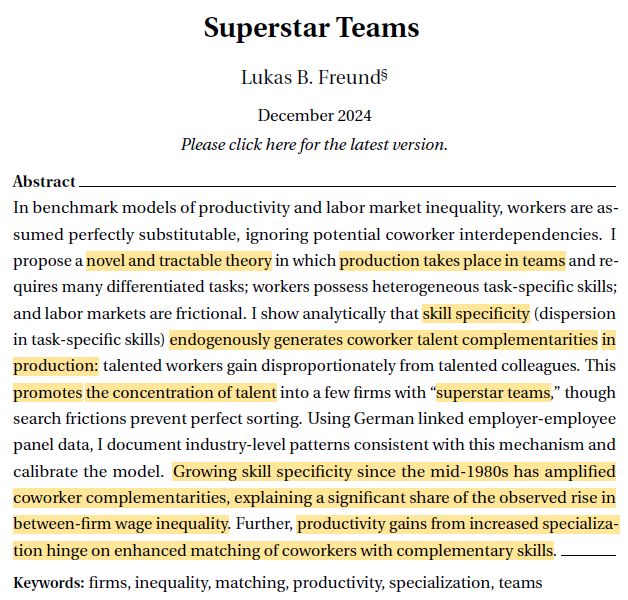
💥New version of "Superstar Teams"
lukasbfreund.github.io/files/freund...
09.12.2024 23:30
👍 8
🔁 5
💬 1
📌 0

Long line up of people on bikes waiting for the light to change on a Paris street, in a separated bike-lane.
Paris definitely wasn’t always this way. This is very recent. It wasn’t magic. It just took vision and leadership. Your city could choose leadership too.
Great pic via @JBPssx
09.12.2024 02:16
👍 2303
🔁 424
💬 30
📌 33
When will that slender moment slip through the editorial net—
An AI’s line, so deftly worn, no human hand can detect its seam?
When ink and code become indistinct, vowels and circuits entwined,
The old division, poet and machine, will vanish into a subtle dream.
06.12.2024 20:14
👍 3
🔁 1
💬 1
📌 0
#eeac Day 4: @gubri.bsky.social JMP "Targeting Behavioral Change Interventions: An Experiment on Debiasing Savings for College" demonstrates the importance of theory-driven identification of behavioral barriers and subsequent personalized interventions targeting specific barriers. #econsky #econjmp
05.12.2024 03:02
👍 10
🔁 5
💬 2
📌 1
A thread about whether the global – and American – center-left needs a different kind of liberalism. These are thoughts triggered by Trump’s victory in the United States and the swing against mainstream incumbents in many other elections around the world.
02.12.2024 17:02
👍 100
🔁 25
💬 10
📌 14
I would add that experimental papers should be the same, the goal should be to tell a story.
Experiments should not be aimed at testing a model. We already know all models are wrong, what is the point?
02.12.2024 01:52
👍 1
🔁 0
💬 1
📌 0

I appreciate the move towards more psychologically realistic models, but the idea of building a realistic general model of human behavior is a fantasy.
What is the use of economic models? I'm with Ariel Rubinstein on this; they tell a story/fable. arielrubinstein.tau.ac.il/papers/74.pdf
02.12.2024 01:52
👍 1
🔁 0
💬 1
📌 0
Economists’ risk measures suck because there is no such thing as risk preferences/attitudes. These are theoretical concepts that have no bearing to reality.
30.11.2024 00:15
👍 0
🔁 0
💬 0
📌 0
This is a great paper. With other papers, it's the solid beginning of a paradigm shift.
Preference-based theories' paradoxes might be cognitive-based theories' regularities.
Exactly as Saturn doesn't really invert its movement -- it just looks so from Earth.
But we're not yet there.
Small 🧵
29.11.2024 09:29
👍 34
🔁 10
💬 2
📌 0
There is an optimal size.
No one goes to the other place anymore, it is too crowded.
29.11.2024 04:43
👍 1
🔁 0
💬 0
📌 0
The reason for this is that these ranges are sufficient for distinguishing between the models used in most experiments.
The problem is that most economically meaningful risky situations involve probabilities of less than 1%.
Yet, an experiment that studies rare events is a rare event!
28.11.2024 23:30
👍 1
🔁 0
💬 0
📌 0
The second issue is the range of probabilities that are studied.
Most experiments deal with a range of 10%-90%. Many experiments only use 50-50 gambles.
28.11.2024 23:30
👍 0
🔁 0
💬 1
📌 0
When people deal with risky situations, they rarely consider the odds explicitly, even when they are knowable (e.g., in the casino).
But because the (as-if) models we use require individuals to use probabilities we provide them and hence end up studying arithmetics rather than risk.
28.11.2024 23:30
👍 1
🔁 0
💬 1
📌 0
There are two issues with the experimental economics literature on risky decision-making.
The first is the explicit use of probabilities.
28.11.2024 23:30
👍 0
🔁 0
💬 1
📌 0

A few thoughts following the recent AER paper by Ryan Oprea...
doi.org/10.1257/aer....
28.11.2024 23:30
👍 5
🔁 0
💬 2
📌 0
