I have an opportunity to hire a staff scientist for my lab. Looking for someone with outstanding skillset in ML/statistics, genomics applications; interest in mentoring, strong publication record, PD experience required.
Email CV to me+cc my assistant (see 'contact' on my website). Ad to follow.
01.06.2025 15:33
👍 83
🔁 108
💬 3
📌 3
Our paper on the theoretical properties of SNP heritability in admixed populations is out in Genetics:
academic.oup.com/genetics/adv...
with @jinguohuang.bsky.social, @nicole-kleman.bsky.social , Saonli Basu, and Mark Shriver
25.05.2025 02:03
👍 40
🔁 23
💬 0
📌 0
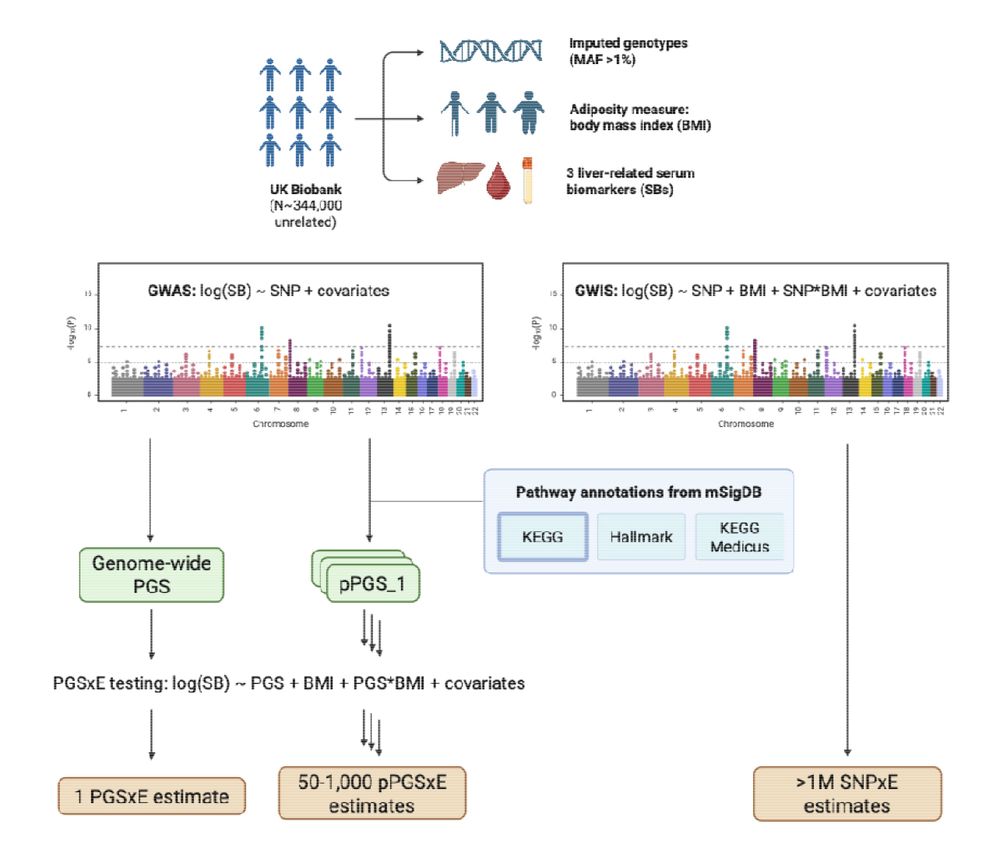
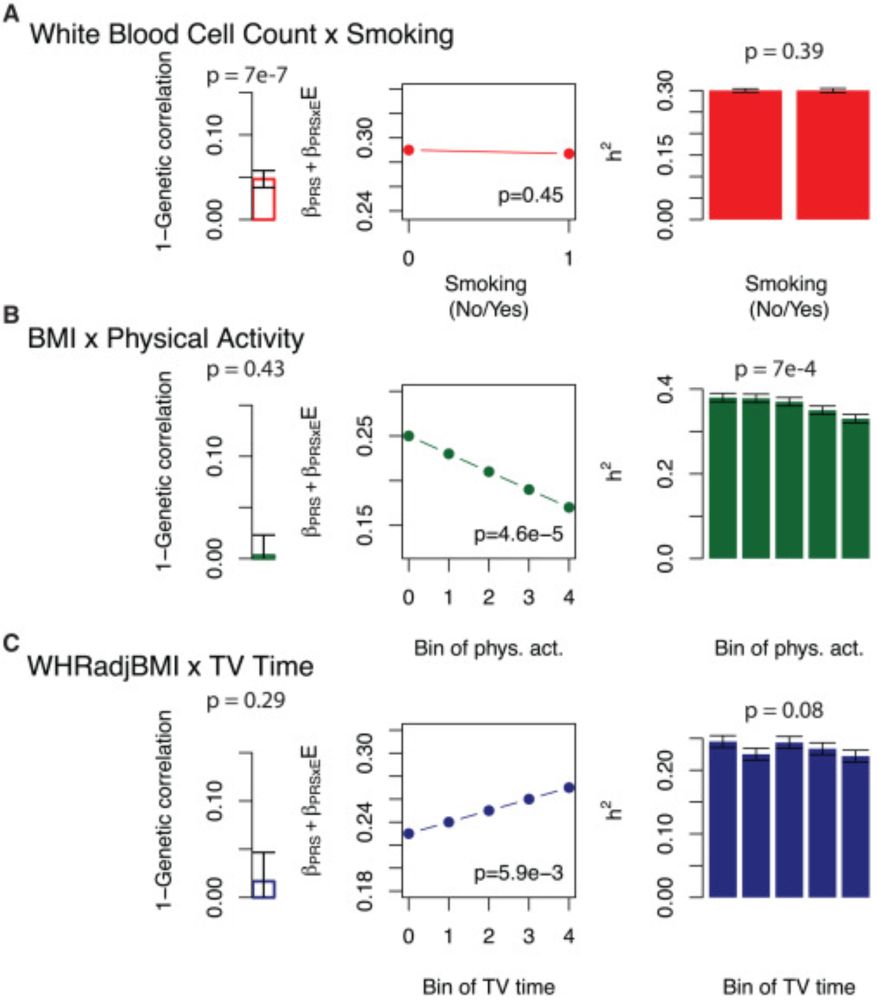
Excited to share our work on using pathway-specific polygenic scores to discover gene-environment interactions www.medrxiv.org/content/10.1...
22.05.2025 15:09
👍 40
🔁 12
💬 0
📌 0
When should adaptation arise from a polygenic response versus few large effect changes? https://www.biorxiv.org/content/10.1101/2025.05.15.654234v1
17.05.2025 20:32
👍 46
🔁 25
💬 0
📌 1
For neutrophil count, J-PEP expands interpretation beyond immune cells, highlighting hepatic-inflammatory and neuroimmune axes.
13.05.2025 20:38
👍 0
🔁 0
💬 0
📌 0
For hypertension (HTN), it identifies stromal and adrenal-endocrine processes missed by prior methods.
13.05.2025 20:38
👍 0
🔁 0
💬 1
📌 0
For type 2 diabetes (T2D), J-PEP refines known pathways like β-cell dysfunction and uncovers underexplored immune and developmental signals.
13.05.2025 20:38
👍 0
🔁 0
💬 1
📌 0
Integrative multi-omics QTL colocalization maps regulatory architecture in aging human brain https://www.medrxiv.org/content/10.1101/2025.04.17.25326042v1
20.04.2025 17:25
👍 2
🔁 1
💬 0
📌 0

If we take regional averages, genes associated with education predict height better than genes associated with height. Why? On a regional level, education-associated genes pick up environmental differences between richer and poorer neighborhoods 🧬💰
From www.nature.com/articles/s41...
21.04.2025 15:18
👍 10
🔁 4
💬 0
📌 0

A line graph titled "Confirmed cases of influenza B Yamagata" shows weekly confirmed cases of B Yamagata influenza worldwide from various types of influenza surveillance. The vertical axis represents the number of cases, ranging from zero to 5,000, while the horizontal axis covers the years from 2013 to 2025. The graph indicates significant fluctuations in case numbers over the years, with a noticeable peak just below 5,000 cases around 2019, followed by a steep decline. A data source note mentions that only a fraction of potential influenza cases is tested by labs for confirmation and strain identification. The data comes from FluNet, World Health Organization, and is dated 2023. The graph is licensed under CC BY.
A flu lineage has likely gone extinct since 2020 🧵
03.04.2025 10:41
👍 409
🔁 84
💬 17
📌 18
Did you get a chance to read the thread on our new @naturehumbehav.bsky.social paper on SES yet?
If not, don't worry, I have something better for you!
Check out this comic by the amazing @lizahaart.bsky.social
Complete comic: communities.springernature.com/posts/are-we...
Or in this thread 👇🏾
28.03.2025 12:39
👍 61
🔁 26
💬 3
📌 11

In every civilization, people end up sorted into levels of socio-economic status (SES). We explore the history, present, and future of scientific research on the complicated relationship between SES and DNA in @naturehumbehav.bsky.social💰🧬🎓
Link: rdcu.be/efacK
Thread below 👇🏽
26.03.2025 11:15
👍 229
🔁 83
💬 6
📌 18

Evidence Aggregator: AI reasoning applied to rare disease diagnostics
Retrieving, reviewing, and synthesizing technical information can be time-consuming and challenging, particularly when requiring specialized expertise, as is the case of variant assessment for rare di...
New preprint! We worked with @msftresearch.bsky.social and @broadinstitute.org to see whether large language models (LLMs) can be useful to variant scientists in deciding whether genetic variants seen in a patient are responsible for their disease. tl;dr yes they can: www.biorxiv.org/content/10.1...
15.03.2025 02:43
👍 143
🔁 47
💬 1
📌 1
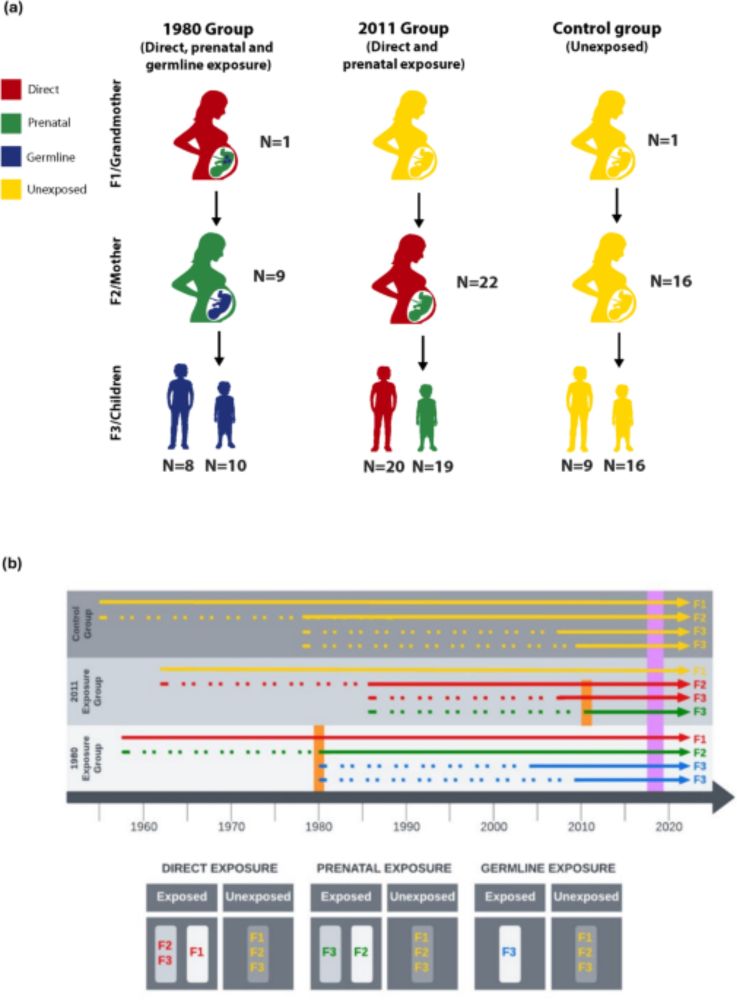
Epigenetic signatures of intergenerational exposure to violence in three generations of Syrian refugees - Scientific Reports
Scientific Reports - Epigenetic signatures of intergenerational exposure to violence in three generations of Syrian refugees
I can't believe we're still allowing completely inadequate and uninterpretable Epigenome-Wide Association Studies (EWAS) to be published.
I don't care that this study is probably well-intentioned, and probably trying to draw attention to awful events in Syria.
www.nature.com/articles/s41...
01.03.2025 16:51
👍 79
🔁 32
💬 4
📌 10

Insufficient evidence for natural selection associated with the Black Death - Nature
Nature - Insufficient evidence for natural selection associated with the Black Death
Insufficient evidence for natural selection associated with the Black Death
These claims are unsupported for four reasons...
Finally, we find no evidence of significant change in frequency of the ERAP2 variant rs2549794...
www.nature.com/articles/s41...
20.02.2025 06:31
👍 3
🔁 0
💬 0
📌 0
Multiple-testing corrections in selection scans using identity-by-descent segments https://www.biorxiv.org/content/10.1101/2025.01.29.635528v1
30.01.2025 08:32
👍 4
🔁 4
💬 1
📌 0
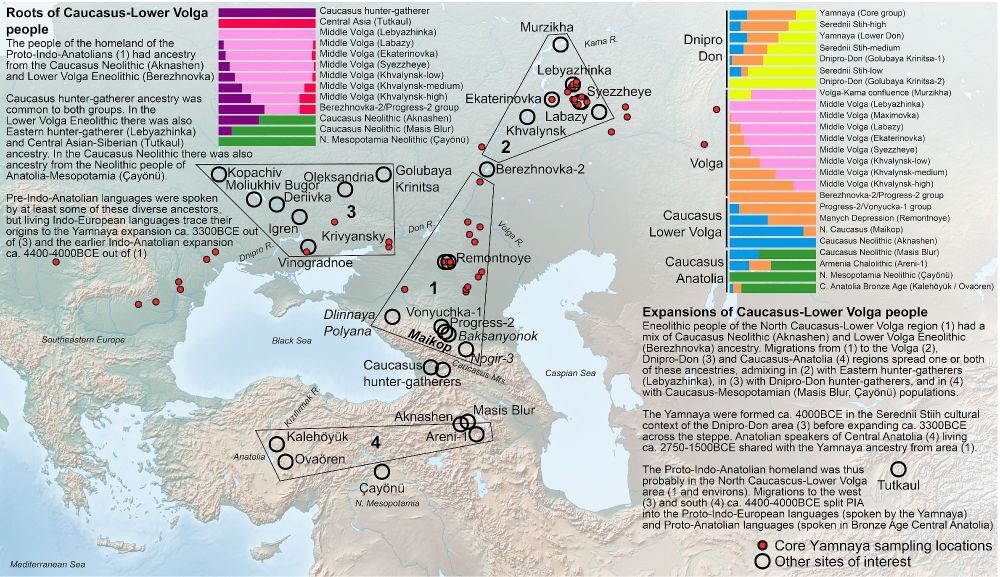
Our papers, out today in @nature.com, show how ancient DNA from the Eneolithic and Bronze Age steppe points to a North Pontic origin of the Indo-European language family and a Caucasus-Lower Volga (CLV) origin of Indo-Anatolian (inclusive of the now extinct Anatolian languages). 1/
05.02.2025 18:33
👍 65
🔁 20
💬 5
📌 5
A Litmus Test for Confounding in Polygenic Scores
Polygenic scores (PGSs) are being rapidly adopted for trait prediction in the clinic and beyond. PGSs are often thought of as capturing the direct genetic effect of one's genotype on their phenotype. ...
Think of a polygenic score you care about. Are direct genetic effects driving variation among people in this predictor? Or perhaps other, confounding factors? We at the @arbelharpak.bsky.social & @docedge.bsky.social Labs developed a method to tackle this question. [1/n]
04.02.2025 18:04
👍 76
🔁 38
💬 2
📌 1


I've always wondered about the pigmentation GWAS signals like TYR, OCA2 etc. in the GWAS of OCT-derived phenotypes. A new preprint elegantly investigates the phenotypic and genetic correlation between retinal pigment epithelium (RPE) thickness (which is measured using OCT) 1/
08.12.2024 04:17
👍 6
🔁 2
💬 2
📌 0