Spring PhD recruitment round @crick.ac.uk is now open and we have a project on offer: www.crick.ac.uk/careers-stud.... If you have a background in maths or physics and are curious about patterning and growth in biology this could be the project for you! Please help us spread the word 💥
23.02.2026 10:14
👍 9
🔁 6
💬 0
📌 0

an insect, a bird, and an elephant visualized with unit height scaling. insect is landscape shaped and the elephant is portrait shaped
Why is it that small animals like insects have a landspace body plan when viewed head-on, but larger animals like elephants are taller than wide?
With @m-v.bsky.social, we find out in our new preprint titled 'Size and shape of terrestrial animals' - arxiv.org/html/2602.00...
03.02.2026 18:36
👍 27
🔁 9
💬 0
📌 1
Such great news! Congratulations!! 🤩🥳
06.09.2025 14:12
👍 1
🔁 0
💬 0
📌 0
Congratulations, Jan! :)
12.08.2025 16:06
👍 1
🔁 0
💬 1
📌 0

Electroreception in treehoppers: How extreme morphologies can increase electrical sensitivity | PNAS
The link between form and function of an organism’s morphology is usually apparent
or intuitive. However, some clades of organisms show remarkable ...
Why do treehoppers look so weird?! Our latest paper, out this week in @pnas.org, suggests a perhaps unexpected reason - static electricity ⚡ We show that treehoppers can detect the electrostatic cues of predators and that their crazy shapes may boost their electrosensitivity! doi.org/10.1073/pnas...
24.07.2025 11:41
👍 415
🔁 166
💬 13
📌 38

New paper in @nature.com! With @kiseokmicro.bsky.social , Siqi Liu, Kyle Crocker, Jojo Wang, Mikhail Tikhonov & Madhav Mani — a massive dataset and simple model reveal a few conserved regimes that capture how soil microbiome metabolism responds to perturbations. www.nature.com/articles/s41...
17.07.2025 06:36
👍 66
🔁 30
💬 2
📌 4
1/n 🧵 Excited to share our new paper! We developed a framework to reveal hidden simplicity in how organisms adapt to different environments, particularly focusing on antibiotic resistance evolution. #EvolutionaryBiology #MachineLearning
15.05.2025 14:33
👍 38
🔁 22
💬 1
📌 2
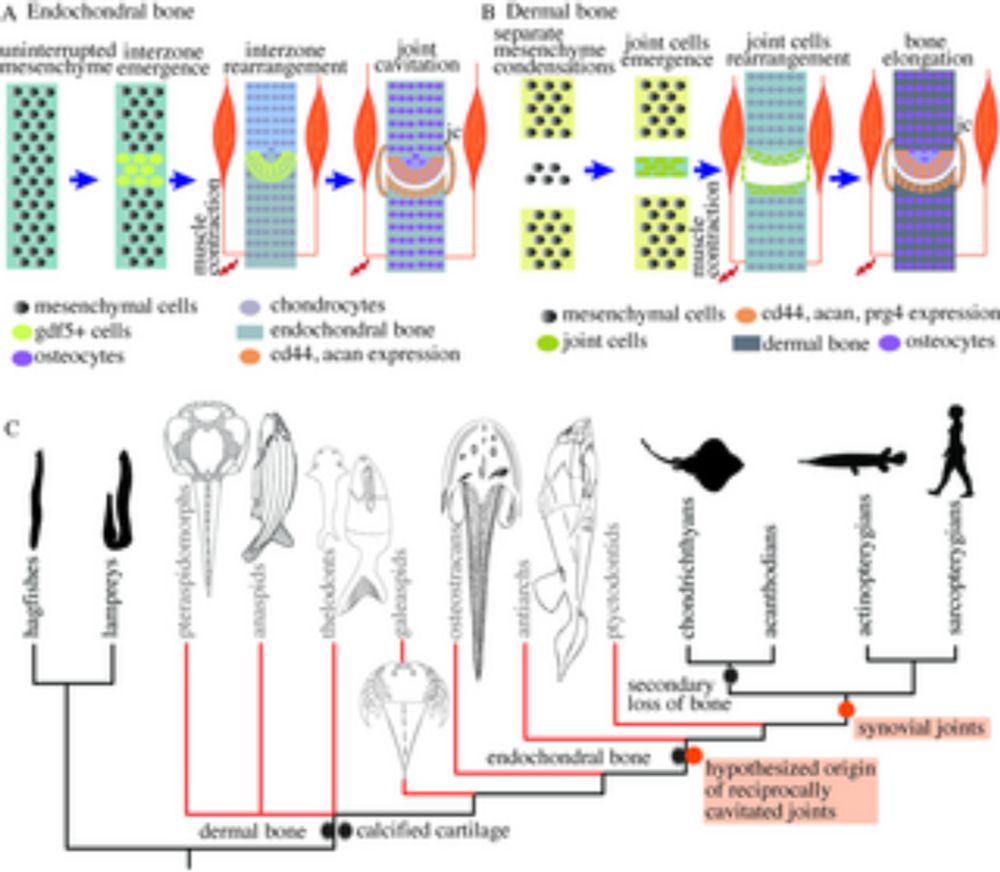
Got the opportunity to write a `behind the paper' story for @the-node.bsky.social about our work on the evolution of synovial joints, and I thoroughly enjoyed the experience.
Here it is, for some leisure reading:
06.05.2025 13:55
👍 7
🔁 1
💬 0
📌 0

Dr Henry Bennet-Clark (1934–2025) - St Catherine's College
Dr Henry Bennet-Clark (1934–2025) St Catherine’s College is deeply saddened to announce the passing of Dr Henry Bennet-Clark, Emeritus Reader...
The incredible Henry Bennet-Clark passed away recently, but his wonderful science will continue to inspire.
www.stcatz.ox.ac.uk/dr-henry-ben...
He wrote numerous amazing papers, including on how fleas jump so high:
scholar.google.com/scholar?q=au...
#biomechanics #obituary #stcatz
04.03.2025 13:06
👍 2
🔁 2
💬 0
📌 0
Started from ontogenetic and molecular studies of living lineages, authors found reciprocally cavitated joints in placoderms. Placoderms can move pectoral fins very smoothly!! Congrats @neelimasharma.bsky.social @neilshubin.bsky.social Yara Haridy! #Teamfish #evodevo
27.02.2025 22:21
👍 3
🔁 1
💬 0
📌 0
Very grateful for your kind mention, Roli! Thank you for working with us :)
Synovial joints are truly striking and one of the examples of evolutionary engineering at its peak.
27.02.2025 14:29
👍 1
🔁 0
💬 0
📌 0

Left: A phylogeny of chordates, flanked by images of a lamprey, a placoderm, a brown shark, a longnose gar and a hawksbill turtle. Agnathans such as lampreys lack synovial joints. The first putative evidence of synovial joints in the fossil record is in early gnathostomes such as the antiarch placoderm fish that lived during the Silurian and Devonian periods. Modern gnathostomes such as cartilaginous fishes (i.e., chondrichthyans such as the brown shark), bony fishes (i.e., osteichthyans such as the longnose gar), and limbed vertebrates (i.e., tetrapods such as the Hawksbill turtle) possess synovial joints in their jaws, fins/limbs, and other locations. All images used are freely available without copyright restrictions. Top right: a typical agnathan joint is shown where glycosaminoglycans and proteoglycans are uniformly distributed across the cartilages (blue) that are connected by fibrous tissue (olive). Bottom right: a typical gnathostome synovial joint is shown where surface cartilage has a unique proteoglycan composition from the underlying cartilage and bone, and a fluid-filled cavity separates adjacent skeletal elements.
When did the lubricated joints that allow our skeleton to swivel, rotate and bend evolve? @crumplab.bsky.social explores a new @plosbiology.org paper by @neelimasharma.bsky.social &co that pinpoints their origin to the earliest jawed vertebrates 🧪 Paper: plos.io/3CTC8La Primer: plos.io/4kkhXa6
26.02.2025 19:38
👍 40
🔁 11
💬 0
📌 3

Top: Immunostaining reveals aggrecan (yellow) at the articular surfaces in the pelvic joint of an embryonic little skate (stage 33). The nucleus is stained using DAPI and is shown in red. Bottom: Phylogenetic tree adapted from Donoghue and Keating, annotated to show that synovial joints exist in extant jawed vertebrates (gnathostomes), but the study’s results do not support their existence in cyclostomes. The presence of reciprocally shaped and cavitated joints in the dermal skeleton of antiarchs suggests that joints that function by relative sliding (similar to synovial joints) first originated in stem gnathostomes.
When did synovial joints evolve? @neelimasharma.bsky.social @neilshubin.bsky.social &co reveal that stable, mobile & lubricated joints were present in the common ancestor of jawed fishes but lacking in jawless ones 🧪 @plosbiology.org plos.io/3CTC8La
25.02.2025 19:09
👍 63
🔁 21
💬 0
📌 3
New paper led by @neelimasharma.bsky.social on the lab! The evolutionary origin of highly mobile joints!
25.02.2025 19:16
👍 65
🔁 12
💬 0
📌 0