I had such a great time visiting Oxford yesterday and getting a preview of all the cool science coming out of the exoplanets groups. Thanks so much for hosting me @airbornegrain.bsky.social @jaynebirkby.bsky.social ! 🪐
20.01.2026 12:26
👍 15
🔁 0
💬 1
📌 1
Cycle 1 Call for Proposals - Roman User Documentation
This article contains...
The complete details of this Call for Proposals are contained within this downloadable PDF document: Roman_Cycle1_Call.pdf.
Executive S
Nancy Grace Roman Space Telescope Cycle 1 Call for Proposals is Open!
roman-docs.ipac.caltech.edu/roman-propos...
Proposal Deadline: March 17, 2026
www.nasa.gov/missions/rom...
"Roman is slated to launch by May 2027, but the team is on track for launch as early as fall 2026."
#NASA #astronomy #AAS
10.12.2025 17:25
👍 10
🔁 6
💬 0
📌 0


Happy to share my insights on the potential of Doppler imaging with the ELT at #ExoELT last week! Also my first time at #ESO Garching!
27.11.2025 19:01
👍 9
🔁 2
💬 0
📌 0
2026 projects | Aerosol Science CDT
CDT in Aerosol Science is welcoming applications for fully-funded PhD studentships as part of our 8th cohort to start in autumn 2026: www.aerosol-cdt.ac.uk/2026-projects/
Aerosol science is crucial to so many things, check out the linked project catalogue for studentships!
#PhD #academicjobs
25.11.2025 11:01
👍 3
🔁 4
💬 0
📌 0
We love to see it!!
09.11.2025 18:58
👍 3
🔁 0
💬 0
📌 0

From gas to ice giants: A unified mechanism for equatorial jets
A bifurcation in equatorial jet formation can explain the differences between the gas and ice giants.
New unified model of equatorial winds on giant planets helps to explain some of the zonal wind observations 🔭 I and my colleagues have made for Neptune and Uranus over the past few decades - www.science.org/doi/10.1126/...
10.10.2025 19:07
👍 29
🔁 5
💬 0
📌 0
🔭 It's paper day! Today I'm sharing the latest in a series of papers looking at the weather on other worlds, in this case bringing you the weather report from a nearby T-dwarf, SIMP-0136. 🪐
🧵 to follow...
26.09.2025 09:05
👍 37
🔁 18
💬 1
📌 2
Congratulations!!!
23.09.2025 21:36
👍 2
🔁 0
💬 0
📌 0
We have job opportunities in the APEx department at MPIA - please spread the word!
Postdocs: aas.org/jobregister/...
Tenure-track staff: aas.org/jobregister/...
Max Planck Research Group Leaders: aas.org/jobregister/...
+ happy to host ERC, Humboldt, and other third-party funds.
15.09.2025 09:32
👍 31
🔁 15
💬 1
📌 3
So great to see another incredible JWST variability study by Akhmetshyn et al. on the planetary-mass object SIMP 0136.
These kinds of datasets reveal the most important details about the atmosphere and how they change over time.
We are officially in in the era of exoplanet weather! 🪐☁️
03.09.2025 07:56
👍 12
🔁 0
💬 0
📌 0
@christinepulliam.bsky.social we won’t stop til we’ve covered the whole spectrum! 🤩
23.07.2025 14:36
👍 3
🔁 0
💬 0
📌 0
Super excited for this accepted HST+VLA program led by Cian O'Toole, who hopes to expand our knowledge of extrasolar aurorae into the UV 🔭
23.07.2025 10:08
👍 19
🔁 2
💬 0
📌 0
We are so excited for Dr McCarthy @alliemccarthy.bsky.social to join the group @tcddublin.bsky.social 🪐☁️
20.07.2025 15:08
👍 19
🔁 1
💬 0
📌 0

@evertnasedkin.bsky.social also gave an excellent talk highlighting time-resolved retrievals on the planetary-mass object SIMP 0136. It turns out that telling that deciphering extrasolar weather is challenging, but we are getting closer with JWST and new retrieval techniques
30.06.2025 16:48
👍 6
🔁 0
💬 0
📌 0

Very proud of Cian O'Toole who gave his very first conference talk at #EAS2025 last week. 🔭
He is investigating the drivers of variability in three brown dwarfs using observations from HST, VLA and a new framework for modelling variable atmospheres. Paper is incoming so watch this space! 📄📄📄
30.06.2025 16:11
👍 29
🔁 2
💬 1
📌 0

It’s a beautiful day in Cork to kick off our symposium on giant exoplanets and brown dwarfs #EAS2025
26.06.2025 07:43
👍 41
🔁 4
💬 0
📌 0
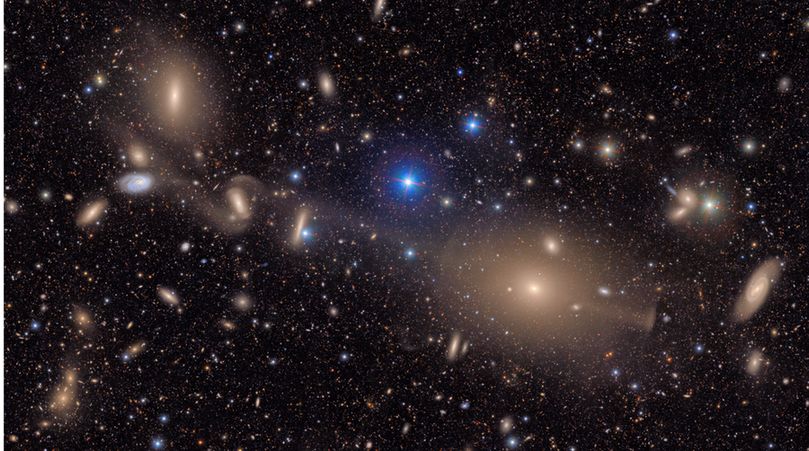
A sprawling, textured field of galaxies scattered across the deep black of space. It is filled with the delicate smudges and glowing cores of galaxies of many shapes, sizes and colors, as well as the bright multi-colored points of stars. The image focuses on a collection of interacting galaxies connected by delicate streams of stars. At top center lies a large elliptical galaxy that is dense and smooth, like a polished stone glowing with golden light. Like delicate spider silk or stretched taffy, these stellar bridges link the large elliptical to the few larger galaxies beneath, evidence of past collisions.
All throughout the image, thousands of galaxies gather in clusters or are spread throughout, like glittering gems strewn on a table. Some are sharp-edged and spiral, like coiled ribbons; others round and diffuse, like polished pebbles. Still others are just smudges of various colors against the black of space. The background is peppered with pinpoint stars in reds, yellows, and blues, crisp against the velvet black.
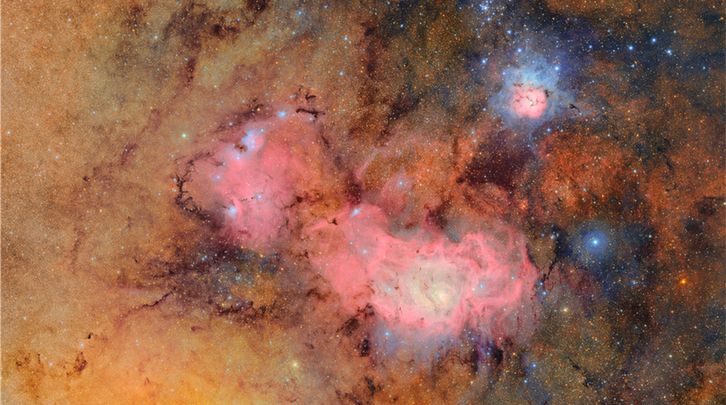
A cosmic tapestry of glowing tan and pink gas clouds with dark dust lanes. In the upper right, the Trifid Nebula resembles a small flower in space. Its soft, pinkish gas petals are surrounded by blue gas, and streaked with dark, finger-like veins of dust that divide it into three parts. It radiates a gentle, misty glow, diffuse and soft like the warmth of breath on a cold hand. To the lower left, the much larger Lagoon Nebula stretches wide like a churning sea of magenta gas, with bright blue, knotted clumps sprinkled throughout where new stars are born. Both nebulae are embedded in a soft tan backdrop of gas that is brighter on the left than on the right, etched with dark tendrils of dust and sprinkled with the pinpricks of millions of stars.
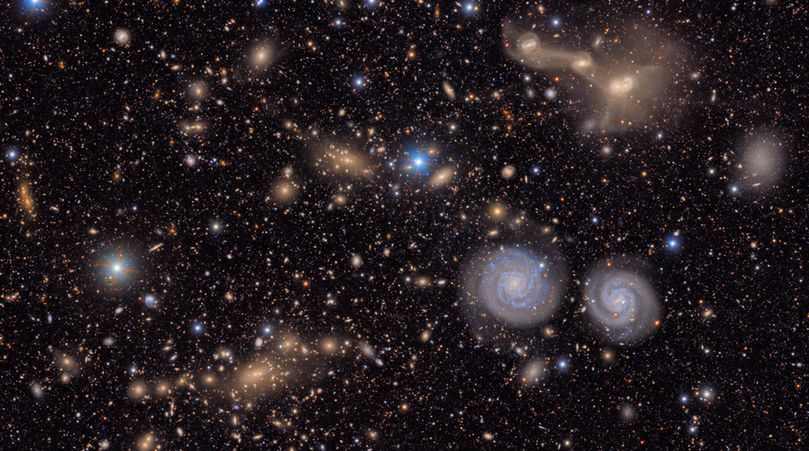
A sprawling, textured field of galaxies scattered across the deep black of space. It is filled with the delicate smudges and glowing cores of galaxies of many shapes, sizes and colors, as well as the bright multi-colored points of stars. To the lower left is a region filled with the hundreds of golden glittering gems of a distant galaxy cluster. In the foreground, below and right of center, two blue spiral galaxies look like eyes beneath the entangled mass of a triple galaxy merger in the upper right. A few bright blue points of foreground stars pierce the glittering tapestry.
All throughout the image, thousands of galaxies gather in clusters or are spread throughout, like glittering gems strewn on a table. Some are sharp-edged and spiral, like coiled ribbons; others round and diffuse, like polished pebbles. Still others are just smudges of various colors against the black of space. The background is peppered with pinpoint stars in reds, yellows, and blues, crisp against the velvet black.
Introducing...your sneak peek at the cosmos captured by NSF–DOE Vera C. Rubin Observatory!
Can you guess these regions of sky?
This is just a small peek...join us at 11am US EDT for your full First Look at how Rubin will #CaptureTheCosmos! 🔭🧪
#RubinFirstLook
ls.st/rubin-first-look-livestream
23.06.2025 04:06
👍 701
🔁 332
💬 22
📌 105
Super cool work!
16.06.2025 14:57
👍 1
🔁 0
💬 1
📌 0

This image shows the exoplanet 14 Herculis c. The view is mostly black, with very faint red splotches in the central region of the image. At the center of the image, there is a black circle, and in the center of that, there is a star symbol representing a real star. This black circle blocks the light from the host star. To the lower right of the circle is a fuzzy bright orange circle, which is the exoplanet.
NEWS: #NASAWebb has directly imaged a cold exoplanet in an extremely misaligned orbit for the first time. The observations have surprised researchers in more than one way: webbtelescope.pub/3ZSctun #AAS246 🔭 🧪
10.06.2025 18:21
👍 89
🔁 27
💬 2
📌 3
PhD & Masters of Research Scholarships in Astrophysics | American Astronomical Society
Macquarie University is seeking outstanding candidates for PhD and Masters of Research scholarships commencing between January and June 2026.
Macquarie has put out the call for fully-funded PhD applications in all areas of astronomy, to start January 2026: aas.org/jobregister/...
Applications due 2 July to astrohdrinfo@mq.edu.au. International scholarships will be competitive, typically expecting publication and/or excellent GPA.
05.06.2025 13:10
👍 12
🔁 8
💬 2
📌 0

Different telescope mirror apertures and their resultant point spread functions.
Together with Sebastiaan Haffert our review on “High-Contrast Coronagraphy” is out - writing an ARA&A review has been on my academic bucket list, and I’m very proud of the result. It uses the showyourwork! framework, making it a completely reproducible paper. #FAIR #astrodon #exoplanets
04.06.2025 13:40
👍 48
🔁 10
💬 4
📌 2
Less than a month till the deadline to apply for this PhD place!
23.04.2025 18:02
👍 6
🔁 4
💬 0
📌 0


