An amazing lineup spanning Neuro, Cog Sci, and AI. Held in a Roman villa with an ancient aqueduct through it!
It’s a unique setting to understand the latest and greatest from the three disciplines of intelligence.
Come!
06.03.2026 18:46
👍 2
🔁 0
💬 0
📌 0

Convex Efficient Coding
Why do neurons encode information the way they do? Normative answers to this question model neural activity as the solution to an optimisation problem; for example, the celebrated efficient coding hyp...
3) Convex Efficient Coding.
Tired of simulations? We show many efficient coding problems are actually convex.
This allows for formal proofs on modular neurons, ON-OFF coding predictions, and more. Check the ICLR paper:
arxiv.org/abs/2601.10482
(3/3)
26.02.2026 21:49
👍 4
🔁 0
💬 0
📌 0
1) A normative theory of prefrontal working memory slots.
We derive, from first principles, why slots emerge in PFC/RNNs, why they align, and why they vary in scale. It’s all about task diversity and task structure!
Accounts for much PFC data!
www.biorxiv.org/content/10.6...
(1/3)
26.02.2026 21:49
👍 6
🔁 0
💬 1
📌 0
Triple paper drop from the inimitable @willydorrell.bsky.social :
1) A normative theory of prefrontal working memory slots.
2) A comprehensive review of normative theories of why grid cells look like grid cells.
3) A new theory of convex efficient coding.
(0/3)
26.02.2026 21:49
👍 29
🔁 6
💬 1
📌 0
Convex Efficient Coding
Why do neurons encode information the way they do? Normative answers to this question model neural activity as the solution to an optimisation problem; for example, the celebrated efficient coding hyp...
3) Convex Efficient Coding.
Tired of simulations? We show many efficient coding problems are actually convex.
This allows for formal proofs on modular neurons, ON-OFF coding predictions, and more. Check the ICLR paper:
arxiv.org/abs/2601.10482
(3/3)
26.02.2026 21:48
👍 1
🔁 0
💬 0
📌 0
1) A normative theory of prefrontal working memory slots.
We derive, from first principles, why slots emerge in PFC/RNNs, why they align, and why they vary in scale. It’s all about task diversity and task structure!
Accounts for much PFC data!
www.biorxiv.org/content/10.6...
(1/3)
26.02.2026 21:48
👍 0
🔁 0
💬 1
📌 0
Will's Wild Website
Cosyne Viewing Parties
Visas, costs, care responsibilities, and environmental concerns all limit Cosyne attendance. Luckily, the talks are livestreamed; but watching alone is the high road to an aneurism. Hence: viewing parties! Gather regionally to watch Cosyne talks! More info: shorturl.at/3DHZX.
14.02.2026 15:45
👍 15
🔁 9
💬 0
📌 0
Last week to apply! #neurojobs
my.corehr.com/pls/uoxrecru...
24.11.2025 14:38
👍 0
🔁 0
💬 0
📌 0
The job is still available despite what it says on the link! #neurojobs
01.11.2025 19:48
👍 1
🔁 0
💬 0
📌 0
Want the freedom of a fancy fellowship, but not the year-long wait or arduous application?
Come join my lab! Work on neuroscience and AI, explore your creativity, be independent or work closely with me, collaborate widely, and have a lot of fun!
my.corehr.com/pls/uoxrecru...
23.10.2025 10:46
👍 45
🔁 14
💬 2
📌 3
Come to hear about the next challenges in AI and how to solve them by an amazing set of speakers!
24.08.2025 09:29
👍 2
🔁 0
💬 0
📌 0

💥 Do we now have all the components necessary to reach #AGI, or are there more discoveries to be made? Can the study of the brain help provide them?
We tackle these questions and more at our Conference on the Mathematics of Neuroscience and AI in sun-soaked Split, Croatia:
www.neuromonster.org
24.04.2025 14:16
👍 13
🔁 4
💬 1
📌 2
Great work from @bakermansjjw.bsky.social demonstrating hippocampal compositions can rapidly construct new statespaces, with replay as a potential mechanism. Indeed when a statespace changes, HPC cells are active in replay at locations they weren't active at before but are active in the future!
19.03.2025 16:39
👍 11
🔁 2
💬 0
📌 0

The program is live! discounted tickets available for students, scientists, and entrepreneurs! check tickets in the link
11.03.2025 22:12
👍 3
🔁 1
💬 1
📌 0
Great weather, a beautiful city, and a magical conference venue!
25.02.2025 17:46
👍 1
🔁 0
💬 0
📌 0
Keynote Speakers:
Prof Jay McClelland
Prof Eve Marder
Prof Wolfgang Maass
Prof Christine Constantinople
Prof @kanakarajanphd.bsky.social (@kempnerinstitute.bsky.social )
Dr Ida Momennejad @neuroai.bsky.social
Dr Kim Stachenfeld @neurokim.bsky.social
Prof Jakob Foerster
25.02.2025 17:46
👍 3
🔁 1
💬 1
📌 0

📢Abstract submissions is 16th March AOE for the Annual Conference on the Mathematics of Neuroscience and AI (May 27-30th; National Opera Theatre, Split, Croatia)
A truly outstanding line-up of keynotes, session chairs, and invited speakers. We'd love you to come along too!
www.neuromonster.org
25.02.2025 17:46
👍 20
🔁 2
💬 1
📌 2
probs relevent to the story: arxiv.org/pdf/2112.04035
16.01.2025 09:26
👍 0
🔁 0
💬 1
📌 0
Sent via email :)
09.12.2024 09:49
👍 0
🔁 0
💬 1
📌 0
Two separate models with different architectures, but their learned mechanisms - which also look different - can be seen in the same light. Don't model interactions
08.12.2024 18:57
👍 2
🔁 0
💬 0
📌 0
Thank you!
08.12.2024 16:18
👍 1
🔁 0
💬 1
📌 0
Many thanks to collaborators Will Dorrell @behrenstimb.bsky.social @melgaby.bsky.social @suryaganguli.bsky.social
08.12.2024 15:28
👍 6
🔁 0
💬 0
📌 0
Overall, a new unifying mechanistic theory of PFC / RNNs / SSMs, as well as a unifying understanding of cognitive maps in neural networks. (9/9)
08.12.2024 15:27
👍 4
🔁 0
💬 1
📌 0

Now how’s this all related to cognitive maps and hippocampus? We show that this slot algorithm is exactly the same maths as TEM just with some equations reshaped and rearranged. Frontal and temporal cognitive maps get unified! (8/9)
08.12.2024 15:27
👍 7
🔁 0
💬 1
📌 0

Slots don’t just have to be flat, they can be hierarchical. We show that in a hierarchical task, RNNs learn hierarchical slots! A prediction for experimentalists to test 😀. (7/9)
08.12.2024 15:27
👍 6
🔁 0
💬 1
📌 0
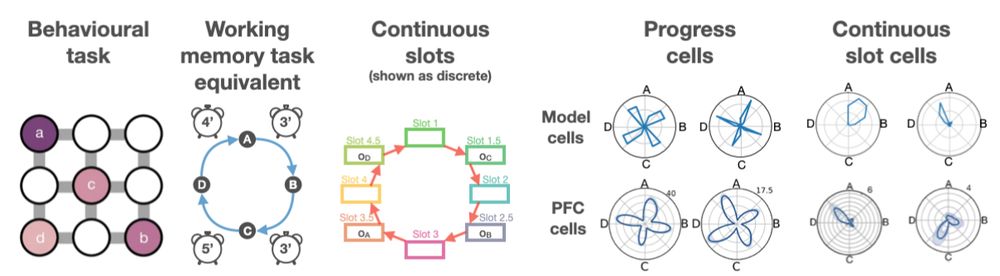
Slots also work for structured behavioural tasks too (Basu et al & El-Gaby et al). A continuous manifold of slots account for PFC neurons including ‘progress’ and ‘structured memory buffer’ neurons. These ‘behavioural’ tasks are really just working memory tasks in disguise! (6/9)
08.12.2024 15:27
👍 7
🔁 0
💬 1
📌 0

Armed with this theory, we can reinterpret PFC representations as slots! Not just in simple sequence repetition tasks (Xie et al), but also cue-dependent recall tasks (Panichello et al). Here the cue acts like a velocity signal to move memories between slots 😀. (5/9)
08.12.2024 15:27
👍 5
🔁 1
💬 1
📌 0

And slots are exactly what randomly initialised RNNs/SSMs actually learn! And for many many task structures and sizes (not just the one shown in the figure here) (4/9)
08.12.2024 15:27
👍 6
🔁 0
💬 1
📌 0