I am guest editing a special issue—"New Perspectives on the Mental Lexicon" in @qjep.bsky.social with @kathyrastle.bsky.social and Jo Taylor. Expression of interest until 20th Dec. Get in touch!
24.10.2025 15:22
👍 8
🔁 3
💬 0
📌 0
Thank you for sharing, your resources for the job market are so helpful! This is so generous and inspiring
01.10.2025 02:54
👍 1
🔁 0
💬 0
📌 0

Research Coordinator, Minds, Experiences, and Language Lab in Graduate School of Education, Stanford, California, United States
The Stanford Graduate School of Education (GSE) seeks a full-time Research Coordinator (acting lab manager) to help launch and coordinate the Minds,.....
I’m hiring!! 🎉 Looking for a full-time Lab Manager to help launch the Minds, Experiences, and Language Lab at Stanford. We’ll use all-day language recording, eye tracking, & neuroimaging to study how kids & families navigate unequal structural constraints. Please share:
phxc1b.rfer.us/STANFORDWcqUYo
15.09.2025 18:57
👍 73
🔁 48
💬 2
📌 0
Check out our new opinion paper where @jyeatman.bsky.social and I lay out how education settings provide a unique window into learning and plasticity in humans, and why we think that intervention studies - as difficult as they are - are worth the effort. onlinelibrary.wiley.com/doi/10.1111/...
26.08.2025 23:52
👍 2
🔁 0
💬 0
📌 0
Stanford | Faculty Positions: Details - Assistant Professor, Psychology
Our department is seeking applicants for an Assistant Professor position with a focus on affective science. Please apply and/or pass this along to anyone who might be interested! facultypositions.stanford.edu/en-us/job/49...
20.08.2025 05:43
👍 57
🔁 44
💬 0
📌 0

PhD and Postdoc Positions (m/f/d) in Human Cognitive Neuroscience of Dynamic Cognition – M/EEG, brain stimulation
Job Offer from August 11, 2025
We’re hiring! 🥳fully funded PhD and postdoc positions in human cognitive neuroscience @mpicybernetics.bsky.social
M/EEG and brain stimulation methods to study timing/ prediction/ attention/ oscillations
tinyurl.com/5dku4du9
@timingresforum.bsky.social @gtc-tuebingen.bsky.social
please repost 🙏
20.08.2025 09:10
👍 59
🔁 48
💬 2
📌 1
For VWFA geeks out there (you know who you are) - check out our new investigation into individual variability in VWFA spatial configuration in children and adults
01.08.2025 19:50
👍 3
🔁 0
💬 0
📌 0
If you are interested in pursuing a PhD in cognitive neuroscience, specially targeting conscious vs. unconscious processing, contact me. We are recruiting 🙏🧠 please RT
21.07.2025 11:50
👍 38
🔁 29
💬 0
📌 2
looks amazing, having the worst FOMO! See you next time :)
22.07.2025 05:20
👍 1
🔁 0
💬 1
📌 0
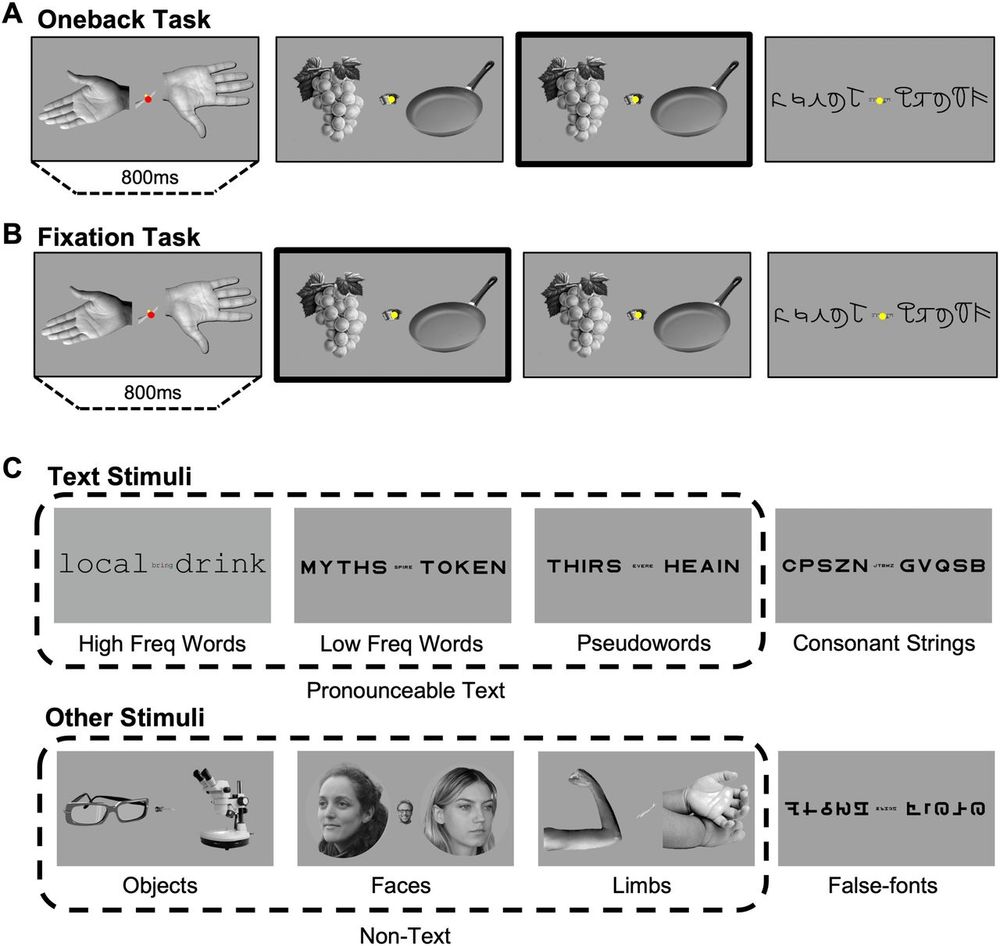
#JNeurosci: Stone, @mayayablonski.bsky.social, @jyeatman.bsky.social, @jamielmitchell.bsky.social, et al. found that text-selective regions in the inferior frontal cortex are linked to reading proficiency in children, showing sensitivity to both stimulus and task responses.
vist.ly/3n6z2q4
16.06.2025 11:40
👍 4
🔁 5
💬 0
📌 0
We're looking for #StudyParticipants for an online experiment which takes less than half an hour. Please help us out by participating or spreading the word!
We're comparing #word #learning across #languages. If you are a native speaker of one of the following languages, please participate:
05.06.2025 14:25
👍 0
🔁 3
💬 1
📌 0
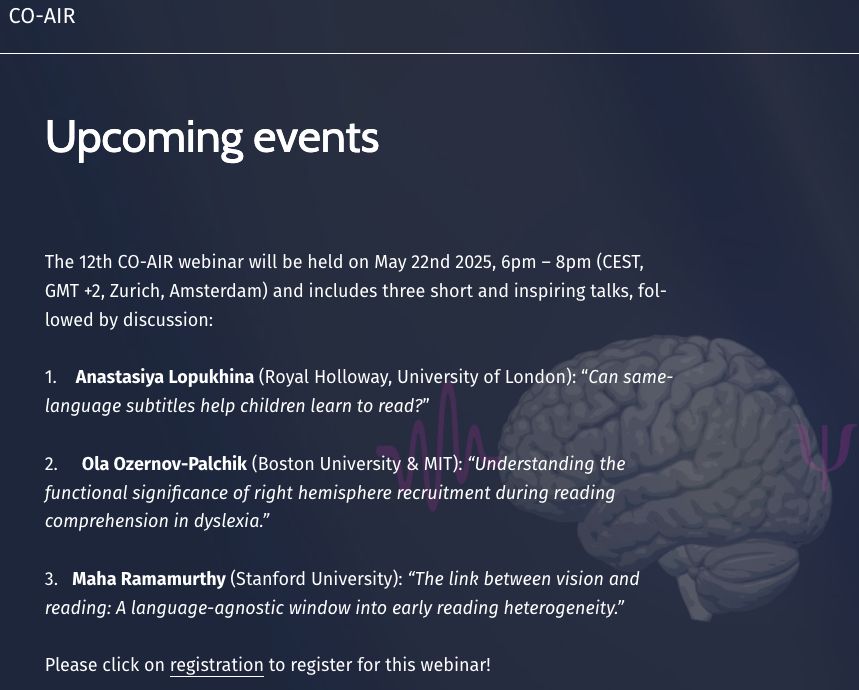
Our 12th CO-AIR webinar on audiovisual integration and reading is coming soon!
Join us Thu. May 22th, 6-8 pm (CEST, GMT+2)!
Inspiring talks by: Anastasiya Lopukhina, Ola Ozernov-Palchik, and Maha Ramamurthy
Program | Register: coairwebinar.wordpress.com/upcoming-eve...
13.05.2025 13:46
👍 3
🔁 2
💬 0
📌 1
Awesome news Monica! Would be great to have you around!
08.05.2025 20:36
👍 1
🔁 0
💬 0
📌 0
In a sample of children, we describe 3 distinct regions in the frontal lobe that show strong task effects that are highly specific to text, even when kids were not required to read. We further find that across children, the level of text-selectivity is associated with their reading proficiency.
08.05.2025 04:50
👍 1
🔁 1
💬 1
📌 0
On 15 May, we're organizing a very special hybrid event at the FIL: a Symposium on Setbacks in Science!
In a series of talks and discussions with a wonderful set of speakers, we will address the disappointments that are entirely common in research, but that we all hesitate to talk about. (1/3)
29.04.2025 15:36
👍 4
🔁 5
💬 1
📌 1
What a wonderful idea! will this be recorded or accessible later for audience in places where the time difference makes it difficult to attend?
29.04.2025 19:38
👍 0
🔁 0
💬 1
📌 0
Wow, great news! Congrats Ziv! 👏🏆
06.02.2025 02:02
👍 1
🔁 0
💬 1
📌 0
If you’ve ever had the pleasure of scanning children or clinical populations, this can be a game changer! We hope this work helps future users of magnetic resonance fingerprinting and hope to see soon more quantitative MRI in dev neuro!
30.01.2025 01:52
👍 1
🔁 0
💬 0
📌 0
how different choices you make in acquisition and analysis affect reliability- this one’s for you. Together with Zihan Zhou who did the heavy lifting on the physics and reconstruction end, we found that a 2-minute scan can reliably capture quantitative individual differences in white matter. 2/n→
30.01.2025 01:52
👍 1
🔁 0
💬 1
📌 0
Out in Imaging Neuroscience - out of our need to cut down scan time for fidgety children came out a cool collaboration with the Setsompop lab, where we examined the reliability of their novel fingerprinting approach to quantitative MRI. If you ever wanted to try a new protocol but weren’t sure 1/n→
30.01.2025 01:51
👍 4
🔁 0
💬 1
📌 0
1st preprint of 2025! @jamielmitchell.bsky.social found that as children with dyslexia improve their reading ability, their reading area in the brain grows, yet remains markedly different from their peers. So excited to see this after years of data collection with this great team! Feedback welcome!
16.01.2025 02:39
👍 8
🔁 3
💬 2
📌 0
Go for it! I took it a couple of years ago and I highly recommend it
18.12.2024 20:52
👍 1
🔁 0
💬 0
📌 0
No more science left in the other place, hope to find more here.
10.12.2024 02:28
👍 7
🔁 0
💬 0
📌 0