
Assortment of fossils from the Upper Cretaceous Northumberland Formation of Hornby Island, British Columbia
A few years ago, I started my personal project on the Upper Cretaceous Northumberland Formation of British Columbia, and I know proper background has been a long time coming. So here's a blogpost explaining what it's about, how and why I started it, and my future plans
Link in reply ⬇️
23.10.2025 19:05
👍 5
🔁 1
💬 1
📌 0

Very tiny beetle

Crow on a power line (large-billed crow?)

Dried up sea star on the beach
Some other animals in the vicinity; the crows are so big, practically like ravens! There were also a lot of large hawk-like birds soaring around (apparently black-eared kites, according to a blogger who visited the place before)
01.06.2025 22:45
👍 1
🔁 0
💬 1
📌 0
I’m not exactly a spider buff, so I only learnt of this species after I looked it up
Still, very glad I got to make this cool observation
01.06.2025 22:45
👍 1
🔁 0
💬 1
📌 0

Close-up of a jumping spider (Siler cupreus)

Close-up of a jumping spider (Siler cupreus), showing its face and eyes

Photo of a jumping spider (Siler cupreus)
I took a longer video beforehand where it actively tried to intercept the ants, and even lunged at one point, but it kinda chickened out for 15 minutes after that, as in the video above
It eventually disappeared though, so I do think it may have caught one
01.06.2025 22:45
👍 1
🔁 0
💬 1
📌 0
Saw a Siler cupreus male(?) in Japan yesterday! It was raising its front legs and shaking its abdomen, so I assumed it was doing a display at the ants at first, but this myrmectophagous species may have been trying to hunt them instead
01.06.2025 22:45
👍 6
🔁 0
💬 1
📌 0
No, that makes sense
Hopefully more prep is done on it
13.04.2025 15:58
👍 0
🔁 0
💬 0
📌 0


@echinoblog.bsky.social very intriguing Late Cretaceous echinoderm fossil from Vancouver Island (not mine) posted in a local paleontology Facebook group (www.facebook.com/groups/nanai...)
Any thoughts?
13.04.2025 06:06
👍 8
🔁 1
💬 1
📌 0
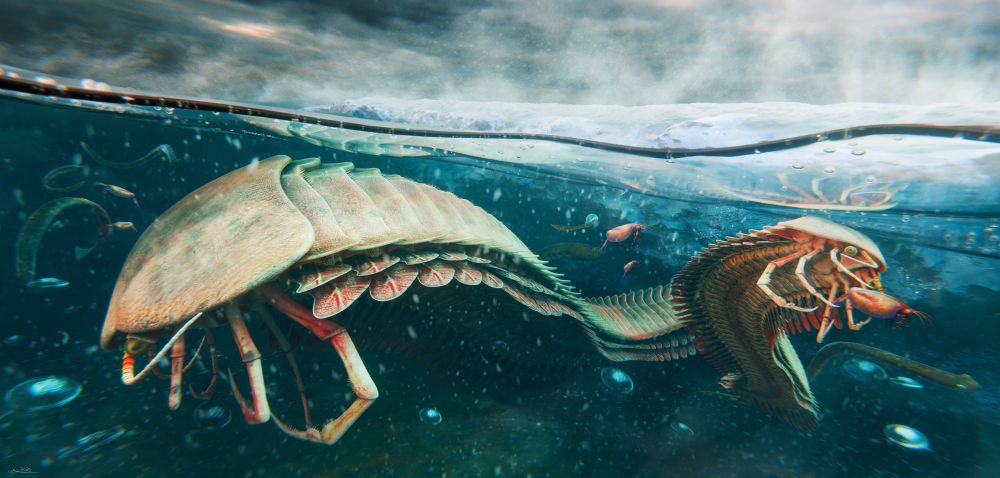
Keurbos susanae, a newly described giant arthropod from the Ordovician-age Soom Shale of South Africa.
29.03.2025 11:06
👍 288
🔁 93
💬 13
📌 2

My first blogpost in over a year is now out! The famous Greenland shark has its own little counterparts in the genus Rhinoscymnus, and among their first records is R. clarki from the Late Cretaceous Northumberland Fm.
How much do we know about them? Check the link in replies ⬇️
#paleoart #sciart
17.03.2025 17:30
👍 34
🔁 7
💬 1
📌 0

Sphenoceramus cf sachalinensis

Sphenoceramus cf sachalinensis

Sphenoceramus cf naumanni

Sphenoceramus cf naumanni
#MolluscMonday
Examples of Sphenoceramus cf sachalinensis and S. cf naumanni from the Late Cretaceous Nanaimo Group of Saanich Peninsula, Vancouver Island.
#PaleoSky #Fossils #FossilCollecting #NanaimoGroup #Cretaceous #CretaceousPeriod #FossilFriday #Paleontology #Palaeontology
24.02.2025 17:06
👍 18
🔁 6
💬 0
📌 0

Cf Thracia subtruncata

Cf Thracia subtruncata

cf Pholadomya subelongata

Indeterminate bivalve
A few more more for #MolluscMonday
These bivalves were collected from the Late Cretaceous rocks of the Nanaimo Group on Saanich Peninsula, Vancouver Island.
#PaleoSky #Fossils #FossilCollecting #NanaimoGroup #Cretaceous #CretaceousPeriod #Paleontology #Palaeontology #FossilFriday
24.02.2025 17:31
👍 13
🔁 6
💬 0
📌 0

Late Cretaceous spatangoid sea urchin fossils from Saanich Peninsula, Vancouver Island, British Columbia, Canada.
From the collection of Dan Bowden

More Late Cretaceous spatangoid sea urchin fossils from Saanich Peninsula, Vancouver Island, British Columbia, Canada.
From the collection of Dan Bowden
An assortment of late Cretaceous spatangoid urchins collected from the Haslam Formation of Saanich Peninsula, Vancouver Island, BC, Canada.
Part of an ongoing project to organize and document fossils in my collection.
#FossilFriday #PaleoSky #FossilCollecting #Fossils #Cretaceous #NanaimoGroup
21.02.2025 16:06
👍 10
🔁 6
💬 0
📌 0
Reposting for #Invertefest... feels a little unorthodox amongst all the extant ones I'm seeing :^)
25.12.2024 22:33
👍 6
🔁 0
💬 0
📌 0

Birds eye view of 3 long necked plesiosaurs swimming in the sea and surrounded by icebergs. 2 Adults are dark, blending with the deep waters, baby is white
In the frigid waters of jurassic arctic a female Colymbosaurus svalbardensis helps her newborn baby take first breath in it´s life. The protective pod stays close
15.12.2024 17:05
👍 163
🔁 46
💬 1
📌 0

15.11.2024 00:40
👍 5
🔁 2
💬 0
📌 0

Reconstruction of the fossil frog crab Bournelyreidus eysunesensis 🦀
Going up a day earlier than on Twitter: my reconstruction of the Late Cretaceous frog crab Bournelyreidus eysunesensis from Greenland, a source of vexation for the past three months...
#SciArt #paleoart
03.11.2024 22:43
👍 31
🔁 4
💬 1
📌 1


Helicoprion, a long extinct shark-esque from the Permian period, ~270 million years ago.
It's known best for it's iconic, sawblade-like tooth whorl
(...which I didn't draw)
24.10.2024 15:44
👍 10
🔁 4
💬 0
📌 0

My first reconstruction of 2024 will probably also be the most frustrating one to have worked on: the fossil sponge crab Sabellidromites laneae from the Campanian Northumberland Fm. in British Columbia
More decapod content coming in the future...
#paleoart #sciart
17.06.2024 19:06
👍 14
🔁 2
💬 1
📌 0

An albino Jormungandr circles a Ginko adiantoides sapling that was blown into the sea by a recent thunderstorm.
It's biting its tail in reference to its namesake, Jõrmungandr the Midgard Serpent, with the ginkgo sapling being a reference to Yggdrasil, the World Tree.
On its snout, the scars spell out "ᛃᛟᚱᛗᚢᚾᚷᚨᚾᛞᚱ" which is Jörmungandr in Old Futhark.
An albino Jormungandr circles a Ginko adiantoides sapling that was blown into the sea by a recent thunderstorm.
Jormungandr is a recently described genus of mosasaur from the Pierre Shale Fm. described by Zietlow et al., (2023) congrats on the successful publication!
31.10.2023 16:05
👍 38
🔁 14
💬 1
📌 0

Schematic of the Northumberland Enchoteuthis, based on Tyler Greenfield's reconstruction
While it may look like a squid, Enchoteuthis is more at home in #OCTOtober, as its closest living relatives are octopuses
While most common in the Late Cretaceous Western Interior Seaway, this specimen shows that the genus also lived in the Pacific, and it has even been found in Australia!
#SciArt 🐡
17.10.2023 18:40
👍 21
🔁 2
💬 1
📌 0

For #FossilFriday, here's the largest known frilled shark: a giant Proteothrinax specimen from the Late Cretaceous (Maastrichtian) of Japan
Although the exact measurements are tentative, it appears to have reached lengths of ~7 m, making it one of the largest squalomorphs ever
06.10.2023 18:42
👍 11
🔁 2
💬 1
📌 0

and to boot, it also lived with a large ~8 m long mosasaur (Konishi et al. 2012) (silhouette from GetAwayTrike's Prognathodon overtoni skeletal)
Want to read more about this giant frilled shark, as well as its close relatives? I have just the blogpost for that, linked in the replies
06.10.2023 18:44
👍 3
🔁 0
💬 1
📌 0
For #FossilFriday, here's the largest known frilled shark: a giant Proteothrinax specimen from the Late Cretaceous (Maastrichtian) of Japan
Although the exact measurements are tentative, it appears to have reached lengths of ~7 m, making it one of the largest squalomorphs ever
06.10.2023 18:42
👍 11
🔁 2
💬 1
📌 0


