
I would love to hear any thoughts on how this matches your experiences in research and innovation!
19.12.2025 14:50
👍 0
🔁 0
💬 0
📌 0
I would love to hear any thoughts on how this matches your experiences in research and innovation!
It took me 2 months to get here rather than 2 weeks, but I've written more about how this project came together in a more abstracted way (no physics knowledge required), and reflected on the hidden mechanics of the scientific process: substack.com/home/post/p-....

In science social media-- we typically share the main ideas and impact of our research papers. I think we should share more about how those stories came together, going inside the black box of science. Check out: condensingmatters.substack.com/p/inside-the... for why!
@hope-ful.bsky.social 👋
/13 @mpsdhamburg.bsky.social and @columbiauniversity.bsky.social were involved, and I'm grateful for funding from @humboldtinkforge.bsky.social and @erc.europa.eu #MSCA funding!
/12 Yunfei Huang, Kenji Watanabe, Takashi Taniguchi, Angel Rubio, Dante Kennes, Michael Sentef, Emmanuel Baudin, Guido Meier, Marios Michael, and James McIver.
/11 This project is the culmination of a collaboration with many wonderful people: Benedikt Schulte, Dorothee Herrmann, Kateryna Kusyak, Matthew Day, Sivasruthi Kesavan, Toru Matsuyama, Xinyu Li, Sara Maria Langner, Jesse Hagelstein, Felix Sturm, Alexander Potts, Christian Eckhardt
/10 These findings open many avenues. In addition to a THz spectroscopy tool, we’ve developed a route to control quantum phases via cavity design. Stay tuned for future results : ) and if you have ideas/questions, please reach out!
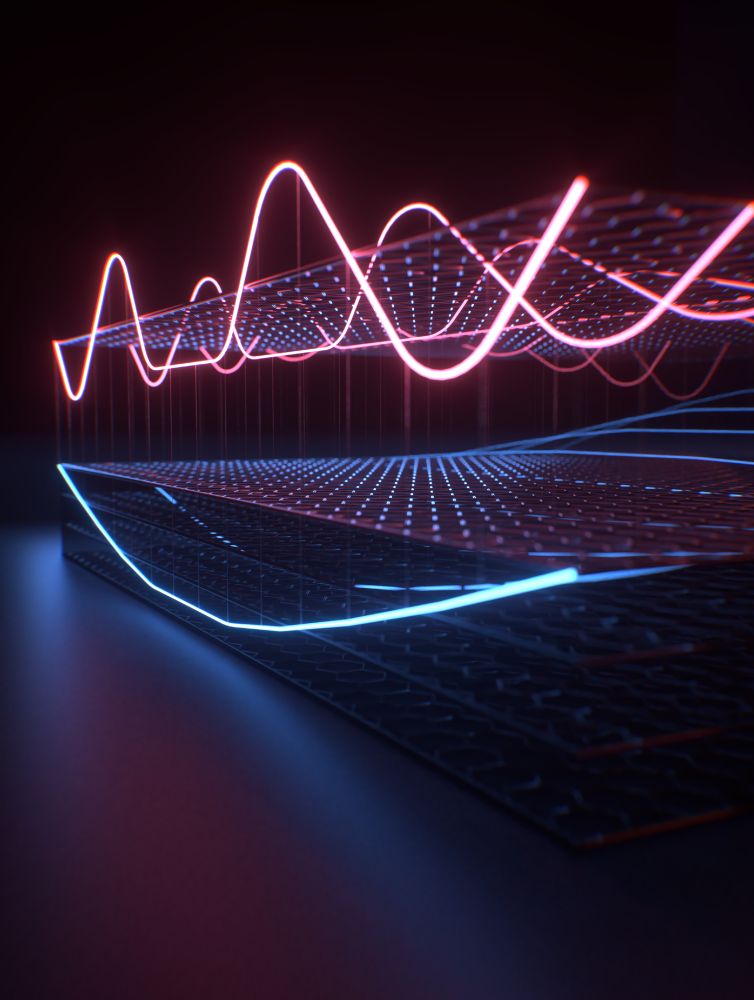
Artist rendering (by Brad Baxley) of two self-cavity modes interacting. A red glowing wave line is found in one layer (represented by a hexagonal lattice). Beneath this is another stack of hexagonal lattices, that also exhibits a second glowing line (blue). The red and blue lines exhibit distorted shapes that are due to their hybridization (also indicated by puppet-like strings tying them together).
/9 In multilayer heterostructures (common in devices with electrostatic gates) each layer acts as a cavity that can hybridize with the others. We demonstrated that this interaction can enter the ultrastrong coupling regime,
/8 meaning electrons and THz light hybridize and bounce back and forth between sample edges. Much like the note of a violin, the cavity mode is set by material properties (carrier density, effective mass) and device dimensions.
/8 Initial tests on thin graphite flakes yielded surprising results: instead of broadband absorption typical of semimetals, graphite absorbed at distinct frequencies. We found that vdW heterostructures are so small relative to THz light that the samples act as “self cavities”,

Micrograph of a device that shows the gold coplanar transmission line, with an inset showing a photoconductive switch in a left hand figure. On the right is a zoomed in image of the graphite heterostructure (graphite encapsulated in graphene) beneath two gold lines and placed on sapphire. Fig. from the paper (extended data)
/7 To overcome this mismatch, we developed an on chip approach combining photoconductive switches (to generate/detect THz pulses) with lithographically patterned transmission lines (that confine THz fields to the length scale of devices).
/6 of collective behavior, like collective modes, quasiparticle spectra, and energy gaps, to illuminate the mechanisms behind such phenomena.
However, THz wavelengths are ~millimeters, whereas vdW devices are ~10 µm: traditional THz spectrometers cannot easily access their optical response.
/5 The breadth and complexity of collective phases in highly tunable materials is exciting for both fundamental understanding and potential applications, yet many questions remain about when and why these phases occur. We set out to use THz light to resonantly measure fingerprints...
/4: In recent years, stacked 2D materials, called van der Waals (vdW) heterostructures, have revealed a vast array of phases with anomalous properties, from dissipationless transport to fractionalized particles. These phenomena often live at low energies (meV; terahertz, THz, frequencies).

/3 Today - the "Cavity electrodynamics of vdW heterostructures,” with co-lead author Gunda Kipp and an incredible team is published here: www.nature.com/articles/s41...
/2 So the next two weeks - I will dive into a couple of threads about a project that is in many ways the culmination of my postdoc! Today will focus more on the science results - and next week more about how this came about (inside the black box of a paper : )
/1 After migrating to bsky- I haven't yet posted much here yet. But to me - it is important to share my research as this is publicly funded, and to make the practice of science more transparent.
Now published in @natrevphys.bsky.social! A discussion on the need for scientists to proactively consider the ways in which social/political forces shape scientific practice: rdcu.be/ebFwf