Jimbob Blinkhorn's Avatar

Jimbob Blinkhorn

@jblinkhorn

1,106
Followers
146
Following
24
Posts
01.09.2023
Joined
Posts Following

Latest posts by Jimbob Blinkhorn @jblinkhorn

Preview
Homo heidelbergensis and The Origins of The Middle Stone Age: The Kabwe (Broken Hill) Lithic Assemblage - African Archaeological Review The Middle Stone Age (MSA) saw the emergence of novel behaviours in the archaeological record and is generally associated with our own species, Homo sapiens. Yet, most archaeological assemblages conta...

Just published a paper on the lithics from Kabwe. We argue that they're indicative of MSA technology, although they can't be definitevely associated with the fossils. Might help better understand the origins of the MSA and its complex pattern across the continent.

link.springer.com/article/10.1...

15.12.2025 09:13 👍 18 🔁 5 💬 0 📌 0

Great to have been part of this team in the field and see the publication out!

21.11.2025 11:21 👍 1 🔁 0 💬 1 📌 0
Preview
Novel archaeological and palaeontological findings in cave and palaeoriver landscapes of inland northeast Arabia Knowledge about environmental change and the evolutionary history of hominins in Arabia has been rapidly developing over the last two decades. Interdisciplinary research on humans and environments acr...

(1/18) New paper alert, a thread! Just published in PLoS ONE, our study: “Novel archaeological and palaeontological findings in cave and palaeoriver landscapes of inland northeast Arabia”. Link: journals.plos.org/plosone/arti...

20.11.2025 19:05 👍 14 🔁 4 💬 1 📌 3

There's still time to register for this week's talk, given by @professorlacy.bsky.social !

Sign up here: liverpool-ac-uk.zoom.us/meeting/regi...

We hope to see you there!

08.10.2025 13:43 👍 5 🔁 2 💬 0 📌 0
Post image

Beautiful clear day at the top of British Camp

06.10.2025 11:54 👍 1 🔁 0 💬 0 📌 0

Post image

Join us at the MPI-GEA or online for a free symposium on Quantifying Complexity in Stone Tools on the 21st of October! 🪨

With a keynote lecture by Charles Perreault. Full speaker list will be released soon!

Secure your spot here: shh-cloud.gnz.mpg.de/index.php/ap...

12.08.2025 12:33 👍 40 🔁 14 💬 0 📌 2
Preview
Identifying late Pleistocene and Holocene refugia for baboons - Communications Biology Hindcasted species distribution modelling of baboons illuminates potential refugia across Africa and Arabia, with predicted maxima and minima of habitable ranges pulsed by orbital precession and obliq...

Hindcasted species distribution modelling of baboons illuminates potential refugia across Africa and Arabia, with predicted maxima and minima of habitable ranges pulsed by orbital precession and obliquity expressed within the last precessional cycle. www.nature.com/articles/s42...

10.07.2025 13:59 👍 9 🔁 4 💬 1 📌 0

This project ended up taking the best part of 3 years 😅 Thank you very much to @margheritac17.bsky.social, @mikleonardi.bsky.social, @jblinkhorn.bsky.social, @elliescerri.bsky.social, Manuel Chevalier, Matt Grove, Andrea Pozzi and Andrea Manica from @eegcam.bsky.social for your hard work!!

10.07.2025 09:18 👍 3 🔁 1 💬 0 📌 0
Preview
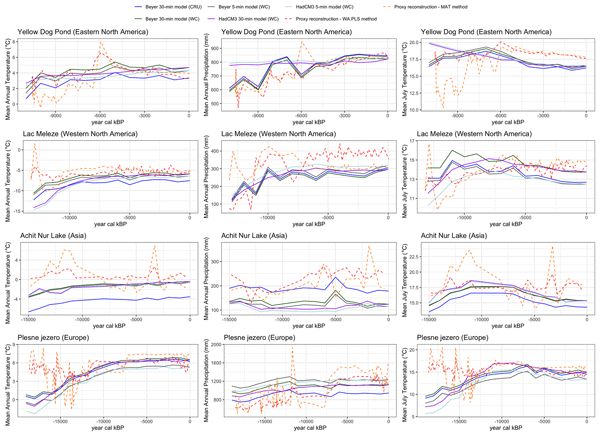
More is not always better: delta-downscaling climate model outputs from 30 to 5 min resolution has minimal impact on coherence with Late Quaternary proxies Abstract. Both proxies and models provide key resources to explore how palaeoenvironmental changes may have impacted diverse biotic communities and cultural processes. While proxies are thought to pro...

Very pleased to see our paper published online at Climate of the Past: cp.copernicus.org/articles/21/...

We present model-data comparisons of Late Quaternary climate across the Northern Hemisphere, showing that increasing model resolution has little net effect on coherence with pollen proxies 😊

10.07.2025 09:09 👍 19 🔁 6 💬 1 📌 2

New paper in collaboration with @lucytimbrell96.bsky.social and @jblinkhorn.bsky.social, with several of us involved (@mikleonardi.bsky.social @margheritac17.bsky.social @andreavpozzi.bsky.social) shows that downscaling palaeoclimate models doesn't necessarily improve coherence with proxy data.

10.07.2025 09:22 👍 8 🔁 5 💬 0 📌 0

New paper out, in collaboration with @jblinkhorn.bsky.social @elliescerri.bsky.social and @lucytimbrell96.bsky.social

05.07.2025 19:50 👍 5 🔁 1 💬 0 📌 0
Preview
Identifying late Pleistocene and Holocene refugia for baboons - Communications Biology Hindcasted species distribution modelling of baboons illuminates potential refugia across Africa and Arabia, with predicted maxima and minima of habitable ranges pulsed by orbital precession and obliq...

New paper alert! Led by @jblinkhorn.bsky.social, we look at refugia for baboons in the Pleistocene and Holocene, offering a potential analogue for early hominins where climatic tolerances are shared.
www.nature.com/articles/s42...

05.07.2025 07:53 👍 13 🔁 4 💬 0 📌 2

Here it is, our case study on how to combine a century of deep (and building) archaeological knowledge around prehistoric social traditions with the new and exciting aDNA data, to help avoid interpretive pitfalls.

I hope you all enjoy reading it as much as we enjoyed the process of writing it 🎁

24.06.2025 15:37 👍 95 🔁 22 💬 6 📌 4
Comparing the extent of human niche and malaria stability index through time a) Extent of the human niche (outlined in black) against the map of malaria stability index at 54, 16 and 8 kya; b) median of level of malaria stability index in the area of human range (dark orange line) and outside the area of human range (dark blue line), including the uncertainty (interquartile, colour in transparency around the darker lines that shows median values). We can see that the level of malaria in the human niche is consistently lower than the areas avoided by humans.

Comparing the extent of human niche and malaria stability index through time a) Extent of the human niche (outlined in black) against the map of malaria stability index at 54, 16 and 8 kya; b) median of level of malaria stability index in the area of human range (dark orange line) and outside the area of human range (dark blue line), including the uncertainty (interquartile, colour in transparency around the darker lines that shows median values). We can see that the level of malaria in the human niche is consistently lower than the areas avoided by humans.

Malaria shaped human spatial organisation for the last 74 thousand years🏺🧪
Margherita Colucci, @ceciliapad.bsky.social, @elliescerri.bsky.social et al
www.biorxiv.org/content/10.1...

Humans avoided or unsuccessful in malaria hotspots. Effects of these choices shaped human demography for last 74 kya

20.06.2025 18:02 👍 36 🔁 9 💬 1 📌 0
Preview
Latnija cave discovery hailed as ‘world class’ by leading archaeologist The discovery showed that Malta’s human history is at least 1,000 years older than previously thought

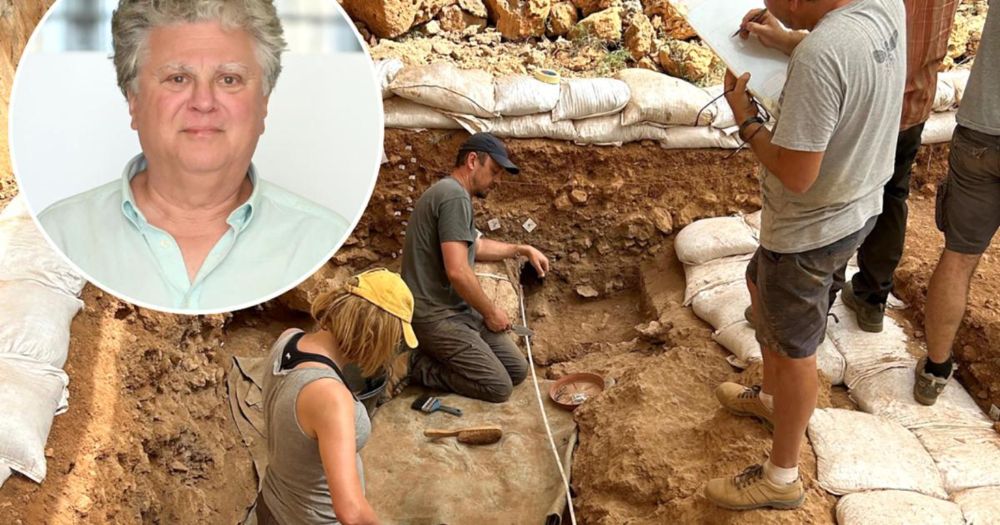
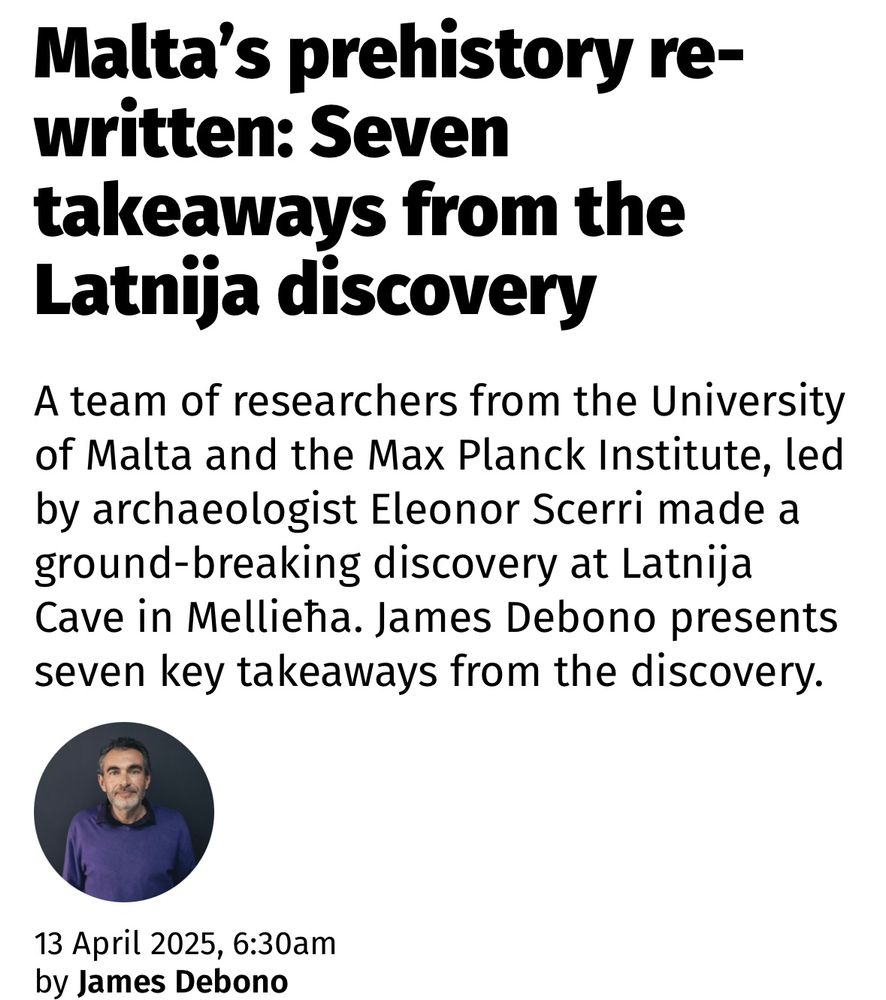
Nice coverage of some our ongoing work at Latnija and our Island Legacies conference last week timesofmalta.com/article/latn...

11.06.2025 16:17 👍 7 🔁 1 💬 0 📌 0
Preview
Malaria shaped human spatial organisation for the last 74 thousand years The mechanisms driving the spatial organisation of early human societies in Africa are typically addressed through climate variables [1][1]-[3][2]. However, genetic and archaeological studies have als...

🚨 NEW preprint🚨 Our latest study @HPS MPI-GEA @elliescerri.bsky.social & @eegcam.bsky.social models #malaria risk over the past 74,000 years revealing its powerful role in shaping human habitat choice and dispersal since the late Pleistocene in sub-Saharan Africa 🦟🌍 www.biorxiv.org/content/10.1...

09.06.2025 16:13 👍 15 🔁 9 💬 2 📌 1

Palaeo folks, I was speaking with the production team recently and they said they are keen to feature more palaeontology stories.

So if you are excavating/surveying this summer and think you might turn up something, drop them a line

21.05.2025 08:11 👍 26 🔁 20 💬 0 📌 0
Preview
Pan-African metapopulation model explains Homo sapiens genetic and morphological evolution Emerging evidence has challenged the traditional view of a single-region origin for Homo sapiens, suggesting instead that our species arose and diversified across multiple geographically distinct popu...

🚨NEW PAPER from the @eegcam.bsky.social!🚨I have never been as proud of something as of the work that finally we can share today: www.biorxiv.org/content/10.1... - we show how a climatically driven Pan African meta population model explains our species genetic and morphological diversity 🧬💀

23.05.2025 12:50 👍 60 🔁 28 💬 4 📌 3
Preview
(PDF) Project Announcement. Introducing the TerraForm Project: The Rise and Fall of Maltese Terraced Landscapes PDF | On May 15, 2025, Huw S. Groucutt published Project Announcement. Introducing the TerraForm Project: The Rise and Fall of Maltese Terraced Landscapes | Find, read and cite all the research you ne...

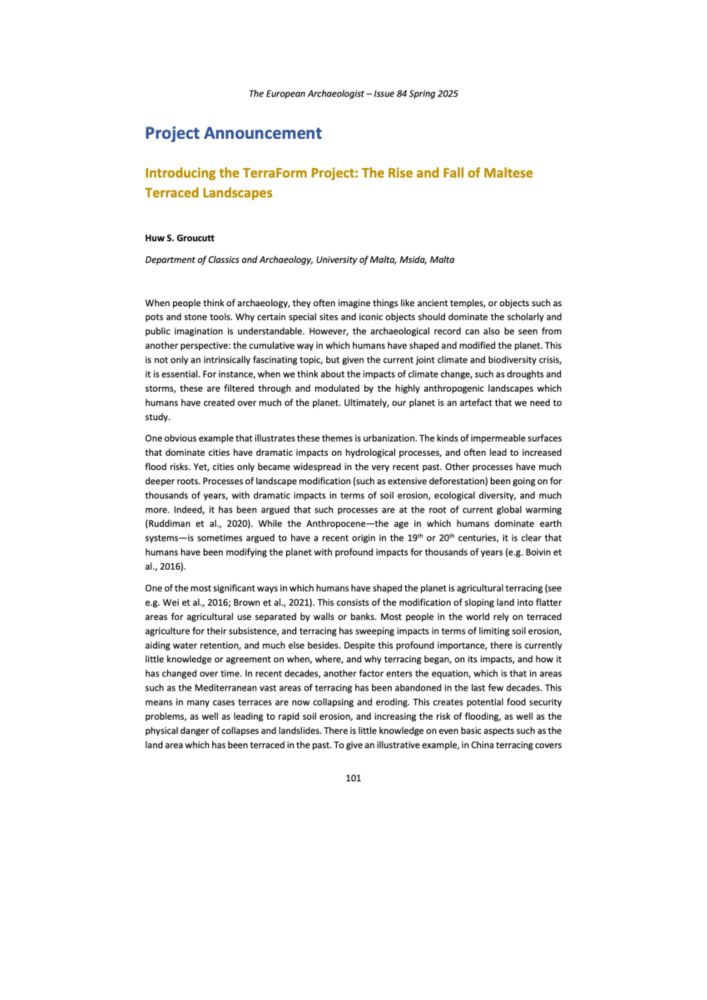
First publication for my recently started TerraForm project is out. A short overview and introduction published in The European Archaeologist (www.researchgate.net/publication/...).

15.05.2025 10:53 👍 7 🔁 2 💬 0 📌 0

Our next MENDLS lecture is coming up next week and it's sure to be a great one. If you're in the Northwest, come and hear Prof Manica talking about the role of climate in human evolution.

06.05.2025 10:23 👍 4 🔁 1 💬 0 📌 1

Really looking forward to this next Wednesday (14th May 2025)!

Anyone is welcome to join - registration is free and available here: forms.gle/9kdzpTbfMuDZ...

06.05.2025 08:15 👍 4 🔁 1 💬 0 📌 0
Post image Post image

@deepakjha.bsky.social presenting CSIA of modern plants and sediments along an aridiy gradient in the Thar Desert at #EGU25

01.05.2025 10:32 👍 6 🔁 3 💬 0 📌 1
Post image

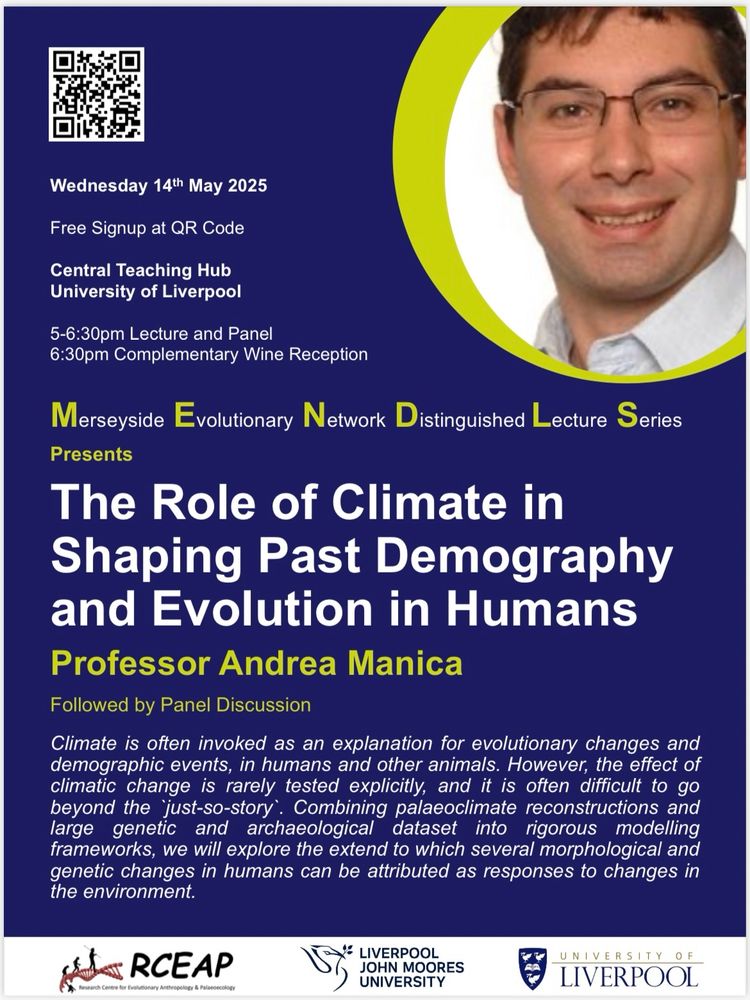
Looking forward to our next MENDLS talk on Wednesday 14th of May with Prof Andrea Manica of the University of Cambridge @eegcam.bsky.social

Join us in Liverpool! Sign up via the QR code below

01.05.2025 15:32 👍 11 🔁 7 💬 2 📌 2
Preview
New Discovery: Stone Age Seafaring to Malta with Dr Eleanor Scerri and Huw Groucutt YouTube video by Archaeology with Flint Dibble

Livestream tomorrow at 5pm UK/noon EDT with Drs Eleanor Scerri (@elliescerri.bsky.social) and Huw Groucutt (@huwgroucutt.bsky.social) to chat about their recent paper that's been all over the news about Hunter gatherer occupation on Malta

www.youtube.com/live/ZGRjN20...

24.04.2025 15:32 👍 64 🔁 16 💬 2 📌 1
Preview
Sexual division of labour shapes hunter-gatherer spatial ranges Mobility lies at the adaptive core of the hunter-gatherer foraging niche, and has shaped the cultural and genetic evolution of our species. Yet, the specific drivers and consequences of mobility are s...

🚨New preprint!🚨"Sexual division of labour shapes hunter-gatherer spatial ranges". Following on the sexual division of labour theme, finally out our analyses on the lifetime spatial ranges of over 700 Mbendjele BaYaka 🤩

www.biorxiv.org/content/10.1...

21.04.2025 05:20 👍 29 🔁 9 💬 1 📌 2
Post image Post image Post image Post image

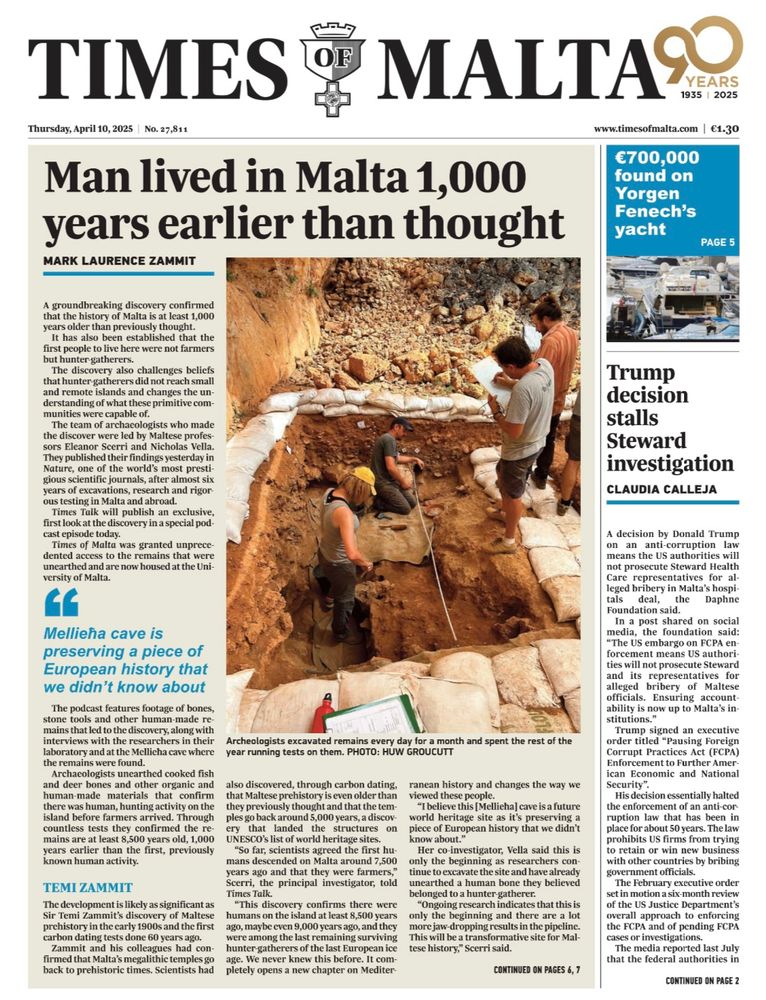
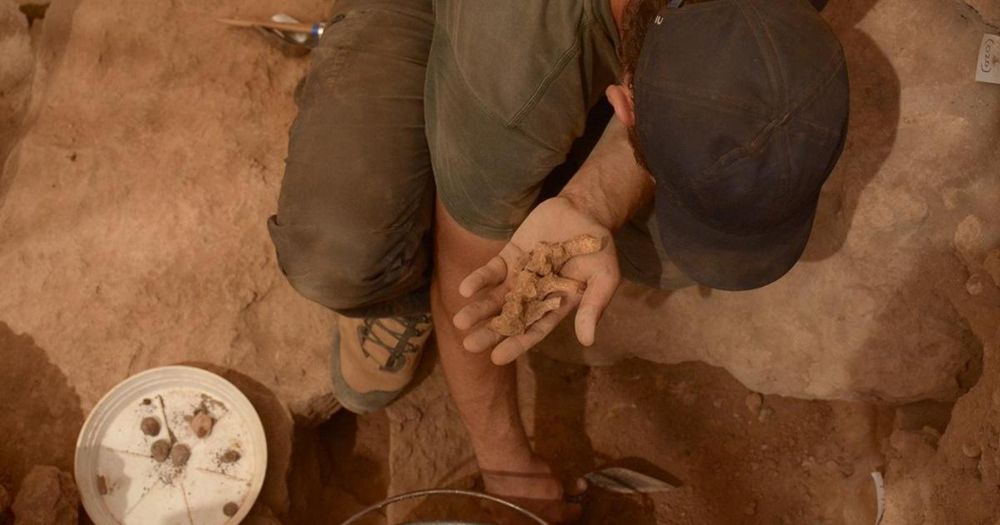
It’s been great to see all the excitement in Malta about our recent findings at Latnija.

Looking forward to the future at this incredible archaeological site!

17.04.2025 21:14 👍 10 🔁 1 💬 0 📌 0
Preview
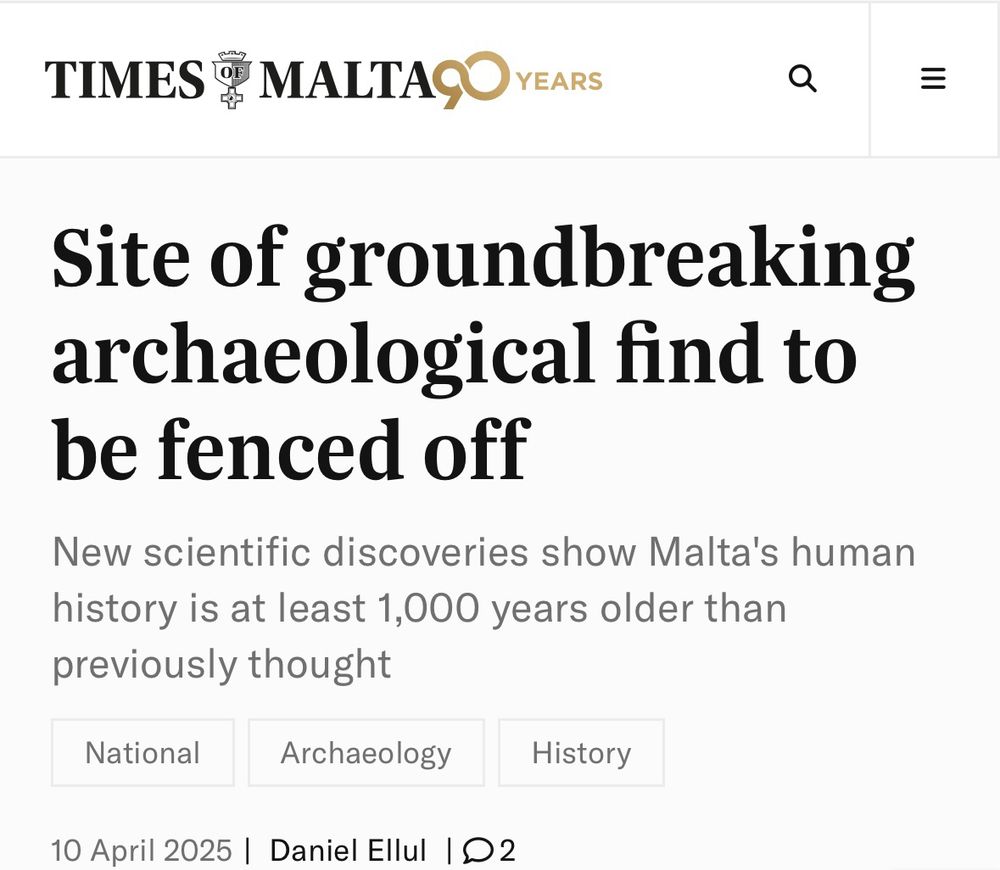
Malta archaeological find hits the world’s headlines Ground-breaking discovery proving first humans settled on island more than 1,000 years than previously thought was revealed last week

timesofmalta.com/article/malt...

17.04.2025 08:41 👍 18 🔁 6 💬 1 📌 0
Preview
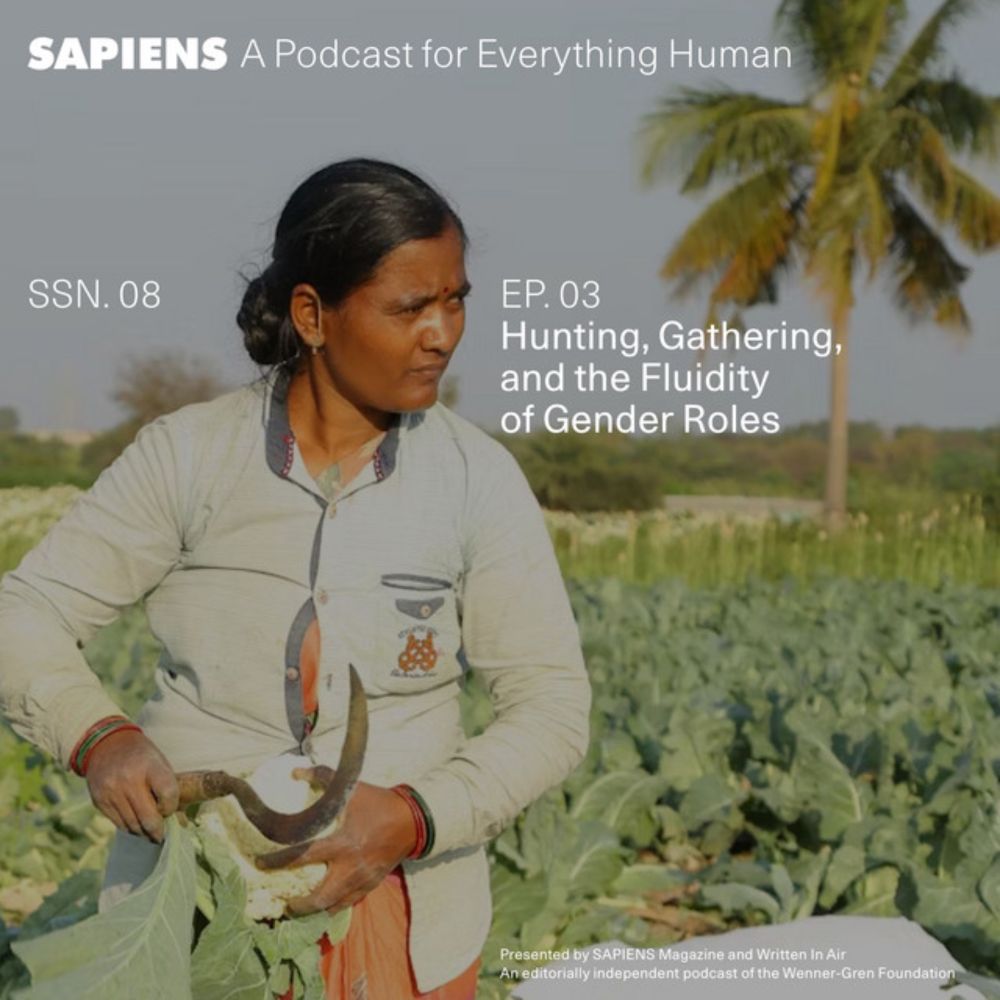
Hunting, Gathering, and the Fluidity of Gender Roles SAPIENS: A Podcast for Everything Human · Episode

Finally out 🥳: I've written and recorded a podcast episode with the amazing Karen Kramer for Sapiens Magazine on the origins and evolution of division of labour in hunter-gatherer societies, and its implications for undestanding (or misunderstanding) gender roles: open.spotify.com/episode/2ZGA...

15.04.2025 13:11 👍 25 🔁 9 💬 2 📌 1
Preview
Recurrent humid phases in Arabia over the past 8 million years - Nature A climatic record from desert speleothems shows that the central Arabian interior experienced recurrent humid intervals over the past 8 million years, which likely facilitated mammalian dispersals bet...

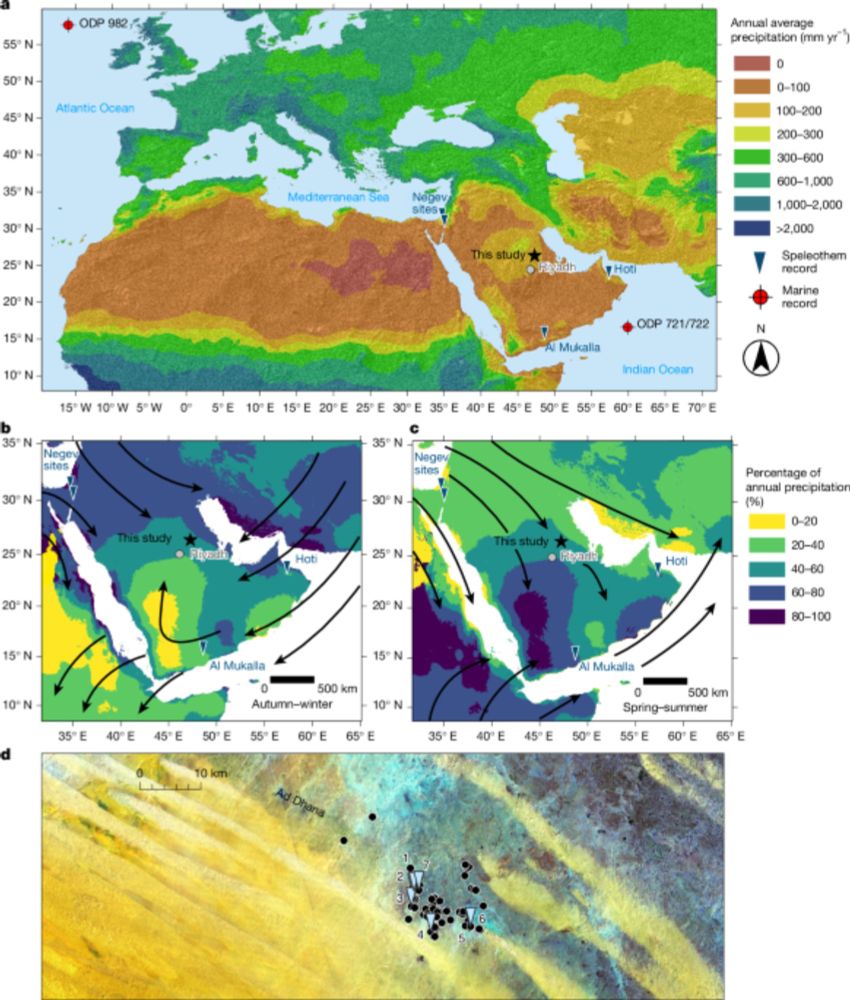
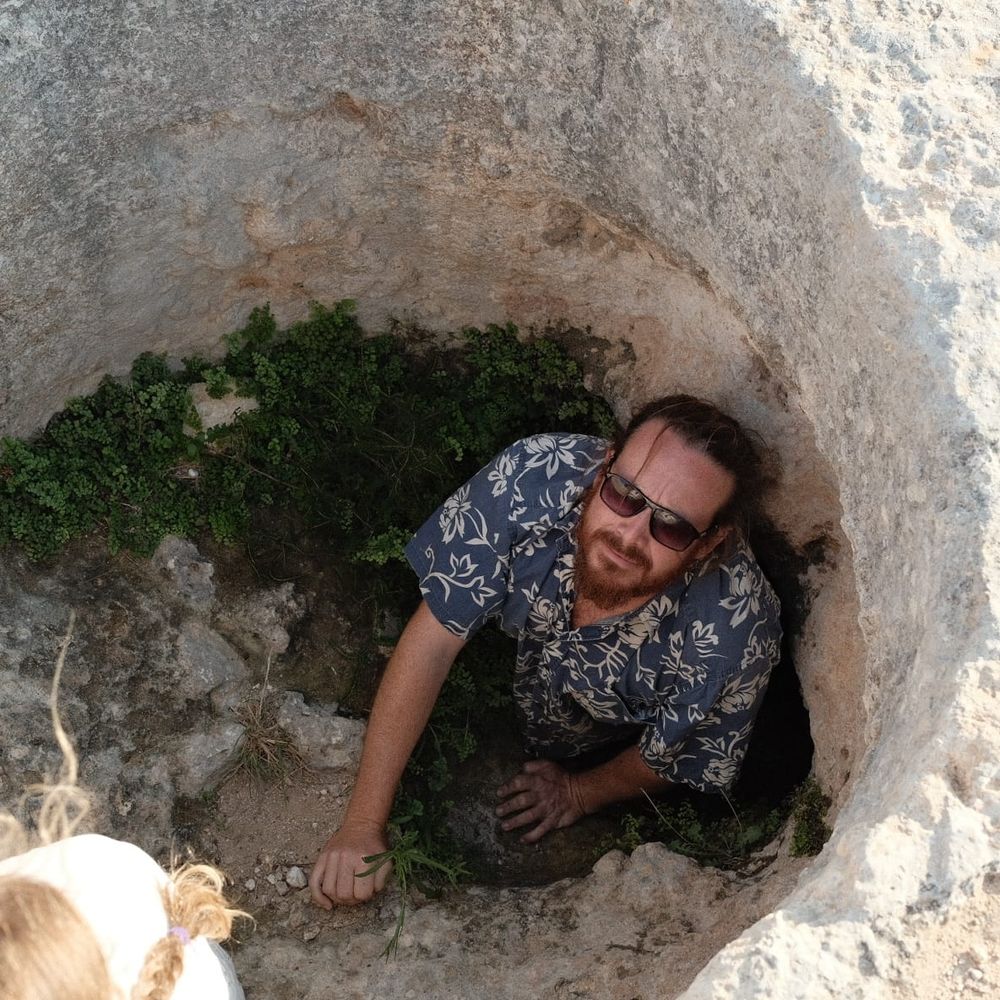
Our new paper just out in @nature.com

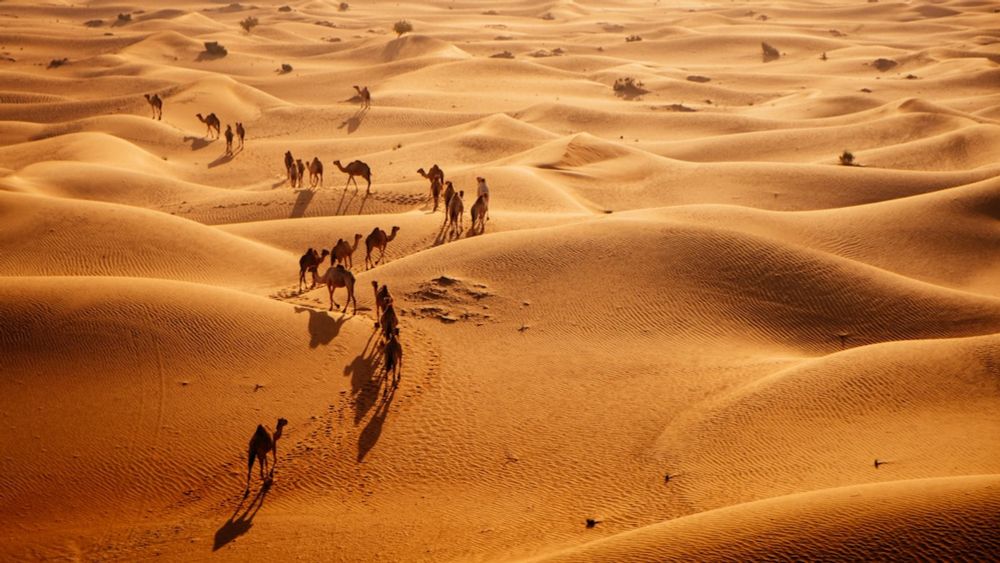
By analyzing speleothems we were able to reconstruct the palaeoclimate of northern Arabia over the past 8-million-years!

Work led by Monika Markowska (University of Northumbria)

www.nature.com/articles/s41...

09.04.2025 22:40 👍 13 🔁 3 💬 0 📌 0
Preview
Saudi Arabia's vast desert was once a lush, green paradise A new study reconstructing the Arabian Peninsula’s ancient past adds clues to how early humans left the African continent.

National Geographic piece on our latest research our in @nature.com where we document recurrent humid periods in Arabia over the past 8-million-years

www.nationalgeographic.com/environment/...

09.04.2025 22:48 👍 11 🔁 7 💬 0 📌 0