

Thrilled to share that my graduate work is officially published in Neuron! 🎉
www.cell.com/neuron/fullt...
18.02.2026 16:15
👍 47
🔁 10
💬 3
📌 1
Thrilled to share that my graduate work is officially published in Neuron! 🎉
www.cell.com/neuron/fullt...
Interestingly, we find functional similarities with locomotor circuits in the vertebrate brainstem.
Thanks! The neuron is CB0257.
Wonderful team effort with @jan-ache.bsky.social, Fathima Iqbal, @sirinlieb.bsky.social, @merterginkaya.bsky.social, @sanderliessem.bsky.social, and others. Thanks to @erc.europa.eu #HorizonEurope #MSCA and @dfg.de for funding.
How does the brain control locomotion? In our new preprint, we uncover a brain circuit in Drosophila that controls forward walking independently of turning. This dedicated locomotor circuit enables flexible motor control and might reflect a shared principle across species. doi.org/10.64898/202...

Landing and takeoff sensorimotor pathways illustrated alongside fly drawings showing behavioral responses.
How do animals channel sensory information into motor pathways to generate flexible behavioral output? Excited to share a new preprint addressing this question by leveraging the new #maleCNS connectome, behavioral experiments, and in-vivo recordings: doi.org/10.64898/202.... A long🧵...
How do neural circuits generate the walking rhythm?
Using connectome simulations, @sarahpugly.bsky.social found a minimal central pattern generator (CPG) that produces oscillations in leg motor neurons. Same circuit motif for each 🪰 leg.
w @bingbrunton.bsky.social
www.biorxiv.org/content/10.1...

New preprint:
Neural manifolds that orchestrate walking and stopping
Here we develop a new theory for neural generation of walking and how it can stop- Next we test the theory using Neuropixels probes in the lumber spinal cord of freely moving rats. See more:
www.biorxiv.org/content/10.1...

Exciting news for #drosophila #connectomics and #neuroscience enthusiasts: the Drosophila male central nervous system connectome is now live for exploration. Find out more at the landing page hosted by our Janelia FlyEM collaborators www.janelia.org/project-team....

Agrawal lab logo. A fly in the UBC colors, with dots framing its body.
The Agrawal lab is moving! This January we will be setting up shop at #UBC in Vancouver, in the department of #Zoology! We are actively recruiting at all levels, especially masters and PhD students. These position are #funded! Please send anyone interested my way!
Wonderful collaboration with @camellyc.bsky.social, @hokuba.bsky.social, Akira Mamiya, @grantchou.bsky.social, Andrew Cook, @anne-sustar.bsky.social, @bingbrunton.bsky.social, and @tuthill.bsky.social. I'm grateful to @dfg.de for supporting this postdoc project.
Now out in @nature.com: Our study discovering a neural circuit in Drosophila that predictively inhibits proprioceptor axons during voluntary leg movements, such as walking and grooming. www.nature.com/articles/s41...
The first full central nervous system connectome dataset of an adult fly, with the most comprehensive annotation of sensory and motor neurons to date.
A heroic effort with contributions from many groups, a product of the collaborative spirit of the Drosophila neuroscience community.

Preprint Alert! Walking mostly feels natural and easy to us - but the neuronal control of walking is actually incredibly complex. We leveraged the fruit fly as a genetically tractable animal model with a compact nervous system to ask how the brain controls walking direction: tinyurl.com/flywalk. 🧵..
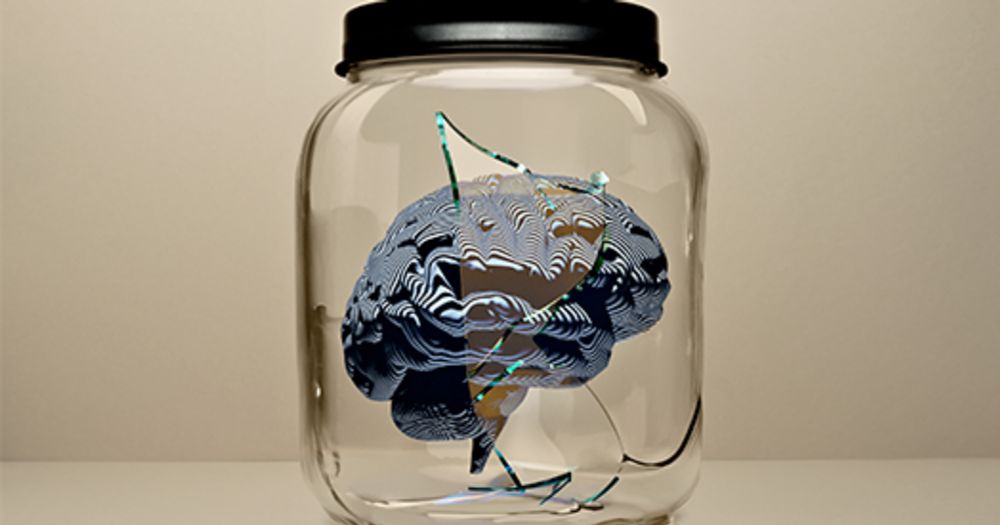
Embodiment is the concept that the function of the brain is inexorably shaped by the body, a lens that is often neglected when neuroscientists study specific brain subsystems, write @bingbrunton.bsky.social and @tuthill.bsky.social.
#neuroskyence #neuroai
www.thetransmitter.org/neuroai/brea...

new preprint, led by @ellenlesser.bsky.social, on proprioceptive sensing of the Drosophila wing. tldr, there are a lot of proprioceptors out in the wing and they are wildly diverse and complex (eg, compared to the fly leg). just one example in this image...(1/4)
www.biorxiv.org/content/10.1...
Excited to contribute imaging data to this project! The axons of these sensory neurons showed beautiful calcium signals in the nerve cord when the fly's leg joints reached the limits of their movement range. Check out the full story!
Excited to share my PhD paper is out! We studied how motion vision is processed beyond the optic lobes to help flies walk straight. It has been a wonderful collaboration with @michaelreiser.bsky.social, @dddavi.bsky.social and many others not in bluesky!
Paper + digest here: bsky.app/profile/cham...
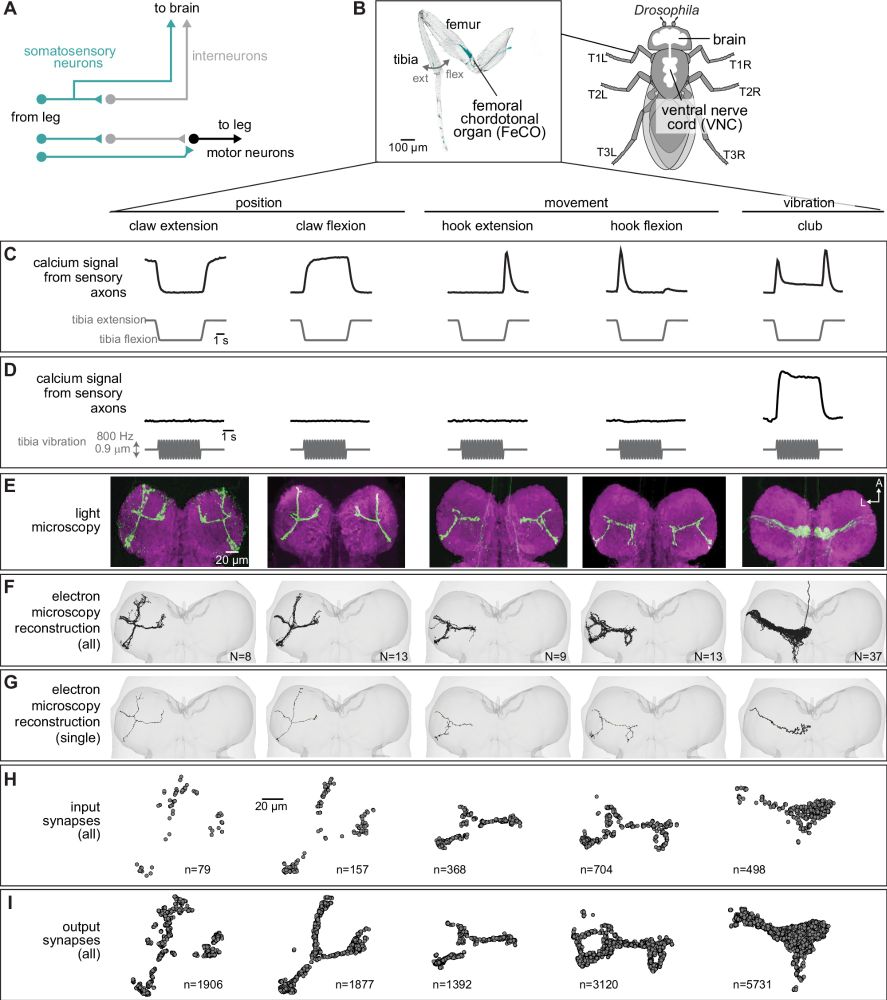
Happy to announce that our paper examining the function of leg mechanosensory neurons by way of their connectivity is finally officially published! rdcu.be/ekqVt
Yay - the extensive review Ansgar Büschges and I wrote on insect motor control and the many things insects can teach us about our own nervous systems just came out in Physiological Reviews @apsphysiology.bsky.social. Check it out - it's free: journals.physiology.org/doi/epdf/10....

The brain is incredibly complex. How do we analyze the growing and massive datasets to create a general model of neural computation?
Eva Dyer and @tyrellturing.bsky.social share their perspective on what needs to happen next in @thetransmitter.bsky.social.
www.thetransmitter.org/neuroai/acce...
Excited to present my #HorizonEU MSCA project with @jan-ache.bsky.social at the @neurowissg.bsky.social meeting in Göttingen. If you're interested in how brain circuits control locomotion, come chat with me at poster T23-6C on Friday. #NWG2025 #Drosophila
Registration started for the Janelia meeting on spinal cord and brainstem circuits for sensorimotor adaptation across species. Spinal cord is more than a hub, it does supercomputing!
www.janelia.org/you-janelia/...

I wrote a piece for @thetransmitter.bsky.social about why I love participating in experimental summer courses, particularly @nsb-mbl.bsky.social.
www.thetransmitter.org/craft-and-ca...


