Suz Everingham's Avatar

Suz Everingham

@suzeveringham

Postdoc at Western Sydney University ~ Co-leader of #BugNet (bug-net.org) ~ global change ecology ~ community & interactions ecology ~ mum 🀍

1,154
Followers
227
Following
39
Posts
30.11.2023
Joined
Posts Following

Latest posts by Suz Everingham @suzeveringham

Redirecting

πŸ“’ New publication 'Exposure and sensitivity of threatened #plant species to changing #drought regimes: A global analysis' by Susan Everingham, Ian Wright, Lina Teckentrup, Stuart Allen and Rachael Gallagher in Biological Conservation πŸ§ͺ

doi.org/10.1016/j.bi...

#IUCN

05.02.2026 00:49 πŸ‘ 4 πŸ” 2 πŸ’¬ 0 πŸ“Œ 0

Thanks for sharing cate!

09.01.2026 08:22 πŸ‘ 1 πŸ” 0 πŸ’¬ 1 πŸ“Œ 0
Preview
PhD Position: Tree Physiological Responses to Atmospheric Drought We invite applications for a fully funded four-year PhD position at the Γ‰cole Polytechnique FΓ©dΓ©rale de Lausanne (EPFL), Switzerland, with a planned start date in June 2026. The selected candidate wil...

🌳PhD Opportunity in plant ecophysiology🌑️ Join EPFL (Switzerland) for fully-funded 4yr PhD on tree responses to air drought and heat. Climate chamber + long-term experiments to uncover physiological thresholds under climate change. www.epfl.ch/labs/perl/pe...

07.01.2026 16:25 πŸ‘ 27 πŸ” 26 πŸ’¬ 0 πŸ“Œ 0
Preview
Exposure and sensitivity of threatened plant species to changing drought regimes: A global analysis Climate change is driving substantial impacts on plants, including widespread increases in drought frequency, duration, and intensity. Changes to thes…

Drought is often omitted from IUCN Red Listing assessments as it is difficult to quantify. But our study has found that >95% of threatened species will be exposed to longer and more frequent droughts! www.sciencedirect.com/science/arti...

07.01.2026 02:11 πŸ‘ 7 πŸ” 4 πŸ’¬ 1 πŸ“Œ 1
PhD Opportunity in Plant Ecophysiology – Adelaide University
We are looking for an PhD candidate to join an exciting research project focused on understanding heat and drought combined impacts on threatened plants’ mortality.
Key Objectives:
Describe drought sensitivity in juvenile and mature individuals of threatened plant species.
Disentangle the effects of elevated temperature, soil dryness, and atmospheric water demand on the sensitivity of threatened species to hotter droughts.
Model threatened species’ risk of mortality under current and future hotter droughts.
Eligibility:
Australians and international applicants with a completed Master's degree (GPA > 5.0) and/or a completed 4-year Bachelor with Honours (GPA > 5.0) in Plant Biology or related areas;
Proof of English proficiency (e.g. IELTS score > 6.5 or equivalent qualification), only for applicants who speak English as a second language.
Strong analytical and programming skills in R or  Python.
Genuine interest in studying plants with previous experience in plant ecology and/or physiology.
Effective writing skills; a passion for reading, writing, and continually improving as a communicator.
Ability to drive in Australia is desirable but not essential.
Start Date: April 2026 (negotiable)
Duration: 3.5 years
Benefits: PhD scholarship (tax-exempt stipend of $36,500 AUD p.a. + $3,000 AUD p.a. top up);
Higher stipend rate for Aboriginal and Torres Strait Islander candidates ($ 53,608 p.a.);
Relocation allowances for both domestic and international candidates;
Single Overseas Student Health cover for international applicants.
100% tuition fee waiver.
How to Apply:
Email the following documents to ilaine.matos@adelaide.edu.au before the 15th of February 2026. Women and people underrepresented in research are encouraged to apply. 
1-page cover letter explaining why you are interested in this position and your previous experiences relevant for this opportunity.
Curriculum Vitae in the Adelaide University format.

PhD Opportunity in Plant Ecophysiology – Adelaide University We are looking for an PhD candidate to join an exciting research project focused on understanding heat and drought combined impacts on threatened plants’ mortality. Key Objectives: Describe drought sensitivity in juvenile and mature individuals of threatened plant species. Disentangle the effects of elevated temperature, soil dryness, and atmospheric water demand on the sensitivity of threatened species to hotter droughts. Model threatened species’ risk of mortality under current and future hotter droughts. Eligibility: Australians and international applicants with a completed Master's degree (GPA > 5.0) and/or a completed 4-year Bachelor with Honours (GPA > 5.0) in Plant Biology or related areas; Proof of English proficiency (e.g. IELTS score > 6.5 or equivalent qualification), only for applicants who speak English as a second language. Strong analytical and programming skills in R or Python. Genuine interest in studying plants with previous experience in plant ecology and/or physiology. Effective writing skills; a passion for reading, writing, and continually improving as a communicator. Ability to drive in Australia is desirable but not essential. Start Date: April 2026 (negotiable) Duration: 3.5 years Benefits: PhD scholarship (tax-exempt stipend of $36,500 AUD p.a. + $3,000 AUD p.a. top up); Higher stipend rate for Aboriginal and Torres Strait Islander candidates ($ 53,608 p.a.); Relocation allowances for both domestic and international candidates; Single Overseas Student Health cover for international applicants. 100% tuition fee waiver. How to Apply: Email the following documents to ilaine.matos@adelaide.edu.au before the 15th of February 2026. Women and people underrepresented in research are encouraged to apply. 1-page cover letter explaining why you are interested in this position and your previous experiences relevant for this opportunity. Curriculum Vitae in the Adelaide University format.

✨ PhD opportunity studying drought and heatwave effects on threatened plants ✨πŸ”₯

Funded by an ARC DECRA awarded to the amazing Dr IlaΓ­ne Matos and co-supervised by Dr Sami Rifai and me!

Limited by the character limit here, so please see the attached flyer for all the details - please share widely!

06.01.2026 00:14 πŸ‘ 19 πŸ” 24 πŸ’¬ 1 πŸ“Œ 0
Preview
Limited responses of plant defence traits to recent climate change - Evolutionary Ecology Direct and indirect effects of climate change may have substantial impacts on plant defences against herbivory. However, there are limited long-term historical data on plant morphological and chemical...

Final PhD paper published! Using resurrection ecology and a glasshouse experiment, we found limited responses of defence traits to climate change across Aus plants. Brilliant coauthors inc. @angelamoles.bsky.social Eve Slavich, Cathy Offord and Juha-Pekka Salminen link.springer.com/article/10.1...

05.01.2026 09:18 πŸ‘ 6 πŸ” 1 πŸ’¬ 0 πŸ“Œ 0
Post image

Of the 8000 plant species introduced to cities around the world, about 300 are in cities on every continent and about 90 are basically in every city. Urbanization has selected for a common set of species that are the fingerprint of our activity: The urban florome.

onlinelibrary.wiley....

24.11.2025 16:23 πŸ‘ 35 πŸ” 10 πŸ’¬ 0 πŸ“Œ 2

There doesn’t seem to be a page - I’m happy to send the pdf via DM if you need? I think applications are via email ☺️

20.10.2025 05:51 πŸ‘ 0 πŸ” 0 πŸ’¬ 0 πŸ“Œ 0
Post image Post image

#PhD opportunity with amazing supervisors at @westsyduhie.bsky.social and the Botanic Gardens Sydney, focusing on restoration success, genomic diversity and macroecology. Please share widely 🌿

20.10.2025 02:19 πŸ‘ 6 πŸ” 4 πŸ’¬ 1 πŸ“Œ 1
Post image Post image Post image Post image

Spring is really springing here in Sydney and we managed to get out on a bush walk in Ku-Ring-Gai NP to see some beautiful wild flowers with a toddler and newborn in tow 🌸🌿

10.10.2025 09:35 πŸ‘ 5 πŸ” 0 πŸ’¬ 0 πŸ“Œ 0
Post image Post image Post image Post image

Fully funded PhD in #Ecophysiology at UBC in Vancouver! 🍁 Possible topics include leaf physiology, thermal ecology, microclimates, scaling, tree physiology, forest ecology, and more. Start Sept 2026/Jan 2027. michaletzlab.org
Please share!
#PlantEcoPhys #Ecology #Botany #PhDposition #GradSchool

02.09.2025 16:36 πŸ‘ 33 πŸ” 27 πŸ’¬ 0 πŸ“Œ 0
Post image

Important reading as you prepare for your semester

31.08.2025 00:10 πŸ‘ 368 πŸ” 104 πŸ’¬ 7 πŸ“Œ 9

Thanks cate πŸ˜€

30.08.2025 03:14 πŸ‘ 1 πŸ” 0 πŸ’¬ 0 πŸ“Œ 0

With the excellent team of @angelamoles.bsky.social Eve Slavich, @plantypotato.bsky.social and Cathy Offord

30.08.2025 02:27 πŸ‘ 2 πŸ” 0 πŸ’¬ 0 πŸ“Œ 0
Preview
Shining a Light on Patterns of Photoperiod Sensitivity in Germination and Flowering Across Latitudes, Ecosystems and Functional Traits Our study investigated the role of photoperiod sensitivity in plant phenology, focusing on germination and flowering patterns across species in Australia and globally. We found that most species show...

Our #OpenAccess paper showing no trends in photoperiod sensitivity in germination 🌱 & flowering time 🌸 across a range of predictors out now in @ecol-evol.bsky.social Led by brilliant Honours student Ashika and my first 'senior author' paper πŸ˜€ onlinelibrary.wiley.com/doi/10.1002/...

30.08.2025 02:25 πŸ‘ 8 πŸ” 5 πŸ’¬ 3 πŸ“Œ 0

Very deserving of the DECRA she recently received πŸŽ‰

18.08.2025 08:17 πŸ‘ 1 πŸ” 0 πŸ’¬ 0 πŸ“Œ 0

She really is!

18.08.2025 03:52 πŸ‘ 1 πŸ” 0 πŸ’¬ 0 πŸ“Œ 0
Post image

PhD opportunity available at @westsyduhie.bsky.social with the brillant Dr Laura Williams - hyperspectral data and process-based modelling of tree diversity 🌳🌲 please share with your networks tinyurl.com/ms6mjz8y

18.08.2025 03:40 πŸ‘ 20 πŸ” 20 πŸ’¬ 1 πŸ“Œ 5

Exciting new paper from @innaosmol.bsky.social and a great team - why are some climate change range shifts counterintuitive to predictions? Changes in biotic interactions!

09.07.2025 06:38 πŸ‘ 5 πŸ” 2 πŸ’¬ 0 πŸ“Œ 0
Preview
Adaptation in Wood Anatomical Traits to Temperature and Precipitationβ€”A Common Garden Study Wood anatomy underpins plant function. Across 58 evergreen species thicker vessel walls increased hydraulic safety in cold and dry sites. Smaller vessels increased safety at warm sites yet hydraulic ....

πŸ“’ New publication ' #Adaptation in Wood Anatomical Traits to Temperature and Precipitationβ€”A Common Garden Study' by Tiantian Pan, Travis Britton, Julian Schrader, Emma Sumner, Dean Nicolle, Brendan Choat and @ianjwright.bsky.social in Plant, Cell and Environment πŸ§ͺ

doi.org/10.1111/pce....

12.06.2025 00:02 πŸ‘ 7 πŸ” 4 πŸ’¬ 0 πŸ“Œ 0

The registration for the 5th @sortee.bsky.social annual virtual conference is now open!

We have two fantastic plenary speakers this year @simine.com and Israel Borokini (not on BSky?).

04.06.2025 08:56 πŸ‘ 8 πŸ” 6 πŸ’¬ 0 πŸ“Œ 0

Huge congrats Fonti! πŸŽ‰

04.06.2025 04:55 πŸ‘ 1 πŸ” 0 πŸ’¬ 0 πŸ“Œ 0
Post image Post image Post image Post image

Despite transport NSW cancelling pretty much all of their Sydney trains we had a great turn out @pintsworld.bsky.social in Parramatta, Aus 🍻 a crew of an astronomist @astrolaura.com an ecologist (me! πŸ‘‹πŸ») and a nuclear chemist (Anton Peristyy) chatting about our big and small research

20.05.2025 11:59 πŸ‘ 11 πŸ” 1 πŸ’¬ 0 πŸ“Œ 0
Preview
Do trait–growth relationships vary with plant age in fire-prone heathland shrubs?

🌱New study reveals functional traits e.g. wood density & leaf mass fraction shape plant growth rates, with these relationships changing as plants mature. Growth isn't a fixed trait–it evolves with age! @lilydun.bsky.social @ianjwright.bsky.socialπŸ§ͺ🌍
πŸ”Article: buff.ly/f0vnEFV
πŸ—žοΈBlog: buff.ly/nY1TorB

13.05.2025 10:02 πŸ‘ 18 πŸ” 7 πŸ’¬ 1 πŸ“Œ 0
Post image

Content submissions for the 5th SORTEE Conference (15-16 Oct 2025) are now OPEN.

Submit your proposal for an unconference, hackathon or workshop by June 2nd via sortee.org/upcoming

The conference will be FREE for members, so consider joining us (sortee.org/join/).

09.05.2025 08:37 πŸ‘ 10 πŸ” 11 πŸ’¬ 0 πŸ“Œ 1
Post image

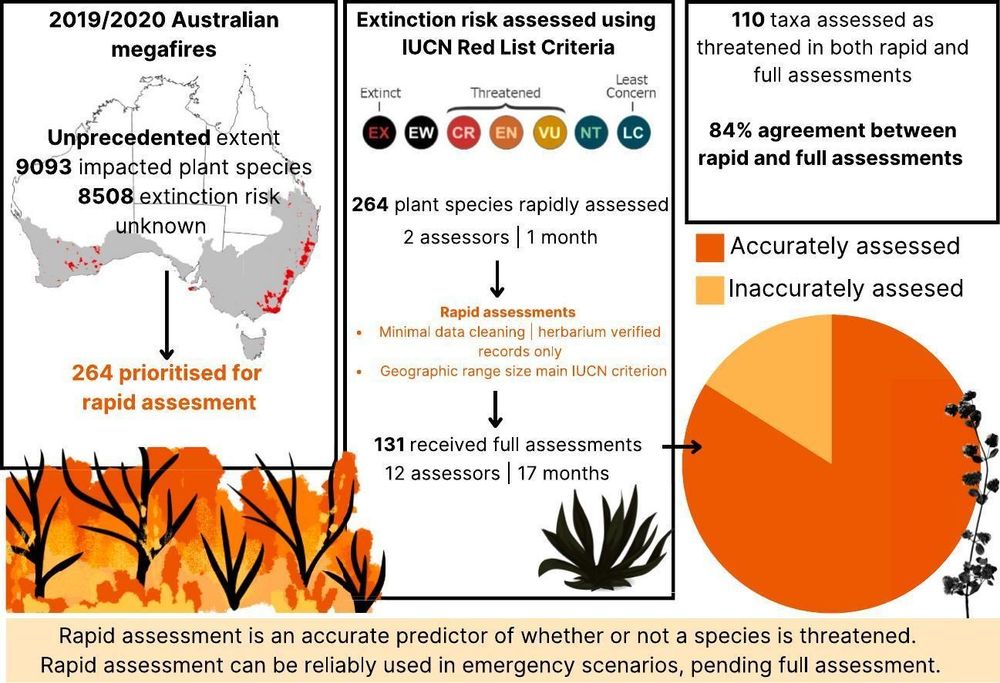
New paper out! After the 2019-2020 #fires in Australia our team undertook #IUCN Red List assessments of fire affected #plant species, to handle the volume we undertook paired rapid and full assessments and compared their accuracy 1/4

doi.org/10.1016/j.bi...

12.05.2025 07:43 πŸ‘ 27 πŸ” 14 πŸ’¬ 1 πŸ“Œ 0
Preview
Do trait–growth relationships vary with plant age in fire‐prone heathland shrubs? We demonstrate that key functional traits undergo shifts in their relationship with growth as plants mature. Therefore, it will be valuable to shift our understanding of plant strategies away from th...

πŸ“’ New publication 'Do trait–growth relationships vary with plant age in fire-prone heathland #shrubs?' by Lily Dun, Elizabeth Wenk, Daniel Falster, Mark Westoby and Ian Wright in Journal of Ecology πŸ§ͺ

doi.org/10.1111/1365...

28.04.2025 01:55 πŸ‘ 16 πŸ” 7 πŸ’¬ 0 πŸ“Œ 1
Preview
Build a Ballot - Get election ready Everything you need to do your research before voting at the 2025 Federal Election. Discover your local candidates & see how they're approaching key issues.

Not sure how to vote based on your values and priorities? Check out this great resource www.buildaballot.org.au.

The same website also has useful explanations about voting and debunks common election myths, including β€˜wasted votes’. No vote is wasted, never.

23.04.2025 21:04 πŸ‘ 29 πŸ” 21 πŸ’¬ 5 πŸ“Œ 3
Preview
Towards an integrative mechanistic framework for biodiversity–consumer relationships Terrestrial plant diversity plays a pivotal role in influencing the abundance, diversity, and impacts of herbivores and pathogens (collectively, plant consumers). However, it is unclear whether the relationships between biodiversity and herbivory reflect the same underlying ecological mechanisms as the relationships between biodiversity and disease. This uncertainty results in part from decades of independent, siloed research on each consumer group. We propose that, across herbivores and pathogens, plant diversity–consumer relationships arise from five fundamental factors: (1) density of a focal plant, (2) total plant biomass, (3) plant neighborhood quality, (4) resource diversity, and (5) structural complexity. By matching established hypotheses to these five fundamental factors, we highlight opportunities for growth in the rapidly developing field of plant–consumer interactions.

Online now: Towards an integrative mechanistic framework for biodiversity–consumer relationships

23.04.2025 11:56 πŸ‘ 8 πŸ” 4 πŸ’¬ 0 πŸ“Œ 0

Led by a brilliant and fun team @fletcher-h.bsky.social @zoexiro.bsky.social @annekempel.bsky.social @ebelingae.bsky.social + Max Brocher, Fabiane Mundim, Mayank Kohli and Alex Strauss πŸ˜€

23.04.2025 01:06 πŸ‘ 3 πŸ” 0 πŸ’¬ 0 πŸ“Œ 0