Feels surreal but this is my last week at UC Davis. Time is truly an enigma.
…after five great years, I will be moving to the University of Montana, as an Associate Professor and W.A. Franke Endowed Chair in the Department of Forest Management🌲🏔️and I could not be more excited. @umontana.bsky.social
25.06.2025 18:00
👍 10
🔁 0
💬 2
📌 0

Fig. 1. Data was collected over 4 acres in the USDA-ARS research farm located at Spence Rd., Salinas, CA. Data collection is done using a sensing kit equipped with: (1) Onboard computer, (2) Cellular module, (3) GPS, and (4) 2 RGB cameras.
🍓From Computers and Electronics in Agriculture: Strawberry yield forecasting improves using YOLO phenology detection with weighted LSTM time-series models. (Andres Montes de Oca, Troy Magney, Stavros G. Vougioukas, Steven A. Fennimore, Mason Earles)
▶️ www.sciencedirect.com/science/arti...
16.06.2025 16:06
👍 5
🔁 1
💬 0
📌 0

Fig. 5. Marginal posterior density of MLR-SIF parameter of KDF from Bayesian calibration process.
🖥️ From Ecological Modelling: Solar-induced chlorophyll fluorescence (SIF) - informed models improve crop gross primary production (GPP) estimates. New DayCent framework uses mechanistic light response and outperforms RUE. (Troy S. Magney, Francis Ulep)
▶️ www.sciencedirect.com/science/arti...
17.04.2025 17:41
👍 6
🔁 3
💬 1
📌 0

Boreal Forests May Be on the Move - Eos
A new model shows a tendency for tree cover to decline in warmer areas and increase in colder ones.
New research from @w-u-r.bsky.social shows that the world’s coldest forests will lose their tree covers because of continued warming. Story by @ktjandra.bsky.social
eos.org/articles/bor...
03.02.2025 14:41
👍 11
🔁 6
💬 0
📌 1


Happy to share a new paper, "Effects of Hot Versus Dry Vapor Pressure Deficit on Ecosystem Carbon and Water Fluxes," led by the amazing Miriam Johnston w/ @mallorybarnes.bsky.social and others agupubs.onlinelibrary.wiley.com/doi/10.1029/...
27.01.2025 16:56
👍 45
🔁 16
💬 0
📌 2
Team included @wwoodgate.bsky.social @drbenrunkle.bsky.social @xiyang.bsky.social @albert-loren.bsky.social @mallorybarnes.bsky.social @mostafaj.bsky.social @jbfisher.bsky.social @stovallatticus.bsky.social and many more not yet on bsky!
23.01.2025 18:23
👍 6
🔁 0
💬 0
📌 0

This was a big collaborative effort and was so fun to put together. Stemming from a FLUXNET workshop we led in 2023. @ameriflux.bsky.social @fluxnetecn.bsky.social
23.01.2025 18:23
👍 6
🔁 1
💬 1
📌 0

Overview of proximal remote sensing instruments at a flux tower site. Shown are three eddy-covariance towers with sonic anemometers collecting data to derive ecosystem fluxes. Shown for spectral reflectance and solar-induced fluorescence (SIF) is a hyperspectral sensor with a narrow field-of-view (FOV) and multi-directional scanning capabilities (Sections II.1 and II.2). We also show the direct emission of SIF from the forest canopy (Section II.2). For thermal infrared radiation, we show a fixed thermal camera and thermal radiation coming from the canopy (Section II.3). For microwave, we show two potential arrangements with antenna A receiving direct signals from under open-sky conditions as well as signals that are reflected from the underlying vegetated surface, and antenna B receiving a direct signal that is propagated downward through the vegetation canopy and attenuated by its moisture content (Section II.4). We also show a light detection and ranging (LiDAR) instrument emitting light to get a 3D representation of canopy structure (Section II.5). Above the forest are a drone, aircraft, and satellite to emphasize the potential of proximal remote sensing to complement observations across scales. In the inset plot, we show sample reflectance spectra for vegetation and wet soil and highlight key wavelength ranges for spectral reflectance. We also show typical SIF retrieval windows and LiDAR emission windows. Next to the reflectance spectra, we show sample radiance in the thermal infrared region, with example spectra for warm soil and cool vegetation. Finally, we show key measurement wavelength bands for microwave backscatter.
New Tansley review paper from Zoe Pierrat & friends in @newphyt.bsky.social linking proximal remote sensing with ecosystem fluxes!
Synergies and best practices for hyperspectral reflectance, SIF, thermal, microwave and lidar 🌈🌲🗼🛰️🧪
nph.onlinelibrary.wiley.com/doi/10.1111/...
23.01.2025 18:23
👍 65
🔁 29
💬 1
📌 3

Details of the Flux Course Mexico - more at https://fluxnet.org/tafe/
Flux Course, Spanish language edition, June 22-July 5 2025 in Mexico! Apply by Jan 31 for instructor or Mar 28 as student at fluxnet.org/tafe/
15.01.2025 19:43
👍 12
🔁 11
💬 0
📌 1
It was impossible to capture the massive complexity of this question given the word/reference count for commentaries.
So we are only able to scratch the surface of the large implications these changes have for climate regulation, biodiversity, and ecosystem services.
14.01.2025 15:39
👍 1
🔁 0
💬 0
📌 0

Simplified conceptual diagram of potential feedbacks associated with a projected open forest state in the year 2100. The transition to an open forest state is closely tied to feedback processes such as changes in biomass and species composition, disturbance (wildfire, insects, wind), albedo, water availability, and permafrost dynamics
Future #climate projections of tree cover suggest the boreal forest is headed for an open state (⬇️🌲in south & ⬆️🌲in north)
But, how will boreal tree cover dynamics influence—and be influenced by—climate feedbacks?
We discuss this in a new commentary @pnas.org. 🧪
www.pnas.org/doi/10.1073/...
14.01.2025 15:39
👍 24
🔁 12
💬 2
📌 0

#JPL has so far been safe as well thanks to round the clock work of our first responders. But over 150 JPLers have lost homes that we know of so far. We are raising funds to support them through Caltech!
Please consider supporting:
caltech.imodules.com/controls/ema...
Thank you!
10.01.2025 19:15
👍 99
🔁 24
💬 1
📌 0
Hello Blue Sky! Good to be here. How well can leaf reflectance spectra predict hydraulic traits in Amazon trees? Find out in our new RSE article led by Dr. Maquelle Garcia! authors.elsevier.com/c/1kGKn7qzT3...
10.01.2025 08:12
👍 3
🔁 2
💬 0
📌 0

Subtle differences in hyperspectral reflectance curves from leaves representing a range of physiological conditions. (a) Reflectance data for the mean (50th percentile, black dashed), high (90th percentile, green), and low (10th percentile, purple) Rdark samples from the Wu et al. (2024; doi: 10.1111/nph.20267) dataset, highlighting key traits associated with regions of interest in the visible (400–700 nm), near-infrared (c. 700–1400 nm), and shortwave infrared (c. 1400–2500 nm). (b) The percent difference between high- and low-Rdark samples from the mean, annotated with the direction of observed differences for key traits. The high-Rdark spectra show increased absorption in the chlorophyll (Chl) regions (c. 400–470 and c. 630–670 nm), while the low-Rdark spectra show decreased reflectance centered at 531 nm, a prominent xanthophyll absorption feature. Additionally, there is greater reflectance in the near-infrared region for high-Rdark spectra, suggesting higher leaf thickness and leaf mass per area (LMA), and higher absorption (lower reflectance) in the water absorption features in the shortwave infrared.
This commentary was on a recently published paper by Wu et al. (nph.onlinelibrary.wiley.com/doi/10.1111/...) - who use hyperspectral reflectance to predict leaf dark respiration. It outperforms traditional trait-based approaches by a lot.
I re-analyzed some of their data to try to explain why
16.12.2024 16:31
👍 4
🔁 1
💬 0
📌 0

Hyperspectral reflectance integrates key traits for predicting leaf metabolism
Click on the article title to read more.
Why does hyperspectral reflectance work for tracking plant physiological dynamics?
I recently wrote a commentary for @newphyt.bsky.social about that, targeted for a broad audience of plant scientists 🍃🌈🧪
nph.onlinelibrary.wiley.com/doi/10.1111/...
16.12.2024 16:31
👍 20
🔁 6
💬 1
📌 0
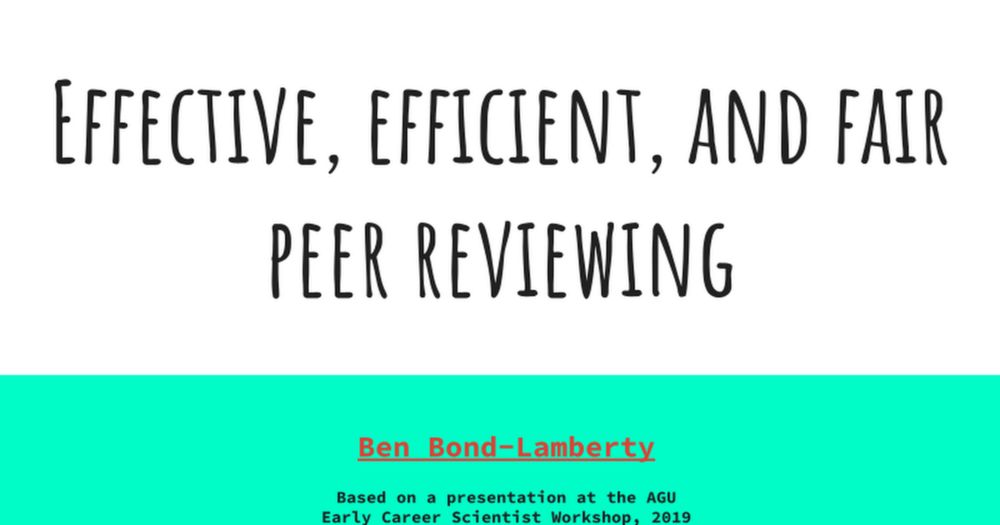
Effective, efficient, and fair peer reviewing 2023
Effective, efficient, and fair peer reviewing Ben Bond-Lamberty Based on a presentation at the AGU Early Career Scientist Workshop, 2019 1
Scientists are expected to do peer reviewing but no one tells you HOW. After talking with several folks about this today at #AGU24 , it seems a good time to link to this presentation I made several years ago -- feel free to use/share! docs.google.com/presentation...
12.12.2024 22:18
👍 148
🔁 55
💬 5
📌 2

I sadly won't be at #AGU24 this year, but some of our lab members and science will be! 🍃🌈🌎🧪
09.12.2024 14:17
👍 5
🔁 0
💬 0
📌 0

🌿📷🌡️ Calling all #NearSurfaceRemoteSensing enthusiasts at #AGU24!
Join us for the session "B21B – Advancing Environmental Monitoring through Near-Surface Imaging Technologies"
📅 Tuesday
⏰ 8:30–10:00 AM
📍 Room 151B
04.12.2024 17:26
👍 5
🔁 2
💬 0
📌 0


Book chapter pre-print on scaling forest ecophysiology using optical techniques. 🍃->🌲🌳->🌎
It was impossible to cover as much as I wanted to, but wanted to share in case anyone has useful feedback, I'd love to hear from you and change accordingly!
essopenarchive.org/users/534071...
13.11.2024 00:47
👍 11
🔁 3
💬 0
📌 0


New paper in Ecology! 🌲❄️
"Seasonal timing of fluorescence and photosynthetic yields at needle and canopy scales in evergreen needleleaf forests" by Zoe Pierrat et al.
esajournals.onlinelibrary.wiley.com/doi/10.1002/...
PS I'm going to start using bsky more :)
20.08.2024 17:24
👍 6
🔁 3
💬 0
📌 0


Recent install of TSWIFT (Tower-Spectrometer on Wheels Investigating Frequent Timeseries) at Tonzi Ranch - excited to link optical and energy fluxes at this iconic oak savannah woodland site!
@ucdavisplants.bsky.social
21.02.2024 18:39
👍 4
🔁 1
💬 0
📌 0

A Century of Reforestation Reduced Anthropogenic Warming in the Eastern United States
<em>Earth's Future</em> is a transdisciplinary, open access AGU journal examining the state of the planet, sustainable and resilient societies, and the science of the Anthropocene.
🌳 🌡️ For my first post here, I'm thrilled to share our latest research! We show how extensive reforestation in the SE US contributed to regional cooling in the 20th century. We also highlight the potential benefits of temperate zone reforestation for local & regional climate adaptation. 🌎 💚
14.02.2024 14:55
👍 43
🔁 18
💬 1
📌 0
really?? That's wild I can send you a pdf
09.01.2024 21:11
👍 1
🔁 0
💬 0
📌 0

Really excited to share with my small following here this paper that summarizes the last 5 years of our work trying to understand how to track photosynthesis in evergreen forests across scales 🌲🌈
Led by Zoe Pierrat, and published in BioScience!
tinyurl.com/bioscizp
09.01.2024 20:47
👍 10
🔁 5
💬 1
📌 0

Looking forward to #AGU23! Come find these great scientists and humans from the Plant Optics Lab
Scientific Program link to our stuff: tinyurl.com/PlantOpticsL...
07.12.2023 15:49
👍 1
🔁 1
💬 0
📌 0
here's to hoping this platform takes off, I finally made it
08.11.2023 17:00
👍 4
🔁 0
💬 0
📌 0


