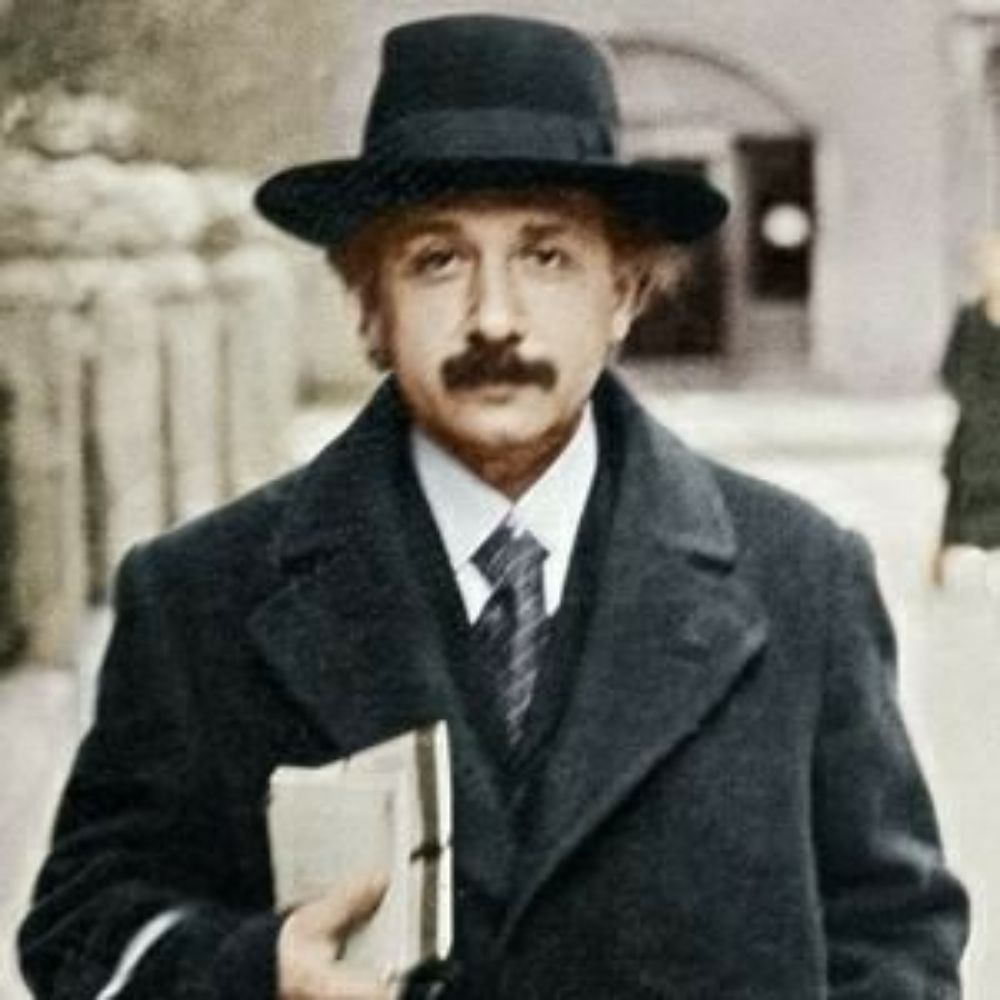

Remark made by Wolfgang Pauli during 5th Solvay Conference in 1927 during a discussion about the religious views of various physicists ✍️
07.03.2026 14:00
👍 5
🔁 3
💬 0
📌 0
Remark made by Wolfgang Pauli during 5th Solvay Conference in 1927 during a discussion about the religious views of various physicists ✍️

We are all agreed that your theory is crazy. The question that divides us is whether it is crazy enough to have a chance of being correct.
-- Niels Bohr to W. Pauli after his presentation of Heisenberg's and Pauli's nonlinear field theory of elementary particles, at Columbia

One of the most amazing 'what ifs' in modern physics involves a blackboard and a cleaner. Physicist Alan Lightman recalls a day in the 1970s when he and two graduate students were explaining their work on spinning black holes to Feynman over lunch at Caltech.
Feynman immediately

Sir Isaac Newton once inserted a bodkin—a long, blunt needle—between his eyeball and the bone of his eye socket just to see what would happen.
He carefully recorded the colored circles and other visual effects produced by pressing and rubbing his eye with the needle. In another

For the things we have to learn before we can do, we learn by doing.
-- Aristotle
(384 BC – 322 BC)

Not often in life has a human being caused me such joy by his mere presence as you did.
-- A. Einstein in a letter to Bohr (1920)

Georg Cantor introduced the concept of different "sizes" of infinity, which is counter-intuitive when you first encounter it. For many people, the idea of infinity means something without end, unlimited and universally same-sized. But Cantor, through his work on set theory,

Richard Feynman's favorite integral trick 🧠
Feynman’s integral trick is a method of evaluating integrals by differentiating them with respect to a parameter that is introduced artificially. The idea is to find a function of two variables, F(x, t), such that the original

There is no authority who decides what is a good idea.
- Richard Feynman

Bernhard Riemann's 1854 habilitation lecture introduced the idea of a manifold with a smoothly varying positive-definite metric tensor—well before the formal definition of tensors existed.

Extinction is the rule.
Survival is the exception.
-- Dr. Carl Sagan

Max Planck introduced the quantum idea in 1900 as a mathematical trick to fit blackbody radiation data, but he didn’t believe in the physical reality of quanta until years later.

The Pythagorean theorem was well-known to the Babylonians over a thousand years before Pythagoras was born. The clay tablet Plimpton 322 (c. 1800 BCE) contains columns of numbers representing Pythagorean triples, long before the Greek philosopher derived the relationship in the

For most of its history, what we now call "physics" was known as "physica" or "natural philosophy." It was considered a branch of philosophy, more about logical discourse and first principles than the rigorous, experiment-driven science it became in the 19th century.

For centuries, Aristotelian physics was the standard in Europe until it was overturned by the work of Galileo and Newton.

The Higgs boson aka the "God particle," was named after physicist Peter Higgs, who proposed its existence in 1964. But, the nickname "God particle" was actually coined by Leon Lederman in his book "The God Particle: If the Universe is the Answer, What is the Question?"

Quantum decoherence is the process where a quantum system loses its superposition due to interactions with its environment. This doesn’t "collapse" the wavefunction but entangles the system with its surroundings, making quantum interference unobservable. As coherence fades,

Physicist J. Robert Oppenheimer Discussing Theory of Matter with Albert Einstein at the Institute for Advanced Study in Princeton, New Jersey, 1947.

Three generations of Einstein - with Albert Einstein (right), his son Hans Albert Einstein and grandson Bernhard Caesar Einstein.

26 Feb, 1616: The Roman Catholic Church officially prohibited Galileo Galilei from promoting or supporting the belief that the Earth revolves around the sun.

The shortest physics paper ever published is the 1951 Physical Review note by Friedrich Lenz, titled
“The Ratio of Proton and Electron Mass.”
At just 27 words long (plus one equation, one number and a single reference).

The famous equation E=mc² was first introduced by A. Einstein in a scientific paper titled “Ist die Trägheit eines Körpers von seinem Energieinhalt abhängig?”, which was published in the German scientific journal Annalen der Physik on September 27, 1905. This paper is now known

Feynman introduced the path-integral formulation in 1948 and, before diagrams caught on, he circulated ideas and (as Dyson later explained) needed personal explanation/translation to colleagues. Evidence for mimeographed handouts is more from historical narratives, but the

Kepler's laws of planetary motion, formulated by Johannes Kepler in the early 17th century, revolutionized our understanding of how planets orbit the Sun.
1. Law of Ellipses (First Law): Each planet orbits the Sun in a path called an ellipse, with the Sun at one of the two foci
Kepler's laws of planetary motion, formulated by Johannes Kepler in the early 17th century, revolutionized our understanding of how planets orbit the Sun.
1. Law of Ellipses (First Law): Each planet orbits the Sun in a path called an ellipse, with the Sun at one of the two foci

"Study the science of art and the art of science. Learn how to see. Realize that everything connects to everything else."
- Leonardo da Vinci (1452 - 1519)

Heisenberg's uncertainty principle ✍️

Doing nothing vs Small consistent effort ✍️
Is time fundamental, or an emergent illusion? ✍️

In 1939, Albert Einstein, along with physicist Leo Szilard, wrote a letter to U.S. President Franklin D. Roosevelt. The letter warned that Germany might be developing an atomic bomb and suggested that the U.S. should accelerate its own nuclear research. This rare incident marked