
1/9 New blog is live! This is part 2 of a series—last time we looked at the Dunning-Kruger effect, now we are digging in to Implicit vs Explicit attitudes and the Implicit Association Test. To start, of course we need a good meme...
haines-lab.com/post/part-2-...
26.01.2026 17:45
👍 42
🔁 15
💬 4
📌 3
This has been a long journey. It started in April 2019 with a real eureka moment. I feel incredibly lucky to have @mattansb.msbstats.info as a major wind and support (and friend!) throughout this work. Years of work with Roi Cohen Kadosh and Avishai Henik, and we're thrilled it's finally out.
10.01.2026 13:14
👍 2
🔁 0
💬 1
📌 0
We also used a numerical Stroop task and found that stronger numerical bias in CLIP predicts larger Stroop effects when numbers must be ignored. This suggests a "tendency layer": varying attentional processes that predetermine how hard it is to ignore irrelevant information.
10.01.2026 13:14
👍 2
🔁 0
💬 1
📌 0

These individual differences predicted math fluency and quantitative reasoning, echoing child SFON research.
10.01.2026 13:14
👍 2
🔁 0
💬 1
📌 0

Hierarchical Bayesian Drift Diffusion modeling lets us combine choice and RT into a single measure, avoiding reliability problems of difference scores. The result: fantastic internal reliability and stable individual differences across all CLIP conditions.
10.01.2026 13:14
👍 2
🔁 0
💬 1
📌 0
Why this matters: Research on children shows that spontaneous focus on numerosity (SFON) predicts math skills and math development. The CLIP task provides a computerized version that can fit both adults and children! It captures these spontaneous tendencies trial by trial, and works great online!
10.01.2026 13:14
👍 2
🔁 0
💬 1
📌 0

Our paper is finally out in Cognition! 🎉
We introduce the "CLIP task"—a computerized paradigm for measuring numerical bias in adults: when number and physical size both matter, do you spontaneously rely more on numbers or on physical size?
10.01.2026 13:14
👍 13
🔁 5
💬 1
📌 2
This has been a long journey. It started in April 2019 with a real eureka moment. I feel incredibly lucky to have @mattansb.msbstats.info as a major wind and support throughout this work. Years of work with Roi Cohen Kadosh and Avishai Henik, and we're thrilled it's finally out.
10.01.2026 12:56
👍 0
🔁 0
💬 0
📌 0
These individual differences predicted math fluency and quantitative reasoning, echoing child SFON research.
10.01.2026 12:56
👍 0
🔁 0
💬 0
📌 0

Hierarchical Bayesian Drift Diffusion modeling lets us combine choice and RT into a single measure, avoiding the reliability problems of difference scores. The result: fantastic internal reliability and stable individual differences across all CLIP conditions.
10.01.2026 12:56
👍 0
🔁 0
💬 1
📌 0
Why this matters: Research on children shows that spontaneous focus on numerosity (SFON) predicts math skills and math development. The CLIP task provides a computerized version that can fit both adults and children! It captures these spontaneous tendencies trial by trial, and works great online!
10.01.2026 12:56
👍 0
🔁 0
💬 1
📌 0
OSF
New preprint with @rogierk.bsky.social @paulbuerkner.com - we introduce "relative measurement uncertainty" - a reliability estimation method that's applicable across a broad class of Bayesian measurement models (e.g., generative-, computational- and item response theory-models osf.io/h54k8
01.10.2025 08:17
👍 19
🔁 7
💬 2
📌 5

Exploring {ggplot2}’s Geoms and Stats – Stat’s What It’s All About
New blog post!
Ever wonder what geom_histogram is actually doing? How about geom_boxplot?
In celebration of the release of #ggplot2 4.0.0 (ggplot8?), I explore the relationships between the “geoms” and “stats” offered by the core {ggplot2} functions.
#rstats
15.09.2025 19:04
👍 80
🔁 35
💬 1
📌 4
Within-person factorial experiments, log(normal) reaction-time data | A. Solomon Kurz
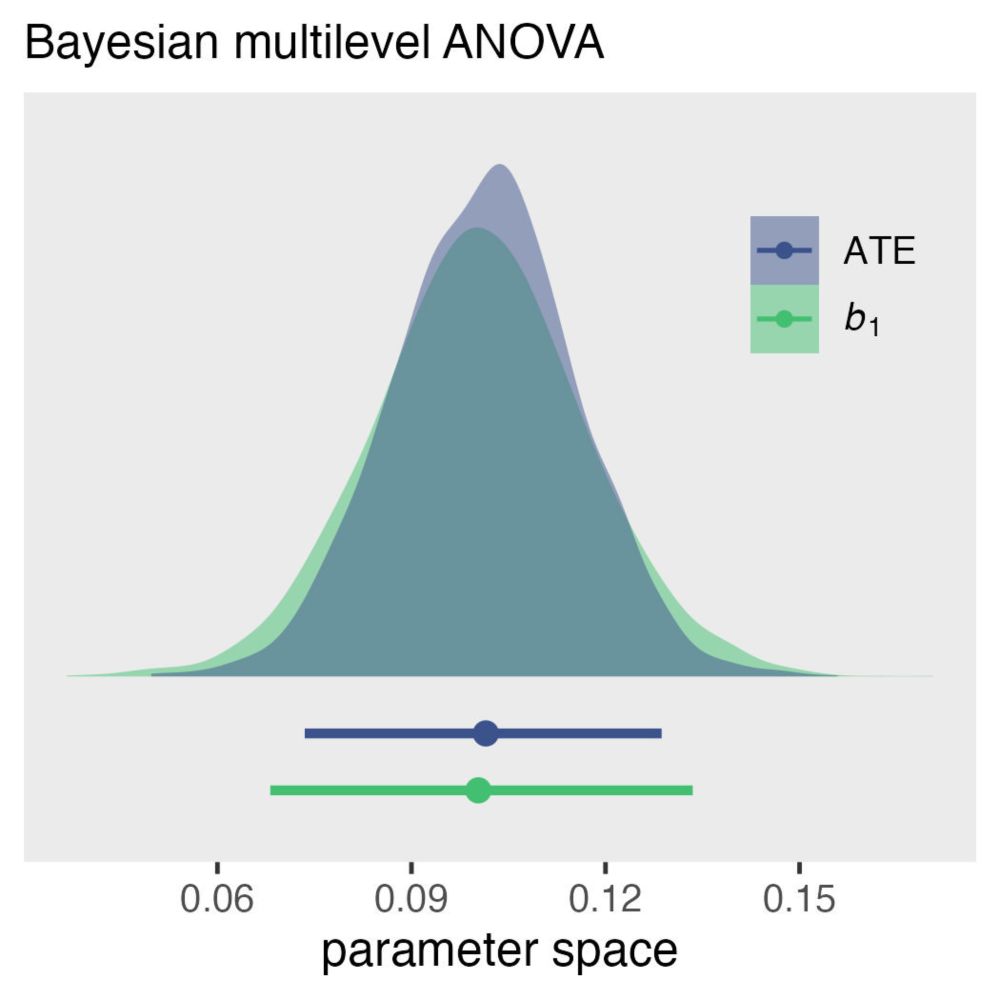
Causal inference with the GLMM, Part 1
New #rstats blog up!
solomonkurz.netlify.app/blog/2025-07...
This is the first in a new series discussing causal inference with experimental data using multilevel models. My basic case is g-computation is the way to go.
21.07.2025 14:14
👍 97
🔁 19
💬 7
📌 1
Beyond the Exclamation Points!!! – CogPsych Reserve
Dive in for code, visuals, and a clearer path through the log-odds fog → cogpsychreserve.netlify.app/posts/logist...
#NLP #Kaggle #marginaleffects #BayesianStatistics #DataScience #SignificantTesting
14.07.2025 07:14
👍 5
🔁 1
💬 0
📌 0
2/3
• NLP + PCA to capture toxicity/incoherence
• Cohen’s d ➡️ log-odds priors in one line using #brms
• #marginaleffects → 0–100 % probability shifts you can explain
• Inference with HDI-ROPE. It flags which effects are big enough to matter. Great for researchers and anyone shipping spam filters!
14.07.2025 07:14
👍 2
🔁 0
💬 1
📌 0

1/3 New post up! 📝 I took the workhorse 🔧 of binary modeling—logistic regression—and gave it a Bayesian tune-up using a Kaggle SMS-spam dataset.
14.07.2025 07:14
👍 19
🔁 6
💬 2
📌 2
Thanks Laura! 🙏 I analyzed vertical-face tasks (6 variants across SOAs) from subjects with mouse responses only. The Preprocessing details are in the post’s collapsible section 😊. Grateful for your work—DM anytime!
08.03.2025 20:22
👍 3
🔁 0
💬 0
📌 0
Thank you! 😊 While latent correlations are possible in Stan via custom likelihoods (modeling latent Gaussian variables), it's quite involved. For 95% of cases, I recommend the simpler brms approach: model questionnaires as predictors of task effects using condition-by-questionnaire interactions.
08.03.2025 20:05
👍 2
🔁 0
💬 0
📌 0
6/6 Thanks to @solomonkurz.bsky.social for statistical inspiration, @natehaines.bsky.social for works that influenced my approach, and @almogsi.bsky.social & @mattansb.bsky.social or thoughtful feedback!
#BayesianStatistics #ReliabilityAnalysis #CognitiveScience
07.03.2025 09:14
👍 5
🔁 0
💬 0
📌 0
5/6 The implications go beyond this single task. Many measures in psychology (and beyond) might be more reliable than we thought—we need to preserve and properly model the information in trial-level data.
07.03.2025 09:14
👍 3
🔁 0
💬 1
📌 0

4/6 This visualization shows the transformation when the same data is analyzed with trial-level Bayesian methods instead of traditional aggregation:
07.03.2025 09:14
👍 4
🔁 0
💬 1
📌 0
3/6 I implemented two Bayesian approaches in #brms:
@jeffrouder.bsky.social & @juliaha.bsky.social's variance decomposition
@gangchen6.bsky.social's approach
Both show substantially higher reliability than traditional analyses.
07.03.2025 09:14
👍 3
🔁 0
💬 1
📌 0
2/6 Recent research by @irenexu.bsky.social claimed the emotional dot-probe task lacks reliability for individual differences research. I wanted to see if more sophisticated analysis methods could tell a different story.
07.03.2025 09:14
👍 2
🔁 0
💬 1
📌 0
The Dot-Probe Task is Probably Fine – CogPsych Reserve
1/6 Hello Bluesky! 👋 Excited to join this community and share my new blog. First post: Using Bayesian hierarchical models to rescue "unreliable" cognitive tasks, with the dot-probe task as my case study. cogpsychreserve.netlify.app/posts/dotpro...
07.03.2025 09:14
👍 64
🔁 17
💬 7
📌 8

