Um, does this only work for highly enriched uranium? Asking for (all my) friends who live on a continent where uranium mining occurs...
03.03.2026 13:51
👍 0
🔁 0
💬 1
📌 0
@kenolivelab
Ast. Dean for Graduate Curricula and Asc. Prof. of Medicine at Columbia University Vagelos College of Physicians and Surgeons. Comments are my own and do not reflect Columbia positions. Dedicated to educating scientists and curing pancreatic cancer.
Um, does this only work for highly enriched uranium? Asking for (all my) friends who live on a continent where uranium mining occurs...
Same. Fortunately the NIH has indicated that they will be flexible for this deadline about NIH biosketch formats
I'm sorry, I can't really celebrate this. Up to 40% MYF is devastating for funding rates. Many careers will be ended because this provision was left in. This was a failure.

Did you know pancreatic tumors plan their travels? Learn more about this fascinating new discovery: www.cancer.columbia.edu/news/pancrea...
The language on multiyear funding (MYF) is ineffective.
Final bill anchors MYF to 2025 instead of 2024. This means MYF will likely continue at the same rate we saw last year, where NCI's payline from ~10% to 4%.
This is incredibly harmful to the US research workforce - especially early career.

Graphic helps visualize how MYF funds FEWER grants despite the increase in budget approval by Congress. https://www.researchamerica.org/wp-content/uploads/2025/11/ACT-for-NIH-Multi-Year-Funding-One-Pager_October-2025.pdf
🧪IMPORTANT! This graphic explains how science all over the US is funded. Congress approved a 2% increase in the #NIH budget for FY 26.
Buried in the bill-
Shift of ~40% of grants to MYF. This will still result in a 35% DECREASE in the NUMBER of grants funded per yr.
Russel Vought is behind this.
The NIH's MYF policy in 2025 resulted in 4000 fewer grants and fellowships that touched every area of biology and medicine; continuing it in 2026 would be disastrous for science, technology and health in the United States 🧪
www.nytimes.com/interactive/...

This line graph illustrates the percentage change in agency staff levels from the previous year for nine major U.S. federal scientific and health organizations between the fiscal years 2016 and 2025. The agencies tracked include the CDC, Department of Energy, EPA, FDA, NASA, NIH, NIST, NOAA, and NSF. For the majority of the timeline between 2016 and 2023, the agencies show relatively stable fluctuations, generally staying within a range of +5% to -5% change per year. However, there is a dramatic and uniform plummet starting in the 2024–25 period. Every agency depicted shows a sharp downward trajectory, with staffing losses ranging from approximately -15% to over -25%. The Environmental Protection Agency (EPA) shows the most significant decline, dropping to roughly -26%, while the National Institute of Standards and Technology (NIST) shows the least severe but still substantial drop at approximately -15%.
This is the most astonishing graph of what the Trump regime has done to US science. They have destroyed the federal science workforce across the board. The negative impacts on Americans will be felt for generations, and the US might never be the same again.
www.nature.com/immersive/d4...
I understand that historically PubMed didn't populate coauthorships, but surely this can be fixed going forward. And I can't think of a better use-case for LLMs than to retroactively annotate every paper in PubMed with coauthorship data... we owe it to our trainees to fix this.
By mandatory, I mean that all NIH grants starting this month must use ScienCV for generating biosketches. Since the system pulls from NCBI's MyBibliography (and by extension PubMed), co-authorships are not indicated.
It is a PROBLEM that the new MANDATORY ScienCV platform does not (as far as I can tell) enable one to indicate co-first or co-senior authorship in your bibliography. This is a massive disincentive to collaborative science and it needs to be fixed.
NIH - you can ONLY use our proprietary system to generate your biosketch. Simply typing it up isn't allowed. Ready GO! Everyone has to start using it RIGHT NOW!
Also NIH - what do you mean they ScienCV is barely functional and hangs every time you use it? no idea what your talking about...
@vicaranda.bsky.social @elizsmckenna.bsky.social @barbmarte.bsky.social
@i-mei.bsky.social @kristabledsoe.bsky.social @annaedart.bsky.social ?
Dear journal editors, what do we think about including summary figures in a cover letter? I've never done this, but a co-author wants to include one for our latest manuscript. Helpful in illustrating the case? Weird and gauche? What say ye?

A PSA on PSA from @glaucomflecken.bsky.social...
www.youtube.com/shorts/_u0CW...
The ghost of USAID enters and the room gets quiet...
100% this
Among the highest compliments that I've received have been the times colleagues mentioned that their lab reviewed one of my papers in their journal club.
Finally, a huge thanks to all of our incredible students at #CSHLPDAC25. This was a standout class who leaned into the science, the questions, and... UNO! Look forward to seeing you all at meetings for many years to come!
and Channing Der (RAS), Jen Jen Yeh (Tumor/Stroma subtyping). Also, a huge shoutout to my fellow course directors, Marina Pasca de Magliano, Ben Stanger @benstanger01.bsky.social, and Tony Hollingsworth.
Howard Crawford @hccvpdac.bsky.social (Tumor Bio I), Herve Tiriac @htiriac.bsky.social (Model Systems II), Teresa Zimmers @teresazimmers.bsky.social (Cachexia), Costas Lyssiotis @lyssiotislab.bsky.social, Rushika Perera @rushika-perera.bsky.social (Autophagy), Faiyaz Notta (Genetics/Genomics)..
So, I dropped the ball in my #CSHLPDAC25 posts. Huge shout out to all of the instructors I didn't get to highlight with photos, including: Ingunn Stromnes (Immunology I), David DeNardo (Immunology II), Bryson Katona (Epidemiology and Early Detection)...
Every time a school implements this policy, behavior problems go down and learning metrics go up. If you need to talk to your kid, you call the main office, just like every prior generation did in the past.
OMG I've never supported a measure more. As does every single teacher I've ever met. Both my kids schools ban phones and it changes every aspect of behavior for the kids. All for the better.
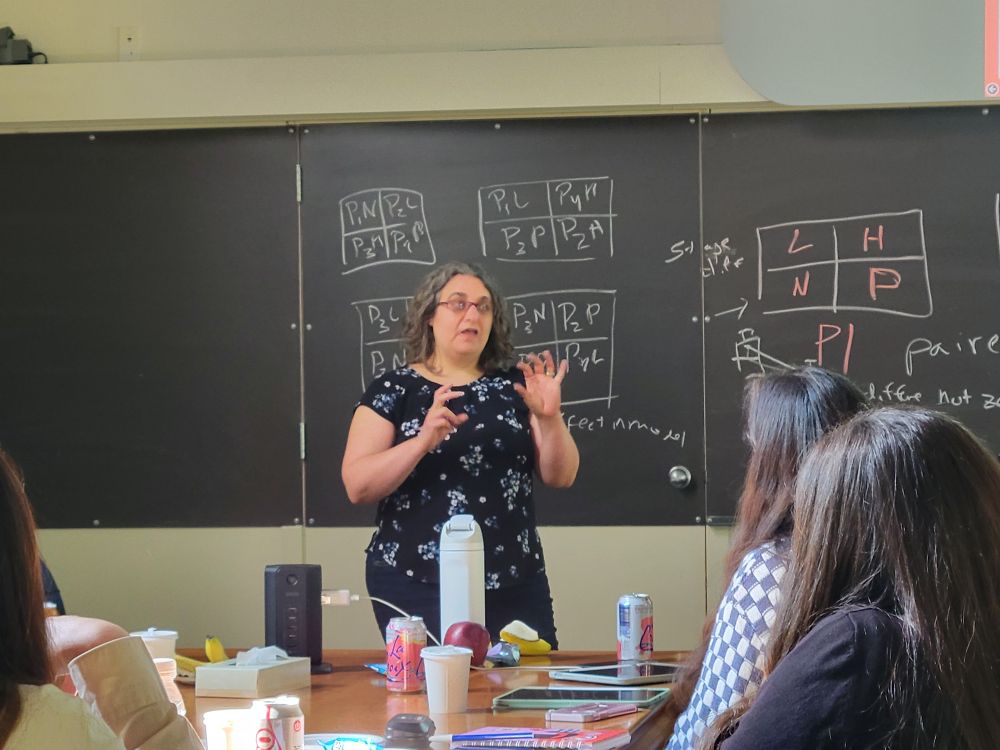
Computational biologist extraordinaire Dr. Elana Fertig @fertiglab.bsky.social asks "what's your QUESTION?" Please be nice to your friendly neighborhood computational scientist!
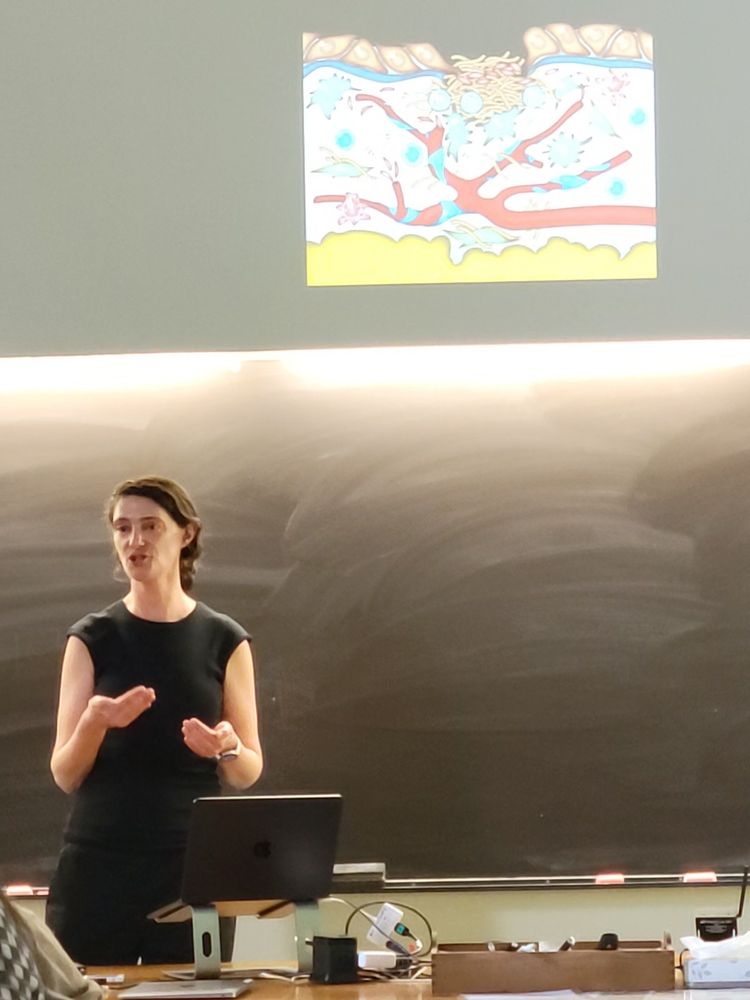
In our second talk on cancer-associated fibroblasts, Dr. Mara Sherman from MSKCC digs into the functional relationships of CAFs with other cells in pancreatic cancer at #CSHLPDAC25.
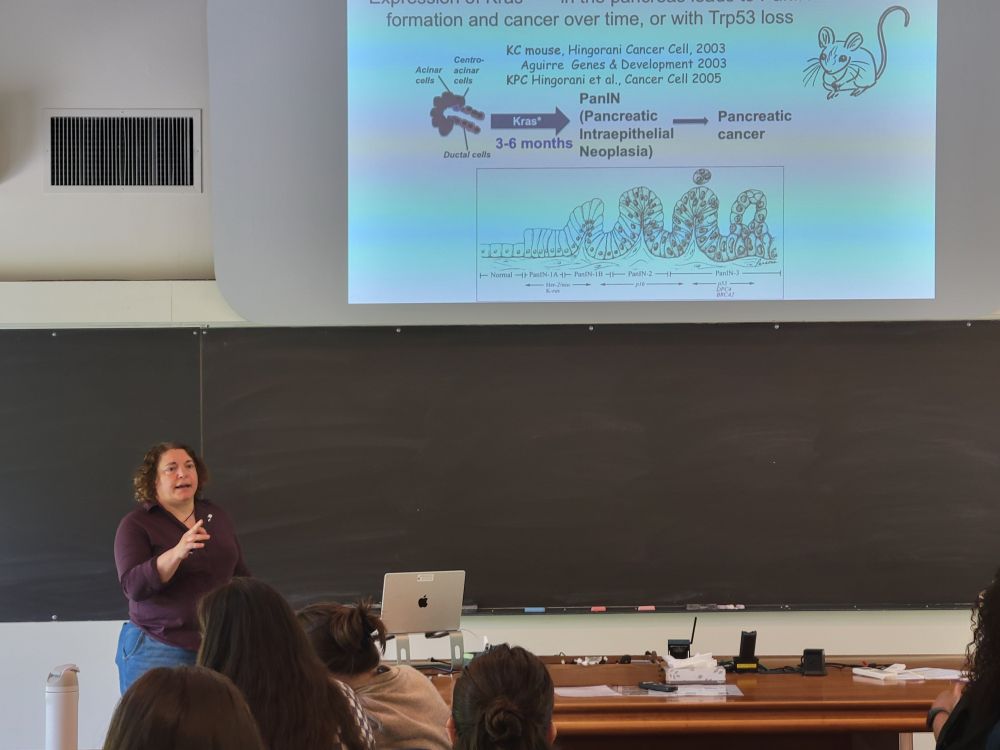
Next up, course director (and fellow Hedgehog pathway afficianado) Dr. Marina Pasca de Magliano from UMich gave the first of two lectures on fibroblasts in the pancreas, preneoplasia, and PDAC.
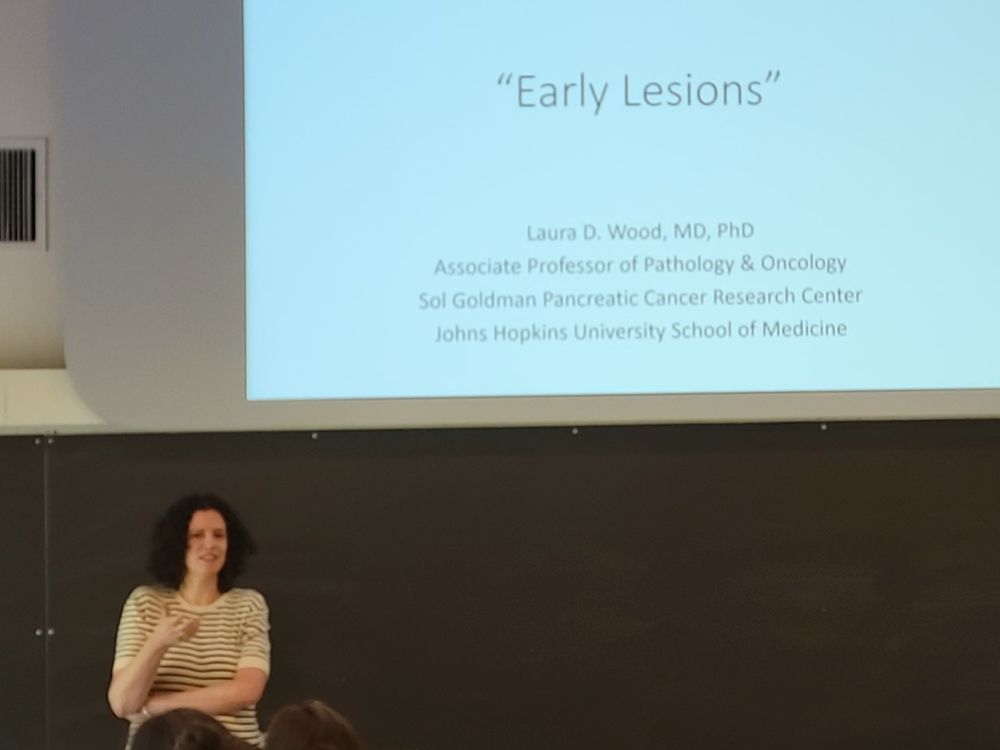
Dr. Laura Wood gave a fascinating lecture on precursor lesions and the spectacular 3D pathology tools that she and her extended team at JHU have developed to quantify pancreatic pathology.
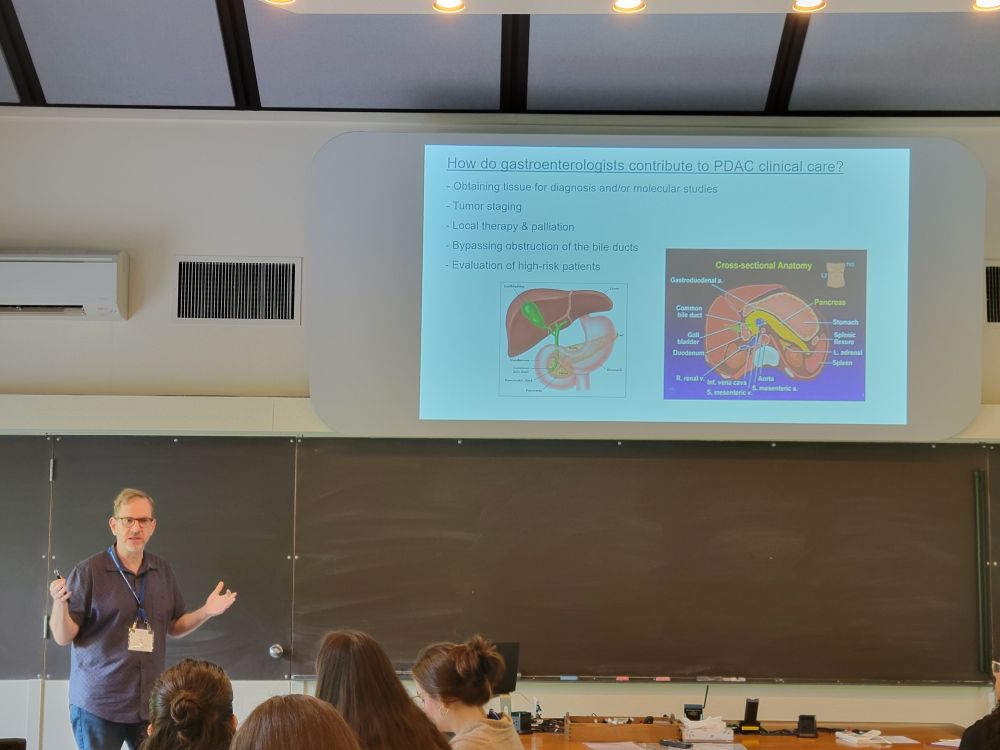
Kicking off the morning with end-to-end coverage of gastroenterology for #PDAC, from the inimitable Dr. Ben Stanger @benstanger01.bsky.social! #CSHLPDAC25
Radiology and Radiation Oncology - Dr. Eugene Koay from MD Anderson tells us they both are RAD!