Image shows chromosome pairs with abnormal, stunted, chromosome 22 which causes chronic myeloid leukaemia. Credit: Nangalia Research Group.
The abnormal gene which causes chronic myeloid leukaemia has a very strong ability to drive rapid growth of the cancer, research has revealed 🧬
Scientists were able to track the evolution of this gene to study the rate at which the cancer cells expand: bit.ly/42riKOk
10.04.2025 10:58
👍 2
🔁 2
💬 1
📌 0
Lovely piece from @s-j-aitken.bsky.social and Claudia Arnedo Pec discussing our recent paper in @nature.com on persistent mutagenic DNA lesions... Love the title!
Puts it in the context of their beautiful previous work on lesion segregation
02.04.2025 21:28
👍 5
🔁 0
💬 0
📌 0

Mitochondrial single cell-multi-omics for lineage tracing and genetics
Interested in 'Mitochondrial single cell-multi-omics for lineage tracing and genetics'? Apply for our free workshop in Berlin following our #ISCO2025 conference!
www.isco-conference.eu
www.mdc-berlin.de/news/events/...
31.01.2025 10:36
👍 9
🔁 5
💬 0
📌 1

Is hypothesis generation a hindrance to Night Science? @itaiyanai.bsky.social and @stearnslab.bsky.social demonstrated how easy we fall into pattern recognition, missing the “Gorilla” in our own data. Today’s seminar was all about identifying new strategies to stay curious about our own data.
31.01.2025 00:59
👍 13
🔁 3
💬 0
📌 1
Thanks Trevor! I remember this was the PhD chapter that probably sparked the most viva discussion.. ☺️
17.01.2025 11:46
👍 0
🔁 0
💬 1
📌 0
Thank you!
16.01.2025 22:20
👍 0
🔁 0
💬 0
📌 0
Ha.. yeah, the big question! Not really unfortunately. We think it is probably structurally non-bulky so as not to substantially stall the replication machinery. And may relate to the hypoxic niche of HSCs. I know others have also speculated that aldehydes may be involved.. Any theories welcome!
16.01.2025 14:22
👍 0
🔁 0
💬 0
📌 0
Thanks for sharing! And apologies for the cheap kitten meme..
16.01.2025 10:41
👍 2
🔁 0
💬 0
📌 0
Thank you Maria!
16.01.2025 10:08
👍 1
🔁 0
💬 0
📌 0
Thanks Andrew. Yeah, an exciting discovery is rarely the end result! But great when it is
16.01.2025 09:37
👍 1
🔁 0
💬 0
📌 0
Ha! Love it.. need to get a copy of that for my wall
16.01.2025 09:34
👍 1
🔁 0
💬 1
📌 0

Discovery of lingering DNA damage could change our understanding of cancer development - Barts Cancer Institute - Queen Mary University of London
Dr Michael Spencer Chapman and team have uncovered forms of DNA damage in healthy cells that can persist unrepaired for years.
📰 Some forms of DNA damage linger unrepaired in healthy cells for years, according to a @nature.com study led by Dr Mike Spencer Chapman @mikespencerchapman.bsky.social at BCI and @sangerinstitute.bsky.social.
The findings could inform our understanding of #cancer development. 🧪 #medsky
15.01.2025 16:42
👍 11
🔁 5
💬 0
📌 0
This is a cool paper about the surprisingly long-term persistence of DNA lesions (single stranded DNA errors) in the human body. Exquisitely meticulous work from conception through to execution. Congratulations @mikespencerchapman.bsky.social
15.01.2025 22:41
👍 28
🔁 9
💬 1
📌 0
Yes! @s-j-aitken.bsky.social your fantastic work on lesion segregation really was the foundation for this.. gave us early confidence that some lesions were able to persist through multiple cell divisions & that our theory was viable
15.01.2025 22:45
👍 5
🔁 1
💬 1
📌 0

a close up of a statue of yoda with the words `` thank you wise one '' written below him .
ALT: a close up of a statue of yoda with the words `` thank you wise one '' written below him .
A huge thank you to Peter Campbell, my supervisor whose insights were vital to getting this study started. When I showed him the 1st unexpected mutation he said (typically) ‘I wondered if this might happen..’ Also, thanks to @imartincorena.bsky.social & @timcoorens.bsky.social for valuable advice.
15.01.2025 21:44
👍 5
🔁 0
💬 2
📌 0
Also, the whole idea of these persistent lesions builds on the concept of 'lesion segregation' observed (again, unexpectedly) and developed by
@s-j-aitken.bsky.social , Martin Taylor, Duncan Odom & team.
15.01.2025 21:44
👍 2
🔁 0
💬 2
📌 0

This discovery science is only possible thanks to the large-scale somatic phylogeny datasets re-analysed here, generated by Emily Mitchell, Stan Ng, Matthias Wilk,Kenichi Yoshida,Jyoti Nangalia+others, funded by @cancerresearchuk.org @sangerinstitute.bsky.social @wellcometrust.bsky.social + others
15.01.2025 21:44
👍 2
🔁 0
💬 1
📌 0

Intriguingly, blood stem cells had a particular type of very long-lasting damage (~2-3 years), leading to 15-20% of their mutations – some contributing to cancer. This damage wasn’t evident in other tissues. We have theories, but we don’t yet know why.
15.01.2025 21:44
👍 2
🔁 0
💬 2
📌 0
It was these patterns of unusual mutation inheritance, or multiple different mutations at the same site in closely related cells that was the key to recognizing & characterizing these unusual types of long-lasting damage.
15.01.2025 21:44
👍 1
🔁 0
💬 1
📌 0

If the base is partially recognizable, the DNA copying machinery may flip between copying it right, and copying it wrong in one specific way. This will only cause 1 mutation, but the pattern of inheritance will not fit a single acquisition event (a ‘phylogeny-violating variant’)
15.01.2025 21:44
👍 3
🔁 0
💬 1
📌 0

But what if it’s not? If the DNA damage sticks around through multiple rounds of cell division & DNA replication it may be misread in different ways in each round. This will lead to different mistakes at the same position (a ‘multi-allelic variant’).
15.01.2025 21:44
👍 3
🔁 0
💬 1
📌 0
If the damaged base is present during DNA replication it may be misread, resulting in permanent mutations that can contribute to cancer development. However, the DNA damage itself is usually recognized and mended quickly by repair mechanisms in our cells.
15.01.2025 21:44
👍 1
🔁 0
💬 1
📌 0

How did we work this out?
DNA damage is distinct from a mutation. While a mutation is one of the 4 standard DNA bases (A, G, T or C) in the wrong place (like a spelling mistake), DNA damage is chemically altered DNA (more like some illegible writing).
15.01.2025 21:44
👍 1
🔁 0
💬 1
📌 0
After ‘pulling the thread’ we found the explanation. Some specific types of DNA damage persist unrepaired through multiple cell divisions, in some cases for years. This goes against the usual idea that damage is efficiently repaired by the cell’s DNA repair machinery.
15.01.2025 21:44
👍 5
🔁 1
💬 1
📌 0

I work with somatic phylogenies: family trees of 100s of cells from 1 individual, illustrating their relationships going back to conception. It is inferred from the pattern of shared mutations in the DNA. In 2019 I noticed a mutation that didn’t fit the phylogeny – the 'blip'
15.01.2025 21:44
👍 1
🔁 0
💬 1
📌 0
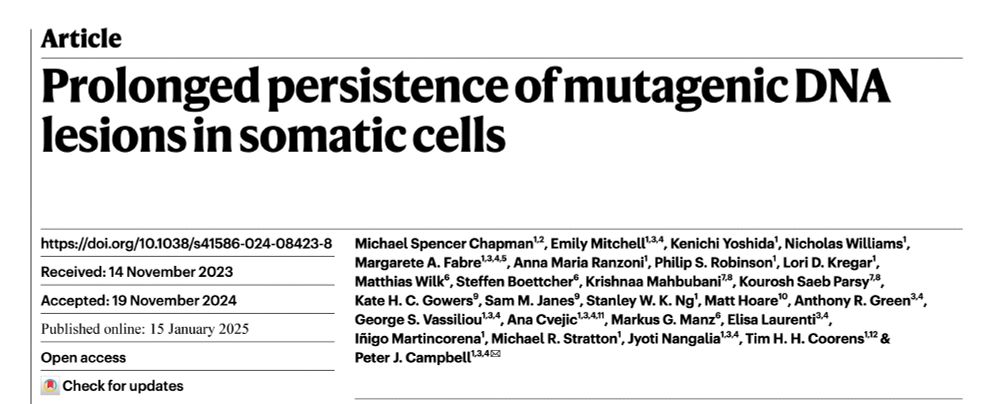
So pleased to have the paper out, available here: www.nature.com/articles/s41586-024-08423-8
For me this was discovery science as I had always hoped it would be. A lot of fun, and some proper detective work with plenty of twists & turns on the way. Brief thread below
15.01.2025 21:44
👍 48
🔁 18
💬 3
📌 1

In science, we often see weird blips in the data. The question: is it artefact (usually!), or something new & exciting? We don’t always have time to dig deep.
Our paper in @nature.com today came from just such a blip. So don’t ignore the weird stuff. Pull on that thread...
15.01.2025 21:44
👍 49
🔁 17
💬 7
📌 1
I've made the switch! Looking forward to a more inspiring newsfeed.. 🤞
14.01.2025 10:59
👍 5
🔁 0
💬 0
📌 0