This is not a reasoned political response. Labour has spent two years making all the voting groups who backed the Greens feel unwelcome and unheard, and now attacks them for daring to back someone else. They believe Labour isn’t listening and Starmer seems determined to prove them right
27.02.2026 16:16
👍 1155
🔁 321
💬 46
📌 28
This is from Keir Starmer’s letter to Labour MPs today. This sort of stuff is shockingly partisan and nasty. It will only backfire with voters who switched to Green or are thinking of switching.
27.02.2026 21:06
👍 90
🔁 19
💬 6
📌 3

Google search results AI Overview: Money is fundamentally a social contract, functioning as a shared agreement among people to trust in and accept a medium—like fiat currency or digital assets—as a store of value and method of exchange. It represents a, YouTube social bond,, YouTube that enables, YouTube cooperation, YouTube and acts as a, YouTube "claim upon society," YouTube rather than possessing, YouTube intrinsic, YouTube value.
I am trying not to read anything too sinister into the fact that, when I searched for "money as a social contract", the concept of "society" induced a nervous breakdown in Google's AI bot, which began randomly yelling "YouTube" at me in response.
10.02.2026 12:29
👍 3
🔁 0
💬 0
📌 0

While rolling targets avoid many of these issues, the fact that the date for meeting them
never arrives means that the fiscal position can progressively deteriorate. History tells us that
Chancellors tend to take advantage, over successive Budgets, of the additional year to meet
their targets by loosening fiscal policy, while planning a sufficiently large fiscal tightening to
hit the target in the target year. Chart 4.4 shows the example of the Coalition’s rolling
structural current balance target (a five-year target from 2010 to 2014, then a three-year
target until 2015), which yielded no structural current surpluses in outturn.
One point worth emphasising is that, by then, tax rises may not be needed to comply with UK fiscal rules, which specify a 3-year *rolling* target (tho may be needed to placate bond markets). As the OBR noted back in 2021, the problem with such rules is 'the date for meeting them never arrives' [2/2]
27.11.2025 10:06
👍 0
🔁 0
💬 0
📌 0

Rachel Reeves’ Budget fails her own 3 claims
Chancellor’s actions not enough to satisfy pledges on cost of living, debt and NHS
Lots of good commentary in the FT from @stephenkb.bsky.social and others questioning whether the delayed fiscal consolidation in yesterday's Budget will ever be delivered, given these tax rises are due to kick in from 2028 with an election looming...
[1/2]
on.ft.com/3LVEeOK
27.11.2025 10:06
👍 0
🔁 0
💬 1
📌 0
There's an important debate to be had on the wisdom of simultaneously increasing employer NICs, the minimum wage and employment rights. The jobs market does look weaker. But an alternative reading of this chart is that employment has just continued on its pre-election trend?
31.08.2025 11:17
👍 15
🔁 4
💬 2
📌 0
This kind of descriptive analysis is v interesting- well worth a read
01.09.2025 07:30
👍 31
🔁 5
💬 0
📌 0

Prosperity and inequality in mature knowledge economies
Abstract. In the 1990s, policymakers in affluent democracies viewed the ‘knowledge economy’ as a solution to economic stagnation and social exclusion. Yet,
What makes recent technological developments so devastating is not their novelty, but rather that the political economy of developed democracies is already set up to ensure the proceeds of growth are not widely shared.
You can download the full article for free here:
doi.org/10.1093/ser/...
[5/5]
01.09.2025 06:17
👍 32
🔁 12
💬 1
📌 2
This is not (just) a story about generative AI displacing new graduates: it is a story about how knowledge work has been transformed and squeezed by successive technological advances, such as cloud computing and the platformisation of the digital economy. [4/5]
01.09.2025 06:17
👍 7
🔁 2
💬 1
📌 0
Moreover, even those sectors that were supposed to epitomise the new high-skill, high-wage paradigm in which 'what you earn depends on what you learn' have in fact become increasingly capital-intensive over time, denying skilled workers a higher share of the proceeds of growth. [3/5]
01.09.2025 06:17
👍 5
🔁 2
💬 1
📌 0
My new article, free to read in the Socio-Economic Review, explores productivity and inequality trends in advanced democracies from 1995 through to the eve of the COVID-19 pandemic. It exposes how the knowledge economy nowhere lived up to its promise of inclusive growth. [2/5]
01.09.2025 06:17
👍 6
🔁 1
💬 1
📌 0
***New article announcement!***
Prosperity and inequality in mature knowledge economies
Barely a week goes by without new reports of generative AI displacing high-skilled knowledge work. But this is part of a trend stretching back more than 20 years. [1/5]
01.09.2025 06:17
👍 13
🔁 9
💬 1
📌 1

Prosperity and inequality in mature knowledge economies
Abstract. In the 1990s, policymakers in affluent democracies viewed the ‘knowledge economy’ as a solution to economic stagnation and social exclusion. Yet,
Will AI eliminate high-skilled, high-paid knowledge work? If the recent past is anything to go by, yes. My new article explores how knowledge work has already become more capital-intensive since the early 2000s, undermining hopes of inclusive prosperity: doi.org/10.1093/ser/...
26.08.2025 11:31
👍 3
🔁 0
💬 0
📌 0

The South was never in spite of all her troubles in a position of such genuine promise as now She has forced to learn economies in production she can grow cotton now profitably at a low price although she used to get poor on it at a high one she has also learned to grow a large crop the labor question is in great measure solved on her soil and her position in the world's markets was never so favorable as now Her great staples are the equivalent of gold in a peculiar sense the governing price of cotton to day is a gold one in the great exchange markets of the world where our paper is not current and never will be The dream of all Southern publicists has always been for direct commercial relations with England Perhaps this is more than a dream perhaps not but what can be more foolish than to insist upon spurning and excluding the currency of mankind in order to cling to the non exportable paper which is the worst foe the country has
A reminder of the impermanence of currency hierarchies from the US Commercial and Financial Chronicle, 1 December 1877: 'in the great exchange markets of the world... our paper is not current and never will be.'
16.07.2025 08:03
👍 1
🔁 0
💬 0
📌 0

The #climate crisis leads to unprecedented losses & damages to real and financial #assets. But the dynamics and consequences of asset stranding are only poorly understood.
If you want to change this, please join
@trgn.bsky.social, @vapunkt.bsky.social & me for our #SASE2025 Mini-Conference (1/2)
15.10.2024 13:18
👍 19
🔁 10
💬 2
📌 2
Really looking forward to this online seminar with Quinn Slobodian, author of Crack-Up Capitalism and Hayek's Bastards, 5pm BST on Weds 4th June.
It promises to be a fascinating discussion of neoliberalism and its discontents. The link to sign up (for free!) is:
www.eventbrite.co.uk/e/professor-...
19.05.2025 08:20
👍 1
🔁 0
💬 0
📌 0

Is the UK failing its graduates?
Young people are bearing the brunt of a long-term slowdown in the labour market, data shows
Excellent (if depressing) article from the FT. Fixating on skills supply in the "knowledge economy", without considering other bottlenecks (housing/transport, access to capital, access to intellectual property/data etc), is tantamount to pumping air into a punctured tyre.
www.ft.com/content/cd13...
13.05.2025 08:28
👍 9
🔁 3
💬 0
📌 0
The lesson of Donald Trump’s business career would seem to be, to adapt Keynes, that Donald Trump can remain irrational longer than Donald Trump can remain solvent.
09.04.2025 09:17
👍 71
🔁 26
💬 1
📌 0
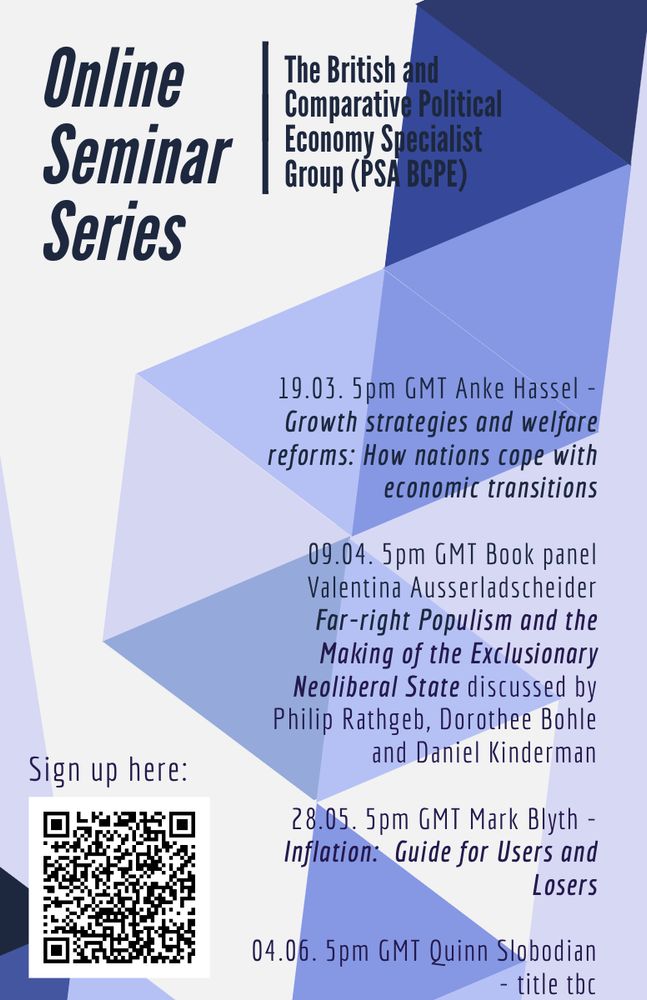
📢 Next week is our first seminar of the @psabcpe.bsky.social online series with fantastic @ankehassel.bsky.social talking about Growth Strategies And Welfare Reforms: How Nations Cope With Economic Transitions💡Please sign up 💻 & share widely ‼️
10.03.2025 10:15
👍 22
🔁 13
💬 1
📌 5
The European Union remains a funny animal.
Outside observers: rich place, lots of industry, lower debt levels than US/China. Should be able to rearm quickly and cheaply if they coordinate decision-making.
Leaders on the inside: I don’t trust my neighbour so let’s bicker while the house burns down.
03.03.2025 10:32
👍 421
🔁 110
💬 15
📌 14

Extract from the guardian website, reading Trump says more tariffs coming and calls for lower interest rates"
"Man rejects means, demands end."
12.02.2025 15:51
👍 3
🔁 0
💬 0
📌 0
Lost much of the afternoon to this.
It’s excellent.
05.02.2025 18:35
👍 15
🔁 5
💬 0
📌 0

By contrast, with second-order network effects, there could come a point when it becomes difficult to improve the quality of connection between any given individual and the things to which they might be connected (products in online retail, webpages in a search engine, diagnoses in a diagnostics app, responses to a prompt in generative AI). Beyond a certain level, additional data may cease to affect results, instead serving primarily to confirm matches. This means that incumbency advantages associated with second-order network effects do not always grow indefinitely. The risk of markets tipping irrevocably on this basis alone is thus limited, and there may be less need for privacy-invading and/or innovation-curtailing interventions to preserve competition. Conceivably, multiple organisations could acquire the number of users necessary to provide an adequate quality of matches.
If you're interested in DeepSeek and the competitive landscape around generative AI, you might find this article from a while back interesting: journals.sagepub.com/doi/full/10....
(Feeling particularly smug about this passage this week...)
29.01.2025 08:51
👍 3
🔁 0
💬 0
📌 0
📊 Last week, we released our new central bank speeches database, which almost doubles the coverage of the @BIS_org
database.
We also released a tool to facilitate research on central bank communication: meet the #CBSpeeches explorer! Four tools for the price of one (=free!)
27.01.2025 15:24
👍 44
🔁 19
💬 1
📌 2

Without Foundation
A critique of the essay Foundations by Bowman, Southwood and Hughes
Really recommend this excellent rebuttal to the 'Foundations' essay
It shouldn't need pointing out but you really can't wonder at the ability of France, South Korea, or post-WW2 Britain at building things *and* argue that the state simply can't do things
open.substack.com/pub/energyne...
18.12.2024 16:56
👍 11
🔁 2
💬 1
📌 0
💯 As I tell my students, having AI write your philosophy paper is like sending a robot to the gym for you and expecting to reap the health benefits.
12.12.2024 16:08
👍 938
🔁 242
💬 21
📌 11
Really interesting which parties have sharp variations in support across ages groups and which don't (Lib Dems relatively cross-generational in appeal; Reform cross-generational among men only).
12.12.2024 10:39
👍 3
🔁 0
💬 0
📌 0
Andy Haldane says “Today’s Great Division is a slow puncture, silently undermining us over more than half a century.”
“Malign neglect of social capital has sowed the seeds of many of today’s largest problems, economic, social and spatial. “
08.12.2024 11:55
👍 11
🔁 5
💬 0
📌 2