Join us tomorrow, Jan. 27 at 12:30–1:30 pm Pacific, for our Northwest Weed Biocontrol in Changing Environments webinar!
Find out more: www.nwriscc.org/events/webin...
26.01.2026 19:22
👍 1
🔁 0
💬 0
📌 0
We've just learned about the Ecology and Evolution of Infectious Diseases Forum, whose seminar series theme for the 2025/2026 year is climate-disease interactions!
08.01.2026 18:16
👍 2
🔁 0
💬 0
📌 0
2026 Seminar Registration – EEID Forum
EEID seminar Jan 8th 1PM EST
The role of climate change, dust-generating events, and rodents in the emergence of Valley fever in California
Jennifer Head, University of Michigan
Register here:
www.eeidforum.org?page_id=261
02.01.2026 17:04
👍 7
🔁 4
💬 0
📌 0

Join us in 2026!
Follow & sign up for our listserv (mailman11.u.washington.edu/mailman/list...) to receive events, research & more.
If you'd like to share any research, opportunities or ideas related to emerging issues at the nexus of climate change & invasive species, please get in touch!
08.01.2026 18:09
👍 1
🔁 0
💬 0
📌 0

NW RISCC's 2026 research & tool summaries included the following:
Jan et al., 2025 discussed the implications of projected decreases in suitable habitat for native bull trout and redband trout with climate change, along with projected increases in niche overlap with non-native predators.
Barker et al., 2025 presented new forecasting tools for spotted lanternfly egg hatch and adult appearance dates in the conterminous U.S.
Our Tool Summary of the Climate Adaptation Knowledge Exchange (CAKE) provided an introduction to using this interactive, online library of resources for climate adaptation planning and implementation.
Our research & tool summaries highlighted research on trout interactions with climate change and nonnative predators (Jan et al., 2025), new forecasting tools for spotted lanternfly (Barker et al., 2025), and the Climate Adaptation Knowledge Exchange.
www.nwriscc.org/resources/re...
08.01.2026 18:09
👍 0
🔁 0
💬 1
📌 0

A graphic saying, "How to tell if you have a European green crab or something else: Count the number of spines (marginal teeth) next to the eye—European green crabs have five!" and showing photos of the invasive European green crab alongside the native hairy helmet crab, native hairy shore crab, and invasive Chinese mitten crab. Below the identifying graphic, text reads, "Another invasive species featured in our "Don't get crabby, get proactive" management brief, the Chinese mitten crab, made headlines after two separate sightings in Oregon in 2025."
Another invasive species featured in our "Don't Get Crabby, Get Proactive" Management Brief, the Chinese mitten crab, made headlines after two separate sightings in Oregon in 2025.
08.01.2026 18:09
👍 1
🔁 0
💬 1
📌 0

Graphic saying "Year in Review 2025 Northwest Regional Invasive Species & Climate Change Management Network"

An infographic showing the advertisement slides for NW RISCC's 3 2025 webinars, "Climate-smart invasive species management from coast to coast," "Something warm in the water: temperature, pathogen, and invasive species impacts on freshwater fishes," and "connecting the dots from forest and estuary management to climate-resilient salmon" along with a total of 298 attendees and 316 YouTube views.

An illustration of a quagaga mussel, zebra mussel, and golden mussel, with the text, "from quagga mussels in Idaho to golden mussels in California, the threats of invasive mussels to Northwest waterways have been growing in recent years. Our "Don't move a mussel" management brief explores how climate change can impact these invasions and what we can do about it."

An illustration of three European green crabs with the text, "Our 'Don't get crabby, get proactive' management brief provides an overview of how milder winters and warmer waters can contribute to the spread and establishment of European green crab and includes a quick guide to identification."
We're celebrating a year of NW RISCC activities!
You can find recordings of our past webinars as well as upcoming ones on our website
nwriscc.org/events/webinars
You can also find our Management Briefs on invasive freshwater mussels and green crabs
nwriscc.org/resources/management-briefs
08.01.2026 18:09
👍 0
🔁 0
💬 1
📌 0
SERISCC Webinar: Dr. Brittany Barker, Oregon State University
YouTube video by Southeast RISCC Management Network
If you want to learn about phenology and invasive species, check out my webinar to the Southeast RISCC group on YouTube. #climate #phenology #invasivespecies #ipm #pest @nwriscc.bsky.social
youtu.be/0lVDIiGgnJM?...
18.09.2025 03:15
👍 4
🔁 2
💬 0
📌 0
Thanks @brittanysbarker.bsky.social for contributing this research summary!
26.08.2025 18:52
👍 1
🔁 0
💬 1
📌 0

NW RISCC Network - Barker et al. 2025
Near Real-Time Forecasts Predict When and Where to Expect the Invasive Spotted Lanternfly
Barker, B.S., Beyer, J. and Coop, L., 2025. Real-Time Integrative Mapping of the Phenology and Climatic Suitab...
The potential establishment of spotted lanternfly in the Northwest poses risks to plant industries, especially viticulture.
Our latest research summary covers a newly developed model that provides forecasts of where and when to expect eggs, nymphs and adults.
bit.ly/Barker-25
26.08.2025 18:52
👍 2
🔁 1
💬 1
📌 0
Something warm in the water: Temperature, pathogen, and invasive species impacts on freshwater fish
YouTube video by NW RISCC Network
A recording is now available for our summer webinar, “Something Warm in the Water: Temperature, Pathogen, and Invasive Species Impacts on Freshwater Fishes.”
Watch via our website (nwriscc.org) or YouTube!
23.07.2025 21:06
👍 1
🔁 1
💬 0
📌 0
RAD (Resist-Accept-Direct) is a decision-making framework that can help managers think through climate challenges; learn more through the upcoming National CASC webinar series!
21.07.2025 22:00
👍 1
🔁 0
💬 0
📌 0
Tomorrow is our summer webinar! There's still time to register! bit.ly/NW-RISCC-July-Webinar
14.07.2025 16:43
👍 0
🔁 0
💬 0
📌 0
Visit our Webinars page for more info: sites.google.com/view/nwriscc...
17.06.2025 21:32
👍 0
🔁 0
💬 0
📌 0
In this webinar, Jonny Armstrong will present NW CASC-supported research on trout, temperature, and pathogens in the Upper Klamath Basin, and Ian Tattam will discuss the Oregon Department of Fish & Wildlife’s work on non-native bass and juvenile steelhead interactions in the John Day River.
17.06.2025 21:32
👍 0
🔁 0
💬 1
📌 0
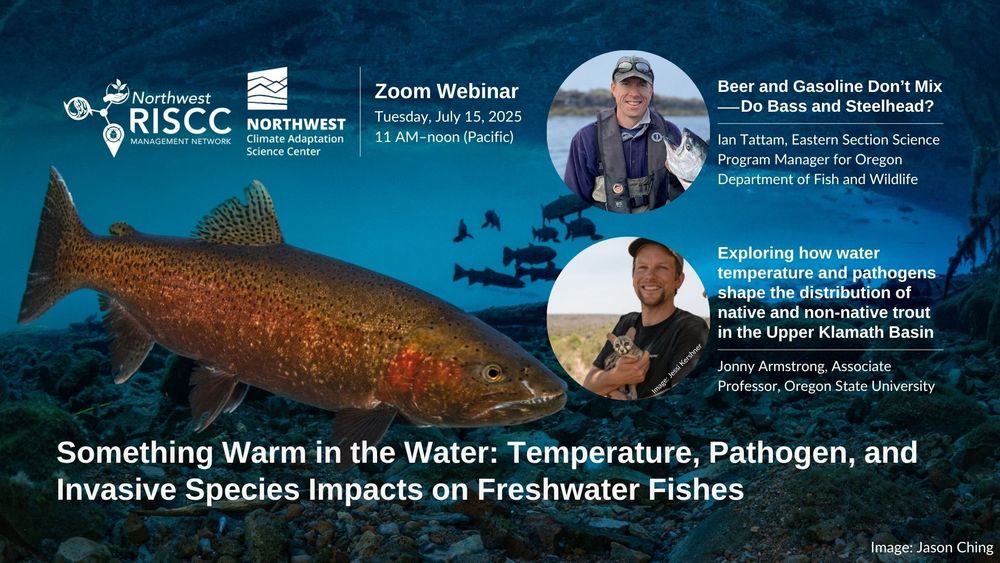
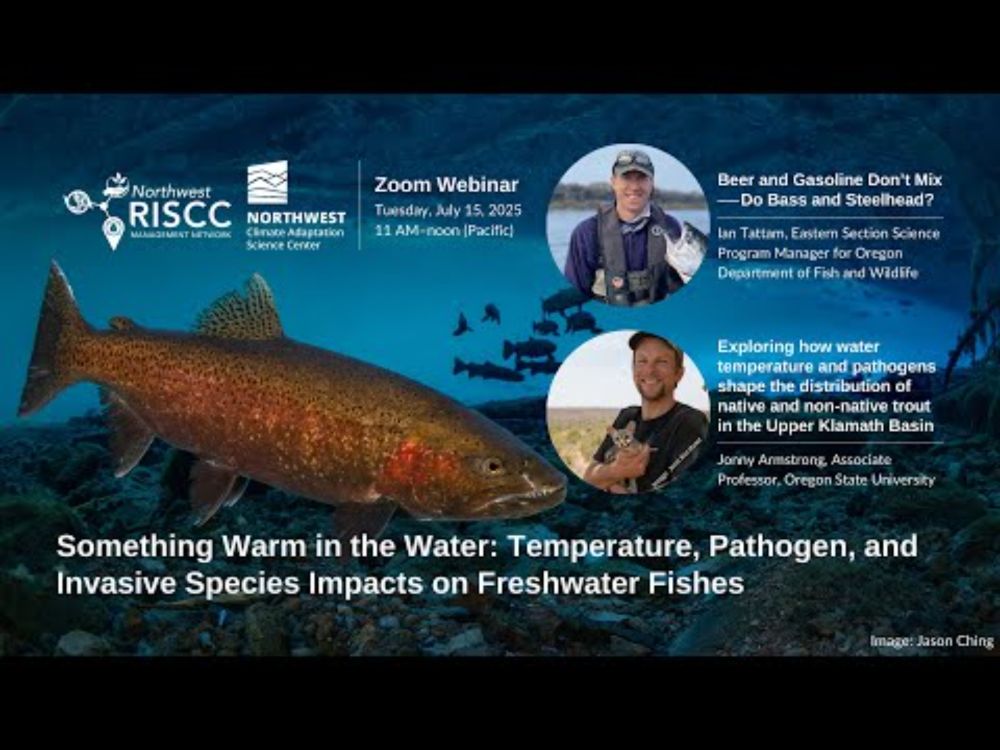
An underwater photo of a rainbow trout surrounded by blue water (image by Jason Ching) serve as the background for white text that says "Something Warm in the Water: Temperature, Pathogen, and Invasive Species Impacts on Freshwater Fishes, Zoom webinar, Tuesday, July 15, 2025, 11 AM–noon (Pacific)." Circular image insets show portraits of the two speakers alongside talk and speaker information, as follows: "Beer and Gasoline Don't Mix—Do Bass and Steelhead? Ian Tattam, Eastern Section Science Program Manager for Oregon Department of Fish & Wildlife" and "Exploring how water temperature and pathogens shape the distribution of native and non-native trout in the Upper Klamath Basin, Jonny Armstrong, Associate Professor, Oregon State University." Also included, in white, are the logos for the Northwest RISCC Management Network & Northwest Climate Adaptation Science Cente.
Join us for some fishy summer fun at our next webinar, "Something Warm in the Water: Temperature, Pathogen, and Invasive Species Impacts on Freshwater Fishes" on Tues., July 15, 11am PT, featuring speakers Jonny Armstrong and Ian Tattam!
Register at: bit.ly/NW-RISCC-July-Webinar
17.06.2025 21:32
👍 1
🔁 1
💬 1
📌 1
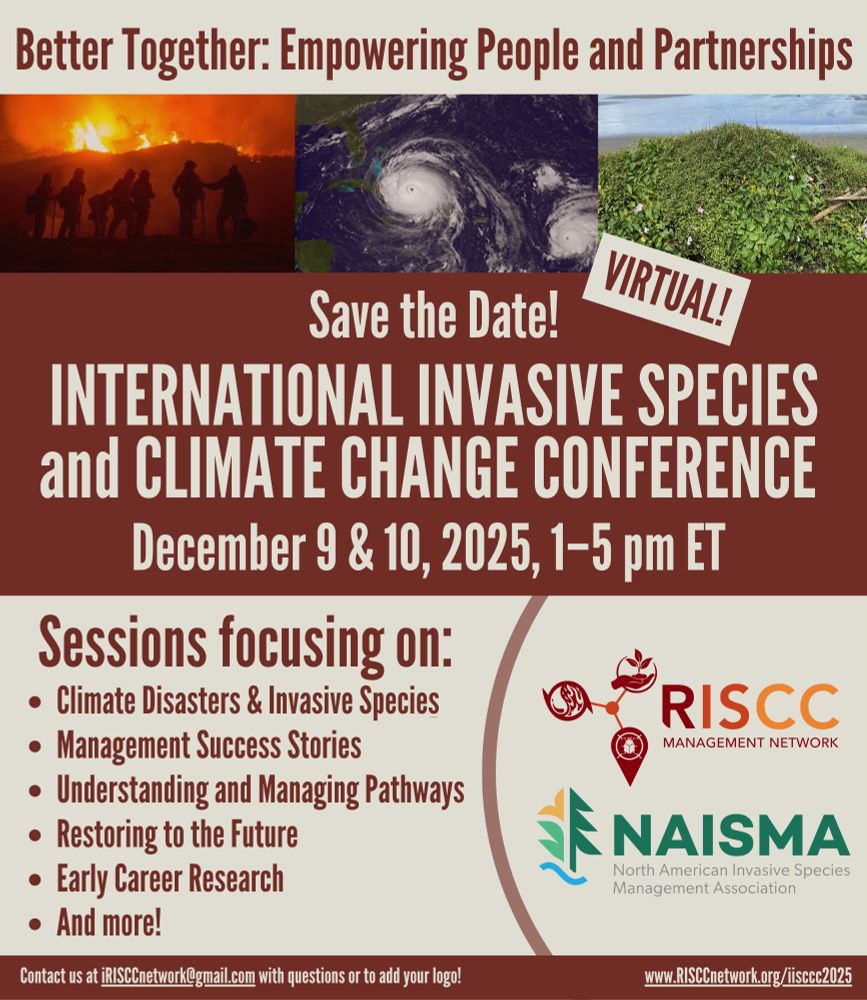
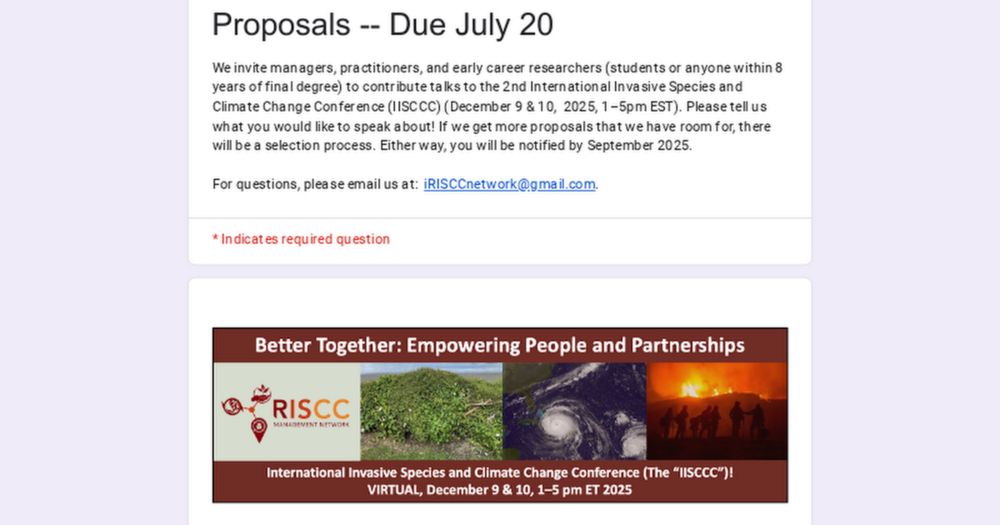
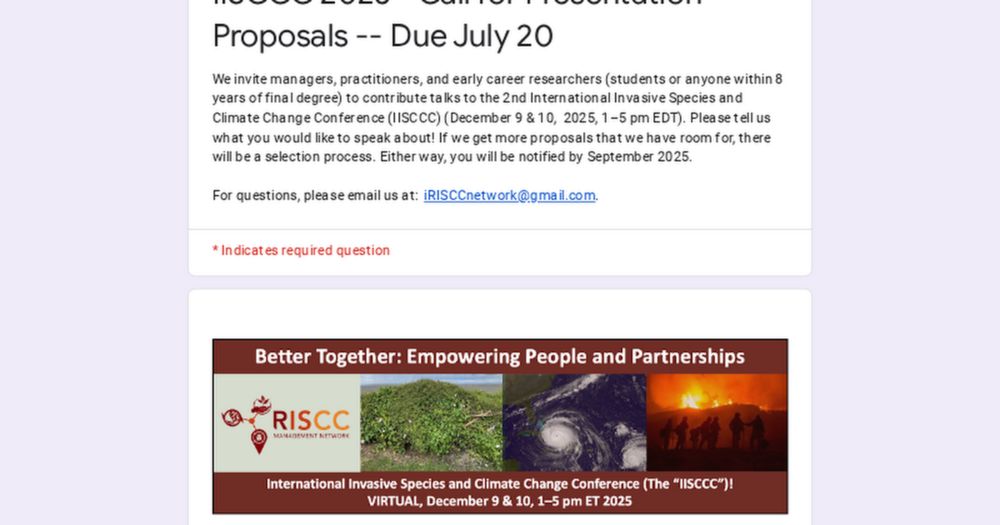
A poster with a burgundy and cream color scheme announcing, "Better Together: Empowering People and Partnerships. Save the Date! International Invasive Species and Climate Change Conference, December 9 & 10, 2025, 1–5 pm ET. Sessions focusing on: Climate Disasters & Invasive Species, Management Success Stories, Understanding and Managing Pathways, Restoring to the Future, Early Career Research, and more! Contact us at iRISCCnetwork@gmail.com with questions or to add your logo! www.RISCCnetwork.org/iisccc2025" and including the logos for the RISCC Management Network and NAISMA, North American Invasive Species Management Association. A banner of images at the top depicts firefighters silhouetted against a blaze, a satellite image of a hurricane, and a tangle of plants on a sand dune.
Save the date for the 2nd annual International Invasive Species & Climate Change Conference (IISCCC): December 9 & 10, 2025, 10am–2pm PT / 11am–3pm MT!
More info: risccnetwork.org/iisccc-2025
03.06.2025 18:35
👍 1
🔁 1
💬 1
📌 0
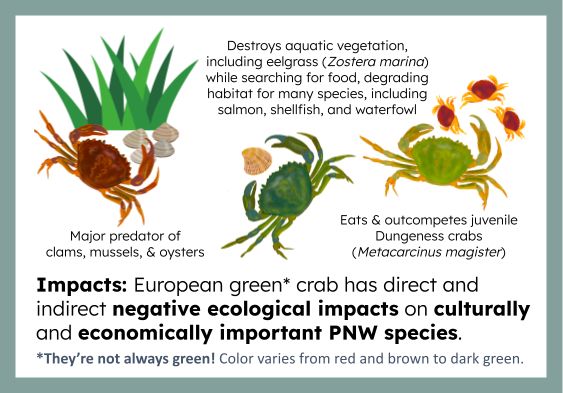
An illustration of three color morphs of the European green crab (red, dark green, and lighter green) alongside grass, clams, and juvenile Dungeness crabs. Text around and below the illustration reads:
Impacts: European green* crab has direct and indirect negative ecological impacts on culturally and economically important PNW species.
Destroys aquatic vegetation, including eelgrass (Zostera marina)3 while searching for food, degrading habitat for many species, including salmon, shellfish, and waterfowl.
Major predator of clams, mussels, & oysters.
Eats & outcompetes juvenile Dungeness crabs (Metacarcinus magister).
*They’re not always green! Color varies from red and brown to dark green.
The European green crab has known and potential economic, cultural, and ecological impacts in the NW + beyond.
Check our latest NW RISCC Management Brief for information on the ways warming temperatures are influencing this ongoing invasion and management efforts:
bit.ly/NW_RISCC_briefs
22.05.2025 23:46
👍 1
🔁 2
💬 0
📌 0
Want to get involved? You can....
✨ Stay up-to-date on events, research summaries & more: tinyurl.com/5t3mxhry
✨Share new research: tinyurl.com/4jw23kww
✨Share invasive species x climate management stories: tinyurl.com/52tzvwyt
✨Join our Advisory Team: tinyurl.com/3tp65hce
3/3
29.04.2025 22:09
👍 1
🔁 0
💬 0
📌 0
We explore on-the-ground management, conservation, and research needs and opportunities related to climate change and invasive plants 🌱, animals 🦀, and pathogens 🦠 (among other organisms!) in the NW (OR, ID, WA, BC, and neighboring states and provinces).
2/3
29.04.2025 22:09
👍 4
🔁 0
💬 1
📌 0
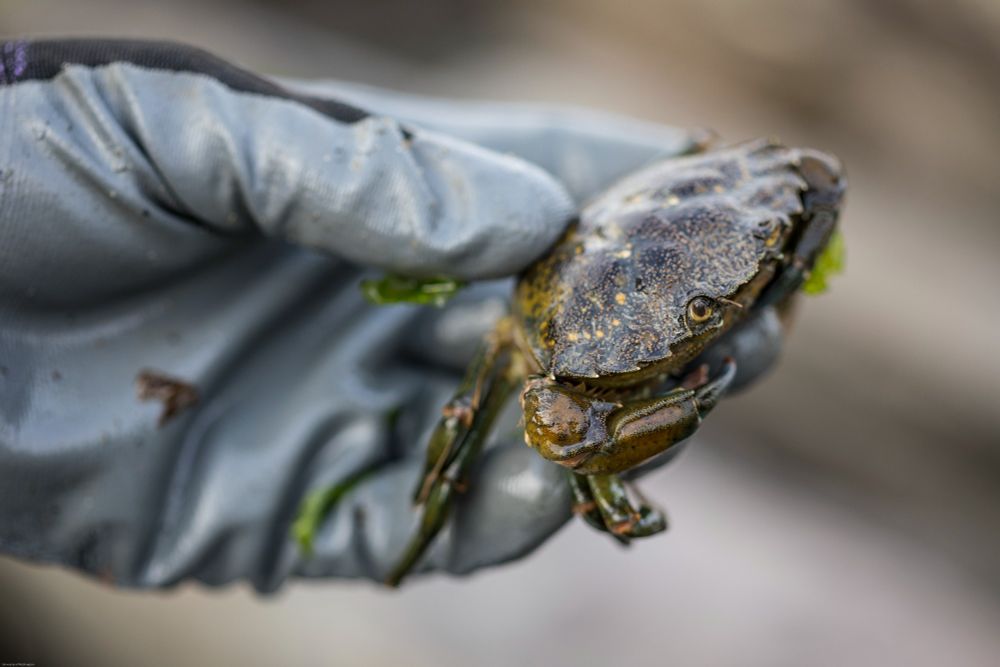
An invasive European green crab is held by a rubber-gloved hand
Hi Bluesky! 👋 Let us introduce ourselves!
The Northwest Regional Invasive Species & Climate Change (NW RISCC) Network (nwriscc.org) is a partnership of regional agencies and orgs connecting climate adaptation & invasive species science and management.
Check out this 🧵 to learn more!
1/3
29.04.2025 22:09
👍 37
🔁 7
💬 2
📌 1