Gang Yu's Avatar

Gang Yu

@gangyuplant

Associate Professor, PI, Shanghai Jiao Tong U @sjtu1896. Interested in plant-microbe interactions, Ralstonia/pathogen effectors, plant immunity. https://orcid.org/0000-0002-6720-7490

911
Followers
956
Following
17
Posts
20.05.2024
Joined
Posts Following

Latest posts by Gang Yu @gangyuplant

Preview
Rewiring an E3 ligase enhances cold resilience and phosphate use in maize - Nature The E3 ubiquitin ligase NLA postively regulates cold tolerance and negatively regulates phosphate uptake in maize, and a genetically engineered variant of this enzyme leads to improved cold ...

@Nature: an E3 ligase, acting via the jasmonate pathway, is a common regulator of both cold stress & phosphate uptake. Guided by AI, the authors use genome editing to show the relevance of this finding for improving maize yield in multi-site field trials.
shorturl.at/KrKBo
& NV
shorturl.at/rwldu

25.02.2026 20:15 πŸ‘ 4 πŸ” 3 πŸ’¬ 0 πŸ“Œ 0
Post image

RNA splicing generates a functionally specialized Rep protein isoform in geminiviruses β€” enabling timely control of the viral cycle. Strikingly, similar strategies might have evolved in DNA viruses infecting different kingdoms: www.biorxiv.org/content/10.6... Spearheaded by @delphinem-p.bsky.social!

20.02.2026 09:31 πŸ‘ 51 πŸ” 34 πŸ’¬ 0 πŸ“Œ 1

www.pnas.org/doi/10.1073/...

Excited to share that PNAS published our research article focused on "Why are Ralstonia goofy?"

23.01.2026 05:43 πŸ‘ 54 πŸ” 21 πŸ’¬ 3 πŸ“Œ 1
Preview
Effector gene silencing coordinated by histone methylation and small RNAs enhances host adaptation in a plant pathogen Abstract. Pathogen adaptability driven by epigenetic processes remains poorly understood and poses a significant challenge to sustainable disease managemen

Our collaborated research identified a two-layer epigenetic mechanism to silence Avr genes in Phytophthora sojae and enable host adaptation in soybean. Please check url: academic.oup.com/nar/article/...

22.01.2026 08:21 πŸ‘ 7 πŸ” 2 πŸ’¬ 0 πŸ“Œ 0
Post image Post image Post image Post image

Incredibly happy and proud of our Chaonan Shi (chaonan123.bsky.social ), who successfully defended her doctoral thesis yesterday at the @zmbp-tuebingen.bsky.social ! (And what a brilliant defence it was!) πŸ₯³πŸ₯³πŸ₯³ Congratulations, Dr Shi!!! 🍾πŸ₯‚πŸ‹β€πŸŸ©πŸŒΆοΈ We are so lucky to have you in our team ❀️

03.10.2025 09:34 πŸ‘ 34 πŸ” 9 πŸ’¬ 1 πŸ“Œ 1
Post image

How do plants fight disease? 🌱 #NASmember Jane Parker studies NLR proteins that help plants sense attackers and launch powerful immune defenses. She shares her latest findings on how these proteins signal plants to resist disease in a new @pnas.org QnAs: www.pnas.org/doi/10.1073/...

26.11.2025 18:00 πŸ‘ 31 πŸ” 13 πŸ’¬ 0 πŸ“Œ 0
Preview
SALICYLIC ACID SENSOR1 reveals the propagation of an SA hormone surge during plant pathogen advance Salicylic acid (SA) is a key phytohormone that orchestrates immune responses against pathogens, including Pseudomonas syringae bacteria. The timing and extent of SA accumulation are tightly controlled...

FRET sensor for SA developed. www.science.org/doi/10.1126/...

09.10.2025 21:11 πŸ‘ 42 πŸ” 21 πŸ’¬ 1 πŸ“Œ 1
Preview
Chromosome architecture affects virulence and competitiveness in Agrobacterium tumefaciens C58 Chromosome architecture influences Agrobacterium fitness, competitiveness, and virulence, shaping its adaptation and evolution.

Chromosome architecture affects virulence and competitiveness in Agrobacterium tumefaciens C58 | Science Advances www.science.org/doi/10.1126/...

05.10.2025 03:20 πŸ‘ 8 πŸ” 8 πŸ’¬ 0 πŸ“Œ 0
Preview
Localized glutamine leakage drives the spatial structure of root microbial colonization Plant roots release exudates to encourage microbiome assembly, which influences the function and stress resilience of plants. How specific exudates drive spatial colonization patterns remains largely ...

A long road to the Cover of Science!
www.science.org/doi/10.1126/...

03.10.2025 12:45 πŸ‘ 137 πŸ” 50 πŸ’¬ 9 πŸ“Œ 4
A quantitative microbiome atlas reveals hidden diversity, eukaryotic keystones, and evolutionary trade-offs in plant rhizospheres The evolutionary success of land plants is tied to their rhizosphere microbiomes. However, the principles governing how bacteria, fungi, and protists assemble and function across wild plants remain un...

A quantitative microbiome atlas reveals hidden diversity, eukaryotic keystones, and evolutionary trade-offs in plant rhizospheres. www.researchsquare.com/article/rs-7...

21.09.2025 06:22 πŸ‘ 2 πŸ” 3 πŸ’¬ 0 πŸ“Œ 0
Preview
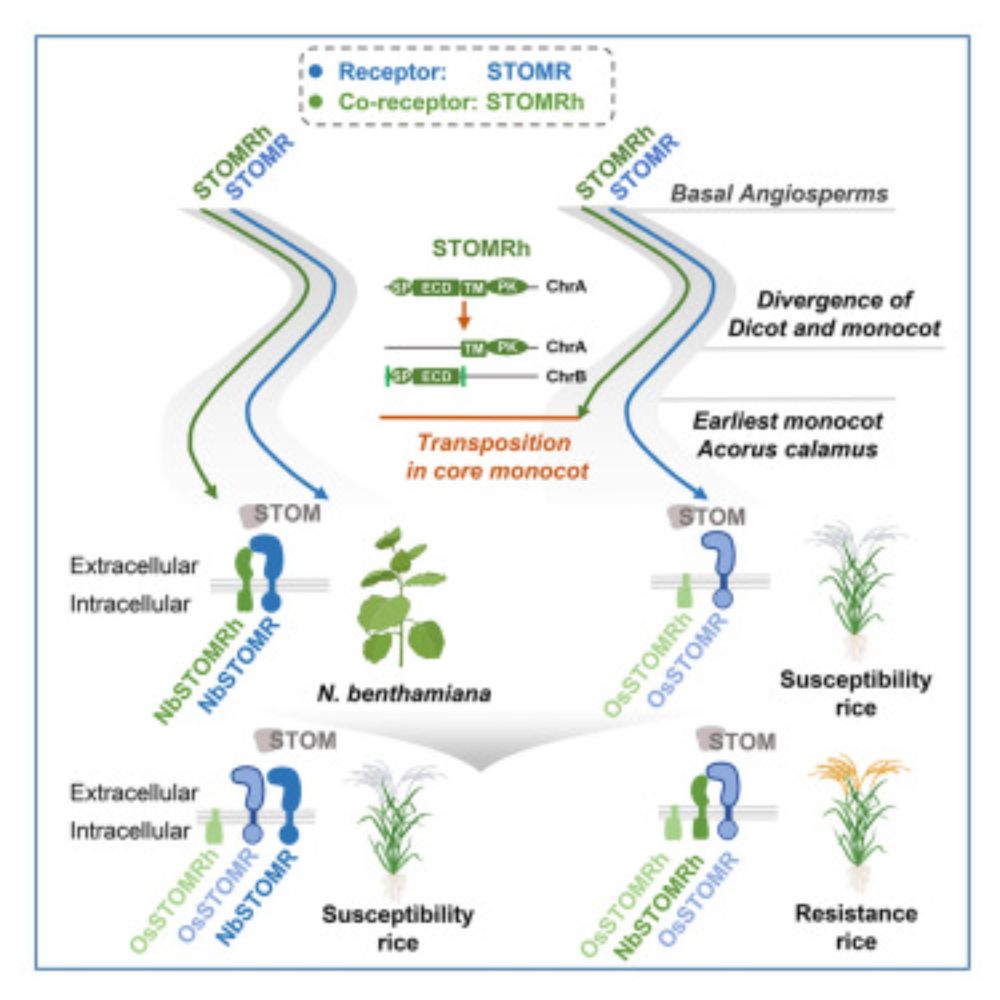
Fungal resistance in rice is restored by interfamily transfer of an evolutionarily lost co-receptor Zhang et al. identify STOM, a previously unknown fungal MAMP, and its receptor-co-receptor pair, STOMR/STOMRh. The evolutionary loss of functional STOMRh in monocots restricts immune recognition, whil...

Fungal resistance in rice is restored by interfamily transfer of an evolutionarily lost co-receptor: Cell Host & Microbe www.cell.com/cell-host-mi...

18.09.2025 13:07 πŸ‘ 4 πŸ” 0 πŸ’¬ 0 πŸ“Œ 0
Preview
Systematic discovery and engineering of synthetic immune receptors in plants Plants deploy a diverse array of pattern recognition receptors (PRRs), which perceive microbe-associated molecular patterns to activate immune responses. Leucine-rich repeat receptor-like kinase subgr...

Very happy to share our latest work β€œSystematic discovery and engineering of synthetic immune receptors in plants” out in @science.org !

www.science.org/doi/10.1126/...

04.09.2025 19:30 πŸ‘ 103 πŸ” 56 πŸ’¬ 7 πŸ“Œ 2
Preview
Phosphorylation‐dependent association of a bacterial effector with plant 14‐3‐3 proteins enhances effector stability and bacterial virulence Gram-negative bacterial pathogens inject effector proteins inside plant cells using specialized secretion systems. These effectors manipulate plant cellular functions and suppress the plant immune s...

Our latest paper is now online at New Phytologist!
Β 
Phosphorylation-dependent association of a bacterial effector with plant 14-3-3 proteins enhances effector stability and bacterial virulence
Β 
doi.org/10.1111/nph....

@newphyt.bsky.social

02.09.2025 09:53 πŸ‘ 12 πŸ” 5 πŸ’¬ 2 πŸ“Œ 1

Very proud of this collaboration with Jose and Alberto, the co-corresponding authors; and of course, many congratulations to the Team.
#MicroSky #PlantScience

02.09.2025 08:09 πŸ‘ 10 πŸ” 5 πŸ’¬ 0 πŸ“Œ 0
Preview
Identification and functional dissection of maize disease resistance genes The review summarizes recent research advances in the cloning and functional analysis of maize resistance genes and discusses new approaches that may facilitate these research processes, aiming to pr...

Identification and functional dissection of maize disease resistance genes
onlinelibrary.wiley.com/doi/full/10....

01.09.2025 10:07 πŸ‘ 1 πŸ” 1 πŸ’¬ 0 πŸ“Œ 0
Preview
Inactivation of Ξ²-1,3-glucan synthase-like 5 confers broad-spectrum resistance to Plasmodiophora brassicae pathotypes in cruciferous plants - Nature Genetics This study implicates GSL5 inactivation in high, broad-spectrum resistance to the clubroot pathogen Plasmodiophora brassicae in Arabidopsis thaliana, Brassica napus, Brassica oleracea and Brassica rap...

Inactivation of Ξ²-1,3-glucan synthase-like 5 confers broad-spectrum resistance to Plasmodiophora brassicae pathotypes in cruciferous plants
www.nature.com/articles/s41...

01.09.2025 10:06 πŸ‘ 7 πŸ” 3 πŸ’¬ 0 πŸ“Œ 1
Preview
Genome sequence of the plant pathogen Ralstonia solanacearum - Nature Nature - Genome sequence of the plant pathogen Ralstonia solanacearum

www.nature.com/articles/415...

Re-reading an oldie but goodie. #Ralstonia was one of the first bacterial genomes to be sequenced. This paper is a great introduction to Ralstonia and their genomes. I am not sure I looked at the supplemental material before, but I like it.

25.08.2025 18:11 πŸ‘ 8 πŸ” 1 πŸ’¬ 2 πŸ“Œ 0
Preview
The transcriptome landscape induced by Pseudomonas syringae core effectors reveals new insights into the immune network in Nicotiana benthamiana The pathogen Pseudomonas syringae pv. tomato DC3000 suppresses plant immunity via type III effectors (T3Es). The majority of current research has focused on specific effectors targeting a single mol...

The transcriptome landscape induced by Pseudomonas syringae core effectors reveals new insights into the immune network in Nicotiana benthamiana - Ma - New Phytologist - Wiley Online Library nph.onlinelibrary.wiley.com/doi/full/10....

26.08.2025 02:09 πŸ‘ 5 πŸ” 0 πŸ’¬ 0 πŸ“Œ 0
Preview
A conserved stripe rust effector elicits variable resistance responses in wheat Plant resistance (R) and pathogen avirulence (Avr) gene interactions are central to pathogen recognition and disease resistance in crops. However, functional characterisation of Avr effectors in Pucci...

Our first wheat stripe rust Avr effector story. It is a short one that points to suppressors in this pathosystem while we could not link this Avr effector to a described R gene. www.biorxiv.org/content/10.1...

03.08.2025 02:41 πŸ‘ 17 πŸ” 11 πŸ’¬ 0 πŸ“Œ 1
Preview
Ancient hybridization underlies tuberization and radiation of the potato lineage Genomic and functional analyses reveal that the potato lineage originated from a homoploid interspecific hybridization event between the Tomato and Etuberosum lineages 8–9 million years ago. The alter...

Ancient hybridization underlies tuberization and radiation of the potato lineage www.cell.com/cell/fulltex...

01.08.2025 05:25 πŸ‘ 3 πŸ” 0 πŸ’¬ 0 πŸ“Œ 0
Preview
Thank ketchup for your French fries Interbreeding with tomatoes 9 million years ago gave potatoes the genes to develop tubers

β€œTomato is the mother of potato.” scim.ag/4mheKrH

31.07.2025 16:01 πŸ‘ 146 πŸ” 39 πŸ’¬ 6 πŸ“Œ 8
Preview
Unlocking expanded flagellin perception through rational receptor engineering - Nature Plants Receptor kinase FLS2 detects the flg22 epitope of bacterial flagellin. Here the authors identify key residues on FLS2’s concave surface that enable expanded perception of flg22 variants, allowing the ...

🌱 From Nature Plants: By modifying key surface residues, researchers expanded FLS2 receptor recognition of polymorphic flagellin. AlphaFold guided the engineering. (Tianrun Li, Esteban Jarquin Bolaños, Danielle M. Stevens, Hanxu Sha, Gitta Coaker)

▢️ www.nature.com/articles/s41...
#PlantBiology

29.07.2025 17:03 πŸ‘ 7 πŸ” 1 πŸ’¬ 1 πŸ“Œ 0
Preview
Unlocking expanded flagellin perception through rational receptor engineering - Nature Plants Receptor kinase FLS2 detects the flg22 epitope of bacterial flagellin. Here the authors identify key residues on FLS2’s concave surface that enable expanded perception of flg22 variants, allowing the ...

Excited this paper is finally published! We focused on the inner concave surface of LRR RKs to expand bacterial flagellin perception in plants. Selection indicates expanded perception is more common than previously thought. Experiments led by @jerrytli.bsky.social www.nature.com/articles/s41...

29.07.2025 01:20 πŸ‘ 107 πŸ” 46 πŸ’¬ 10 πŸ“Œ 1

Our new work lead by Anuphon. Cryo Structure of CARD1 reveals copper in the ecodomain, required for sensing H202. The phenotype of card1 is same as rbohd, suggesting ROS produced by RBOHD is sensed by CARD1.

28.07.2025 08:23 πŸ‘ 16 πŸ” 9 πŸ’¬ 0 πŸ“Œ 1
Post image

Parker Group alumni, from the early 2000s to 2025, the best folks! Grateful for everyone who helped shape the science over the years #2025ISMPMI
Thanks @federicalocci.bsky.social for taking the picture

17.07.2025 09:24 πŸ‘ 33 πŸ” 7 πŸ’¬ 1 πŸ“Œ 1
Post image

#2025ISMPMI has been great, so many connections made and re-established. I found this on the railway bridge.

17.07.2025 14:23 πŸ‘ 64 πŸ” 13 πŸ’¬ 4 πŸ“Œ 1
Preview
Proteome profiling of plant Cajal bodies uncovers kingdom-specific components Insight into the molecular composition of cellular microenvironments is essential for understanding their function. Membraneless organelles (MLO), such as the nuclear Cajal body (CB), play fundamental...

Cajal bodies are membraneless structures with fundamental roles across eukaryotesβ€”but which proteins actually make them up? Using FAPS, Zhou et al. isolated 34 million plant Cajal bodies and profiled their proteome via LC-MS/MS. Curious? Check out our latest preprint! www.biorxiv.org/content/10.1...

16.07.2025 05:24 πŸ‘ 25 πŸ” 12 πŸ’¬ 0 πŸ“Œ 1

Large group. See you guys soon.

13.07.2025 08:45 πŸ‘ 1 πŸ” 0 πŸ’¬ 1 πŸ“Œ 0

Excited and happy to meet @gittacoaker.bsky.social after quite a few years #2025ISMPMI. Nice discussions about science, as always.

13.07.2025 05:07 πŸ‘ 12 πŸ” 0 πŸ’¬ 0 πŸ“Œ 0
Post image

In Cologne, breakfast with beautiful view. Excited to attend 2025 IS-MPMI. Learn and discuss new science about MPMI, meet old and new friends.

12.07.2025 05:07 πŸ‘ 9 πŸ” 0 πŸ’¬ 0 πŸ“Œ 0