

06.03.2026 16:23
👍 33
🔁 7
💬 0
📌 0
The cortex generates invariant dynamic primitives; the cerebellum reconfigures them to drive distinct policies.
Huge congrats to first author Martha Garcia-Garcia for leading this tour de force, and @somnirons.bsky.social & Michal Wojcik for a great collaboration!
www.biorxiv.org/content/10.6...

At the Bernstein Conference 2024, Jeremie Lefebvre and I organized a workshop on the computational consequences of neural heterogeneity. Now, slightly more than a year later, we funneled the emerging discussions into a perspective piece: www.cell.com/neuron/fullt...

Thrilled that my paper is out in the @nature.com. We explored how the brain builds complex tasks by compositionally combining simpler sub-task representations. The brain flexibly performs multiple tasks by dynamically reusing neural subspaces for sensory inputs and motor actions
rdcu.be/eRVUk
New paper out at PNAS: www.pnas.org/doi/10.1073/...
Revisiting the high-dimensional geometry of population responses in the visual cortex with @jpillowtime.bsky.social. The review took forever because a reviewer was doubtful our new estimator can infer eigenvalues beyond the rank of the data! (1/6)
We are very excited to announce that our new preprint with Saleh Esteki, @stefanofusi.bsky.social, and @roozbehkiani.bsky.social is now available on biorxiv! www.biorxiv.org/content/10.6.... We investigated how reward context is learned, represented, and updated to bias decisions. Thread 🧵👇! 1/13

Really thrilled that this paper led by @neurozz.bsky.social is now published in its final version in @elife.bsky.social!!
This is a memory-focused (as opposed to RL-focused) account of the detailed characteristics of forward and backward awake and sleep replay!
elifesciences.org/articles/99931
New preprint from the lab! 🚀
We find that hippocampal OLM interneurons provide a circuit-level inhibitory feedback signal that dynamically controls when and where behavioral timescale synaptic plasticity can occur.
Feedback welcome!
Rapid neocortical network modifications via dendritic plateau potential induced plasticity https://www.biorxiv.org/content/10.1101/2025.11.19.689338v1

Now in PRX: Theory linking connectivity structure to collective activity in nonlinear RNNs!
For neuro fans: conn. structure can be invisible in single neurons but shape pop. activity
For low-rank RNN fans: a theory of rank=O(N)
For physics fans: fluctuations around DMFT saddle⇒dimension of activity
Our latest project find shared representations while controlling for confounds is out www.biorxiv.org/content/10.1... Check @s-michelmann.bsky.social 's thread for the executive summary. Code in python and matlab: github.com/s-michelmann... — Now is play time 👨💻
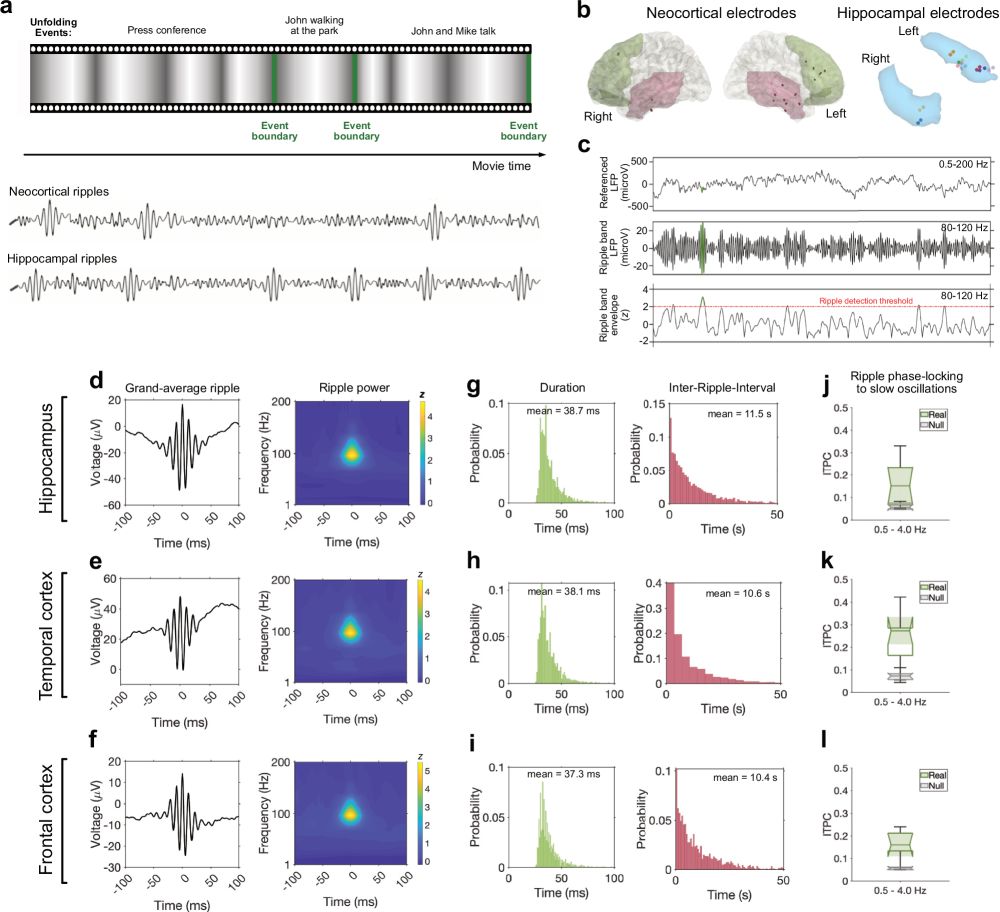
🧠 Paper out!
We investigated how hippocampal and cortical ripples support memory during movie watching. We found that:
🎬 Hippocampal ripples mark event boundaries
🧩 Cortical ripples predict later recall
Ripples may help transform real-life experiences into lasting memories!
rdcu.be/eui9l
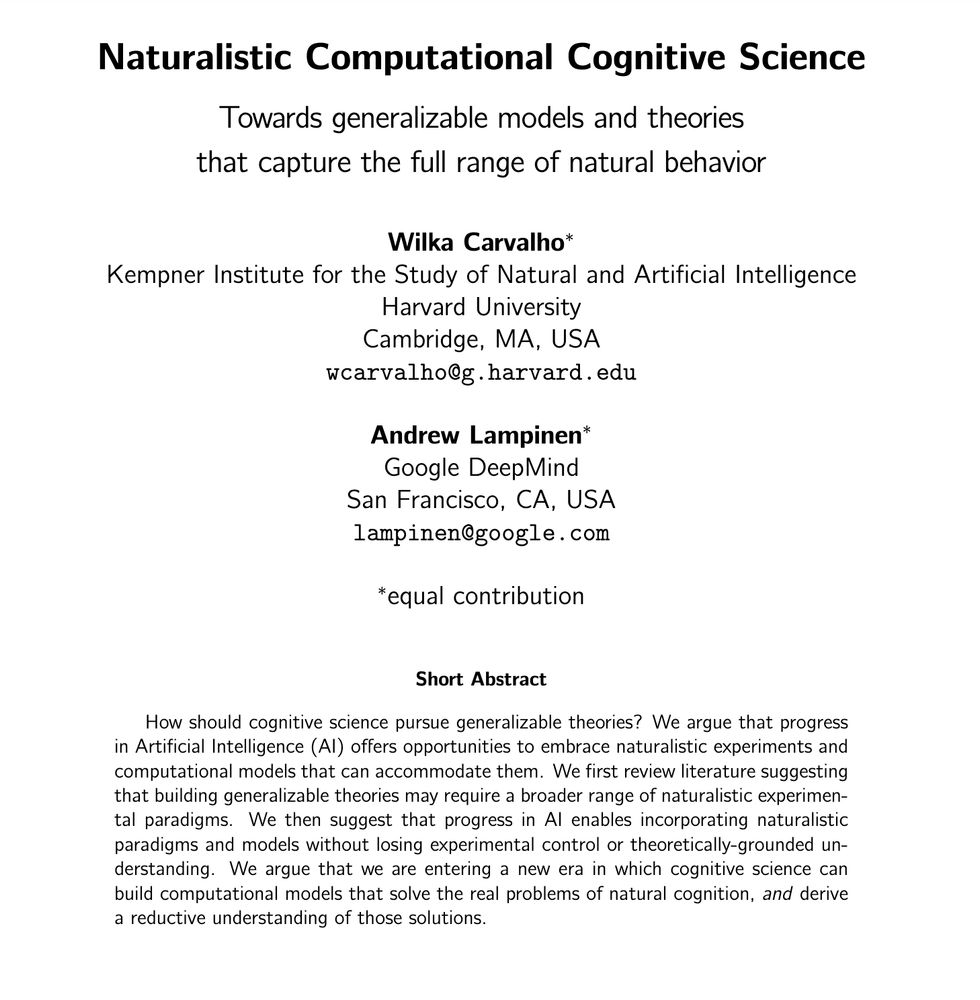
Excited to share this project specifying a research direction I think will be particularly fruitful for theory-driven cognitive science that aims to explain natural behavior!
We're calling this direction "Naturalistic Computational Cognitive Science"
7/ In the era of limited funding, our work showcases how to use models to bridge neural and natural behavior data to (1) increase discrimination power over neural models, (2) improve behavioral predictions, and (3) reveal novel bioplausible algorithms for neural computation in natural settings.
6/ Finally, we studied the nonlinear accumulation model of song encoding more closely, revealing previously unknown song patterns driving female slowing, and a neural algorithm for encoding long input sequences that leverages nonlinear adaptation to remember fine temporal patterns for long periods.
5/ Methodologically, our work shows how natural behavior can refine predictions of how neural data generalize beyond their original experimental context AND that modeling hidden neural activity can improve pure natural behavior predictions, even relative to popular black-box deep networks.
4/ This suggests that linear-nonlinear feature detection is not enough, but rather that flies may encode long communication sequences via nonlinear accumulation along multiple dimensions of activity space in a heterogeneous neural population code for song history.
3/ We found that one encoding model, based on multi-dimensional, nonlinear accumulation, allowed us to predict female locomotion much better than a classic linear-nonlinear feature-detection model, also outperforming many other predictors, including several black-box artificial neural networks.
2/ To gain further model discrimination power, we turned to a separate pure-behavior dataset of naturalistic fly courtship. We simulated the female’s neural responses to the male’s song using the encoding models then tried to predict her locomotion from the simulated neural data.
1/ How is the male fruit fly’s complex courtship song encoded in the female fly brain? Calcium imaging of responses to simplified song stimuli suggest neural codes are spread across a population with heterogeneous selectivities and timescales, but multiple encoding models fit the data equally well.
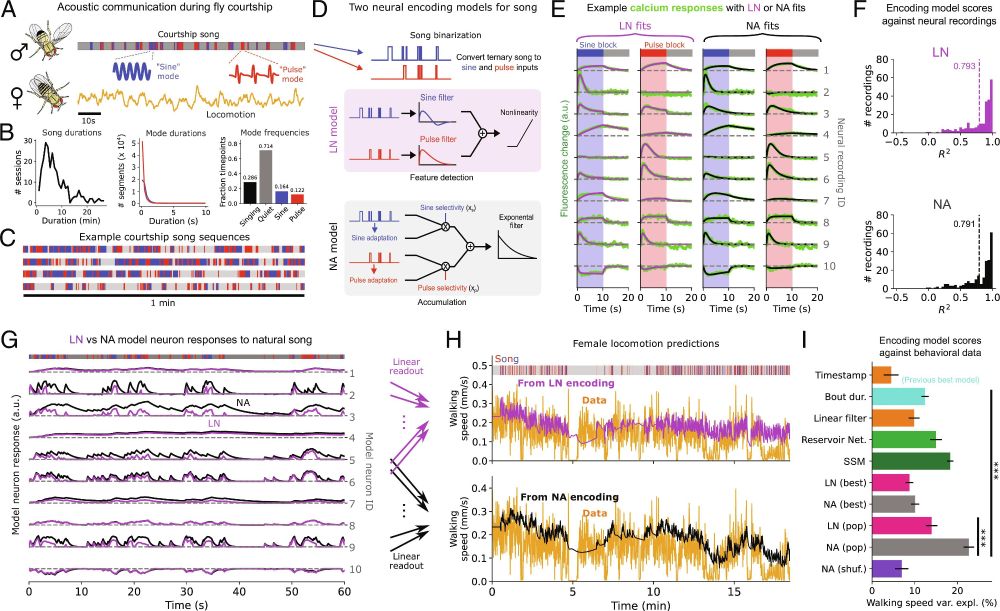
How do we get more neuroscience out of our behavioral data? Excited to share new work with C.A.Baker, M.Murthy and @jpillowtime.bsky.social, where we use natural behavior data to extend predictions from neural recordings about population codes for dynamic social stimuli: tinyurl.com/2d3wwfyf
An intuitive way to derive Shannon's famous entropy formula that you may not have seen before (unless you're a physicist): rkp.science/an-alternati...

🧠🤖 Computational Neuroscience summer school IMBIZO in Cape Town is open for applications again!
💻🧬 3 weeks of intense coursework & projects with support from expert tutors and faculty
📈Apply until July 1st!
🔗https://imbizo.africa/