Nuffield Trust responds to reports that NHS will pay more for branded new medicines
Sally Gainsbury responds to reports that the NHS will pay a higher price for branded new medicines.
We've responded to reports that the NHS will pay a higher price for branded new medicines as a condition of a UK-US trade deal.
Read the statement from @sallygainsbury.bsky.social 👇
01.12.2025 16:35
👍 18
🔁 12
💬 1
📌 2
see p50 (printed p50, not pdf p50...) here efpia.eu/media/676753...
08.10.2025 15:56
👍 1
🔁 0
💬 0
📌 0
Patent protections mean pharma cos can set prices high. The VPAG agreement at the centre of the row offers the NHS a modest counterbalance against those high prices when sales volumes exceed expectations and already contains exemptions to allow companies to recoup their R&D costs
08.10.2025 14:53
👍 0
🔁 0
💬 1
📌 0
There is mounting evidence that rather than being “too low” the NICE threshold (the max the NHS will pay for a yr of health gained through a drug) is currently too high as it outstrips how much health could be gained if the £ was spent instead on extending existing services >
08.10.2025 14:53
👍 0
🔁 0
💬 1
📌 0
Key points: Big pharma’s threat to pull investment from the UK if the NHS doesn’t pay more is based on politics, not economics. Industry’s own research shows that decisions on R&D location are driven by where you can do good science, not local market prices for the end product >
08.10.2025 14:53
👍 0
🔁 0
💬 2
📌 0
interesting. I wonder if the catch up at 16 seen in the overall dashed ECHP line is a genuine improvement in outcomes, or rather a widening of who is included in that cohort to include those whose edu outcomes were higher/likely to be slightly higher already?
03.10.2025 15:03
👍 1
🔁 0
💬 0
📌 0
this is really interesting Luke, thank you. It seems to suggest that educational outcomes (measured by the standardised score) have improved since ~2015 for the older kids on ECHPs, but declined for the younger. Or am I misinterpreting that?
03.10.2025 13:51
👍 1
🔁 0
💬 1
📌 0
But the gov hasn’t made things easy for itself with its rhetoric around the NHS as an engine of economic growth (rather than the quaint notion it is there to improve our health)>>
25.08.2025 08:34
👍 0
🔁 0
💬 1
📌 0
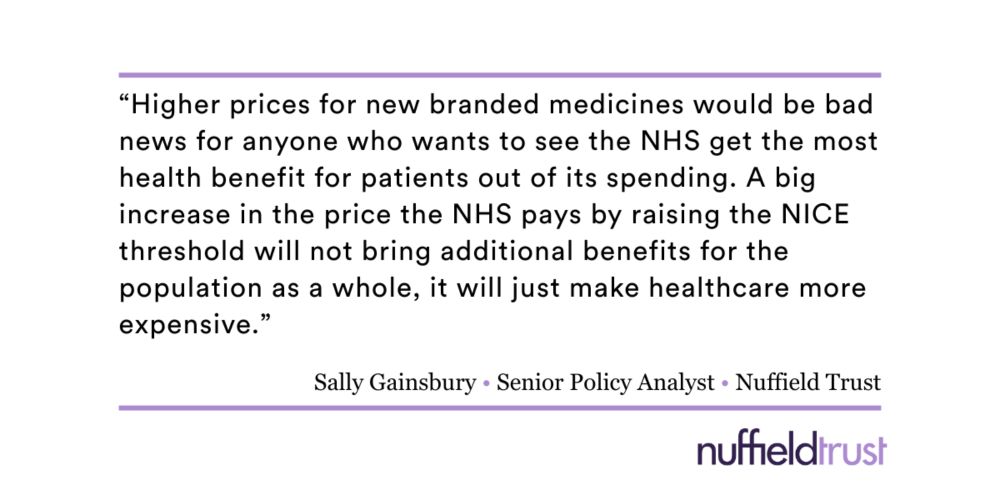
If the gov pays more for new medicines, we are highly likely to get LESS health benefit out of the NHS, not more. It’s right the gov holds firm and considers population-wide health needs rather than bow to industry threats and scare stories >>
25.08.2025 08:34
👍 0
🔁 0
💬 1
📌 0
It’s correct the £30k threshold has been in place since the late 1990s, but ample economic research shows it is likely too high rather than too low >>
25.08.2025 08:34
👍 0
🔁 0
💬 1
📌 0
This isn’t penny pinching: the threshold exists in order to ensure expensive new drugs don’t displace pre-existing treatments, because the nhs can only spend its budget once >>
25.08.2025 08:34
👍 0
🔁 0
💬 1
📌 0
Sometimes new drugs fail that test simply because they are very expensive. Other times they fail because their price might be modest, but the health improvements they offer above already existing treatments are extremely marginal >>
25.08.2025 08:34
👍 0
🔁 0
💬 1
📌 0
The nhs (via NICE) generally requires that for a new drug to be adopted, the extra health benefits it brings should not add more than £30k above existing treatments for that disease >>
25.08.2025 08:34
👍 0
🔁 0
💬 1
📌 0
The 10 year nhs plan already sets out a terrifying raft of concessions to pharma and med tech to try and convince them to invest in the uk to feed the political addiction to economic growth >>
25.08.2025 08:34
👍 0
🔁 0
💬 1
📌 0
PSA that the purpose of the #NHS is NOT to provide investment opportunities or lucrative income streams for the pharmaceutical industry #r4today >>
25.08.2025 08:34
👍 5
🔁 3
💬 1
📌 0
Editorial from me and LSE’s Huseyin Naci on the government's bid to use the NHS as a means to attract more med tech and pharma investment into the UK. TLDR: great for profits, less great for getting the most value for patients out of the NHS www.bmj.com/content/390/...
19.08.2025 16:54
👍 1
🔁 0
💬 0
📌 0
Thanks Dave
17.07.2025 13:45
👍 1
🔁 0
💬 0
📌 0
The quaint idea the #NHS exists to improve health has been supplemented with the idea it can also drive economic #growth. My thoughts on the gamble the gov is making by inviting in more tech- and pharma- and whether we’ll end up with less as a consequence: www.nuffieldtrust.org.uk/news-item/an...
17.07.2025 07:52
👍 1
🔁 2
💬 0
📌 0
Not the question you asked, but: I worry that when humans get AI to do stuff like sort through info and order/summarise it, we lose the ability to do that ourselves. Mental agility dies. We save time, same as we do when drive instead of walk, but physical strength declines. Is this a legit concern?
17.07.2025 06:52
👍 2
🔁 0
💬 1
📌 0
Trump, medicines and the NHS
Following recent press speculation that the UK may soon agree to pay more for drugs used within the NHS as part of a trade deal with the USA, we spoke to Mark Dayan and Sally Gainsbury to discuss the ...
🆕 Following recent press speculation that the UK may soon agree to pay more for drugs used within the #NHS as part of a trade deal with the USA, we asked experts @markgdayan.bsky.social and @sallygainsbury.bsky.social to explain the situation. 💊
01.07.2025 08:55
👍 4
🔁 8
💬 1
📌 2