

Sample questions from the geography section of state certification exams for Missouri public school teachers in 1907
07.02.2026 18:11
👍 3
🔁 0
💬 0
📌 0
Sample questions from the geography section of state certification exams for Missouri public school teachers in 1907

Bollinger in latest book, *University: A Reckoning*: “It is worth emphasizing again that sometimes you don't know what you think or what you believe until you hear other people say it, perhaps via just a little difference in the way they express the idea.“ (2026: 45)
… “Exactly how does attaining the *immediate purpose of this specific experience* I am providing for members of my class contribute to the fulfillment of the major purposes of my teaching?” *snaps*
Edith Putnam Parker, in her 1955 address to the National Council of Geography Teachers: “All of us can keep sharpening our geography-teaching perspective by asking ourselves time after time, …

Title page, 1822

Overview of Kentucky, 1822

Questions on the Modern Maps, 1822
Found a second edition of “Elements of Geography, Ancient and Modern; with an Atlas” by J.E. Worcester, published by Cummings and Hilliard, Boston, in 1822.

Transylvania U BoT minutes 1829
In the “course of study and list of text books” recorded in the minutes of the 9 July 1829 meeting of the BoT, the faculty of Transylvania University requested to include “Worcester’s Geography and Atlas” among the texts of the preparatory department. kdl.contentdm.oclc.org/digital/coll...


“List of books wanted by R H Bishop”, ca 1810, Transylvania University. Dr Bishop offered coursework in geography at TU before becoming the first president of Miami U of Ohio in 1824
10. The knowledge of the position of the different parts of the earth, and their mutual relations with each other, will afford us much useful instruction, and also as much pleasure, as we can derive from any other origin.
PETER GORDON HUNT.
8. It has great power in political economy, politics, census, and astronomy.
9. Knowing geography well gives us great pleasure.
5. Ancient describes all those places of ancient history in tables; recent describes those that are recorded in recent history.
6. Geography is one of the most useful sciences.
7. It may be called one of the eyes of history, the other of which is chronology.
3. The earth is divided into continents, islands, peninsulas, isthmuses, and so on; water is divided into oceans, seas, lakes, ravines, rivers, and so on.
4. Geography is divided into ancient and recent.
This is by Peter Hunt for his AB degree in 1824:
GEOGRAPHICAL THESES.
1. Geography is the science that describes the most remarkable places on the globe.
2. The globe of the earth is a spherical mass of matter, composed of land and water.

Reading geography student final papers in the 1820s from Transylvania University.
The 2025 NACIS Annual Meeting will be in Louisville, KY, Oct 15-18! We invite you to submit abstract proposals for presentations in the Main Conference or Practical Cartography Day or to organize specialty themed sessions, discussion panels, workshops and field trips. Submissions due May 15, 2025.

Hooray? 🎉 🤪
thank you, @shannonmattern.bsky.social for the visit and for these kind words!
@jswab.bsky.social and I have organized a @geographers.bsky.social session on "Minor Histories of GIS," feat. @wilsonism.bsky.social, @mapasurbanos.bsky.social, me on *Processing Place*, and others
today, 2:30, rm 336!
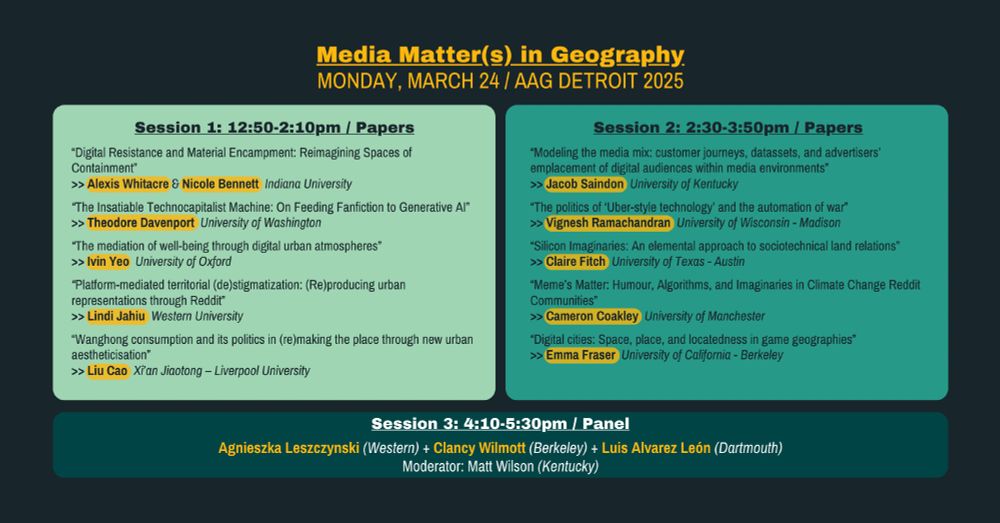
A flyer for the three Media Matters in Geography sessions at the AAG conference in Detroit scheduled for Monday, March 14th. The first two sessions are from 12:50 to 2:10pm and 2:30-3:50pm and each feature five paper presentations. The third and final session is from 4:10 to 5:30pm and is a panel of three scholars. The names and paper titles of participants are available at the linked URL.
Geographers attending AAG in Detroit: Please join @wilsonism.bsky.social and I on Monday afternoon in room 259 for our “Media Matter(s) in Geography” sessions! We will be joined by a fantastic set of presenters and panelists—more details in the flyer and link: jacographer.com/aag-cfp-25/

Someone noting Doreen Massey’s book, For Space, being published **two decades ago** took my breath away

Grateful to join the Familiar Landscapes workshop at @knowltonosu.bsky.social with a little invited essay that thinks with Pumpkin Center, Missouri (and shout-out to the new book by @psimpy.bsky.social)

Family photo album 1970
When the research for an essay overlaps with organizing a storage area of my parents’ house #familiarlandscapes

We have been so blessed to have Candida in leadership at the AAG throughout the years. 💛 @geographers.bsky.social
www.aag.org/chief-operat...

Check this cuteness that arrived in the mail from the Sayre second graders I visited #geography
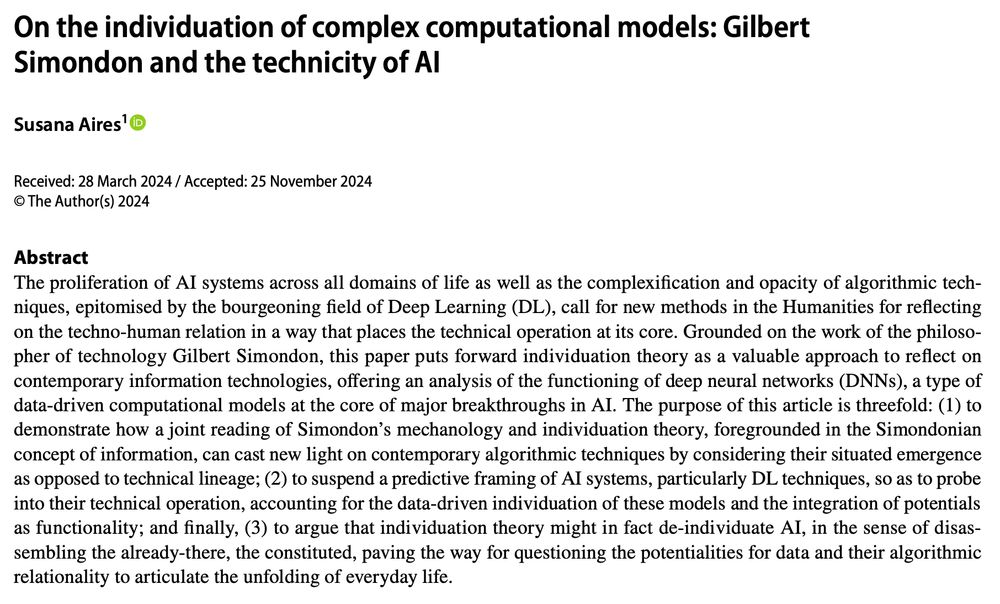
Happy to share that my paper "On the individuation of complex computational models: Gilbert Simondon and the technicity of AI" is now available on AI & Society. Thanks to @ludovico-rella.bsky.social and @fabio-iapaolo.bsky.social for putting together this special issue!
🔗 doi.org/10.1007/s001...


Always fun to host the GEO702 seminar students for brunch! Hard to believe another Fall semester is nearly over. Best wishes to all finishing the term!

@NOAA: November 2024 was the world's second-warmest November on record. It is almost certain that 2024 will be Earth's warmest year in NOAA's 175-year global record. Get the latest global #November2024 #climate report: bit.ly/3ZwbeQz #StateOfClimate

While doing course planning, typed “Internment in Geography” instead of “Internship”. 🪦
Well done, chair brain.

"Winterer’s 📕 tells the story of the gradual discovery, spanning the early 19th c., that the Earth was millions, and even billions, of years older than the Bible would suggest.... Once the idea of deep time fully sunk in..., it transformed the way 🇺🇸s perceived their country and their continent."
Thinking with this alongside recent article by @profgillian.bsky.social, “Visualising human life in volumetric cities: City digital twins and other disasters”
doi.org/10.1177/2754...
“A good computer system must include, Mr. Wood said, flexible compatible, retrievable data for specific neighborhoods within a city covering social and physical development, health and education, and new construction and rehabilitation.” (AP 1967)
