FRIENDS
Frameworks, Research and applIcations in complEx Networks with signeD edgeS
🕸️ Working on signed networks? Planning to attend @netsciconf.bsky.social in Boston? 🕸️
🔥Abstract submissions for the FRIENDS satellite are open🔥
Deadline March 20th (acceptance on a rolling basis).
Details: signet-friends.github.io
18.02.2026 09:09
👍 5
🔁 5
💬 0
📌 2
Cool satellite alert!! 🙆
18.02.2026 09:49
👍 1
🔁 0
💬 0
📌 0

a countdown timer with the words `` it 's the final countdown ! '' on it .
ALT: a countdown timer with the words `` it 's the final countdown ! '' on it .
DEADLINE FISES JOVEN!!!
Ampliamos el plazo para el envío de contribuciones hasta este viernes, 16 de enero.
Toda la información disponible en: fisesjoven26.gefenol.es
Si tienes cualquier duda, no dudes en escribirnos a fisesjoven@ifisc.uib-csic.es
13.01.2026 17:44
👍 3
🔁 2
💬 0
📌 2

a cartoon drawing of a clock with a face and arms and legs
ALT: a cartoon drawing of a clock with a face and arms and legs
Os recordamos que el cierre de contribuciones es el 12 de enero. Esta fecha es improrrogable, así que tened en cuenta que no se extenderá.
¡No os quedéis fuera! Se otorgarán certificados oficiales que acrediten la participación como ponente.
Toda la información en: fisesjoven26.gefenol.es
15.12.2025 11:35
👍 2
🔁 2
💬 0
📌 0

Parece que también ha sido mi podcast más escuchado :)
03.12.2025 22:11
👍 2
🔁 2
💬 0
📌 0
FisEs Joven'26
Esta cuarta edición, celebrada del 10 al 12 de marzo de 2026, tendrá lugar de forma gratuita y virtual mediante la plataforma Zoom.
🚨🚨 ¡Atención! 🚨🚨
La IV edición del congreso FisEs Joven, un congreso online dedicado a jóvenes investigadores e investigadoras en física estadística, se celebrará los días 10, 11 y 12 de marzo. (1/2)
03.12.2025 10:40
👍 10
🔁 9
💬 1
📌 1
On the more dynamical side:
- Doyle & Snell. "Random walks and electric networks" (1984).
- Lovász. "Random walks on graphs" (1993).
29.11.2025 12:30
👍 2
🔁 0
💬 0
📌 0
A few important but overlooked papers prior to Watts/Strogatz and Barabasi/Albert that come to mind:
- Cartwright & Harary. "Structural balance: a generalization of Heider's theory" (1956).
- Molloy and Reed, “A critical point for random graphs with a given degree sequence” (1995).
29.11.2025 12:29
👍 4
🔁 0
💬 1
📌 0

Guess the new project
27.11.2025 11:41
👍 2
🔁 0
💬 0
📌 0
Signed Networks: theory, methods, and applications
Fernando Diaz-Diaz, Elena Candellone, Miguel A. Gonzalez-Casado, Emma Fraxanet, Antoine Vendeville, Irene Ferri, Andreia Sofia Teixeira
Signed networks provide a principled framework for representing systems in which interactions are not merely present or absent but qualitatively distinct: friendly or antagonistic, supportive or conflicting, excitatory or inhibitory. This polarity reshapes how we think about structure and dynamics in complex systems: a negative tie is not simply a missing positive one but a constraint that generates tension, and possibly asymmetry. Across disciplines, from sociology to neuroscience and machine learning, signed networks provide a shared language to formalise duality, balance, and opposition as integral components of system behaviour. This review provides a comprehensive and foundational summary of signed network theory. It formalises the mathematical principles of signed graphs and surveys signed-network-specific measures, including signed degree distributions, clustering, centralities, motifs, and Laplacians. It revisits balance theory, tracing its cognitive and structural formulations and their connections to frustration. Structural aspects of signed networks are examined, analysing key topics such as null models, node embeddings, sign prediction, and community detection. Subsequent sections address dynamical processes on and of signed networks, such as opinion dynamics, contagion models, and data-driven approaches for studying evolving networks. Practical challenges in constructing, inferring and validating signed data from real-world systems are also highlighted, and we offer an overview of currently available datasets. We also address common pitfalls and challenges that arise when modelling or analysing signed data. Overall, this review integrates theoretical foundations, methodological approaches, and cross-domain examples, providing a structured entry point and a reference framework for researchers interested in the study of signed networks in complex systems.
Read the full article at: arxiv.org
Signed Networks: theory, methods, and applications
26.11.2025 17:07
👍 3
🔁 3
💬 0
📌 0

Nos hace mucha ilusión anunciar a
David Soriano Paños, Universitat Rovira i Virgili
@sorianopanos.bsky.social
como conferenciante invitado. Te esperamos el 21-23 enero 2026 en Sevilla para compartir avances en sistemas complejos.
🚨 Envía tu abstract hasta el 30 Oct 2025
🌐 cs3.es/conference-2...
08.10.2025 12:57
👍 10
🔁 6
💬 0
📌 0

Continuamos con nuestros conferenciantes invitados!
En la 4º reunión de la Sociedad Española de Sistemas Complejos tendremos el placer de contar con
Carlos Gershenson, SUNY Binghamton
@cgershen.bsky.social
🗓️ 21-23 enero Sevilla 2026
🚨 Envía tu abstract hasta el 30 Oct 2025
🌐 cs3.es/conference-2026
15.10.2025 14:52
👍 7
🔁 5
💬 0
📌 0
¡Comienza la cuenta atrás para la IV edición de FisEs Joven!
Este encuentro reúne a jóvenes investigadores en física estadística y áreas afines, fomentando el intercambio y la colaboración desde las primeras etapas de la carrera científica. (1/2)
02.10.2025 10:29
👍 8
🔁 6
💬 1
📌 0

Empezamos a anunciar nuestra lista de invitados con 🥁...
Susanna Manrubia, @mncn-csic.bsky.social
Encantados de tenerla en la 4º reunión de la Sociedad Española de Sistemas Complejos!
🗓️ 21-23 enero 2026 |📍Sevilla
✏️Contribuciones abiertas hasta el 30 Oct 2025
🌐 cs3.es/conference-2...
06.10.2025 13:17
👍 14
🔁 6
💬 0
📌 0
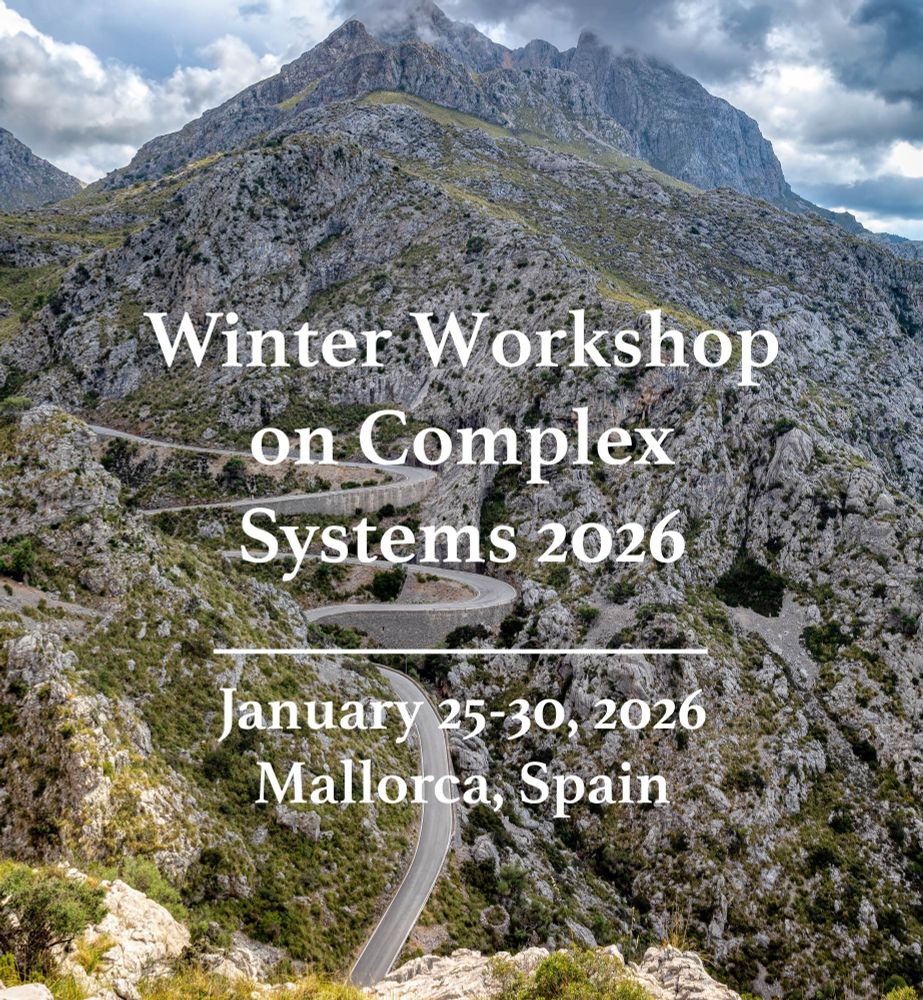
The 𝗪𝗶𝗻𝘁𝗲𝗿 𝗪𝗼𝗿𝗸𝘀𝗵𝗼𝗽 𝗼𝗻 𝗖𝗼𝗺𝗽𝗹𝗲𝘅 𝗦𝘆𝘀𝘁𝗲𝗺𝘀 (𝗪𝗪𝗖𝗦𝟮𝟲) has extended its hashtag#deadline for applications to 𝗢𝗰𝘁𝗼𝗯𝗲𝗿 𝟭𝟯𝘁𝗵!
For more information 🔗 wwcs2026.github.io
Apply here: tinyurl.com/yu3a8ydd
06.10.2025 20:29
👍 9
🔁 6
💬 0
📌 0

🎓 La tesis de Rodrigo Martínez-Peña (Reservoir computing in quantum systems), dirigida por Roberta Zambrini y Miguel C. Soriano (@miguelcsoriano.bsky.social), ha sido premiada en los III Premios #TesisDoctoralRelevante del @csic.es. ¡Enhorabuena!
🔗 ifisc.uib-csic.es/es/news/iii-...
24.09.2025 08:42
👍 5
🔁 1
💬 0
📌 0

Ayer tuvimos el honor de celebrar el acto de entrega de la I edición de los Premios DIFENSC de tesis doctorales. ✨❄️
¡Enhorabuena de nuevo a los ganadores Guillermo Barrios Morales y Jorge Tabanera Bravo! 🏅
Gracias a la fundación Sicómoro por hacerlo posible.
24.09.2025 09:39
👍 1
🔁 1
💬 0
📌 0

🎤 We’re thrilled to announce our next #WWCS26 speaker: Carmen Cabrera, Lecturer in Geographic Data Science at the University of Liverpool.
Camren's research focuses on human mobility patterns across spatiotemporal scales and population groups. We look forward to meeting her at Mallorca ❄️🌍
05.09.2025 10:56
👍 4
🔁 1
💬 0
📌 0


This week I travelled to the island of Ons in Galicia. An amazing natural reserve in the middle of the Atlantic. ⛵🗺️
23.08.2025 11:27
👍 4
🔁 0
💬 0
📌 0
That said, my main reference when thinking about communities is precisely your work on descriptive vs inferential approaches that you mention, so I will probably agree with you on most aspects :)
11.07.2025 09:05
👍 1
🔁 0
💬 0
📌 0
But at the same time, I think it's nice to keep in mind that there are situations where looking at disconnected components as a extreme case of communities can make sense, especially if the objective of the study is not to analyze data.
11.07.2025 09:01
👍 0
🔁 0
💬 2
📌 0
I completely agree, mixing two conceptualizations of community can lead to problems, because minimizing cut-sets and maximizing likelihoods are based on very different assumptions.
11.07.2025 09:01
👍 0
🔁 0
💬 1
📌 0
To be clear, I agree that interpreting community detection as a maximum-likelihood problem is a more powerful approach to understand complex datasets. My point is that, from a mathematical (not statistical) point of view, the other vision can be insightful too.
11.07.2025 08:42
👍 0
🔁 0
💬 1
📌 0
In fact, I would say the pure-math approach to communities tends to understand them as "almost disconnected" regions (partitions with a small cut-set), and this perspective has led to nice results (for example the Cheeger inequalities, the spectral clustering algorithms, perturbative methods, etc).
11.07.2025 08:42
👍 0
🔁 0
💬 1
📌 0
I think the interpretation of communities as network partitions with a small cut-set is useful in certain areas. Ofc, claiming that this conceptualization of community is statistically meaningful is problematic, but as a descriptive concept I think it's ok.
11.07.2025 08:42
👍 0
🔁 0
💬 1
📌 0
Me muero de calor
05.07.2025 17:22
👍 0
🔁 0
💬 0
📌 0
It's so frustrating that symmetric graphs always have degenerate spectra. Why do I have to choose between graphs that look nice and graphs that behave properly? I want both :(
04.07.2025 13:20
👍 1
🔁 0
💬 0
📌 0