We've been saying for a while now that beta bursts might be functionally heterogeneous. Check out @quentinmoreau.bsky.social's paper where we show that different types of bursts have different relationships to behavior in a sensorimotor adaptation task 👇👇👇
09.03.2026 07:07
👍 14
🔁 8
💬 1
📌 0

Sage Journals: Discover world-class research
Subscription and open access journals from Sage, the world's leading independent academic publisher.
3/3 This might explain why the post-movement beta rebound has been so debated: it's not one thing. It's composed of functionally distinct bursts that cancel out when averaged.
Waveform morphology is a window into cortical computation! journals.sagepub.com/doi/full/10....
09.03.2026 06:50
👍 1
🔁 0
💬 0
📌 0

🧵 2/3 We recorded MEG while people adapted to a visuomotor rotation. Classic beta power & burst rate told part of the story, but sorting bursts by their waveform shape showed that distinct subtypes have opposing relationships with movement error !
09.03.2026 06:50
👍 2
🔁 0
💬 1
📌 0
🧵1/3 New paper out! Beta bursts aren't all the same and their waveform shape are functionally meaningful ! @maciekszul.bsky.social & @danclab.bsky.social👇
www.biorxiv.org/content/10.6...
09.03.2026 06:50
👍 11
🔁 6
💬 1
📌 3

Important dates - ESCAN 2026
📣 ESCAN 2026 – Symposium deadline
Good news!
The symposium submission deadline has been extended to January 17.
The poster and single-talk deadline remains February 16.
🔗 escan2026.eu/important-da...
09.01.2026 07:46
👍 9
🔁 9
💬 1
📌 1

Our group has been looking at beta bursts for the last 5 years, but we do it a little differently than most - we group into types them based on their waveforms. In this open access article we lay out why and what we think this might mean
journals.sagepub.com/doi/10.1177/...
#neuroskyence
12.12.2025 10:00
👍 61
🔁 22
💬 1
📌 0
Beta band is not an oscillation. It's best seen as a set of diverse events, indexed by waveform shape.
11.12.2025 08:06
👍 10
🔁 3
💬 0
📌 0

8 snippets showing 5 seconds of intracranial oscillatory brain activity from an electrodes located in the temporal cortex. brain plot showing the location of the electrode + surrounding electrodes.
auditory tau-rhythm with a cool waveform, oscillating at 10 Hz, recorded with intracranial electrodes. 🧠〰️🙂
06.11.2025 13:29
👍 24
🔁 3
💬 2
📌 0
New study led by @quentinmoreau.bsky.social & @vchamberland.bsky.social and @ppsp-team.bsky.social 👏 We show how brain stim can shape social inference in human–machine interaction 🧠🤖⚡ New causal evidence linking rTPJ to Theory-of-Mind & Self–Other distinction, & path towards social #neuromodulation!
17.10.2025 15:28
👍 13
🔁 1
💬 0
📌 0
7/ Big thanks to our supporting institutions:
@umontreal.ca, @cra-chusj.bsky.social, @mila-quebec.bsky.social, @braincanada.bsky.social, @simonsfoundation.org, @azrielifoundation.bsky.social, @ivado.bsky.social & @cifar.bsky.social 🙏
17.10.2025 13:58
👍 2
🔁 1
💬 0
📌 0

6/ Grateful to all participants and to the dedicated @ppsp-team.bsky.social.
Special thanks to @introspection.bsky.social for his guidance.
Proud to share first authorship with @quentinmoreau.bsky.social and collaborate with Lisane Moses and Gabriela Milanova.
17.10.2025 13:58
👍 2
🔁 1
💬 1
📌 0

5/ Results:
❌ No effect of rTPJ stimulation on motor coordination (Experiment 1 and 2).
✅ Repeated HD-tRNS sharpened detection of competitive intent and reduced humanness attribution during competitive interactions (Experiment 1 only).
17.10.2025 13:58
👍 2
🔁 1
💬 1
📌 0

4/ Two complementary experiments:
Exp1 (n=39): HD-tRNS⚡ or sham 🚫 randomized blocks
Exp2 (n=40): HD-tRNS⚡ and sham 🚫 randomized trials
During trials, participants synchronized finger movements with a covert virtual partner, then rated perceived cooperativeness & humanness.
17.10.2025 13:58
👍 1
🔁 1
💬 1
📌 0

3/ We applied high-definition transcranial random noise stimulation (HD-tRNS) over the right temporoparietal junction (rTPJ) of participants interacting with the virtual partner of the HDC, aiming to probe the rTPJ’s causal role in real-time social interaction.
17.10.2025 13:58
👍 1
🔁 1
💬 1
📌 0

2/ Our work directly builds on Dumas et al. (2020), who combined high-density EEG with the Human Dynamic Clamp (HDC) paradigm to reveal the rTPJ as a key cortical hub for integrating self–other representations.
17.10.2025 13:58
👍 2
🔁 1
💬 1
📌 0
1/ TL;DR:
High-definition transcranial random noise stimulation (⚡) over the right temporoparietal junction (🧠) sharpened detection of competitive intent during interaction with a covert virtual partner (🤖)—without affecting motor coordination.
17.10.2025 13:58
👍 3
🔁 1
💬 1
📌 0
It's been a while since our last laminar MEG paper, but we're back! This time we push beyond deep versus superficial distinctions and go whole hog. Check it out- lots more exciting stuff to come! 🧠📈
02.06.2025 12:31
👍 22
🔁 9
💬 1
📌 0
Great thanks to coauthors and collaborators: Ishita Agarwal, Quentin Moreau (@quentinmoreau.bsky.social), Bassem Hiba, Sven Bestmann (@armlabucl.bsky.social), Gareth Barnes, and James Bonaiuto (@danclab.bsky.social). It was a huge amount of work and cluster time, but it’s out now!
02.06.2025 11:54
👍 4
🔁 1
💬 2
📌 0
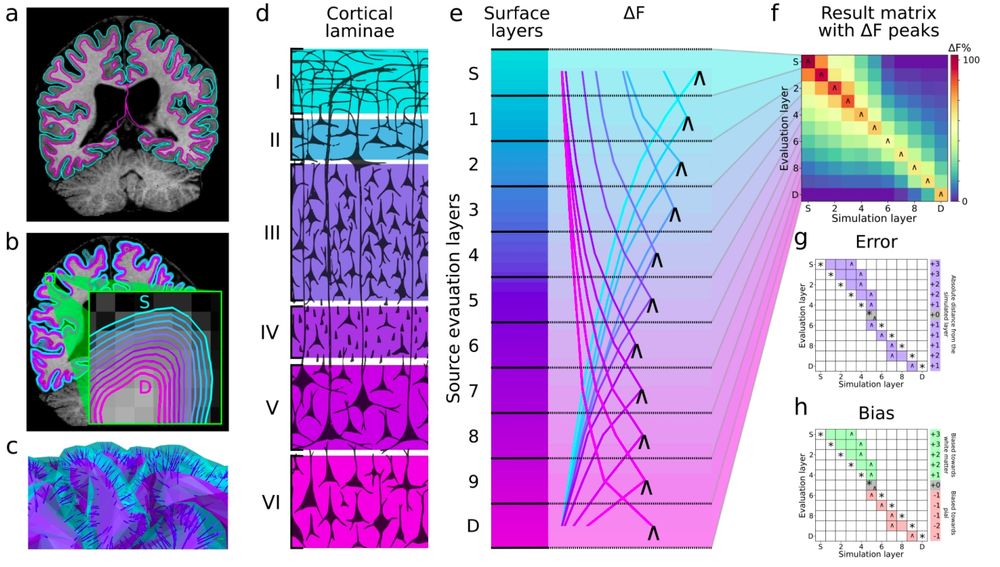
Overview of the simulation strategy and analysis. a) Pial and white matter boundaries
surfaces are extracted from anatomical MRI volumes. b) Intermediate equidistant surfaces are
generated between the pial and white matter surfaces (labeled as superficial (S) and deep (D)
respectively). c) Surfaces are downsampled together, maintaining vertex correspondence across
layers. Dipole orientations are constrained using vectors linking corresponding vertices (link vectors).
d) The thickness of cortical laminae varies across the cortical depth (70–72), which is evenly sampled
by the equidistant source surface layers. e) Each colored line represents the model evidence (relative
to the worst model, ΔF) over source layer models, for a signal simulated at a particular layer (the
simulated layer is indicated by the line color). The source layer model with the maximal ΔF is
indicated by “˄”. f) Result matrix summarizing ΔF across simulated source locations, with peak
relative model evidence marked with “˄”. g) Error is calculated from the result matrix as the absolute
distance in mm or layers from the simulated source (*) to the peak ΔF (˄). h) Bias is calculated as the
relative position of a peak ΔF(˄) to a simulated source (*) in layers or mm.
🚨🚨🚨PREPRINT ALERT🚨🚨🚨
Neural dynamics across cortical layers are key to brain computations - but non-invasively, we’ve been limited to rough "deep vs. superficial" distinctions. What if we told you that it is possible to achieve full (TRUE!) laminar (I, II, III, IV, V, VI) precision with MEG!
02.06.2025 11:54
👍 112
🔁 45
💬 4
📌 8

PhD Call 📢📢📢
Are you interested in a PhD in Cognitive and Social Neuroscience? Join us! We are booking for highly motivated and inspired future researchers! Waiting for you in Rome!
🗓️ Deadline 19th June
Useful links👇🏻👇🏻👇🏻
phd.uniroma1.it/web/concorso...
phd.uniroma1.it/web/pagina.a...
22.05.2025 15:25
👍 10
🔁 9
💬 0
📌 2
EEG of the Dancing Brain - new paper out! 🧠🕺
Thrilled to share our latest work on disentangling the neural basis of real-time social dance!!
www.jneurosci.org/content/45/2...
A full @giacomonovembre.bsky.social NPA Lab production 🎬
#dance #socialinteraction #hyperscanning #motioncapture
22.05.2025 10:30
👍 27
🔁 9
💬 3
📌 1
Amazing work, @felixbigand.bsky.social ! And thanks to all our lab collaborators: Sara Abalde, @robertabianco.bsky.social and @trinhnguyen.bsky.social !
22.05.2025 14:37
👍 2
🔁 1
💬 0
📌 0
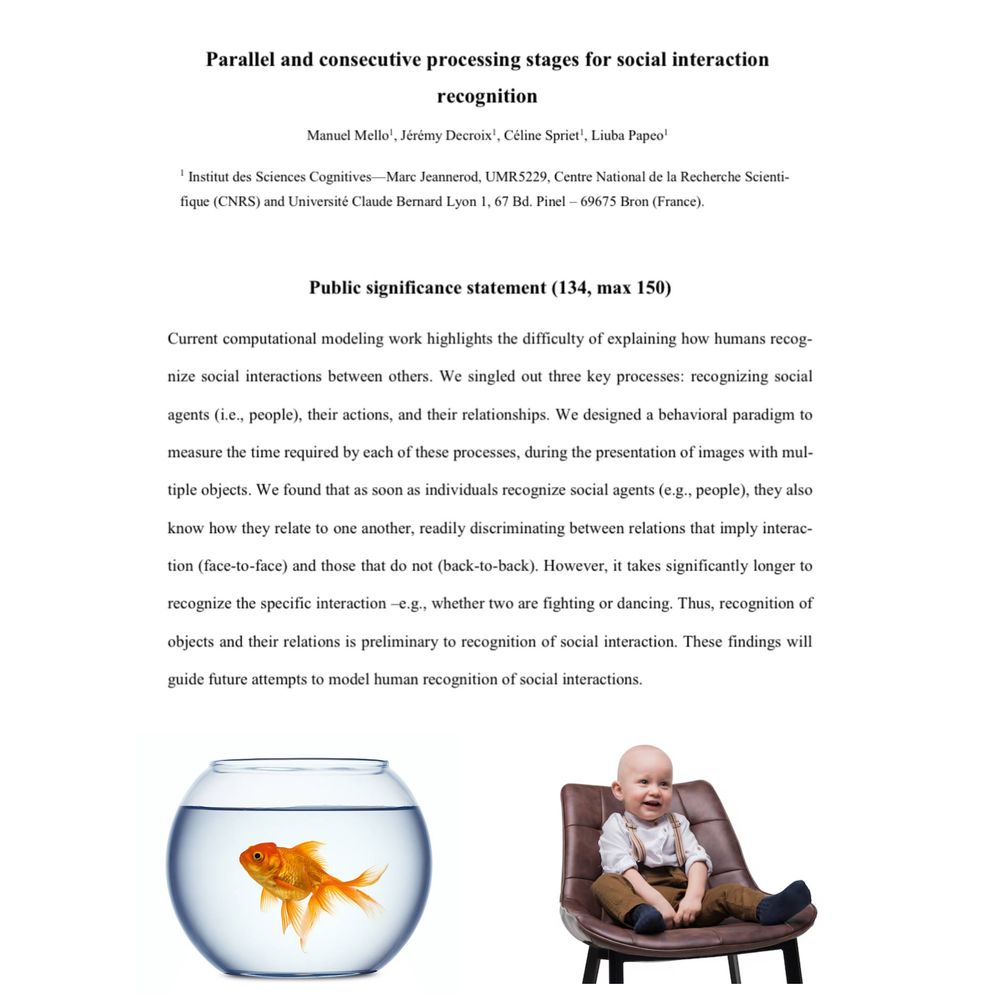
You wouldn’t drink from a glass if a fish is IN the glass, or would not grab a chair if one is already sitting ON it.
How do we represent relations between things? And how does it relate to object and action recognition?
New paper out osf.io/preprints/ps...
@mmellon.bsky.social
21.05.2025 12:00
👍 11
🔁 3
💬 1
📌 0

Kick off of #Cortico2025 with @dngman.bsky.social who came to Lyon by bike from Basel !! 🚲
12.05.2025 07:59
👍 7
🔁 2
💬 0
📌 0

New in #eNeuro from Pesci, Moreau, Era, and Candidi: How people interact with and process the movements of avatars differs depending on whether avatars look like people. eneuro.org/lookup/DOI/10.1523/ENEURO.0390-24.2025
07.04.2025 19:26
👍 2
🔁 1
💬 0
📌 0


