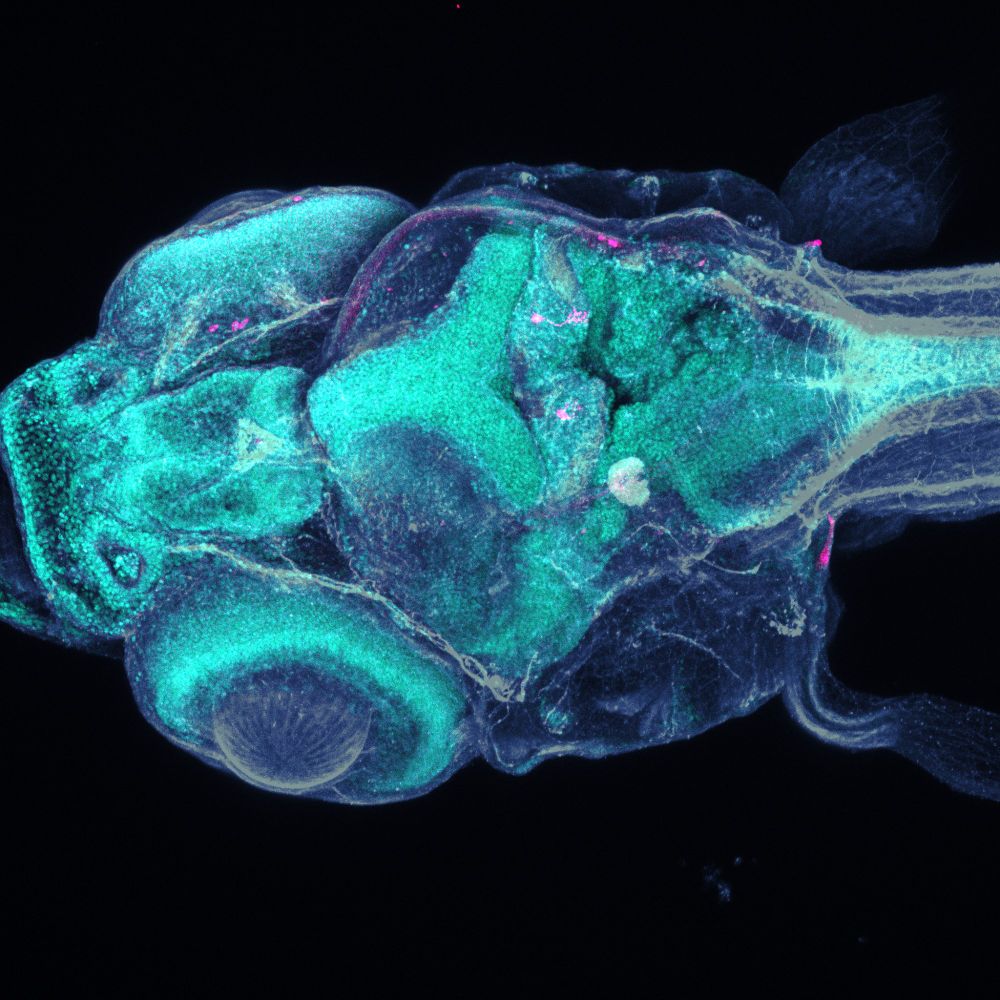
Juvenile zebrafish brain stained with filipin to measure free cholesterol.
I'm pleased to share our newest preprint, which was actually the very first project started in my lab. It took a long time to come together! We address the challenge of translating complex psychiatric genetics into biological mechanism. tinyurl.com/4w7hv8d8
18.02.2026 15:24
👍 13
🔁 4
💬 1
📌 1
And finally, shout-out to mentors @mishaahrens.bsky.social, Florian Engert, and Mark Fishman, our RA Arman Zarghani-Shiraz who made the transgenic lines, an everyone else in our labs who's helped along the way!
09.02.2026 18:03
👍 1
🔁 0
💬 0
📌 0

brain maps showing hot spots of heart-rate correlated activity across the brain
So, if it's not interoceptive feedback, how is the brain linking behavior to heart rate? Well, we don't know yet. Brain-wide imaging reveals many areas reflecting this state, but it's hard to guess their roles without anatomically grounding their connectivity. Something we hope to do very very soon.
09.02.2026 18:03
👍 0
🔁 0
💬 1
📌 0

Time series of heart rate and calcium in nodose ganglion neurons where activity matches stimulus evoked tachycardia, but does not increase when optopacing brings up the heart rate
This suggests the interoceptive representation of optopaced tachycardia is different from the naturally occurring one. So, we looked at what's happening in the nodose ganglia and saw that while some neurons had activity mirroring "normal" tachycardia, they actually don't respond to the optopacing!
09.02.2026 18:03
👍 0
🔁 0
💬 1
📌 0

bar plot showing that At 70% oxygen, increasing pacing rate does not change OMR rate
However, the interpretation of these data was tricky. These "optopaced" beats are not normal beats, and seem to be less efficient at transporting blood. So, we "helped" the fish by adding extra oxygen to the water, and saw that this rescued the OMR during the optoacing.
09.02.2026 18:03
👍 1
🔁 0
💬 1
📌 0

time series of heart rate with LED pacing rate showing that heart rate will match up with the intended pacing rate

bar plots showing reduction of OMR probability as LED-driven optopacing rate is increased
But could a high heart rate, by itself, be enough to stop the OMR? To test this, we used optogenetics to control how fast the heart beat using timed light pulses, and saw that this was sufficient to bring down the OMR
09.02.2026 18:03
👍 0
🔁 0
💬 1
📌 0

Graph showing effect of propranolol on OMR and heart rate relationship, with heart rate lowered and OMR probability increased

time series of heart rate in sham and preganglionic axon ablated fish showing loss of heart rate dynamics on left, and bar plots showing preservation of post-threat OMR change on right being unaffected
We do believe noradrenergic signaling is involved in both cardiac and behavior states - propranolol abates the heart rate and elevates the OMR. However, severing spinal inputs to sympathetic ganglia only affects heart rate suggesting feedback is not involved in the behavioral changes.
09.02.2026 18:03
👍 1
🔁 0
💬 1
📌 0
So, does the reduced OMR occur because the fish _senses_ a high heart rate? Or do central mechanisms control both cardiac and behavioral changes? We manipulated the autonomic nervous system in various ways, and long story short, we believe interoceptive feedback is _unnecessary_ for the coupling.
09.02.2026 18:03
👍 0
🔁 0
💬 1
📌 0

time series of heart rate following a threat showing that if the fish struggled, the heart rate goes up; if the fish didn't, then heart rate doesn't go up

Graph showing omr probability as a function of heart rate going from 0.8 to 0.2 as heart increases from 2 to 3 Hz
A quick thread of highlights:
We find two types of behavioral coupling: elevations in heart-rate occur after high energy swim events and persist for over a minute.
Second, with higher heart rate comes a reduced tendency to perform a routine behavior, the optomotor response (OMR).
09.02.2026 18:03
👍 0
🔁 0
💬 1
📌 0

Synchronization of behavioral and cardiac dynamics in larval zebrafish
Animals reprioritize behavioral goals in response to internal physiological states. Using larval zebrafish, we investigated whether engagement with a …
New paper out : "Synchronization of behavioral and cardiac dynamics in larval zebrafish"
Here, we report a pretty striking relationship between behavioral state and heart rate in larval zebrafish, and then explore the mechanisms that lead to this coupling
bit.ly/4ciYt3R
09.02.2026 18:03
👍 24
🔁 7
💬 1
📌 1

bar plots showing no change in omr proability with changing LED pulse-induced heart rate at 70% O2
However, the interpretation of these data was tricky. These "optopaced" beats are not normal beats, and seem to be less efficient at transporting blood. So, we "helped" the fish by adding extra oxygen to the water, and saw that this rescued the OMR during the optoacing.
09.02.2026 17:42
👍 0
🔁 0
💬 0
📌 0
Social context modulates cannibalistic attraction in Drosophila larvae https://www.biorxiv.org/content/10.64898/2026.01.08.698439v1
09.01.2026 23:15
👍 1
🔁 1
💬 0
📌 0
To study how animals understand the physical world (and the rules that govern its dynamics), @jinyao-y.bsky.social trains rats to play fetch with robots 🐀🤖🎾
To learn more, come to our poster Tuesday morning!
[Board W11] Rats learn and use intuitive physics knowledge to solve fetch tasks.
#SfN2025
18.11.2025 01:16
👍 69
🔁 20
💬 0
📌 0

Behavioral and circuit principles of temperature gradient navigation
Behavioral thermoregulation is critical for survival across animals. Balakrishnan
and Haesemeyer discover that thermoregulatory behavior in larval zebrafish is organized
into longer-term swim modes. T...
Out now in @currentbiology.bsky.social led by Kaarthik A Balakrishnan: We identify medullary circuits that represent the valence of thermal stimuli and control both long-term strategies of cold-avoidance and short term hot avoidance behaviors to enable thermoregulation. www.cell.com/current-biol...
24.10.2025 14:57
👍 12
🔁 9
💬 0
📌 0
🧠🌟🐭 Excited to share some of my postdoc work on the evolution of dexterity!
We compared deer mice evolved in forest vs prairie habitats. We found that forest mice have:
(1) more corticospinal neurons (CSNs)
(2) better hand dexterity
(3) more dexterous climbing, which is linked to CSN number🧵
22.10.2025 20:41
👍 378
🔁 124
💬 19
📌 26
Lab’s 1st preprint!
Menstruation is understudied due to societal taboos + a biological challenge: mice (a key system for research + drug discovery) don’t menstruate.
@cagricevrim.bsky.social made menstruating mice + used them to discover early events in menstruation.
He is on the job market!
10.10.2025 13:26
👍 301
🔁 91
💬 18
📌 8
“Blame your parents if you can’t pay enough attention." At least when you are a zebrafish! Our new study on attentional switching together with Kumaresh Krishnan, @paulapflitsch.bsky.social , @zwitscherarmin.bsky.social and Florian Engert is out in Science Advances:
doi.org/10.1126/scia...
03.10.2025 21:23
👍 22
🔁 7
💬 0
📌 1
🚨Our preprint is online!🚨
www.biorxiv.org/content/10.1...
How do #dopamine neurons perform the key calculations in reinforcement #learning?
Read on to find out more! 🧵
19.09.2025 13:05
👍 197
🔁 71
💬 11
📌 4
Preprint -
Excited to present WHOLISTIC, which extends the concept of whole-brain functional imaging to the entire body. Pioneering work by incredibly talented Virginia Ruetten @vmsruetten.bsky.social, this platform reveals whole-organism cellular dynamics in vivo.
www.biorxiv.org/content/10.1...
08.09.2025 16:23
👍 194
🔁 70
💬 3
📌 6
🚨Hiring Alert! Join Gregor Schuhknechts’s
new group Brain Algorithms and Circuits @mpibrain.bsky.social !
🧠 Fully funded PhD & Postdoc
🐟 Larval #zebrafish model
🔬 Imaging, electrophysiology, EM
💻 #SystemsNeuroscience
👉 brain.mpg.de/schuhknecht
01.08.2025 13:49
👍 3
🔁 4
💬 0
📌 0
🚨Very happy that my PhD work is now out in @nature.com!
We discovered that evolution, by acting in the midbrain, shifted the threshold to escape in Peromyscus mice, to fine-tune defensive strategies in different environments
www.nature.com/articles/s41...
This was a truly collaborative effort! 🧵⬇️
23.07.2025 15:05
👍 473
🔁 103
💬 26
📌 5
A connectomic resource for neural cataloguing and circuit dissection of the larval zebrafish brain https://www.biorxiv.org/content/10.1101/2025.06.10.658982v1
15.06.2025 22:15
👍 5
🔁 3
💬 0
📌 1
Now published in @plos.org Computational Biology our paper led by @yesthatlindsay.bsky.social on the integration of sensory and motor information in zebrafish thermoregulation. Thanks to the peer reviewers for great suggestions.
dx.plos.org/10.1371/jour...
10.06.2025 23:39
👍 6
🔁 3
💬 0
📌 1

Wouldn't it be great if we could not only image large connectomic volumes but also completely reconstruct them? And if a whole mouse brain project didn't cost billions?
With the PATHFINDER preprint (www.biorxiv.org/content/10.1...), we preview a future where it doesn't have to.
22.05.2025 11:41
👍 33
🔁 13
💬 2
📌 0