A female Small Copper butterfly (Lycaena phlaeas) egg-laying on Common Sorrel (Rumex acetosa)

Two eggs of the Small Copper butterfly (Lycaena phlaeas) on Common Sorrel (Rumex acetosa)
Excited to see one of my PhD chapters now published! We found a trade-off between the quality of host plants and how warm they were for a declining grassland butterfly (Small Copper, Lycaena phlaeas) and looked at how this shaped their egg-laying choices: doi.org/10.1111/een....
07.03.2026 17:16
👍 51
🔁 12
💬 3
📌 2
Are these photos posted online somewhere?
14.02.2026 19:19
👍 0
🔁 0
💬 1
📌 0
Really excited to present the results of a fantastic collaboration with Jesse Veenvliet @jesseveenvliet.bsky.social @mpi-cbg.de @poldresden.bsky.social 🤩
We find a unique mechanism for body axis elongation in mammals, different from other vertebrate species
➡️ www.biorxiv.org/content/10.1...
28.10.2025 08:24
👍 142
🔁 47
💬 6
📌 3
According to blaadmineerders.nl P xenia feeds on Aspen
02.10.2025 20:45
👍 1
🔁 0
💬 0
📌 0
Could these mines not be microtheriella? Looks like the correct shape, and there's multiple mines on the same leaf, which is common for microtheriella
02.10.2025 05:02
👍 1
🔁 0
💬 1
📌 0

Mine of Dialectica scalariella on Viper's Bugloss (Echium vulgare)

Larva of Dialectica scalariella, exposed from its mine

Adult Dialectica scalariella
Collected leaf-mines of Dialectica scalariella on Viper's Bugloss/Echium vulgare from Freshwater Bay, Portland (VC 9) on 13th Sept - adults emerged on 25th Sept
@portlandbirdobs.bsky.social @dorsetbutterflies.bsky.social
27.09.2025 11:23
👍 10
🔁 1
💬 0
📌 0
I am excited to share the first preprint from my postdoc work! We found that ligand-receptor pairs are not static and show an antagonistic spatial localization! We show ligand is important to fine tune the amplitude of Wnt oscillations ensuring robust tissue patterning! Check out the preprint!
11.09.2025 15:42
👍 9
🔁 1
💬 2
📌 0
Out now in Seminars in Cell & Dev Biol!
doi.org/10.1016/j.se...
With thanks to co-authors @callumbucklow.bsky.social and @bertaverd.bsky.social
08.09.2025 11:59
👍 4
🔁 6
💬 0
📌 1

Portland moth / Actebia praecox resting on sand

Arctosa perita on an egg tray
Haar kept moth numbers down at Findhorn dunes (VC 95) last night, with a meagre return of 15 species across two traps. However i did find a nice Portland moth / Actebia praecox resting on the heather, and an attractive Arctosa perita sought refuge (or prey) inside one of the traps
18.08.2025 15:44
👍 1
🔁 0
💬 0
📌 0
Can't be taken beyond genus but most likely to be cagnagella with those white terminal cilia
30.06.2025 17:15
👍 1
🔁 0
💬 0
📌 0
25.06.2025 07:39
👍 2
🔁 0
💬 0
📌 0

Nemapogon ruricolella, resting on my finger

Argyresthia glaucinella

Stephensia brunnichella
Great night mothing in Wytham Woods on midsummer's day - warm weather brought in 121 species including (presumed) Nemapogon ruricolella, Argyresthia glaucinella, and a very handsome Stephensia brunnichella
@tmbirding.bsky.social #mothsmatter
25.06.2025 07:39
👍 11
🔁 1
💬 1
📌 0
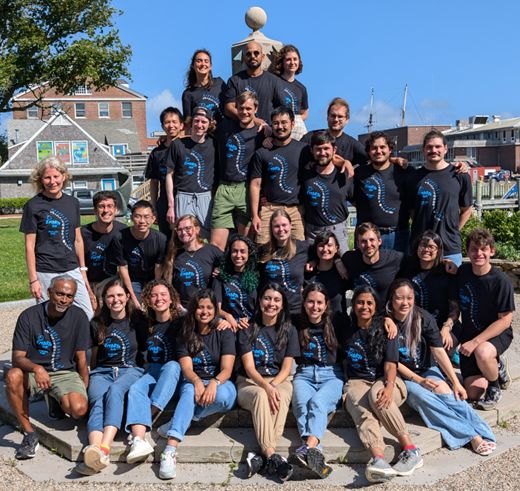
The 2024 Embryology cohort. Top row (left to right): Lucrezia Ferme, Vivek Ramalingam, Louise Dagher. Second row (left to right): Yuchuan Miao, Angelo Arrigo, Cliff Rostomily, Ekasit Sonpho, James Hammond, Jakke Neiro, Fjodor Merkuri, Paul Maier. Third row (left to right): Tatjana Piotrowski, Marc Trani Bustos, Roy Chen, Amanda Powell, Maya Pahima, Verena Kaul, Alexandra Lion, Frederic Zimmer, Kaitlyn Abshire, Stanley Marjenberg. Bottom row (left to right): Athula Wikramanayake, Kate McCluskey, Virgínia Andrade, Arushi Gupta, Francisca Espinoza Romero, Ruth Styfhals, Chaitra Prabhakar, Erica Lin.
In this Perspective, students from the 2024 Embryology Course share their experiences spending the summer at the Marine Biological Laboratory (@mblscience.bsky.social) in Woods Hole:
journals.biologists.com/dev/article/...
10.06.2025 08:51
👍 6
🔁 1
💬 0
📌 0
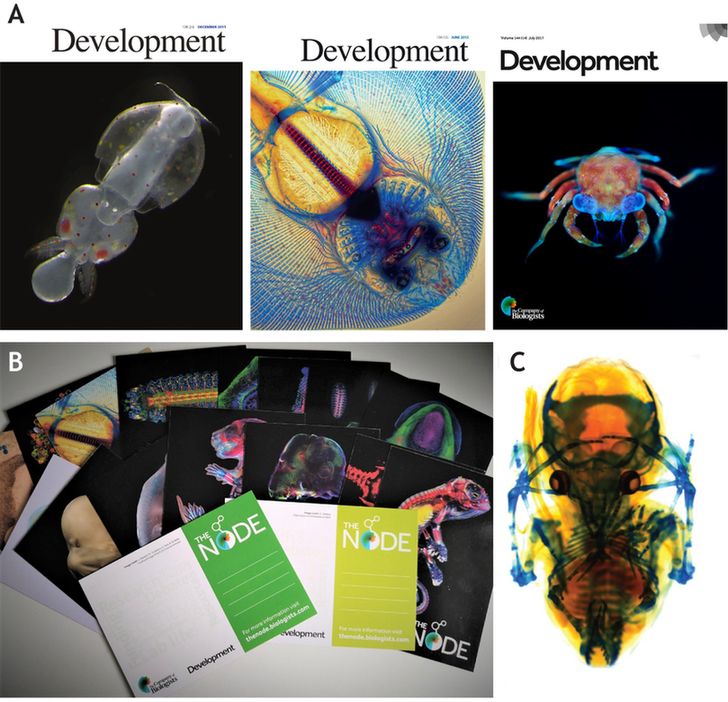
Images taken during the Woods Hole Embryology Course that have been promoted by Development and the Node.
The Company of Biologists and the Woods Hole Embryology Course
We explore the association of Development and @biologists.bsky.social with the Woods Hole Embryology Course @mblscience.bsky.social and hear from former students about the impact the course has had on them:
doi.org/10.1242/dev....
10.06.2025 08:51
👍 14
🔁 8
💬 1
📌 0


From hydra grafts to butterfly gene expression, the 2024 @mblscience.bsky.social #Embryology Course was a playground for #discovery. 🌊 @planaria1.bsky.social Lab postdoc Ekasit Sonpho co-authored a reflection in @dev-journal.bsky.social on what made this summer so transformative: bit.ly/3ZIMRQu
04.06.2025 16:07
👍 13
🔁 4
💬 0
📌 0
Somitic Change Drives Changes in Vertebral Regionalisation in African Cichlids Despite Strong Canalisation of Somite Number https://www.biorxiv.org/content/10.1101/2025.05.23.655800v1
28.05.2025 20:32
👍 1
🔁 3
💬 0
📌 0

Experimental embryology postdoc available in my lab at the @biology.ox.ac.uk @ox.ac.uk working on the evolution of vertebral counts. Reach out if you’re passionate about EvoDevo, enjoy lab work and microscopy and are into or could get into cichlid fishes. Deadline on the 16th June. Please share!
19.05.2025 16:10
👍 64
🔁 66
💬 4
📌 5

Modularity of the segmentation clock and morphogenesis
Vertebrates have evolved great diversity in the number of segments dividing the trunk body, however the developmental origin of the evolvability of this trait is poorly understood. The number of segme...
Segmentation clock & tissue development are decoupled - explanation for evolution of flexible body plans?
#EvoDevo #SegmentationClock
Study from Verd Lab @bertaverd.bsky.social @oxfordmathematics.bsky.social
🆕 #preprintpeerreview @biorxivpreprint.bsky.social
--> doi: doi.org/10.1101/2024...
30.04.2025 09:19
👍 5
🔁 2
💬 1
📌 0
I assume you reared them from larvae? What did you feed them - are you close enough to Bearberry to feed them that, or did you try them on Willow?
28.04.2025 17:28
👍 0
🔁 0
💬 1
📌 0
Not argyrana IMO, suspect one of albuginana/suspectana, worth dissecting
27.04.2025 19:36
👍 2
🔁 0
💬 1
📌 0
How'd you find this one? On a fencepost?
18.04.2025 18:44
👍 1
🔁 0
💬 1
📌 0

A male of the micro moth Pammene juniperana.

A female of the micro moth Pammene juniperana.

Habitat of the micro moth Pammene juniperana with wild Juniper growing on chalk downland.

Larval feeding signs of the micro moth Pammene juniperana, with green Juniper berries discoloured pale blue.
Previously only recorded once in the UK in 2018, records of Pammene juniperana have been increasing since 2022. Pleased to finally share this paper with @jamesehammond.bsky.social confirming that this lovely moth is breeding here, probably both on both wild and garden Junipers: shorturl.at/E2LrU
18.04.2025 09:00
👍 61
🔁 4
💬 5
📌 2
Thank you!
26.03.2025 14:52
👍 0
🔁 0
💬 0
📌 0
Thank you! Obviously heavily inspired by your work
25.03.2025 10:23
👍 2
🔁 0
💬 0
📌 0

Latest work:
Review on the evolvability of vertebral number, and the developmental processes underpinning it
Written by Callum Bucklow, @bertaverd.bsky.social, and myself
Check it out here: doi.org/10.32942/X2K...
24.03.2025 21:26
👍 23
🔁 5
💬 1
📌 3

Rannoch sprawler / Brachionycha nubeculosa

Rannoch sprawler / Brachionycha nubeculosa

Yellow horned / Achlya flavicornis

LepiLED drew in thirteen Rannoch sprawler (Brachionycha nubeculosa) at Drynachan up the Findhorn valley, including some nice dark specimens. Conditions about perfect, 90 moths of 11 species for 1.5 hrs trapping
20.03.2025 23:09
👍 5
🔁 0
💬 0
📌 0