
Is that still there! A regular haunt of Jeff Colombe, Dave Tuck and me. Good times.
19.02.2026 15:59
👍 1
🔁 0
💬 1
📌 0
Is that still there! A regular haunt of Jeff Colombe, Dave Tuck and me. Good times.


Littlesea, East Fleet, Dorset. Two White-tailed Eagles ca. 1130h this morning. With thanks to Fred for alerting me to them.

Littlesea, Weymouth: first frog spawn for 2026; exactly two weeks earlier than last year.
I posted on 15 November comparison photos of Cirl and Yellowhammer. Might be worth a look if you missed it/them.

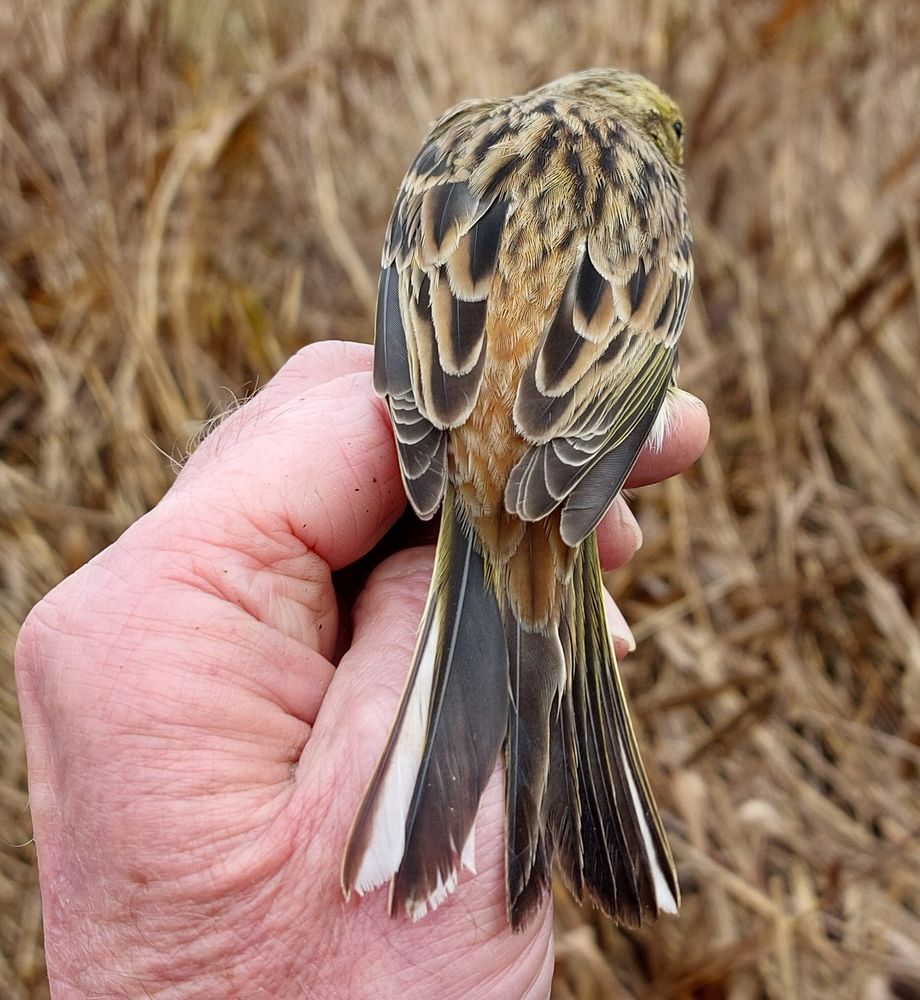


Worthwhile trip to East Fleet, Dorset this morning with three bunting species trapped - Reed Bunting (no photo), Yellowhammer and Cirl Bunting. The latter was colour ringed as part of a Dorset-wide project that started this year.

Yellow-browed Warbler trapped at Chickerell this morning. Also ringed 2 Firecrest and 2 Goldcrest. With thanks to Sarah Faulkner for the photo.
0ne in Littlesea garden too; probably different bird. Also probable Dusky.

2/2 Occasionally, unexpected and rare species turn up in nets and are of interest to a wider audience, hence the reason behind this particular Little Bunting post. I hope this helps.
1/2 Thanks for your query. In the UK bird ringers are licensed by the British Trust for Ornithology to carry out surveys of birds using a variety of methods, one of which is ringing and then releasing them unharmed back into the wild.
Brett is correct. The first one was trapped on 28th November 2019, so ample time this autumn for another one.


LITTLE BUNTING trapped this morning at East Fleet, nr Weymouth, Dorset. With thanks to Sarah F. for a couple of the photos. Also trapped: 2 Cetti's, 1 Reed Warbler and 1 Dartford.
Really pleased to hear that Lapwing are still breeding there. In my day they also bred to the south of the railway line, immediately north of my house.
Fond memories Steve, even they are from a long time ago. Are the strips in Buckland Farm, around Lawrence Lane, or in Box Hill Farm, to the east? You may recall Buckland Farm had a full-time gamekeeper who also looked after the sandpits. Nice guy, long gone now.
Littlesea, Weymouth: a bit of a surprise considering the Force 6 to 7 in the garden all day to see a Humming-bird Hawk-moth feeding on Abelia flowers 5 minutes ago.
Glossy Ibis, 1 Cuttcleaves Cove now. 4 Knot, 15 Dulin at 0600h.
Cuttcleaves Cove this morning:
Greenshank 2
Common sand. 7 + 2
Whimbrel. 1
Dunlin ca.10
Sedge warbler ca.20

Spot Fly. First one of autumn in Littlesea garden.
They're always late reaching the East Fleet compared to further west but 1st Sedge trapped today. Another 2 Grasshopper Warbler also, bringing total for last six days to 4.
Thanks Steve. You too.

East Fleet. First Grasshopper Warbler of autumn; about one week earlier than previous years.
Bearded Tits on the Fleet just to the west of Weymouth: I've always thought they came from Radipole but a pair ringed in October 2024 have just (18th June) been controlled, presumably on breeding grounds, a few miles east of Salisbury. Assumption based on breeding site fidelity.
Thanks Steve. Most of the conifers at the entrance to the caravan park have gone too; the nearest 'large' conifer area now is probably at the cemetery at west end of Abbotsbury Road.

Juvenile Coal Tit trapped at Littlesea this morning. Scarce here, only the 2nd in the last four years and when they do turn up it's usually October or November.


Norfolk Hawker at Littlesea this morning. Sunning itself on bamboo pole (left) or tree mallow stem. Second consecutive year in garden; first noted last year on 7th June.


In the almost complete absence of birds all day, if not all week, I thought I would share with you some other quality wildlife photos. Left: Grass Snake (probably my earliest ever record); right: frog. A clue for you - target species are dead centre in the photos.
1253h: Hobby SE towards Littlesea Wood.
16.10h. Littlesea, Fleet: 1 Whimbrel calling.

Sea-watch for a change, at Camp Road. 30 minutes: 1720 to 1750h. 27 Gannet E, plus 1 Sandwich Tern W in Narrows. Plus 2 Wheatear in field on left.
Certainly possible. Lots of (unidentified) phyllosc this morning were tree hopping and willows might favour the higher, as opposed to low or middle, part of the canopy.