Without a doubt, that is the species. We are working a lot with it because it spreads very well inside birds (hence the RSPB site is no surprise). We have a paper in review about the genetics of different populations in the UK and beyond.
06.03.2026 16:29
👍 1
🔁 0
💬 0
📌 0

Location of the 16 sampling sites in Doñana National Park, southwestern Spain. The blue shaded area corresponds to the region where ponds and marshland ecosystems co-occur, reflecting the dynamic nature of the landscape, with overlapping aquatic habitats that vary seasonally depending on the hydrological regime.

Species contribution to β-diversity (SCBD) and indicator values (IndVal) in ponds and marshland habitats. (A) Species with the highest SCBD values, representing those contributing most to overall β-diversity. (B) Species with the highest IndVal values in the ponds habitat. (C) Species with the highest IndVal values in the marshland habitat.
New paper on diversity and functional ecology of ciliates in temporary dune ponds and marshes of #Doñana. 110 species. Beta diversity strongly influenced by conductivity and pond vs marshes. @ebdonana.bsky.social @ictsdonana.bsky.social @protistologyuk.bsky.social doi.org/10.1111/fwb....
26.02.2026 10:37
👍 9
🔁 3
💬 0
📌 0

Just published: a cross-taxon synthesis of how #non-native species spread: from dispersal and #invasion fronts to Allee effects, human pathways, and predictive models. Understanding spread is key to management & policy.
👉 onlinelibrary.wiley.com/doi/10.1002/...
#bioinvasions #InvasiveSpecies 🧪🌍🌐
24.12.2025 08:41
👍 47
🔁 18
💬 1
📌 1

Categorisation of dispersal pathways according to the Convention of Biological Diversity (A) based on on Hulme (2009) and CBD (2014) to illustrate the distinction between key anthropogenic pathways through which non-native species are introduced and dispersed (B) and how non-native species spread naturally (C) beyond their native ranges. Example human-mediated pathways shown include international trade and travel (i), artificial waterways (ii), angling and recreational equipment (iii), railroads and roads (iv), horticulture, landscaping, and soil trade (v), and the pet trade (vi, including intentional releases).
New year, New paper in Biological Reviews: on the Spread of non-native species @ebdonana.bsky.social @sibecol.bsky.social @wileyecology.bsky.social onlinelibrary.wiley.com/doi/10.1002/...
02.01.2026 13:11
👍 3
🔁 1
💬 0
📌 0

Temporal variation in ciliate species richness and abundance (Ind·mL−1) over time after waterbird faeces inundation. Boxplots show the median, interquartile range (IQR), and outliers for each time point during the experiment.
See our new paper on dispersal of ciliates by waterbirds: Cochak, et al. Experimental evidence of ciliate dispersal and successional patterns via endozoochory in temporary aquatic systems. Protist @ebdonana.bsky.social @beaplab.bsky.social
authors.elsevier.com/c/1mDCz56A9x...
15.12.2025 13:54
👍 0
🔁 0
💬 0
📌 0

Temporal variation in the richness (B) and abundance (A) of the main taxonomic groups of ciliates throughout the experiment (T0–T42). Taxa were classified at the order level. Abundance is expressed in individuals per milliliter (ind.mL− 1), using a linear scale.
Using an experimental approach in Doñana National Park and ciliates as model system, we show that endozoochory is a key driver shaping microbial metacommunities and supporting biodiversity in fragmented aquatic landscapes @ebdonana.bsky.social @drandygreen.bsky.social @victormartinvel.bsky.social
05.12.2025 18:31
👍 7
🔁 4
💬 0
📌 1

Better out than in: faecal matrix inhibits establishment success after waterfowl endozoochory
🌱Check the newly published article ‘Better out than in: faecal matrix inhibits establishment success after waterfowl endozoochory’ in @annbot.bsky.social by @iciarjimenez.bsky.social and co-authors🧵1/10
👉 doi.org/qfrv
@drandygreen.bsky.social
#PlantDispersal #SeedEcology #Endozoochory #AoBpapers
25.11.2025 12:08
👍 3
🔁 3
💬 1
📌 1


Cientos de plumatellidos enganchados a las hojas de la lechuga de agua en el guadalquivir. Como la llegada de una nueva especie #invasora modifica la red de interacciones del ecosistema @drandygreen.bsky.social @ebdonana.bsky.social @chguadalquivir.bsky.social
14.11.2025 17:01
👍 6
🔁 2
💬 0
📌 0

The importance of waders for seed dispersal in a rapidly changing world
NEW PERSPECTIVE by Green and Lovas-Kiss
www.waderstudygroup.org/article/19803/
#ornithology #waders #shorebirds #OpenAccess
31.10.2025 16:49
👍 6
🔁 3
💬 0
📌 0
Our PhD student Julian explains the key message from his latest paper
12.11.2025 14:31
👍 1
🔁 0
💬 0
📌 0
And it turns out those black specks in that photo are bryozoan statoblasts (Plumatella). So what is that telling us about bryozoan dispersal?
12.11.2025 14:26
👍 3
🔁 1
💬 0
📌 0

We're pleased to announce that our 2026 conference will be in... SPAIN 🇪🇸
🗓 Dates for your diary are 4-7th September 2026
Watch this space for more details to come!
#IWSG2026 #waders #shorebirds #ornithology
28.09.2025 19:25
👍 20
🔁 7
💬 0
📌 0

The importance of waders for seed dispersal in a rapidly changing world. Short "Perspective"article by Green & Lovas-Kiss #ornithology #waders #shorebirds #OpenAccess @ebdonana.bsky.social @waderstudy.bsky.social @btobirds.bsky.social @seobirdlife.bsky.social
www.waderstudygroup.org/article/19803/
09.10.2025 09:25
👍 5
🔁 4
💬 0
📌 0

Plant height measured at 7, 15, 30 and 45 days after germination for (a) J. bufonius and (b) E. palustris. Curves were obtained from the fitted logistic base functions (Table 1), and points represent measured height for individual plants. Treatments including faeces addition (CF, IF) are represented in pink and treatments including gut passage (IF, INF) with dashed lines. Asterisks represent mean xmid parameters for treatments grouped with faeces (pink) and without faeces (green). CF = control, faeces; CNF = control, no faeces; IF = ingested, faeces; INF = ingested, no faeces.
Our new paper shows good establishment of wetland plants after seed dispersal inside waterfowl, but plants grow better when seeds are first removed from the faeces (e.g. when poo falls into water) #endozoochory @ebdonana.bsky.social @freshwaterscience.bsky.social academic.oup.com/aob/advance-...
03.10.2025 10:47
👍 4
🔁 1
💬 0
📌 0

PhD position available on climate change, cyanobacterial blooms, and human health @ebdonana.bsky.social We are looking for interested candidates, details attached. Please share.. @sibecol.bsky.social @freshwaterscience.bsky.social @aillimnologia.bsky.social @aslo.org @sil-limnology.bsky.social
28.08.2025 13:01
👍 10
🔁 16
💬 1
📌 0

Finally published!! Our new paper titled: Spatiotemporal differences in plastic biovectoring among three sympatric waterbirds doi.org/10.1016/j.en...
@ebdonana.bsky.social @drandygreen.bsky.social @sanchezmarta.bsky.social
Further details can be found in the full study
#Guanoplastic
1/8
05.08.2025 09:08
👍 6
🔁 5
💬 1
📌 0

In this new paper led by @juliancap.bsky.social we show the role of different aquatic birds as biovectors of #plastic. Polyethylene and polypropylene were the most prevalent plastics transported @ebdonana.bsky.social @juliancap.bsky.social @drandygreen.bsky.social
doi.org/10.1016/j.en...
11.08.2025 15:31
👍 6
🔁 3
💬 0
📌 0

Our latest paper "Trait-based selection of seeds ingested and dispersed by North American waterfowl" is on the cover of Plants #seeddispersal #ducks #endozoochory #waterfowl @ebdonana.bsky.social @mdpiopenaccess.bsky.social www.mdpi.com/2223-7747/14...
14.07.2025 12:16
👍 6
🔁 6
💬 0
📌 0
An excellent PhD thesis. Birds don't understand borders, and the community of storks, ibis, gulls etc in the ricefields of the Tagus/Tajo delta is similar to that of the ricefields in Doñana, with similar conservation issues and agricultural conflicts
14.07.2025 12:12
👍 5
🔁 2
💬 0
📌 0
We, at the Doñana Biological Station, urge world leaders to act swiftly on biodiversity loss and climate change. News clip: www.ebd.csic.es/divulgacion/... and full statement: www.ebd.csic.es/sites/defaul... Very proud of @ebdonana.bsky.social speaking up!
26.06.2025 09:51
👍 14
🔁 9
💬 0
📌 0

New paper out! Traits of plants whose seeds are ingested and dispersed by North American waterfowl differ from those of species available in the wetland environment (represented by the dotted horizontal line on the figure) @ebdonana.bsky.social @botsocamerica.bsky.social doi.org/10.3390/plan...
27.06.2025 08:39
👍 8
🔁 1
💬 0
📌 0

📢🌍 Desde la @ebdonana, instamos a los líderes mundiales a actuar con urgencia ante la pérdida de biodiversidad y el cambio climático en la IV Conferencia Internacional sobre Financiación para el Desarrollo.
Noticia: www.ebd.csic.es/divulgacion/...
Comunicado: www.ebd.csic.es/sites/defaul...
26.06.2025 10:02
👍 7
🔁 9
💬 0
📌 2
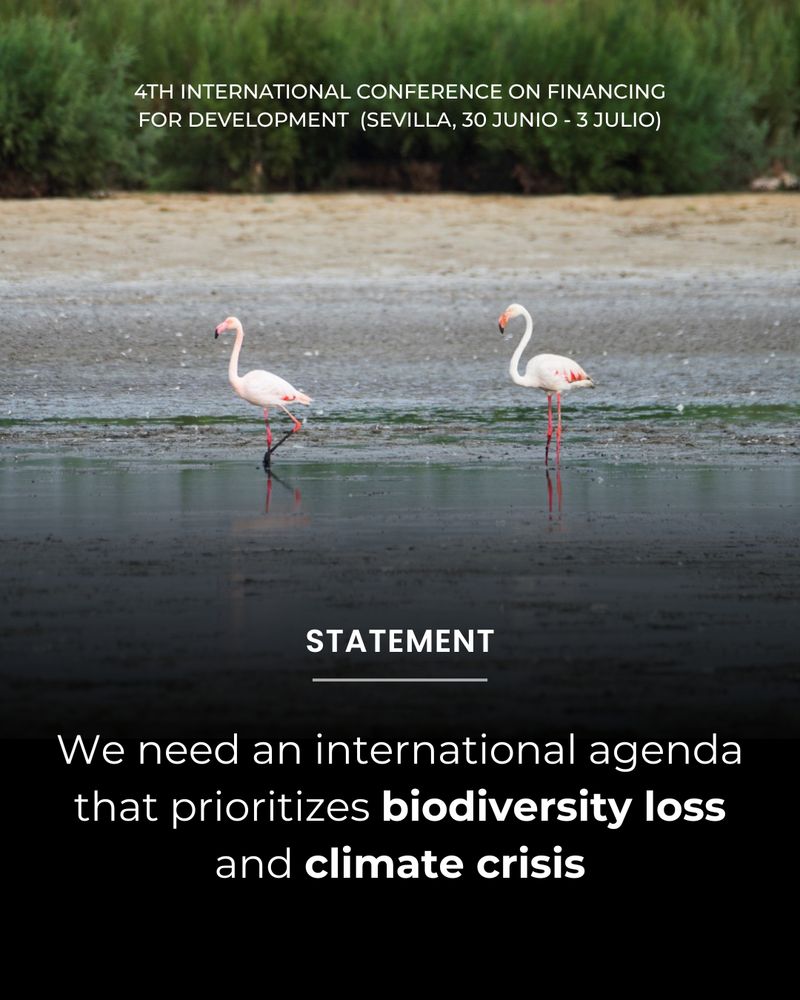
📢🌍 From @ebdonana, we urge world leaders to take urgent action on biodiversity loss and climate change at the 4th International Conference on Financing for Development.
Press release: www.ebd.csic.es/en/outreach/...
Statement: www.ebd.csic.es/sites/defaul...
26.06.2025 10:22
👍 15
🔁 16
💬 1
📌 1

Land–water transition zone from terrestrial to littoral to pelagic habitat, illustrating organisms shown to be capable of endo- or ectozoochorous dispersal by waterbirds of the Anatidae and/or Rallidae families. Major taxonomic groups are indicated by the larger font, and key families known to be dispersed in the smaller font. Words in brackets indicate the resting stages dispersed. For each group, representative organisms are drawn in their typical habitat. Blue represents aquatic habitats, brown represents terrestrial habitat and lake sediments. See the paper for more details of these dispersal interactions
Our publication "Dispersal of aquatic and terrestrial organisms by waterbirds: A review of current knowledge and future priorities" is a "Highly cited paper" according to ISI Essential Science Indicators Database 2024 😀 @ebdonana.bsky.social onlinelibrary.wiley.com/doi/full/10....
25.06.2025 08:01
👍 13
🔁 4
💬 0
📌 0

Today I learned from this "ONE" profile that I seem to be an expert in "marbled meat" and "White (mutation)". I guess the former comes from "marbled teal", the latter I just don't know.... Some other things there make more sense...
09.06.2025 13:49
👍 1
🔁 0
💬 0
📌 0


