Rodrigo Costas's Avatar

Rodrigo Costas

@rodrigocostas

Senior researcher in #bibliometrics, #informetrics & #scientometrics at the Centre for Science and Technology Studies (CWTS) Also at http://social.cwts.nl/@rodrigocostas ORCID: https://orcid.org/0000-0002-7465-6462

1,064
Followers
187
Following
3
Posts
24.10.2023
Joined
Posts Following

Latest posts by Rodrigo Costas @rodrigocostas

Preview
Sharing the load: Building a collective to support open research information online Can we share resources and burdens to make available key open research information resources in actionable and connectable form in the cloud? Through sharing processes and systems, is it possible, ove...

The #OpenAIREGraph joins #ORION, a coordinated effort to making #OpenResearch information combinable and actionable at scale, reducing duplication & easing pressure on #APIs.
πŸ”— Read more on @upstreamblog.bsky.social: doi.org/10.54900/2pn...
πŸ”— Learn more about ORION: orion-dbs.community

17.02.2026 11:04 πŸ‘ 7 πŸ” 4 πŸ’¬ 1 πŸ“Œ 0
News & Tutorials – orion-dbs

We are keen to coordinate with all who are interested in
supporting a community effort towards availability and reusability.

(including addressing issues around the Google-shaped 🐘 in the room!)

Blogpost: doi.org/10.54900/2pn...
Website: orion-dbs.community/blog/

16.02.2026 12:32 πŸ‘ 1 πŸ” 1 πŸ’¬ 0 πŸ“Œ 0

🌌 Today, ORION was launched, an initiative to bring together Open Research Information (ORI) resources in a cloud-based solution. CWTS is involved with multiple colleagues, including our data science team.

πŸ’» Check out the initiative's website and blog post! πŸ‘‡

16.02.2026 16:58 πŸ‘ 6 πŸ” 4 πŸ’¬ 0 πŸ“Œ 0
Open Research Information on BigQuery – ORION-DBs

Link to the resources: orion-dbs.community
@najko.bsky.social @msphelps.bsky.social @alyssonmazoni.bsky.social @neesjanvaneck.bsky.social Cameron Neylon

16.02.2026 13:44 πŸ‘ 3 πŸ” 0 πŸ’¬ 0 πŸ“Œ 0
Preview
Sharing the load: Building a collective to support open research information online Can we share resources and burdens to make available key open research information resources in actionable and connectable form in the cloud? Through sharing processes and systems, is it possible, ove...

Today we launch ORION: a coordinated initiative to make open research information more inclusive, accessible and democratic. Our experience with GoogleBigQuery support collaborative and community solutions for ORI infrastructures, increasing sustainability & resilience.
doi.org/10.54900/2pn...

16.02.2026 13:44 πŸ‘ 13 πŸ” 7 πŸ’¬ 1 πŸ“Œ 1
Preview
Sharing the load: Building a collective to support open research information online Can we share resources and burdens to make available key open research information resources in actionable and connectable form in the cloud? Through sharing processes and systems, is it possible, ove...

Today we're starting ORION, an effort to coordinate making #openresearchinformation resources available, with an initial focus on Google BigQuery. We are keen to coordinate with all who are interested in supporting a community effort towards availability and reusability!
doi.org/10.54900/2pn...

16.02.2026 12:19 πŸ‘ 11 πŸ” 7 πŸ’¬ 1 πŸ“Œ 0
Preview
Social and epistemic inequalities in science: insights from a multi-method study of forest research Inequalities in science have come under scrutiny in the last decade. Different strands of science studies, including scientometrics and sociological works, have examined geographic and gender inequali...

πŸ“£ Upcoming seminar: 'Social and epistemic inequalities in science: insights from a multi-method study of forest research', with Nelius Boshoff (Stellenbosch University) and Susanne Koch @tum.de.

πŸ“… Friday, 5.12.2025 | 3:00-4:15 PM (CET)
πŸ“Œ Online & at CWTS

www.universiteitleiden.nl/en/events/20...

28.11.2025 14:24 πŸ‘ 3 πŸ” 4 πŸ’¬ 0 πŸ“Œ 0

1/2 πŸ“Š @cwtsnl.bsky.social published the 2025 release of its Leiden Ranking Open Edition: a real step toward open research information.
Built on OpenAlex, it:
β€’ Uses transparent, reusable data
β€’ Includes national & regional publishing (not only β€œcore” journals)...

30.10.2025 12:46 πŸ‘ 5 πŸ” 4 πŸ’¬ 1 πŸ“Œ 0

Very proud of the improvements made by the Leiden Ranking team to the Open Edition of the ranking.

This demonstrates our commitment at CWTS to @barcelonadori.bsky.social and the open research information transition.

Great work by @neesjanvaneck.bsky.social and the rest of the team!

29.10.2025 17:59 πŸ‘ 13 πŸ” 6 πŸ’¬ 0 πŸ“Œ 0
CWTS Leiden Ranking The CWTS Leiden Ranking offers important insights into the scientific performance for major universities worldwide. Select your preferred indicators, generate results, and explore the performance of u...

πŸ”Ž We invite you to take a look at the new release and explore all the innovations for yourself πŸ‘‰ www.leidenranking.com

29.10.2025 12:37 πŸ‘ 0 πŸ” 1 πŸ’¬ 1 πŸ“Œ 0
CWTS Leiden Ranking The CWTS Leiden Ranking offers important insights into the scientific performance for major universities worldwide. Select your preferred indicators, generate results, and explore the performance of u...

πŸ“Š The CWTS Leiden Ranking 2025 is online! πŸŽ‰ This time, we have released not one, but two editions: the Traditional Edition and the Open Edition. www.leidenranking.com

29.10.2025 12:37 πŸ‘ 5 πŸ” 8 πŸ’¬ 1 πŸ“Œ 3
Preview
The CWTS Leiden Ranking 2025 - More open, more inclusive, more informative The release of the CWTS Leiden Ranking 2025 marks a next step toward more open and more inclusive research analytics for universities. This post highlights the most significant developments.

πŸ“Š Today, the CWTS Leiden Ranking 2025 has been released. The new Open Edition marks a next step towards more open and more inclusive research analytics for universities. Our new blog post highlights the most significant developments.

πŸ‘‡ Read it now on Leiden Madtrics

29.10.2025 12:35 πŸ‘ 6 πŸ” 6 πŸ’¬ 1 πŸ“Œ 0
Preview
The CWTS Leiden Ranking 2025 - More open, more inclusive, more informative The release of the CWTS Leiden Ranking 2025 marks a next step toward more open and more inclusive research analytics for universities. This post highlights the most significant developments.

βœ’οΈ We have also written a blog post to explain the updates and their implications in more detail πŸ‘‰ www.leidenmadtrics.nl/articles/the...

29.10.2025 12:37 πŸ‘ 1 πŸ” 3 πŸ’¬ 0 πŸ“Œ 0
Preview
An open dataset of EurekAlert! press releases for science communication research - Scientific Data Scientific Data - An open dataset of EurekAlert! press releases for science communication research

πŸ“° Quantitative research on science communication requires suitable data. When it comes to academic press releases, that data is scarce. In a new paper, we introduce a dataset of more than 500,000 press releases published on @eurekalert.bsky.social. doi.org/10.1038/s415...

27.10.2025 10:41 πŸ‘ 9 πŸ” 8 πŸ’¬ 1 πŸ“Œ 2

🌏 This paper has been a collaboration between Jingwen Zhang from Ningbo University, @eomalea.bsky.social from the Polytechnic University of Valencia, Alysson Fernandes Mazoni from the University of Campinas, and @rodrigocostas.bsky.social and me from @cwtsnl.bsky.social.

27.10.2025 10:41 πŸ‘ 3 πŸ” 2 πŸ’¬ 1 πŸ“Œ 0
Preview
Resilience in times of crisis: Strengthening Open Science against geopolitical pressures The success of the Open Science movement relies on researchΒ products and infrastructures being open, accessible andΒ sustainably curated. Recent global events, however, haveΒ illustrated the vulnerabili...

Want to be part of a conversation about geopolitics and Open Science? Why not join us in Leiden on the 6th of November for the workshop "Resilience in times of crisis". Registration open now (in person only). www.universiteitleiden.nl/en/events/20...

10.10.2025 15:30 πŸ‘ 2 πŸ” 4 πŸ’¬ 0 πŸ“Œ 0
Preview
The MetaROR Publish-Review-Curate Model: our experience as authors | Open Science NL As professionals working in open science and scholarly communication reform, we believe in practicing what we preach. That’s why we recently chose to publish an article using the…

QSS is now accepting articles that have gone through independent, open peer review via MetaResearch Open Review (MetaROR). The authors of an article on tracking transformative agreements through open metadata shared their experiences using MetaROR's Publish-Review-Curate (PRC) model:

15.09.2025 13:16 πŸ‘ 12 πŸ” 9 πŸ’¬ 0 πŸ“Œ 0
Preview
Analysing research funding flows in the Global South In a context marked by deep asymmetries in access to research resources, the research project β€œTracking Research Funding Flows in the Global South” aims to make visible and analyze the ways in which i...

πŸ’Έ Our latest blog post describes how the research project β€œTracking Research Funding Flows in the Global South” by @clacso.bsky.social, @cwts.nl & Siris Academic aims to make visible & analyze ways in which international science funding circulates.

πŸ‘‡ Read it now on Leiden Madtrics

22.07.2025 13:13 πŸ‘ 3 πŸ” 6 πŸ’¬ 1 πŸ“Œ 1
Preview
Analysing research funding flows in the Global South In a context marked by deep asymmetries in access to research resources, the research project β€œTracking Research Funding Flows in the Global South” aims to make visible and analyze the ways in which i...

πŸ™ A big thank you to our contributing authors: MatΓ­as AlcΓ‘ntara, MariΓ‘ngela NΓ‘poli, Judith Naidorf, @rodrigocostas.bsky.social & @ismaelrafols.bsky.social

22.07.2025 13:14 πŸ‘ 6 πŸ” 2 πŸ’¬ 0 πŸ“Œ 0

πŸ‘ Thanks to our authors (Juan Pablo Bascur, @rodrigocostas.bsky.social, @suzanv.bsky.social), reviewers (@dwh.bsky.social, @essepuntato.bsky.social, Verena Weimer) & editors (@alexh.bsky.social, Kathryn Zeiler) for their contribution to (and trust in) MetaROR and the publish-review-curate model!

16.07.2025 15:40 πŸ‘ 4 πŸ” 2 πŸ’¬ 0 πŸ“Œ 0
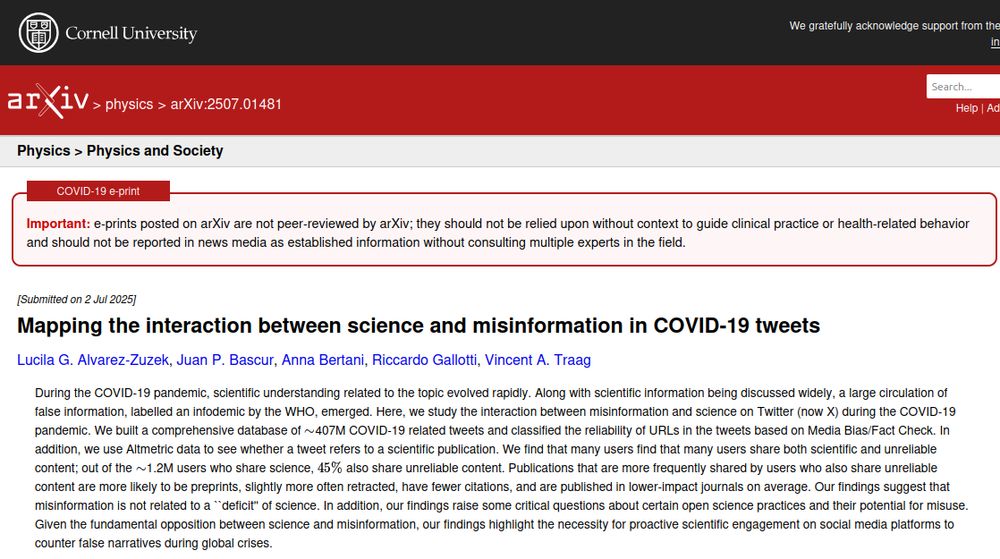
Mapping the interaction between science and misinformation in COVID-19 tweets.
Publication from @luzuzek.bsky.social, Juan Pablo Bascur, @annabertani.bsky.social, @ricgallotti.bsky.social. This project is supported by European Media and Information Fund.

Abstract: During the COVID-19 pandemic, scientific understanding related to the topic evolved rapidly. Along with scientific information being discussed widely, a large circulation of false information, labelled an infodemic by the WHO, emerged. Here, we study the interaction between misinformation and science on Twitter (now X) during the COVID-19 pandemic. We built a comprehensive database of  407M COVID-19 related tweets and classified the reliability of URLs in the tweets based on Media Bias/Fact Check. In addition, we use Altmetric data to see whether a tweet refers to a scientific publication. We find that many users find that many users share both scientific and unreliable content; out of the  1.2M users who share science,   also share unreliable content. Publications that are more frequently shared by users who also share unreliable content are more likely to be preprints, slightly more often retracted, have fewer citations, and are published in lower-impact journals on average. Our findings suggest that misinformation is not related to a ``deficit'' of science. In addition, our findings raise some critical questions about certain open science practices and their potential for misuse. Given the fundamental opposition between science and misinformation, our findings highlight the necessity for proactive scientific engagement on social media platforms to counter false narratives during global crises.

Mapping the interaction between science and misinformation in COVID-19 tweets. Publication from @luzuzek.bsky.social, Juan Pablo Bascur, @annabertani.bsky.social, @ricgallotti.bsky.social. This project is supported by European Media and Information Fund. Abstract: During the COVID-19 pandemic, scientific understanding related to the topic evolved rapidly. Along with scientific information being discussed widely, a large circulation of false information, labelled an infodemic by the WHO, emerged. Here, we study the interaction between misinformation and science on Twitter (now X) during the COVID-19 pandemic. We built a comprehensive database of 407M COVID-19 related tweets and classified the reliability of URLs in the tweets based on Media Bias/Fact Check. In addition, we use Altmetric data to see whether a tweet refers to a scientific publication. We find that many users find that many users share both scientific and unreliable content; out of the 1.2M users who share science, also share unreliable content. Publications that are more frequently shared by users who also share unreliable content are more likely to be preprints, slightly more often retracted, have fewer citations, and are published in lower-impact journals on average. Our findings suggest that misinformation is not related to a ``deficit'' of science. In addition, our findings raise some critical questions about certain open science practices and their potential for misuse. Given the fundamental opposition between science and misinformation, our findings highlight the necessity for proactive scientific engagement on social media platforms to counter false narratives during global crises.

New preprint! 🚨

We study the interaction between misinformation and science on Twitter during COVID-19 based on ~407M tweets. Both science and misinformation featured prominently during the pandemic, but the interaction between the two has not been studied on this scale before.

🧡 (1/10)

04.07.2025 10:37 πŸ‘ 102 πŸ” 40 πŸ’¬ 4 πŸ“Œ 5

Great news: At #Metascience2025 @wellcometrust.bsky.social just announced its signature of the Barcelona Declaration on Open Research Information!

Wellcome CEO John-Arne RΓΈttingen made the important argument that open research information offers crucial evidence to support metascience.

@cwts.nl

30.06.2025 15:51 πŸ‘ 48 πŸ” 17 πŸ’¬ 0 πŸ“Œ 0

Together with Fernanda Beigel, @cwtsleiden.bsky.social colleague @ismaelrafols.bsky.social offers a highly critical perspective on developments in open science. Worth a read!

08.05.2025 17:17 πŸ‘ 13 πŸ” 6 πŸ’¬ 0 πŸ“Œ 0
Preview
The contested field of Open Science: a debate through the lens of inclusion Most implementations of Open Science do not fulfil the expectations that Open Science will lead to more equity and improve the societal impact of research. We discuss these worrying trends through the...

🌏 In our latest blogpost, @ismaelrafols.bsky.social and Fernanda Beigel discuss whether open science actually fulfils its expectations of leading to more equity and improving research's societal impact.

πŸ‘‡ Read it now on Leiden Madtrics

08.05.2025 08:48 πŸ‘ 4 πŸ” 3 πŸ’¬ 0 πŸ“Œ 1
Preview
The use of informetric methods to study diversity in the scientific workforce: A literature review Abstract. This literature review examines the application of informetric methods to assess diversity within the scientific workforce, focusing on recent advances in author name disambiguation, researc...

It took some time, but here it is! "The use of informetric methods to study diversity in the scientific workforce: A literature review" now in QSS πŸ›°οΈ w @torressalinas.bsky.social @carmencs.bsky.social @rodrigocostas.bsky.social & Z. Chinchilla πŸŽ† doi.org/10.1162/qss_... πŸŽ†

21.04.2025 15:36 πŸ‘ 14 πŸ” 9 πŸ’¬ 0 πŸ“Œ 1
Original post on akademienl.social

Excited to announce I've been appointed Executive Director of the Barcelona Declaration @BarcelonaDORI , (alongside my other consulting activities). We have funding for the next 3 years and will soon discuss the creation of a governance board […]

07.02.2025 14:56 πŸ‘ 22 πŸ” 9 πŸ’¬ 3 πŸ“Œ 0
Preview
Independent researchers: traces in bibliographic data This blog post presents preliminary findings from an exploratory study on independent researchers, using OpenAlex data to trace their research interests and career paths. We also discuss our experienc...

πŸ“’ New Blog Post!

Camilla LindelΓΆw and elinevdw.bsky.social share some preliminary findings from an exploratory study on independent researchers πŸ“š, using OpenAlex data.

Read the full post here πŸ‘‡ www.leidenmadtrics.nl/articles/ind...

14.01.2025 14:36 πŸ‘ 4 πŸ” 3 πŸ’¬ 0 πŸ“Œ 0

It is urgent that all authors retain at least part of the copyright. In Spain it is already mandatory for those financed with public funds, to be able to deposit the accepted version in institutional or thematic repositories. Metadata should always be open.

25.11.2024 22:33 πŸ‘ 9 πŸ” 6 πŸ’¬ 0 πŸ“Œ 0

At CWTS we are reorganizing our knowledge agenda into three focal areas www.leidenmadtrics.nl/articles/the.... Here is an introduction to our Focal Area Engagement & Inclusion! www.leidenmadtrics.nl/articles/int... Feedback, comments, collaborations are most welcome! Reach out if you are interested!

23.11.2023 10:16 πŸ‘ 12 πŸ” 3 πŸ’¬ 1 πŸ“Œ 0