Rebecca J. Strauch's Avatar

Rebecca J. Strauch

@rjstrauch

Paleontologist. Philosopher. Whale enthusiast. Birder. Geology PhD student @georgemasonu.bsky.social

103
Followers
161
Following
9
Posts
27.05.2025
Joined
Posts Following

Latest posts by Rebecca J. Strauch @rjstrauch

Preview
Opinion | Science Keeps Changing. So Why Should We Trust It?

Science Keeps Changing. So Why Should We Trust It? www.nytimes.com/2026/01/05/o...

06.01.2026 01:24 πŸ‘ 0 πŸ” 0 πŸ’¬ 0 πŸ“Œ 0
Preview
2025 in review: advances in marine mammal paleontology It's time for the end of the year roundup - for a while I wasn't so sure that 2025 was going to have that long a list of papers, but we en...

🧡Happy New Year! 2025 ended up being a decent year for marine mammal paleontology - loads of new fossil whales and dolphins, a couple of sea cow studies, but a bit light on pinnipeds and archaeocetes. Read my new blog here, and this thread for some of this year's highlights! πŸ§ͺπŸ¬πŸ¦–

01.01.2026 18:28 πŸ‘ 51 πŸ” 16 πŸ’¬ 1 πŸ“Œ 0
Preview
Cranial variation of Lutra lutra (Carnivora: Mustelidae) across the Palaearctic: taxonomic and management implications Abstract. The Eurasian otter (Lutra lutra) exhibits the widest range among the Lutrinae, encompassing 11 extant subspecies across Eurasia and North Africa.

Really great to see people quantifying morphological variation across the range of an extant taxon. I saw another paper recently about variation in extant iguanas. It gives us a baseline for what to expect in fossil species academic.oup.com/zoolinnean/a...

22.12.2025 19:20 πŸ‘ 5 πŸ” 2 πŸ’¬ 0 πŸ“Œ 0
Preview
Max’s New Gould paper β€” Extinct My new paper in Paleobiology (OA), on some lesser known aspects of the early history of punctuated equilibria, is available to read online. It is, in effect, a synthesis of some of my older work on ...

My new Gould paper is out today in Paleobiology (OA)! It is, in effect, a synthesis of some of my historical work on Stephen Jay Gould’s early career, which explores the curious position of punctuated equilibria in his early vision for evolutionary paleontology

www.extinctblog.org/palaeonews/2...

12.11.2025 13:47 πŸ‘ 33 πŸ” 13 πŸ’¬ 0 πŸ“Œ 2
Post image

New research out! 🐬

We tested 16 NZ toothed whale species to see if habitat predicts PFAS levels.

Results:
β€’ Habitat = weak predictor
β€’ Sex & age = stronger predictors
β€’ Even remote oceans aren’t safe from PFAS

doi.org/10.1016/j.sc...
#PFAS #MarineScience #Cetaceans #MAVELab #CERG

23.11.2025 23:14 πŸ‘ 9 πŸ” 5 πŸ’¬ 0 πŸ“Œ 0

Paleo folks: Please recommend researchers (incl yourselves) interested in phylogenetic reconstruction in deep time, molecular clocks (discord w/ fossil clocks), foundational/methodological issues in phylo/paleo-reconstruction & who'd be interested in hanging w/ historians & philosophers of science βš’οΈ

24.11.2025 00:02 πŸ‘ 70 πŸ” 42 πŸ’¬ 13 πŸ“Œ 0
Post image

This feels mandatory

21.11.2025 10:24 πŸ‘ 17 πŸ” 1 πŸ’¬ 1 πŸ“Œ 0
Post image

@rjstrauch.bsky.social investigate the mandibular symphysis in whales. Toothed whales exhibited unfused, partially fused, or fully fused symphyses, while baleen whales evolved a decoupled, highly mobile symphysis that represents a novel condition unobserved in other mammalian clades.

21.11.2025 11:56 πŸ‘ 1 πŸ” 1 πŸ’¬ 1 πŸ“Œ 0
Post image Post image

I had a wonderful time at #2025SVP in Birmingham, UK! Gave a talk about suction feeding in fossil odontocetes (β€œtoothed whales”). I thoroughly enjoyed the numerous insightful, engaging conversations I had with colleagues throughout the meeting. Looking forward to Cleveland next year!

17.11.2025 01:16 πŸ‘ 3 πŸ” 1 πŸ’¬ 0 πŸ“Œ 0
This is figure 5, which shows CIRBP overexpression extends lifespan and enhances DNA damage resistance in Drosophila.

This is figure 5, which shows CIRBP overexpression extends lifespan and enhances DNA damage resistance in Drosophila.

The remarkably long lifespan of bowhead whales could be due to an increased ability to repair DNA mutations, according to research in Nature. go.nature.com/4hzvDN7 🌏 πŸ§ͺ

04.11.2025 02:10 πŸ‘ 99 πŸ” 30 πŸ’¬ 2 πŸ“Œ 1
Preview
First-Ever Footage Shows Killer Whales Attacking Great White Shark Nursery An orca pod has been spotted for the first time repeatedly targeting and flipping young great white sharks onto their backs to paralyze and dismember them

An orca pod has been spotted for the first time repeatedly targeting and flipping young great white sharks onto their backs to paralyze and dismember them

03.11.2025 14:48 πŸ‘ 44 πŸ” 10 πŸ’¬ 2 πŸ“Œ 4
Post image

My newest publication is out in @peerj.bsky.social! In this collaboration with Ana Valenzuela, Nick Pyenson & Mario Suarez we describe the most complete skeleton of the #AquaticSloth - #Thalassocnus - from #Chile!
Artwork by @alexboersma-art.bsky.social
1/6
#FossilFriday
peerj.com/articles/198...

03.10.2025 13:40 πŸ‘ 79 πŸ” 24 πŸ’¬ 1 πŸ“Œ 2
Preview
Tying the knot between morphology and development: using the patterning cascade model between cheek teeth to study the evolution of molarization in hoofed mammals - Journal of Mammalian Evolution Hoofed mammal premolars show a range of occlusal crown morphology from molariform to caniniform, and the position of taxa on this spectrum can be described as the relative molarization of the premolars. Molarized premolars function together with the molars in grinding mastication in which these unique premolars appear. The degree of molarization varies across dietary ecologies, which has led to cheek tooth morphology being designated as an important contributor to dietary predictions in extant and extinct taxa. Recent research into mammalian occlusal cheek tooth patterning have found independent patterning mechanisms of the premolars and molars. A research gap exists in understand how molarization of the premolars has occurred so frequently in hoofed mammals if these dental regions are independent in their patterning. In this study, we tested the application of the patterning cascade model to the lower premolar-molar boundary in hoofed mammals using a geometric morphometrics framework. We used 2D geometric morphometrics to study occlusal cuspid covariation at the lower p4-m1 boundaries of 16 artiodactyl and 18 perissodactyl species. Phylogenetically informed modularity analyses were used to test alternate a priori hypotheses originating from evolutionary, developmental, and functional considerations of cheek tooth morphogenesis. Our results showed artiodactyls and perissodactyls differ significantly in their p4-m1 boundary covariation patterns, which we hypothesize could be caused by heterochronic shifts between premolar and molar development. To our knowledge, our study is the first to contribute a comprehensive yet accessible 2D geometric morphometric method to further investigate the evolution of molarized premolars.

Ashbaugh, A.J., Jamniczky, H.A. & Theodor, J.M. Tying the knot between morphology and development: using the patterning cascade model between cheek teeth to study the evolution of molarization in hoofed mammals. J Mammal Evol 32, 23 (2025). doi.org/10.1007/s109...

05.10.2025 12:32 πŸ‘ 28 πŸ” 8 πŸ’¬ 1 πŸ“Œ 1
Preview
Handbook of the Historiography of the Earth and Environmental Sciences This open access handbook assesses the historiography and the future of major themes and approaches within the history of the earth sciences.

Very happy to announce that the Handbook of the Historiography of Earth and Environmental Sciences I coedited with Elena Aronova and Marco Tamborini is now available, for free (open access) via this link:
link.springer.com/referencewor...

05.10.2025 14:50 πŸ‘ 22 πŸ” 8 πŸ’¬ 0 πŸ“Œ 0
Preview
Frontiers | A global review of operational fishery interactions with killer whales (Orcinus orca): dynamics, impacts, and management strategies Killer whales (Orcinus orca) are cosmopolitan, apex predators that sometimes interact with commercial fisheries. These fishery interactions can affect killer...

Frontiers | A global review of operational fishery interactions with killer whales (Orcinus orca): dynamics, impacts, and management strategies

26.09.2025 16:57 πŸ‘ 13 πŸ” 3 πŸ’¬ 0 πŸ“Œ 1

A big shout out to my coauthors @jakeberv.bsky.social @paleodm.bsky.social and everyone who made this work possible @miamiuniversity.bsky.social

17.09.2025 18:27 πŸ‘ 3 πŸ” 1 πŸ’¬ 0 πŸ“Œ 0

Whales span a range of symphyseal morphologies, varying in degree of mobility (fusion) and length (elongation). In this paper, we examine the evolution of these traits across whale phylogeny and geologic time.

17.09.2025 18:27 πŸ‘ 3 πŸ” 1 πŸ’¬ 1 πŸ“Œ 0
Morphological diversity of the cetacean mandibular symphysis coincides with novel modes of aquatic feeding | Paleobiology | Cambridge Core Morphological diversity of the cetacean mandibular symphysis coincides with novel modes of aquatic feeding

Second pub out of my master’s research is now out!

www.cambridge.org/core/journal...

17.09.2025 18:27 πŸ‘ 5 πŸ” 1 πŸ’¬ 1 πŸ“Œ 1

My paper "Models and Analogies in the Reconstruction of Extinct Life" is also out now in this volume dedicated to Hesse ⬇️
#HPS #PaleoSky #Philsky βš’οΈ
link.springer.com/chapter/10.1...

03.09.2025 17:55 πŸ‘ 51 πŸ” 17 πŸ’¬ 1 πŸ“Œ 1
Preview
A cornucopia of tiny, bizarre whales used to live in Australian waters – here’s one of them If alive today, these tiny whales would be as iconically Australian as kangaroos.

A few years in the making, but I can finally share my first PhD paper and my first ever first-authored whale paper. In it, we name a new species of toothed baleen whale: Janjucetus dullardi. You can find our conversation article here: tinyurl.com/dullardi

13.08.2025 01:39 πŸ‘ 53 πŸ” 20 πŸ’¬ 1 πŸ“Œ 1
Preview
S5 E4 - Heather Douglas on Rethinking Science’s Social Contract The HPS Podcast - Conversations from History, Philosophy and Social Studies of Science Β· Episode

What happens when the old contract between science and society no longer fits?

This week, Prof. Heather Douglas unpacks the legacy of the value-free ideal, examines research ethics & funding β€” and proposes a new social contract for science. This was an illuminating conversation.

Listen now! 🎧
07.08.2025 21:13 πŸ‘ 63 πŸ” 26 πŸ’¬ 2 πŸ“Œ 3
Preview
American Primordial: remembering the Great Taconic Controversy β€” Extinct In which Max remembers the biggest American geological brouhaha of the nineteenth century

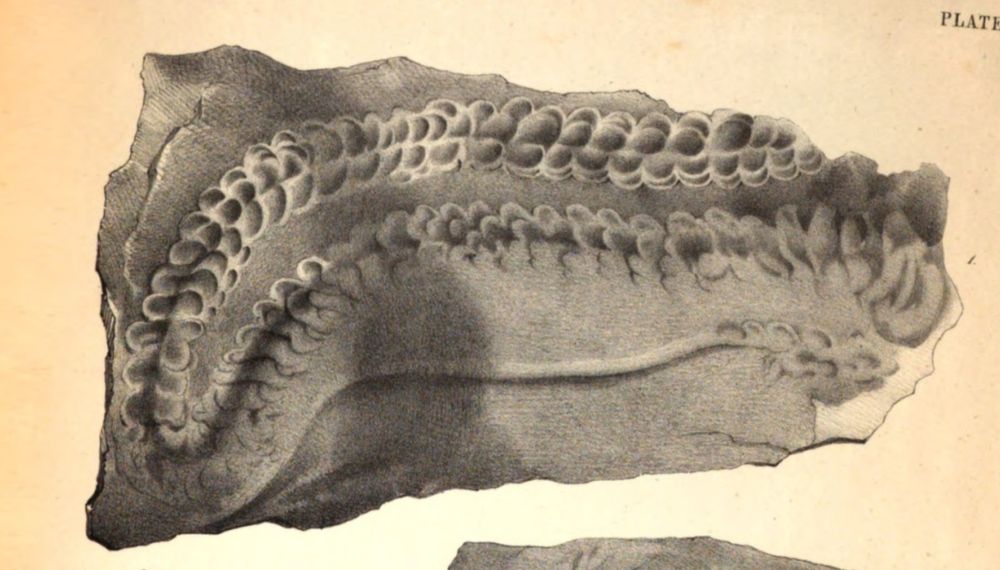
The wildest debate in the history of American geology raged between ~1840 and 1890. It was called the Great Taconic Controversy, and it involved the oldest fossil-bearing rocks on the planet (allegedly). Read all about it on your local philpaleo blog, Extinct...
www.extinctblog.org/extinct/2025...
30.07.2025 15:33 πŸ‘ 18 πŸ” 9 πŸ’¬ 1 πŸ“Œ 0
Preview
What would imaginary ancestors do? Thought experiments and intuitive plausibility in human cognitive evolution - Biology & Philosophy The reconstruction of the evolutionary history of human cognition is a complex, interdisciplinary science. Human evolutionary theorists generally use a wide variety of evidential sources to construct ...

Sometimes when we’re trying to explain the evolution of human cognition we rely on intuitive judgements about how our ancestors thought that our current cognition might not be well-suited to make, or so argues Margaret Farrell in this cool new paper… link.springer.com/article/10.1...

25.07.2025 11:12 πŸ‘ 18 πŸ” 5 πŸ’¬ 1 πŸ“Œ 0
Preview
S5 E2 - Surekha Davies on Humans: A Monstrous History The HPS Podcast - Conversations from History, Philosophy and Social Studies of Science Β· Episode

New episode of The HPS Podcast! πŸŽ™οΈ

Today, Dr Surekha Davies joins us to discuss her new book Humans: A Monstrous History – a sweeping look at how ideas of monstrosity shaped science, empire, and what it means to be human.

@drsurekhadavies.bsky.social #hps #history #monsters

🎧 Listen here:

24.07.2025 21:31 πŸ‘ 18 πŸ” 6 πŸ’¬ 1 πŸ“Œ 2
Post image

The Society for Marine Mammalogy’s Official List of Marine Mammal Species and Subspecies has been updated.

Visit the SMM website for the full list: marinemammalscience.org/science-and-...

Image: Uko Gorter 2025

#SMM #Marinemammal

18.07.2025 19:13 πŸ‘ 54 πŸ” 17 πŸ’¬ 1 πŸ“Œ 2
Screenshot of a journal article titled "Two ontogenetic challenges to trait individuation" by Alejandro FΓ‘bregas-Tejeda, published in Synthese (2025) 205:219.  The abstract reads: "Trait individuation is an epistemically indispensable and heuristically fruitful practice in biological science. However, important ontological issues transcend an epistemology-only reading of what trait individuation entails (e.g., adaptation and homology), prompting scholars to advance models and frameworks to grapple with this problem. Here, I articulate two challenges that arise when advancing theories and frameworks to tackle trait individuation: the synchronicity and the diachronicity challenges. The synchronicity challenge involves specifying the traits an organism has at a given moment in ontogeny, whereas the diachronicity challenge involves understanding the causal processes that drive trait individuation in development and tracing these units across time. To delve deeper, I introduce extant functionalist and structuralist perspectives on trait individuation and evaluate how they address both challenges. Overcoming these challenges is necessary for such accounts to fulfill their theoretical promise of individuating the traits that organisms have in an ontologically sound way."

Screenshot of a journal article titled "Two ontogenetic challenges to trait individuation" by Alejandro FΓ‘bregas-Tejeda, published in Synthese (2025) 205:219. The abstract reads: "Trait individuation is an epistemically indispensable and heuristically fruitful practice in biological science. However, important ontological issues transcend an epistemology-only reading of what trait individuation entails (e.g., adaptation and homology), prompting scholars to advance models and frameworks to grapple with this problem. Here, I articulate two challenges that arise when advancing theories and frameworks to tackle trait individuation: the synchronicity and the diachronicity challenges. The synchronicity challenge involves specifying the traits an organism has at a given moment in ontogeny, whereas the diachronicity challenge involves understanding the causal processes that drive trait individuation in development and tracing these units across time. To delve deeper, I introduce extant functionalist and structuralist perspectives on trait individuation and evaluate how they address both challenges. Overcoming these challenges is necessary for such accounts to fulfill their theoretical promise of individuating the traits that organisms have in an ontologically sound way."

β€œTraits” are central units of biological analysisβ€”but how should they be individuated, and relative to which ontogenetic frame of reference? In my new paper, I argue that answering this isn’t easyβ€”and matters more than it seems. πŸ“ƒπŸ‘‡ link.springer.com/article/10.1... #philsci #HPBio #evosky #evodevo

18.07.2025 18:33 πŸ‘ 80 πŸ” 22 πŸ’¬ 0 πŸ“Œ 0
Studying Philosophy Does Make People Better Thinkers | Journal of the American Philosophical Association | Cambridge Core Studying Philosophy Does Make People Better Thinkers

A popular and very old argument for the value of philosophy claims that studying philosophy cultivates important intellectual abilities and dispositions. But empirical evidence for that claim has been hard to come by. Until now!
1/4

12.07.2025 13:21 πŸ‘ 97 πŸ” 28 πŸ’¬ 6 πŸ“Œ 10
Preview
Killer whales seen grooming each other with kelp in first for marine tool use Behavior in orca population off coast of US and Canada captured by scientists using drone observation

Killer whales seen grooming each other with kelp in first for marine tool use

23.06.2025 19:03 πŸ‘ 69 πŸ” 19 πŸ’¬ 6 πŸ“Œ 1

Whales provide an opportunity for studying the morphology of the symphysis as it relates to feeding in an aquatic environment with clear departures from the ancestral feeding mode (i.e. mastication).

19.06.2025 16:14 πŸ‘ 2 πŸ” 0 πŸ’¬ 0 πŸ“Œ 0

In toothed whales, the symphysis ranges from unfused to complete ossification. Baleen whales evolved a decoupled, highly mobile symphysis that represents a novel condition among mammals.

19.06.2025 16:14 πŸ‘ 2 πŸ” 0 πŸ’¬ 1 πŸ“Œ 0