
Check out our new paper! We evaluate what we know (and don't know) about the link between memory consolidation during sleep and next-day learning 👇
19.11.2025 18:42
👍 21
🔁 9
💬 0
📌 0
Check out our new paper! We evaluate what we know (and don't know) about the link between memory consolidation during sleep and next-day learning 👇

🚨Preprint: Semantic Tuning of Single Neurons in the Human Medial Temporal Lobe
1/8: How do human neurons encode meaning?
In this work, led by Katharina Karkowski, we recorded hundreds of human MTL neurons to study semantic coding in the human brain:
doi.org/10.1101/2025...
How does our brain learn that thunder follows lightning? We don't just remember two separate events; we build a predictive model to anticipate the world. My research dives into this very question: how we learn and predict the order of events. 🧵👇 1/9 #neuroscience #memory #sleep

Congrats to our amazing postdoc @mskehl.bsky.social for their fantastic talk at the REPLAY conference in Cardiff! 🧠 Their work on "Human ripples facilitate memory consolidation by reactivating learning-related neurons" sparked many great discussions. Proud lab cheering him on!
I’m looking for a postdoc and RA for an ERC-funded project “SLEEPAWAY: Forgetting unwanted memories in sleep”. You’ll use MEG/EEG and fMRI to understand how the sleeping brain remembers and forgets. PLEASE REPOST 😊
Postdoc: tinyurl.com/vr5thp7s
RA: tinyurl.com/ycyzkatc
Thank you Mel, so excited it’s out there!

Just published my first paper!
Really grateful to everyone at the plasticity lab @oxcin.bsky.social who made this possible.
huge thanks to my co-authors — couldn’t have done it without you.
If you want to check it out:
📄 paper: www.nature.com/articles/s41...
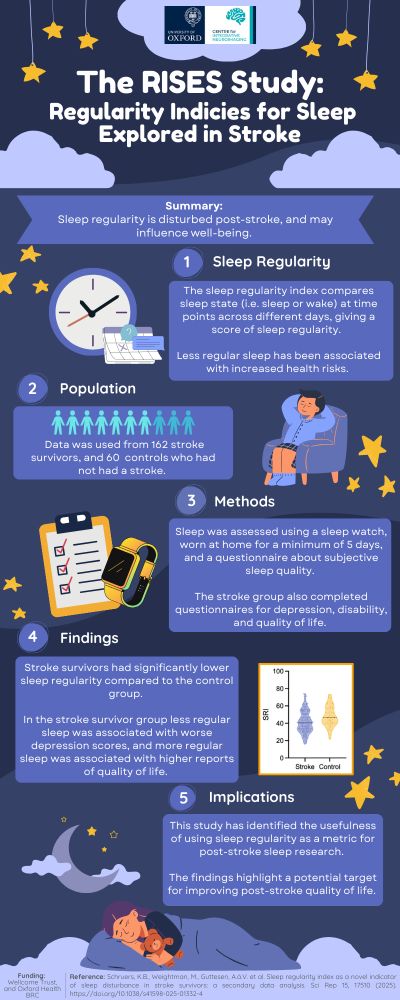
An infographic summarising the methods and findings of the RISES Study. Images of stars, the moon, and people sleeping with text as follows. Summary: Sleep regularity is disturbed post-stroke, and may influence well-being. Sleep regularity: The sleep regularity index compares sleep state (i.e. sleep or wake) at time points across different days, giving a score of sleep regularity. Less regular sleep has been associated with increased health risks. Population: Data was used from 162 stroke survivors, and 60 controls who had not had a stroke. Methods: Sleep was assessed using a sleep watch, worn at home for a minimum of 5 days, and a questionnaire about subjective sleep quality. The stroke group also completed questionnaires for depression, disability, and quality of life. Findings: Stroke survivors had significantly lower sleep regularity compared to the control group. In the stroke survivor group less regular sleep was associated with worse depression scores, and more regular sleep was associated with higher reports of quality of life. Implications: This study has identified the usefulness of using sleep regularity as a metric for post-stroke sleep research. The findings highlight a potential target for improving post-stroke quality of life. Funding: Funding: Wellcome Trust, and Oxford Health BRC. Reference: Reference: Schruers, K.B., Weightman, M., Guttesen, A.á.V. et al. Sleep regularity index as a novel indicator of sleep disturbance in stroke survivors: a secondary data analysis. Sci Rep 15, 17510 (2025). https://doi.org/10.1038/s41598-025-01332-4
📣 New paper alert! 📣
🔎 The RISES Study looked at the sleep regularity index in stroke survivors compared to people who haven't had a stroke.
🔗 See a summary of our findings in our infographic below, and find the full paper here: rdcu.be/emZ09
@oxcin.bsky.social @ndcnoxford.bsky.social
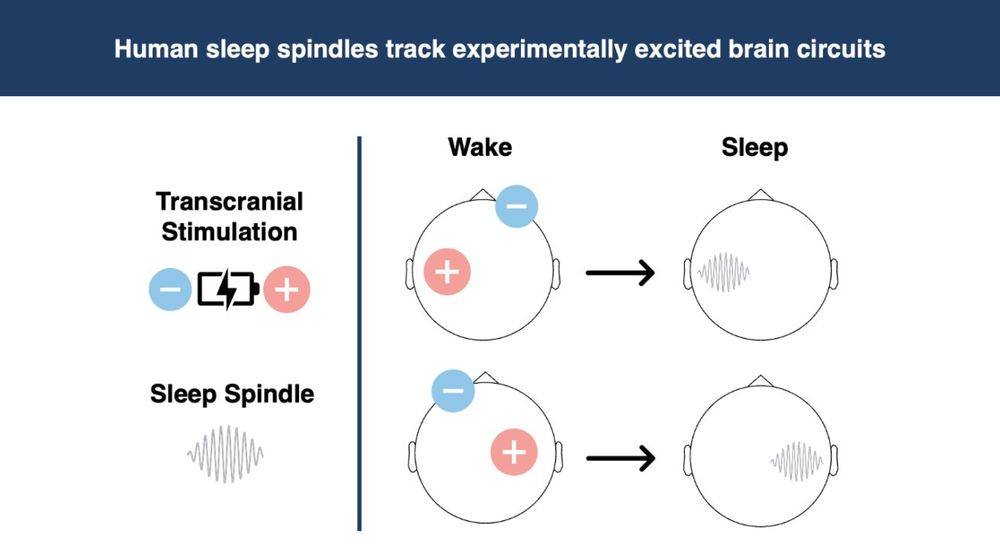
New paper out in SLEEP @sleepjournals.bsky.social!
In his study, Jude Thom shows how cortical regions excited by tDCS before sleep express more spindles during subsequent sleep. doi.org/10.1093/slee...
@oxexppsy.bsky.social @oxcin.bsky.social @ukri.org

We're excited to share that our lab is hiring for the position of Lab Manager/Research Assistant. A great opportunity to join our lab!
You can find full details and apply via the link below:
www.jobs.ac.uk/job/DMN515/r...
Please feel free to share this with anyone who might be interested!


Our final 2 lab members @pinchunc.bsky.social and Jude Thom did a fantastic job with their poster presentations at the final day of #CNS2025 in Boston today! It was a great way to wrap up the conference. An amazing showcase of everyones hard work!
Hi friends,
If you’re attending #CNS2025, come check out my poster (F5) tomorrow (April 1st) from 8-10am on my recent work with @bstaresina.bsky.social: Cortical Signatures of Hippocampal Ripples in Human Sleep.😴
Or just come say hi! 🙋🏻♀️🙋🏻♀️🙋🏻♀️
@cogneuronews.bsky.social


🎉 Big shoutout to our amazing lab members who presented their posters at #CNS2025! 🎉
So great to see @mskehl.bsky.social , @manqisha.bsky.social , @xianhuihe.bsky.social and Mathew Thomas Kollamkulam showcasing their hard work and research! 🧠
Some behind-the-scenes shots of them in action 👇

This was followed by another amazing Data Blitz by DPhil student @xianhuihe.bsky.social, who presented on ‘Learning and sleep reshape the representational geometry of visual experiences’

What a great start to #CNS2025!
@manqisha.bsky.social kicked of the first session with her Data Blitz on ‘Coupled sleep rhythms in the human hippocampus support memory consolidation’
@pinchunc.bsky.social @bstaresina.bsky.social @simonfsoubeyrand.bsky.social @mskehl.bsky.social
Poster Session F
Poster F4: Human sleep spindles are directed by excitatory non-invasive brain stimulation -Thom, Jude
Poster F5: Cortical Signatures of Hippocampal Ripples in Human Sleep- Chen, Pin-Chun
Poster C48: Ripples facilitate human memory consolidation by driving reactivation of learning-related neurons - Kehl, Marcel S.
Poster C24: Learning and sleep reshape the representational geometry of visual experiences - He, Xianhui
The Staresina Lab is ready for CNS 2025 in Boston!🇺🇸
If you are around come and check out our work at the following poster sessions:
Poster Session C
Poster C16: Coupled sleep rhythms in the human hippocampus support memory consolidation - Sha, Manqi
We start of the day with a datablitz by our amazing DPhil student Manqi Sha! Her talk is titled ‘Coupled sleep rhythms in the human hippocampus support memory consolidation’ and will be held in the Grand Ballroom
Poster C58: Sleep predicts a hippocampal-cortical shift during memory recall - Thomas Kollamkulam, Mathew