Agent Psychosis: Are We Going Insane?
What’s going on with the AI builder community right now?
Weekend thoughts on Gas Town, Beads, slop AI browsers, and AI-generated PRs flooding overwhelmed maintainers. I don't think we're ready for our new powers we're wielding. lucumr.pocoo.org/2026/1/18/ag...
18.01.2026 10:38
👍 271
🔁 66
💬 23
📌 32

The Mythology Of Conscious AI | NOEMA
Why consciousness is more likely a property of life than of computation and why creating conscious, or even conscious-seeming AI, is a bad idea.
“If we conflate the richness of biological brains & human experience with the information-processing machinations of deepfake-boosted chatbots, or whatever the latest AI wizardry is, we do our minds, brains & bodies a grave injustice.”
— @anilseth.bsky.social, winner of @berggruen.org Essay Prize
14.01.2026 17:45
👍 50
🔁 24
💬 0
📌 9

He coins a term: verification debt. AI generates code faster than humans can comprehend it. The gap between generation and understanding allows software to reach production before anyone validates what it actually does.
"Vibe coding is fine," Vogels says, "but only if you pay close attention to what is being built. We can't just pull a lever on your IDE and hope that something good comes out."
He pauses. "That's not software engineering. That's gambling."
that's not software engineering. that's gambling.
www.implicator.ai/werner-vogel...
08.12.2025 20:53
👍 95
🔁 24
💬 6
📌 0

Self-Assembly Gets Automated in Reverse of ‘Game of Life’ | Quanta Magazine
In cellular automata, simple rules create elaborate structures. Now researchers can start with the structures and reverse-engineer the rules.
In cellular automata, simple rules create elaborate structures. Now researchers are working backward — starting with the result to learn the rules behind it. @georgemusser.com, SFI’s 2025 Journalism Fellow, explores how this could reshape computation and self-organization in Quanta:
12.09.2025 17:54
👍 57
🔁 21
💬 0
📌 1
four responses to overload
Four responses to overload, by Woods and Hollnagel, summarized by @dobbse.bsky.social: burnout.wiki.do/view/four-re...
19.07.2025 18:17
👍 7
🔁 2
💬 0
📌 1

Man being interviewed: His
"Philip K. Dick. Ray Bradbury. Like so many others in tech, I draw inspiration from completely misunderstanding those authors."
Cartoon by Ellis Rosen for The New Yorker.
01.07.2025 11:34
👍 365
🔁 100
💬 5
📌 5
I love the Dijkstra quote:
> The question of whether a computer can think is no more interesting than the question of whether a submarine can swim.
29.06.2025 22:54
👍 45
🔁 7
💬 1
📌 0

The Am Dash
A version of the m-dash that's purposefully human. www.theamdash.com
25.06.2025 07:12
👍 2
🔁 1
💬 0
📌 0

“The way you work is as much a part of your product as the product itself” #DDDEU
06.06.2025 07:43
👍 8
🔁 5
💬 0
📌 0
From an engineering perspective, software wants to be decoupled. From a business value perspective, software wants to be deeply interconnected. That's the fundamental friction that software design, and Domain-Driven Design specifically, attempts to address.
06.06.2025 07:57
👍 29
🔁 12
💬 1
📌 2

The black circle with a central dot evolves along a one-dimensional state space, representing three possible scenarios:
- > Long-loss: outcomes fall short, with a declining trajectory driven by incoherence penalties.
- > Short-win: maintains the status quo but drifts over time as the relevance landscape shifts.
- > Balanced: anticipates future states through consolidation of features, aiming for long-term coherence.
9/9:Platform eng. can scaffold a reliability mindset for product engineers by providing a causal understanding of systems _below the line_ and by helping connect the dots with systems _above the line_. A balanced and coherent view of boundaries gives confidence to evolve them in the right direction.
19.05.2025 09:08
👍 0
🔁 0
💬 0
📌 0
8/9: Consideration of all three problem spaces gives us the ability to anticipate future states and evolve toward that target. It helps grasp boundaries and trace trajectories for better relevance.
Design for Tension empowers product teams to make the best possible decisions in the midst of change.
19.05.2025 09:07
👍 0
🔁 0
💬 1
📌 0
7/9: Domain modeling unfold data semantics and enables more reliable systems with greater affordances – more user actions in context. Product relevance guides us to explore and verify models against the evolving landscape, mostly found in the interconnections of data-flow.
19.05.2025 09:06
👍 0
🔁 0
💬 1
📌 0
6/9: Business or domain concern gives us a sense of data — causal relations and transactional boundaries. That knowledge can be used to relax our consistency model and enhance availability (through clear isolation), which is good for event-driven, cloud-native applications.
19.05.2025 09:05
👍 1
🔁 0
💬 1
📌 0
5/9: How exactly Design for Tension works:
I’m starting this thread with a data-flow perspective on purpose. It’s always a good way to figure out what’s going on in the middle of an incident by asking how data is stored and transferred between.
In the cloud we care about consistency and availability
19.05.2025 09:04
👍 0
🔁 0
💬 1
📌 0
4/9: Platform eng. could help product t. design and build for Tension:
- observability 2.0 (wide: cloud, domain, product)
- components (event-driven foundation, reliability)
- causal understanding (atl toolchain for grasp semantics)
Design for Tension is a team sport. Activates platform eng. invest.
19.05.2025 09:03
👍 0
🔁 0
💬 1
📌 0
3/9: Tension arises when we try to model volatile semantics into strict syntax.
Tension here implies coherence: a proper domain data model reduces cloud concerns and amplifies product velocity.
A sweet spot for DORA uplift.
19.05.2025 09:02
👍 0
🔁 0
💬 1
📌 0

The Excalidraw sketch illustrates the “Design for Tension” concept. A black circle with a central dot represents a bounded context that isolates the data-flow we care about. Three arcs around it depict distinct problem spaces: cloud, domain, and product. The circle sits in the tension field between infrastructure “Gravity” and “Feature Lift.” The vertical axis maps value creation, while the horizontal axis reflects rising tension.
2/9: Infrastructure Gravity leads us to pay attention to cloud concerns: how data is stored, processed, and transferred between components.
Feature Lift is about product concerns — a field of relevance: how many opportunities for meaningful interaction the data allows us to realize.
19.05.2025 09:01
👍 0
🔁 0
💬 1
📌 0
The article has connected some dots in my notes. Therefore, a thread🧵: filling the gap between “gravity” and “feature lift,” and how to empower product teams to make better decisions.
Where domain eng. brings advantages, and how platform eng. could fit in.
A story thro a data-flow perspective.
19.05.2025 08:59
👍 2
🔁 0
💬 1
📌 0

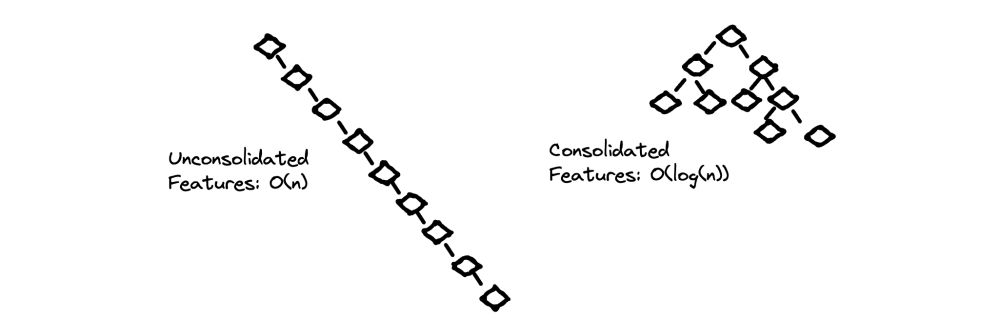
Linked list on the left side means unconsolidated features with O(n) time complexity. B-tree on the right side means consolidated features with O(log(n)) time complexity
I like these visuals. Linked lists and B-trees are exactly how I represent remodeling in my mind. When you’ve worked with a domain for a long time, you start remodelling it to better fit concurrent product streams and to ‘activate’ their velocity.
17.05.2025 11:44
👍 0
🔁 0
💬 0
📌 0
Infrastructure Gravity & Domain Engineering | Jack Danger
The following is an excerpt from Executive Engineering.
“You become responsible, forever, for what you have tamed.”
– Antoine de Saint-Exupéry, in The Little Prince
Each company draws its own ...
Excellent article on positioning domain engineering between product engineering and infrastructure engineering. I fully agree with the financial model section. However, I prefer to call it ‘platform engineering: the hard parts,’ simply because in the middle, we face more volatile semantics.
17.05.2025 11:35
👍 6
🔁 1
💬 2
📌 2
Building Living Neighborhoods --What is an Unfolding
An unfolding is by its nature personal, and requires human input and human feeling from the people doing the work, as an essential part of its contribution to the formation of the environment.
From “What is an unfolding?”
13.05.2025 10:21
👍 0
🔁 0
💬 0
📌 0
Every piece of technology is also a coordination problem
17.03.2025 11:04
👍 1
🔁 0
💬 0
📌 0

We Don’t Need More Cynics. We Need More Builders.
Cynicism is the cheap seats. It’s the fast food of intellectual positions. Anyone can point at something and say it’s broken, corrupt, or…
«The most effective response to cynicism isn’t to argue against it. It’s to build things that make it obsolete. Want to prove systems can work? Build better systems. Think people are fundamentally corrupt? Create incentive structures that reward cooperation and long-term thinking.»
20.01.2025 23:34
👍 1
🔁 1
💬 0
📌 0
Organisations that take advantage of this fear to squeeze more out of their people might see short-term gains but will ultimately be left behind.
Now is the time to double-down and invest in fostering trust, encouraging challenge, and creating a culture of safety.
09.01.2025 18:41
👍 3
🔁 2
💬 1
📌 0

A single page comic about entropy and what flows against it (life). It begins with regimented grid of panels reading typical left to right - showing time running out of an hourglass, omelettes not turning back into eggs, laundry not picking itself up, mountains crumbling, and coffee and the universe growing cold. It then turns into a spiraling composition that ultimately. reads right to left and bottom to top wherein it shows how swirls form stars, other swirls form life, as it loops back out of the spirals - and then shows a person putting her hand in the downward stream - creating swirls of her own as the text reads "reach in to send up something uniquely our own against the flow."
While yes, on one hand things fall apart, entropy rules. On the other, life - and all of us, are momentary reversals where things become more ordered. In this brief time in the stream, we all have the opportunity to send something uniquely our own against the flow spinweaveandcut.com/sketching-en...
31.12.2024 20:39
👍 58
🔁 14
💬 6
📌 0

Posting Less
Everyone's Doing It
“How do you live a digital life whose primary byproduct isn’t resentment? The most straightforward way: you stop posting. You leave the party.”
15.12.2024 15:54
👍 141
🔁 39
💬 2
📌 4